Cubase’s Groove Quantize can extract rhythmic timing from a favorite sample or MIDI part and apply it to programmed MIDI. The Quantize Panel also offers velocity and note-length controls when the groove contains the relevant information. This tutorial shows how to create a groove from audio and adjust its application to give a programmed phrase a different feel. You can use material from instruments other than drums and keep favorite grooves for later projects.
Extract a groove and use it in your music!
Groove Quantize in Cubase
Have you ever programmed a rhythm pattern from a song you like?

Even when the notes are exactly the same, the result may not have the feel you were expecting.
This is because the sound, timing, dynamics and note lengths can differ
from those in the original song.
With Groove Quantize, you can extract groove information from a favorite pattern
and use it in your own music. The sound itself is not copied.
The available timing, velocity and length information depends on the source.
Video tutorial
- Cubase 7.5 and later
- Cubase 7 and earlier
Extracting the groove

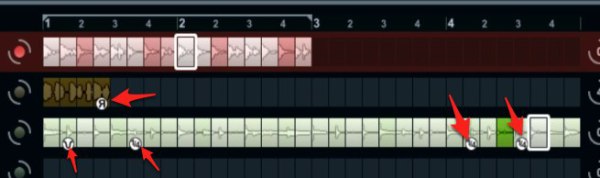
↑ We found a great pattern on a sample CD.
↑ This MIDI part was programmed using the pattern above as a model.
Both the timing and velocities are uniform, except for the ghost notes.
It sounds a little stiff.
Let’s use Groove Quantize here.

Right-click the audio material you want to use as a reference,
and select Advanced Quantize > Create Groove Quantize Preset.
Now the groove is ready to use.

Open the Quantize Panel and you will see the name of the source event.
- Position: determines how closely the timing follows the reference beat.
- Velocity: determines how strongly the groove’s velocity values affect the MIDI notes, when the groove contains velocity information.
- Length: can also adjust note lengths. For this drum example, use 0.
Select the event you want to quantize and click Quantize at the lower right.

The groove has now been applied.
The result will not always be perfect,
so fine-tune the pattern after quantizing to refine it further.
Extracting the groove

↑ We found a great pattern on a sample CD.

↑ This MIDI part was programmed using the pattern above as a model.
Both the timing and velocities are uniform, except for the ghost notes.
It sounds a little stiff.
Let’s use Groove Quantize here.
Double-click the audio file you want to extract the groove from.

↑ The Sample Editor opens.
- 1. Click the Hitpoints tab.
- 2. Adjust the threshold to detect the attacks in the audio.
Find a setting that detects the attacks accurately. - 3. Select the smallest note value to be detected in the sample.
- 4. Click Create Groove.
The timing of this loop is now available as a groove.
Using the extracted groove
Apply the extracted groove template to the MIDI part from earlier.
Select the MIDI part,
then choose Edit > Quantize Panel from the top menu.

↑
- 1. Select the groove name. It will have the name of the source event.
- 2. Choose how much of the extracted groove to apply to the destination, with the full groove represented by 100%.
Here we use 100% to copy the full feel. - 3. Click Apply.

↑ The reference values have been applied to the MIDI part.
That sounds good!
- Cubase 7.5 and later
- Cubase 7 and earlier
We used a drum loop in this example,
but grooves can also be extracted from other instruments.
Try extracting and saving grooves you like
and keeping a collection for later use.
Frequently Asked Questions
Q1. Which Cubase versions support Groove Quantize?
This article shows separate procedures for Cubase 7 and earlier and for Cubase 7.5 and later. The Japanese FAQ says the feature requires 7.5, but that conflicts with its older-version instructions. Availability and menu names can vary by edition and version; consult the manual for yours.
Q2. What setting matters when extracting a groove?
In the Sample Editor’s Hitpoints tab, adjust the threshold so the audio attacks are detected accurately. The detected hitpoints determine the extracted timing.
Q3. What if I am not satisfied with the result after applying Groove Quantize?
Try adjusting the Position and Velocity amounts in the Quantize Panel, or fine-tune manually afterward. Starting with an amount of 50–80% instead of 100% can also be useful.
Q4. Can I use Groove Quantize with instruments other than drums?
Yes. You can extract a groove from material such as bass or piano and apply it to a programmed part on another instrument.
NEW ARTICLES
Latest English Articles