This synth recipe uses a pitch envelope to add attack to a sound. When a volume envelope alone produces too little attack, assign an unused envelope to oscillator pitch and set a modulation range of at least 12 semitones. The pitch rises at the start of a note and returns to its played value; Decay controls the return time. This can add presence to bass, leads, chords and other parts, helping them stand out and add impact to a mix.
Emphasize attack so a sound stands out in the mix

In this synth recipe, we use something other than a volume envelope
to emphasize a sound’s attack.
If you set the volume envelope’s sustain high,
the smaller level difference can make the attack feel less pronounced.
But lowering sustain can leave the sound feeling weak.
This technique is especially useful in that situation.
How to create the sound
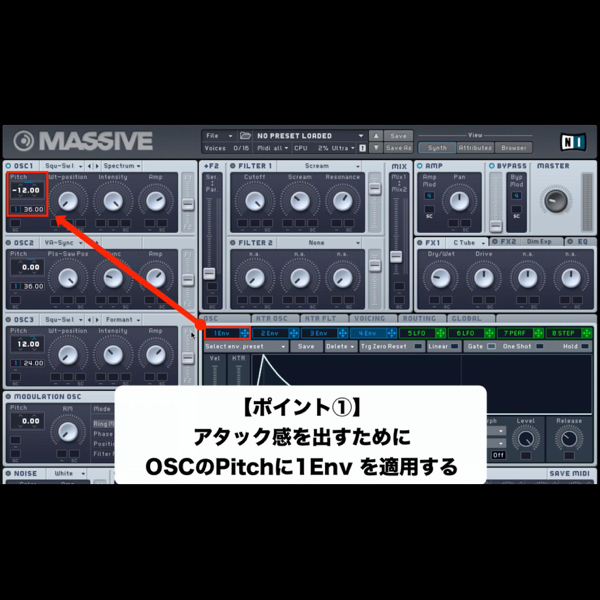
Apply an envelope to pitch
The method is simple.

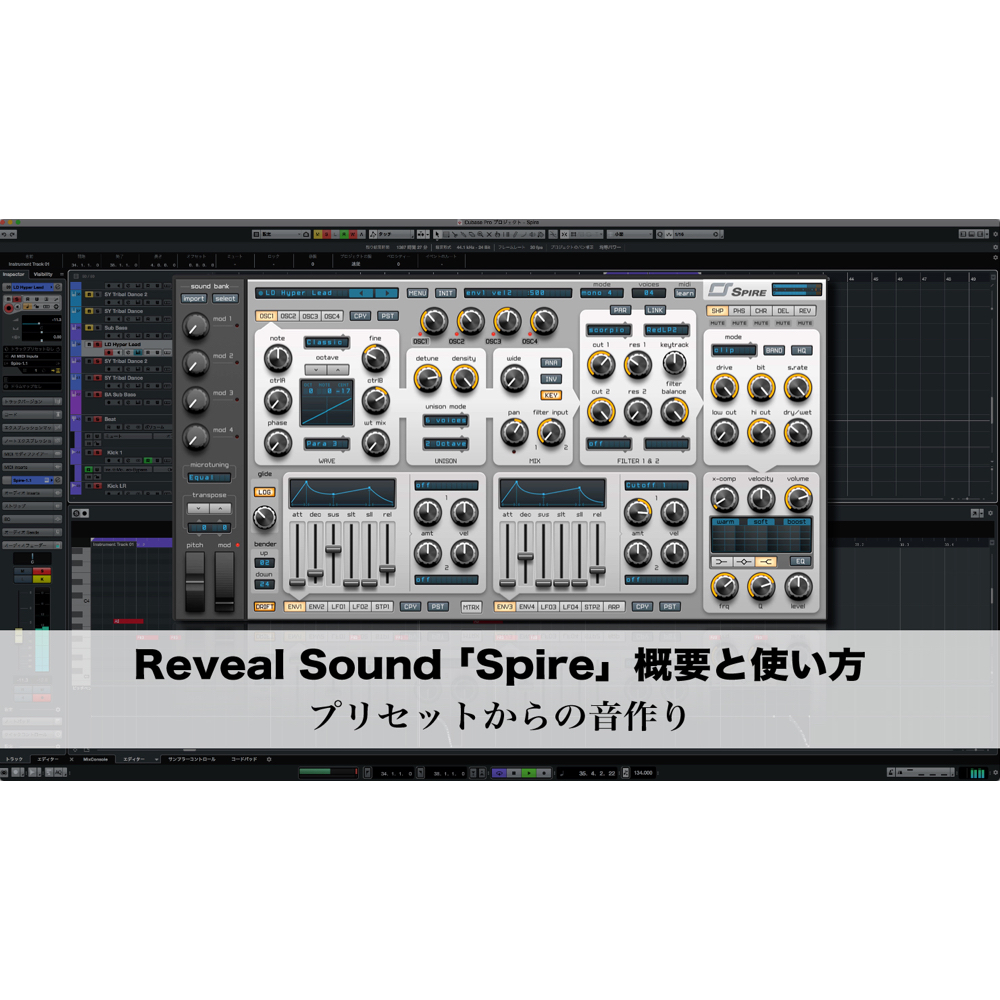
Assign an unused ENV to the pitch of the oscillator you are using and set a positive pitch modulation amount.
For a clear effect, we recommend at least 12 semitones (one octave),
but try different values to find the sound you like.

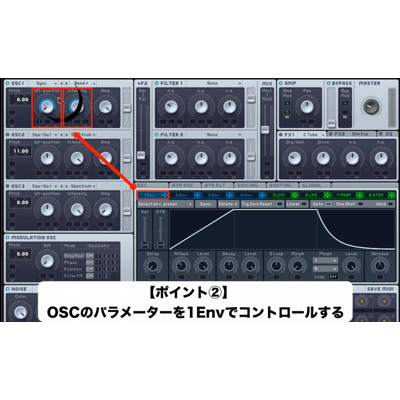
Set Attack to 0 and the Level to the right of Decay—commonly called Sustain—to 0.
This makes the pitch rise immediately when a note is played, then return to its actual pitch.
Use Decay to set the return time.
Play while shortening Decay to find a suitable amount of attack.
A relatively fast setting emphasizes the attack without undermining the overall sense of pitch.
This technique can be used on bass, leads, chords, arpeggios and many other parts.
Try it when you want a sound to stand out in the mix.
Frequently asked questions
Q1. How many semitones of pitch-envelope modulation are recommended for attack?
For a clear effect, start with 12 semitones (one octave) or more, but experiment with different values to suit the sound.
Q2. What parts can use this pitch technique?
It works on bass, leads, chords, arpeggios and other parts, particularly when you want a sound to stand out in the mix.
Q3. How should Attack and Sustain Level be set?
Set both Attack and Sustain Level to 0. The pitch rises at the start of the note and then returns to the played pitch.
NEW ARTICLES
Latest English Articles