Part 3 of our behind-the-scenes series with composer Yusuke Shirato follows a demo through professional studio recording to the finished song. It covers recording drums, bass, guitar, strings and vocals, collaboration between composer and performers, and mixing techniques used by professional engineers. The session offers a practical look at replacing programmed parts with live instruments and taking a song through mixing and mastering. This report documents the 2021 project; its release announcements, biographical details and session settings refer to that period.
From demo to finished master through professional recording
This is Part 3 of our series following Yusuke Shirato’s music-making process, focusing on recording.
The largely programmed demo created in Part 2 will now have its parts replaced with live instruments.
Thanks to the generous support of our crowdfunding backers, we were able to record with leading musicians in a professional studio.

Parts of the demo arrangement were deliberately kept simple enough to communicate the intended direction. As the programmed parts are replaced, the performers are given some freedom to bring their individual playing habits and creativity to the song. The composer, too, looks forward to discovering how the arrangement develops through this process.
Behind the scenes, Part 3: recording video
- 1Behind the scenes with Yusuke Shirato: composing
- 2Behind the scenes with Yusuke Shirato: arranging
- 3Behind the scenes with Yusuke Shirato: recording
Selected questions and answers from the YouTube video

This was wonderful! By the way, are the speakers positioned as shown in the video when mastering?

Yes, we listen with the speakers in the positions shown in the video!
“TOMORROW” project sound data: original sales announcement
The original announcement made MIDI data, audio files and project files for “TOMORROW” available through the shop.

Yusuke Shirato
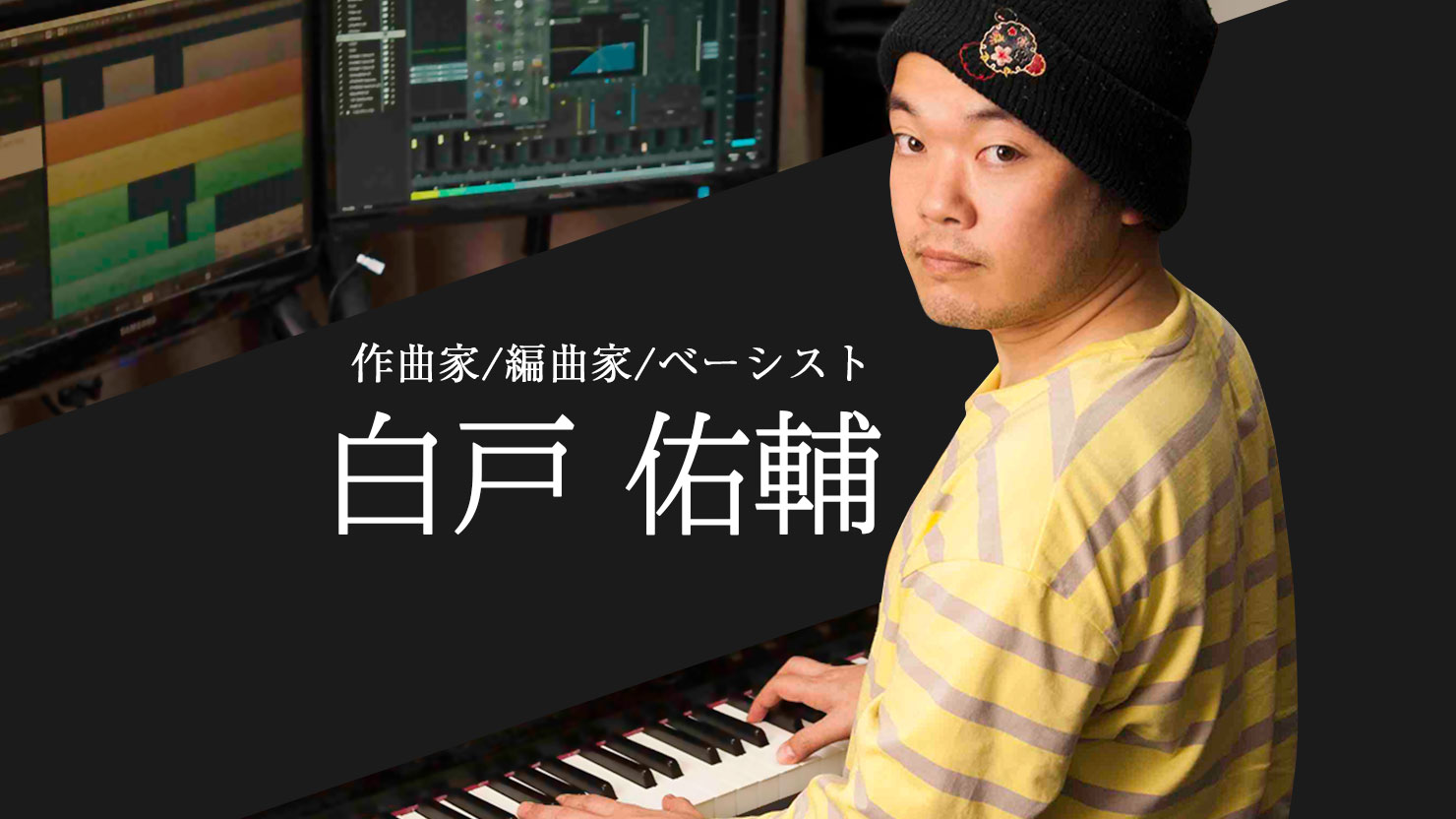
Born in Ibaraki in 1981, Shirato grew up listening to classical music and learning piano.
He discovered drums and composition in high school, then entered the composition department at Tokyo College of Music. While composing chamber and orchestral music, he took up bass in his third year and worked as a bassist after graduating.
He began his professional songwriting career in 2007, going on to write for a variety of artists and perform as a supporting musician.
At the time of this project, he was a composer with DreamMonster.
He is known for anime and idol songs that make effective use of piano and strings, as well as contrasting, heartfelt ballads.
His work includes anime opening and ending themes, TV themes and insert songs, plus background music and theme songs for pachinko, films and games.
Twitter: @sirato10
Individual sponsors


Corporate sponsor

Recording the rhythm section: drums and bass
For this session, drums and bass are recorded together.
When highly skilled players perform together, the way they respond to each other’s groove and phrases can create a chemistry that is harder to achieve by recording the parts separately.

Many microphones are set up around the drums, and the engineer makes fine adjustments while the drummer plays.

Even while staying precisely in time with the programmed tempo, the players add a human groove. This takes considerable skill.
It is difficult to reproduce every detail through programming, but there is plenty to learn from the phrasing.

After hearing the performances, Shirato gives direction and requests changes.

Once a satisfying take is recorded, the players join him in the control room to decide which take to use.
Recording guitar
Next comes guitar recording.
This song uses both acoustic and electric guitar, starting with the acoustic part.

The acoustic guitar is recorded in a booth separated by partitions, reducing unwanted resonance for a tight, clear recording.

The player also offers ideas for the arrangement.

For electric guitar, shaping the sound with the player’s own effects is an important part of their individuality. The settings are adjusted carefully while aligning the sound with Shirato’s vision.

The arrangement develops through experimentation, considering the song’s structure, chords, vocals and other factors. This is a collaboration between composer and performer, and responding to ideas on the spot requires a high level of playing skill.
Recording the string section
The string section uses a “4-4-2-2” lineup: four first violins, four second violins, two violas and two cellos. They perform together, captured by multiple microphones.

Shirato communicates his intentions as the composer to the section leader, who gives detailed direction to the players.
Alongside the phrases themselves, dynamics and playing techniques require careful attention and clear communication.

The leader returns to the control room to check the recorded material closely. The work proceeds both carefully and quickly.

The feedback is immediately applied as the final takes are recorded. It is impressive to see the musicians perform almost entirely at sight and respond precisely to the requests.
Even at this high level, the subtle fluctuations and differences in timing that come from human performance give the sound richness.
Recording vocals
Next are the vocals, which give the song its identity.
Direction is important because the voice can convey so many moods and emotions. Shirato explained that he does not decide everything beforehand, but develops the direction through his interaction with the vocalist.

Three microphones are set up, and test recordings help select the one that best suits the singer’s voice.

The equipment combinations are also chosen for their compatibility and the intended result—for example, pairing a microphone that cuts through clearly with a compressor that softens the sound.

Once the most suitable microphone is chosen, recording begins.

After capturing a take that works overall, the composer gives more detailed direction about rhythmic phrasing and delivery.
Where the choice is unclear, several approaches are tried to find the expression that best fits the song, lyrics and vocal tone.

The vocalist responds quickly to direction while also actively offering her own ideas.

Although the session began without a fixed interpretation, it progressed smoothly and produced a strong take in a short time. The experience showed how important communication through words and sound is in vocal recording, alongside technical skill.
Mixing and mixdown
Video: a professional engineer explains the mix
On the second day, the team moves on to mixdown: adjusting the balance and tone of the recorded material to create a stereo mix.

First, engineer Mitsutaka Seki takes his time to build a mix according to his own interpretation.

A range of studio outboard equipment is used to establish the foundation of the sound.

Plug-in effects are chosen for the job based on their individual characteristics. Their flexibility supports a careful process of experimentation.

Once the mix has taken shape, Shirato listens and communicates his requests from the composer’s perspective.
The team checks on studio monitors and consumer equipment such as a radio/cassette player, considering different listening environments.
Even in a professional session, ideas such as “What happens if we try this?” are tested freely. The stereo mix is completed only after the team is satisfied.
Mastering
The completed stereo mix is handed over for mastering in preparation for release.

Final level adjustment, associated EQ changes and other refinements are made through careful listening by an experienced engineer.

For mastering, too, the engineer first processes the material according to his own interpretation, then listens to the composer’s requests and completes the master.

One valuable insight was that reducing an overly heavy low end slightly can actually make the bass line easier to hear.

The loudness for this particular master was −7.8 LUFS. The engineer considered this neither pushed too hard nor too quiet for the project.
The level was also set with the expectation that streaming playback might turn it down to around −13 LUFS. These are the session’s 2021 assumptions and settings, not universal mastering targets or current requirements for every streaming service.
The linked articles below explain loudness normalization in more detail.

WaveLab Tutorial 7: loudness normalization
Understanding loudness metering is important when using WaveLab’s mastering tools. Loudness measurement accounts for human hearing in ways that RMS metering alone…

Checking loudness normalization easily with Loudness Penalty
Loudness Penalty, from MeterPlugs, analyzes a song to assess loudness normalization on streaming services such as YouTube and Spotify…

The engineer also explained the plug-ins used in detail.
The chain runs from Brainworx bx_digital V3 through Ozone’s EQ, compressor and maximizer. The EQ uses mid/side processing to boost the vocal range in the Mid signal, while multiband compression slightly controls the low end.

For the format, the engineer described mastering the 24-bit/96 kHz stereo mix at its original resolution, while monitoring at 44.1 kHz. The signal is converted to analog through a D/A converter, then captured again through an A/D converter at 16-bit/44.1 kHz. A separate master is prepared for high-resolution distribution.
With these stages complete, the song is finished.
The project began with the composing episode. Its positive reception led to the arranging episode, and crowdfunding support beyond our expectations made this full studio-recording episode possible.
We are deeply grateful to everyone who watches our content and to all who supported the project. We hope it provides useful insight for aspiring composers.
“TOMORROW,” the song created through this project, was released on streaming platforms on December 30, 2021, as the first single from our label, Sleepfreaks Records. We hope you enjoy it.
This concludes our behind-the-scenes series with Yusuke Shirato.
Thank you again for watching all the way to the end!
Listen to the song on streaming platforms
Professionals come together behind the scenes: recording, mixing and mastering with composer Yusuke Shirato (@sirato10) in Part 3 of our series!
Original announcement: premieres December 30, 2021, at 8 p.m. JST 🎥
Video: https://t.co/ENXYbxCbjs“TOMORROW” is also released on streaming services! https://t.co/xU3bZp5R3f #DTM #DTMer #Composition pic.twitter.com/r781M1j2LT
— SLEEP FREAKS (@SLEEPFREAKS_DTM) December 30, 2021
Frequently asked questions
Q1. How should I prepare to replace programmed demo parts with live instruments in a recording studio?
Keep the demo arrangement simple enough to communicate your intentions, while leaving room for the performers’ creativity. It is also important to communicate your vision clearly as the composer.
Q2. What are the benefits of recording drums and bass together?
Playing together lets the musicians respond to each other’s groove and phrasing. That interaction can create a natural, engaging groove that differs from recording each part separately.
Q3. What matters most when recording vocals?
Alongside technical skill, communication between composer and vocalist through words and sound is essential. Developing the direction through their interaction, rather than fixing everything in advance, can be effective.
Q4. What equipment is used in professional mixing?
Studio outboard equipment and plug-in effects are used where each works best. Through experimentation and checks on several monitoring systems, the team shapes a mix with different listening environments in mind.
NEW ARTICLES
Latest English Articles