
Understanding dominant and subdominant functions helps explain how chord progressions create musical direction. This article uses C major: the tonic triad is C, the dominant triad G has its root a perfect fifth above C, and the subdominant triad F has its root a perfect fifth below C when placed in the appropriate octave. Each shares a note with the C-major triad, while the F-major and G-major triads share no notes with each other. These relationships provide a starting point for exploring contrast, tension and release in cadential progressions.
The Theory Behind Chord Progressions
Chord progressions can give a piece of music a sense of drama.
We often hear about tonic, subdominant and dominant functions, but may have fewer opportunities to examine how those relationships work.
Here, we explore dominant and subdominant chords and the ideas behind them as a guide to building progressions.
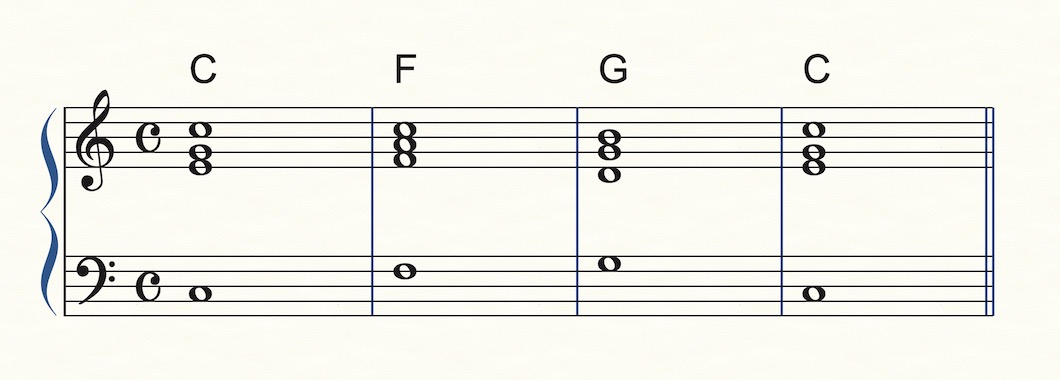
C (tonic) → F (subdominant) → G (dominant) → C (tonic)
This is a basic functional progression. Its return to the tonic illustrates a cadence, a harmonic point of arrival or closure. The full I–IV–V–I pattern is one example of a cadential progression, not the only possible cadence.

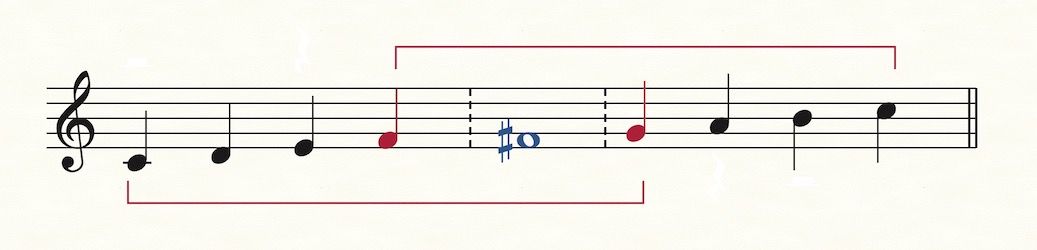
Within an octave, measured by the shorter chromatic distance from the pitch class C, the halfway point is F♯, six semitones away. However,
within the C-major scale, the notes on either side of that chromatic halfway point are F (the subdominant) and G (the dominant).

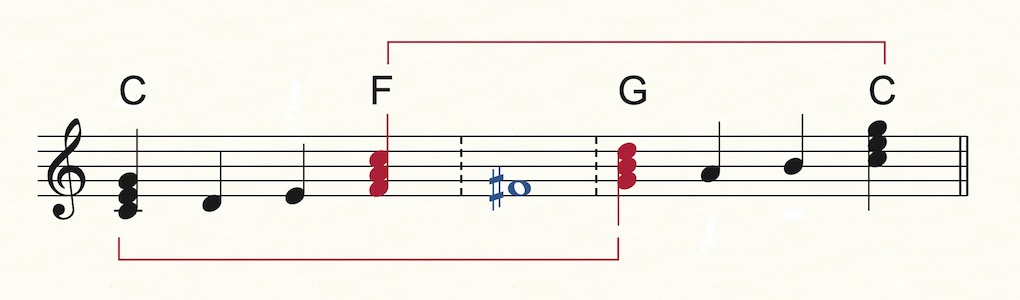
The F-major subdominant triad is rooted a perfect fifth below C when F is placed in the lower octave.
The G-major dominant triad is rooted a perfect fifth above C.
In this sense, the two roots lie the same interval away from the tonic, in opposite directions. This concerns root relationships, not identical harmonic functions or the register used in every voicing.
The prefix sub- means below, as in subway and submarine. Here, it helps describe the subdominant as lying a fifth below the tonic, in contrast with the dominant a fifth above. The corresponding Japanese terms are zokuon for the dominant scale degree and kazokuon for the subdominant.
The idea is therefore a pair of fifth-related chords above and below the tonic.
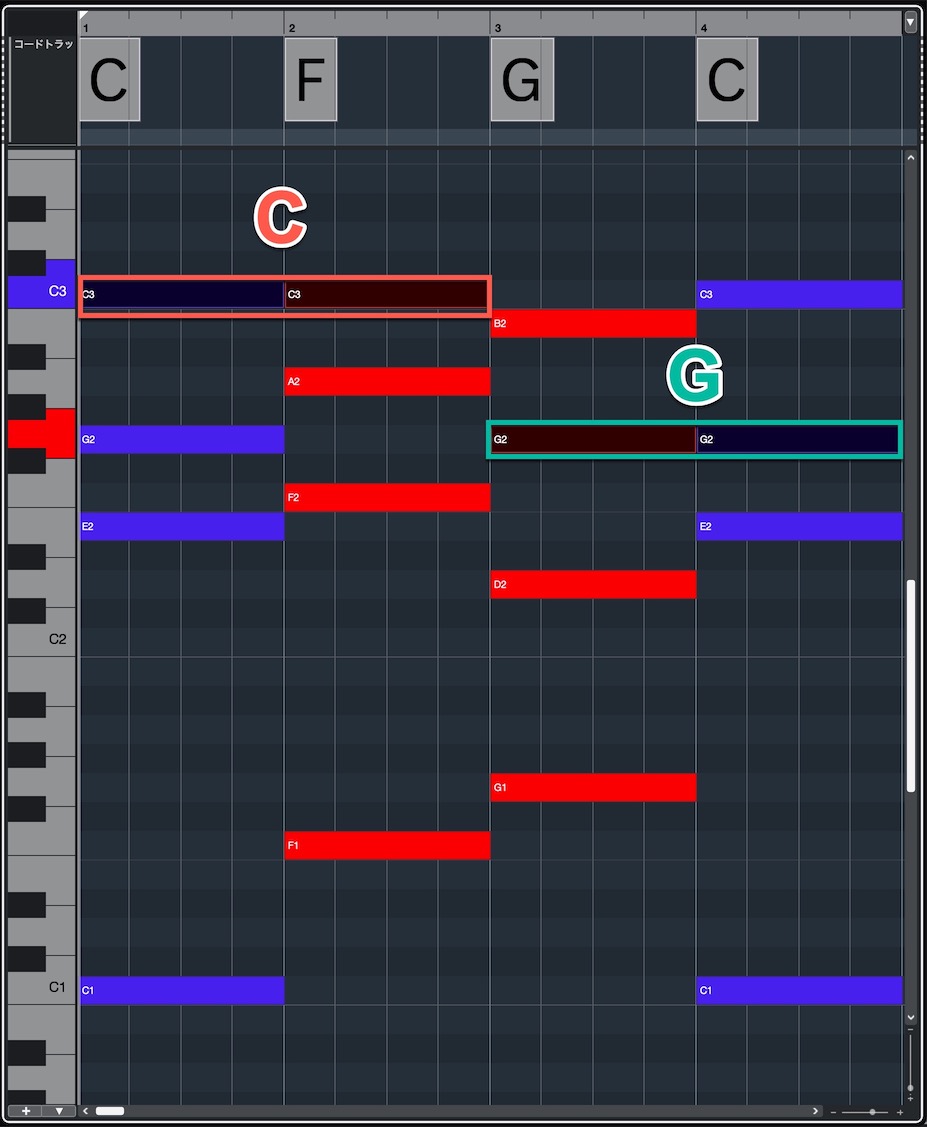
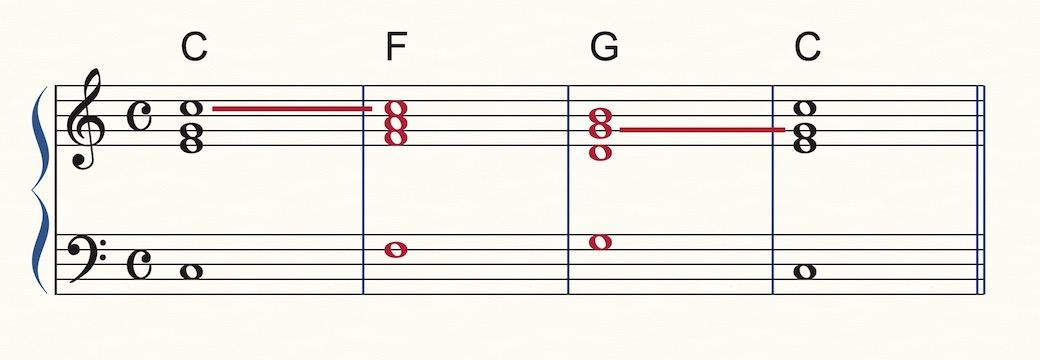
Both the subdominant and dominant triads share a note with the tonic triad: F–A–C shares C with C–E–G, while G–B–D shares G with it. The F-major and G-major triads themselves have no common notes. Their contrast can therefore be heard against their shared relationship to the tonic. This comparison concerns these triads; added notes can change which pitches they share.
Connecting these different harmonic characters can produce a cadential progression with tension and release, leading toward a point of arrival.
The author likens this shaping of expectation and release to comedy or rakugo, the Japanese storytelling tradition.
Frequently Asked Questions
Q1. What is a cadence in music production?
A cadence is a harmonic point of arrival or closure, often heard at the end of a phrase. This article illustrates it with tonic → subdominant → dominant → tonic, or C → F → G → C in C major. The chord functions shape tension and release, but cadences are not limited to this one progression.
Q2. How do dominant and subdominant chords differ?
In this C-major example, the dominant triad is G major, rooted a perfect fifth above C, and the subdominant triad is F major, rooted a perfect fifth below C when placed in the lower octave. The roots have a symmetrical fifth relationship to C, while the chords serve different harmonic functions.
Q3. How can I use this when building a chord progression?
Listen to how the subdominant and dominant relate to the tonic, and how they contrast with each other. Experiment with their order, voicing and timing to shape tension, release and phrase endings. Use the theory as a way to understand and develop musical choices rather than as a compulsory formula.
NEW ARTICLES
Latest English Articles































































































