Linear-phase EQ avoids the frequency-dependent phase shifts associated with conventional EQ, making it useful for tasks such as mastering and bus processing. It can introduce pre-ringing, however, particularly with extreme settings, potentially blurring attacks. Gentle curves and small adjustments are often a good starting point. Consider CPU load and choose the processing that suits the material.
Benefits and side effects of linear-phase EQ
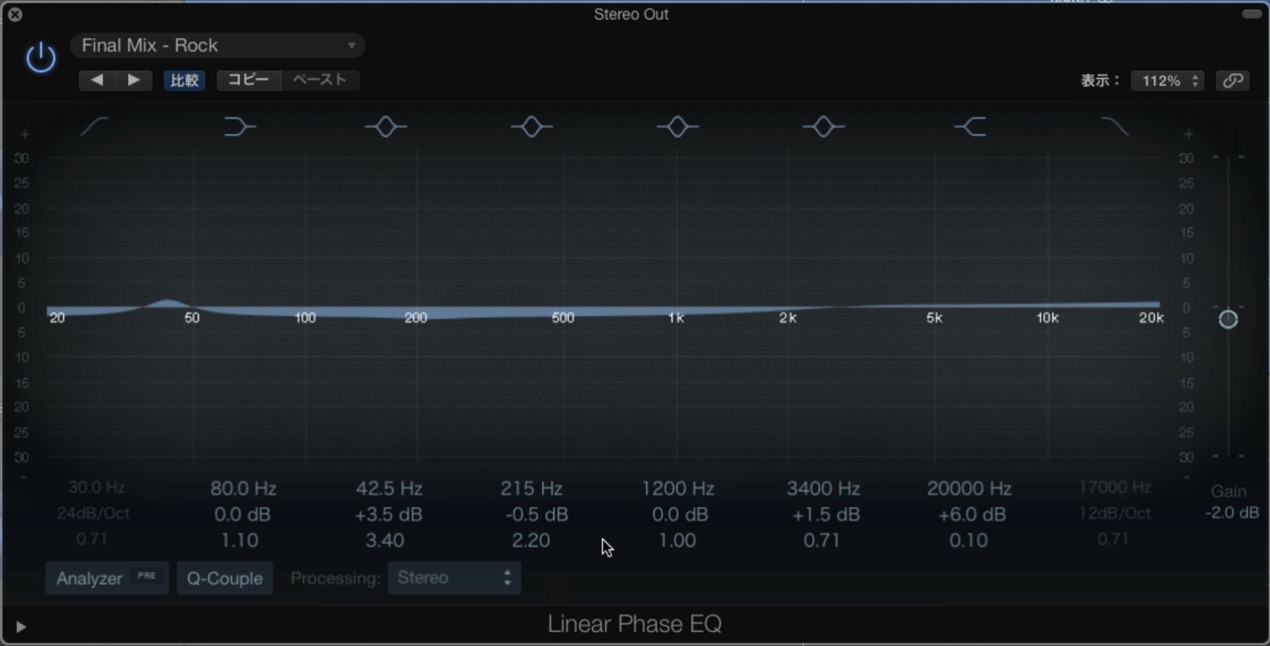
Linear-phase equalizers, or linear-phase EQs,
are increasingly included in DAWs or offered as a selectable mode,
making them more accessible.
They may appear to be high-performance EQs at first glance, but depending on how they are used, they can have side effects.
We will explore their benefits, suitable applications and settings to approach with care.
Video tutorial
The main benefit: preserving phase relationships
Conventional equalizers commonly used on individual tracks during mixing
introduce frequency-dependent phase shift.
The image below visualizes this phase shift using iZotope Ozone 7.

Though the changes are very small, frequency components near the EQ point
may be advanced or delayed relative to others.
On an individual track, this is not necessarily harmful:
it can be considered part of an EQ’s character or color.
In mastering, however, you might want to add as little coloration as possible,
or worry that small shifts could have a larger effect when multiple tracks are combined.
These are situations that can arise in mastering.
A linear-phase EQ is an option in such cases.

The source describes linear-phase EQ as having no phase shift. More precisely, it preserves the phase relationships between frequency components while introducing a uniform delay.
However, using linear-phase EQ for every adjustment is not necessarily the best choice.
One reason is the potentially high CPU load of its processing.
It can also have another side effect, discussed below.
A side effect: pre-ringing
Suppose we want to apply the following EQ to a kick-only track.

The settings use narrow Q values and fairly large boosts and cuts.
What happens when we compare the original, conventional EQ and linear-phase EQ?
Please listen to the video; the waveforms look like this.

Notice where the waveform begins to rise.
The original and conventional EQ begin at the same position, but the linear-phase EQ begins to produce sound a little earlier.
This side effect of linear-phase processing with an extreme EQ curve is called pre-ringing.
As a result, the attack can become less distinct or sound smeared.
When to use linear-phase EQ
Given these tradeoffs, consider where linear-phase EQ is most useful.
- Because of its CPU load, use it where it matters, such as on a master or bus.
- For tracks needing extreme EQ, consider avoiding it if pre-ringing is audible.
In other words, it can be useful for final adjustments in a mix.
Linear-phase EQ presets can offer useful examples.
You may find that they use gentle curves and relatively small gain changes.
Used appropriately, a linear-phase EQ can provide clear processing while preserving the mix’s phase relationships.
We hope these points help you use it effectively.
Frequently asked questions
Q1. What is the main difference between linear-phase and conventional EQ?
Linear-phase EQ preserves relative phase relationships across frequencies, although it introduces a uniform delay. Conventional EQ can produce frequency-dependent phase shifts around the adjusted bands. This can make linear-phase processing useful in mastering and on buses.
Q2. Why can linear-phase EQ cause pre-ringing?
With some linear-phase filters, especially under extreme settings, ringing can appear before the transient. This can make the attack sound less distinct or smeared.
Q3. When should I use linear-phase EQ?
Try it for final, subtle adjustments on a master or bus, using gentle curves and modest gain changes. For more extreme processing, including on a kick, compare the sound and listen for pre-ringing before deciding.
NEW ARTICLES
Latest English Articles