This article analyzes non-diatonic chords in Ikimono-gakari’s “Arigatou.” Explore secondary dominants, the temporary tonicization suggested by E7 → Am7, and the expressive effect of strong bass movement by ascending fourths. An inverted chord helps create a compelling bass line in the progression.
Non-Diatonic Chords and Strong Bass Movement
This is the third installment of our chord analysis of Ikimono-gakari’s “Arigatou.”
This time we focus on non-diatonic chords and strong bass movement.
The song discussed

Tutorial video
1. Identifying the key
2. Chord progressions
3. Non-diatonic chords (this article)
4. ii–V progressions
5. Pivot chords
6. Double dominants and the minor subdominant
7. Slash chords
What Is a Secondary Dominant?
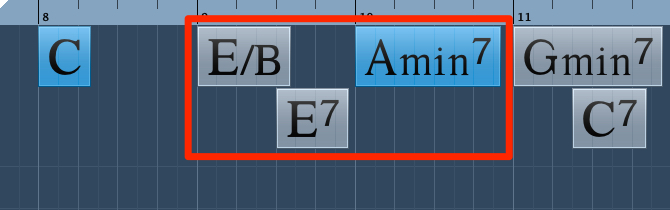
When a non-diatonic chord appears,
consider its relationship to the chord that follows.
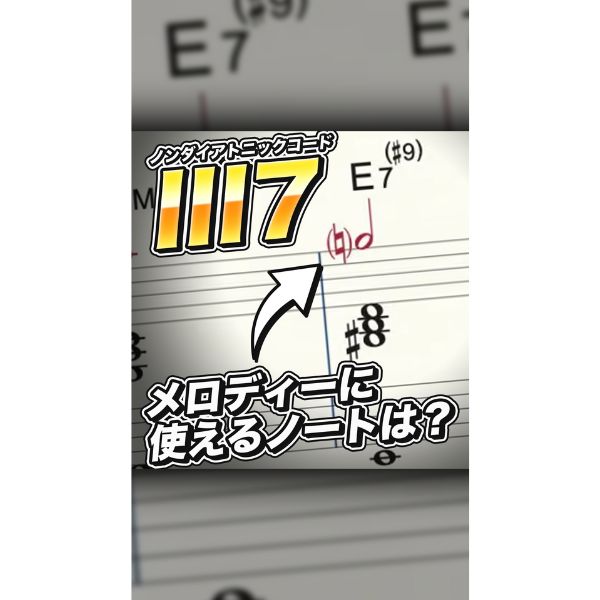
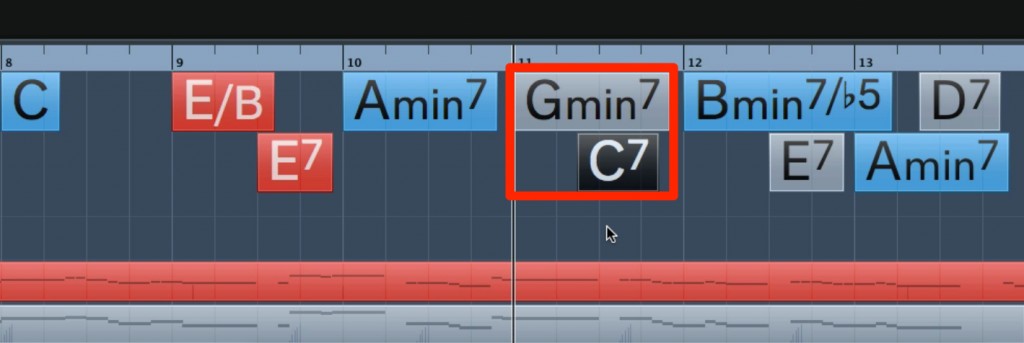
Here E7 leads to Am7, preceded by the related E/B chord.
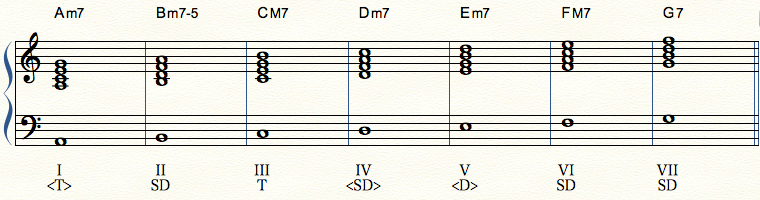
Let’s look at chords in A minor, where Am7 can serve as the tonic.
A natural minor scale

A harmonic minor scale

Different forms of the minor scale are used in different contexts.
When considering chords, musicians sometimes raise the seventh scale degree by a semitone
to form the harmonic minor scale.
In A harmonic minor, G becomes G♯.
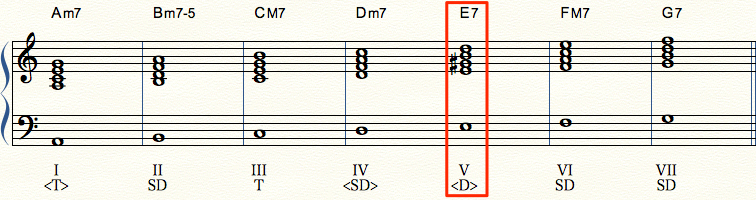
The key point here is that the chord on the fifth degree, the dominant, changes.
(Other chords containing G can also use G♯, although they do not always do so.)
Looking at E/B → E7 → Am7,
the motion is from V (dominant) to i (tonic) in A minor.
It suggests a shift toward A minor,
but because that focus is so brief, a full modulation would be an overstatement.
It is more useful to think of the harmony as briefly drawing on A minor.
A dominant chord that temporarily targets a chord other than the home key’s tonic is called a secondary dominant.
For more detail on secondary dominants, see our reharmonization tutorial.
Listen for Strong Bass Movement
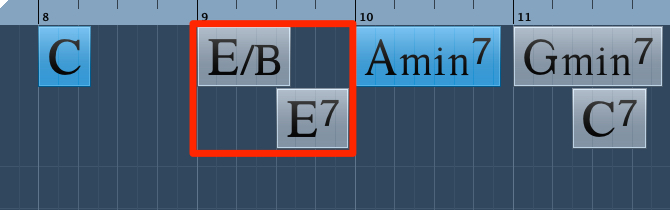
E/B and E7 both have E as their chord root; E/B means an E major chord with B in the bass. E7 also includes a seventh.
The change in inversion changes the bass while retaining the related E harmony.
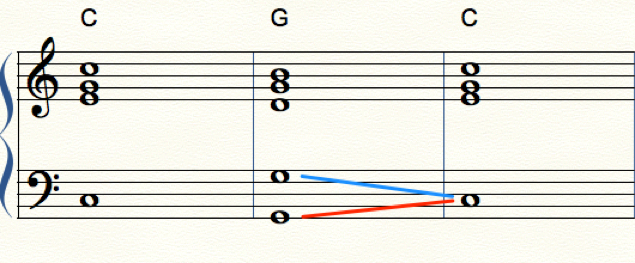
In a root-position dominant-to-tonic progression,
the bass moves up a fourth (or down a fifth).
This is often described as a particularly strong and powerful progression.
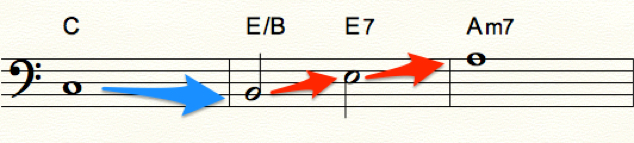
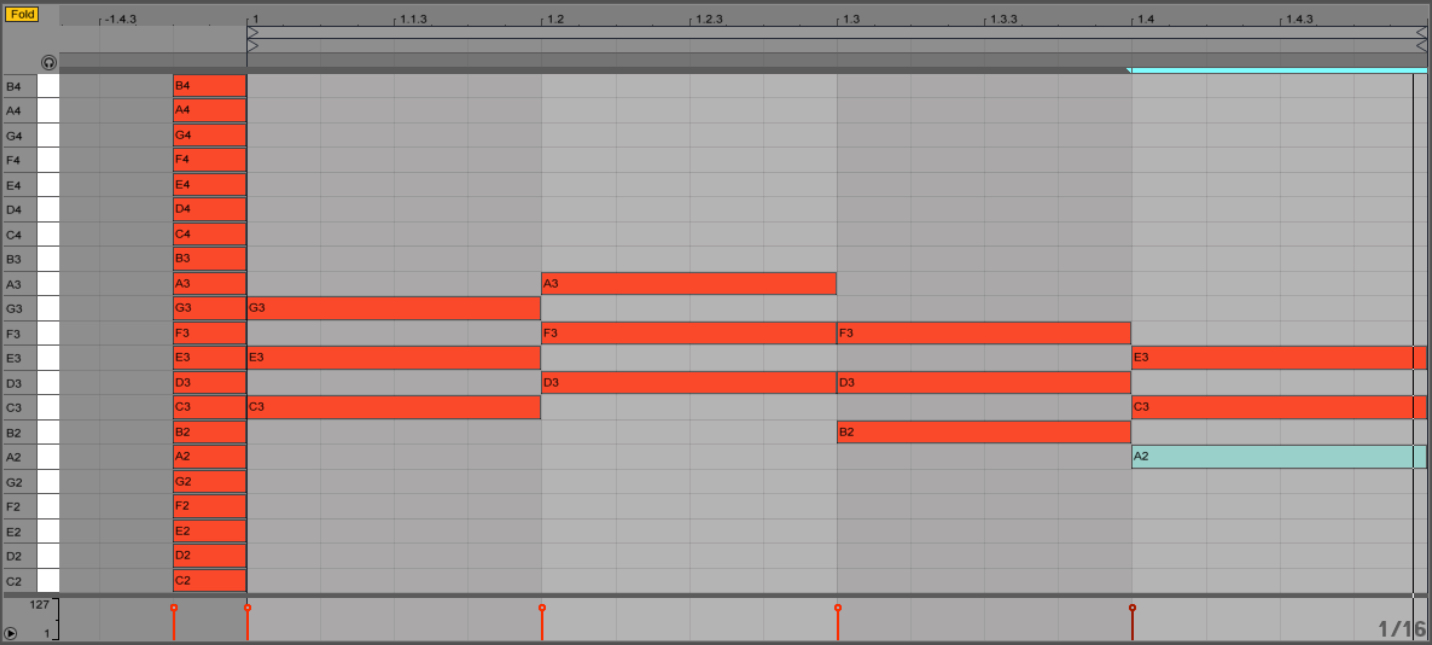
Here, E/B places B in the bass, creating the sequence B → E → A.
Two successive fourth movements make the arrival on Am7 feel especially conclusive.
The opening C → B descends gently by a semitone;
the two strong movements that follow create a striking contrast.
Frequently Asked Questions
Q1. What is a secondary dominant?
It is a dominant chord that briefly tonicizes a chord other than the home tonic. This can create tension and release without establishing a full modulation.
Q2. Are non-diatonic chords and borrowed chords the same?
A non-diatonic chord contains notes outside the prevailing key. A borrowed chord is commonly understood as a chord taken from a parallel mode; the source uses “borrowed” more broadly. Secondary dominants are another way to introduce non-diatonic harmony.
Q3. What is a strong progression?
An ascending fourth or descending fifth in the bass, as in a root-position dominant-to-tonic movement, creates a strong sense of direction and arrival. Other bass movements are possible when chords are inverted.
Q4. What does E/B mean?
The chord is written before the slash and the bass note after it. E/B is an E major chord with B in the bass, an inversion.
NEW ARTICLES
Latest English Articles