This analysis of “Heavenly Flight” from Dragon Quest III explores the importance of key in music production. Identifying the key helps narrow down the notes and harmonies used in a piece and recognize the effect of notes outside it. We start by collecting the melody’s notes, then examine dominant chords and the distinction between major and minor keys. An analogy with secret ingredients in curry illustrates the balance between stability and tension.
Understanding Key

Knowing the key helps narrow down the melodies and harmonies that make up a piece.
Conversely, it also helps identify moments when the melody or harmony departs from the key.
You may discover that these departures are an important spice in the music.
Melodies and harmonies built from the key have a sense of stability, while
departures can create tension. Listening for the balance between the two is important.
In a curry, the curry base provides most of the flavor,
but households may add a secret ingredient, such as sauce or instant coffee. Discovering the
secret recipe is one of the pleasures of analysis.
The Piece We Are Analyzing

Video Tutorial
1. Song Structure
2. Key (This Article)
3. Chord Progression
4. Focusing on the Bass Line
5. Tritone Substitution
6. Bass-Line Cliché
7. Pedal Points
8. The Picardy Cadence
Identifying the Key
As discussed in earlier articles, there are several ways to determine a key.
A simple approach is to focus on the melody and identify its notes.

If we list all the notes in the 16-bar melody, we find that they are all white keys.
This suggests that the key is likely either C major or A minor.
Once you have a likely key in mind, check it from several angles.
Look at the chords at important points in the piece.

Chords at the boundaries between phrases are useful clues.
The passage is largely built from arpeggios, so identify their notes one by one.
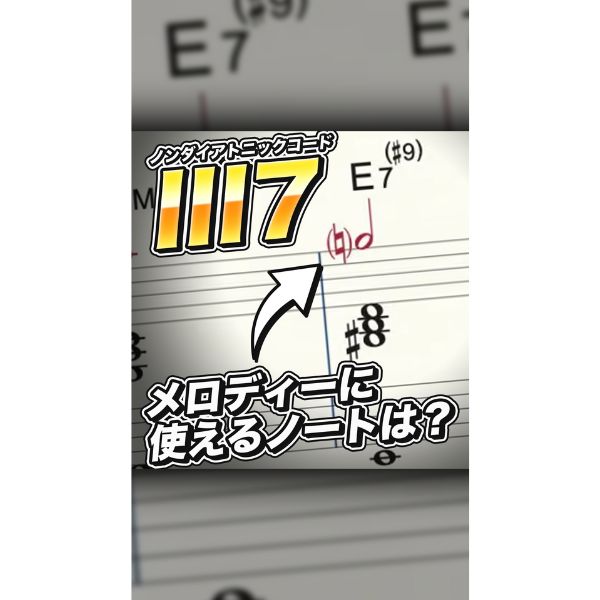
Here, the last chord of the A phrase is E7.
(Looking at the whole bar, it could be described as E7(9).)

In this context, E7 points toward A minor.
It functions as the dominant chord built from the A harmonic minor scale.

As a further check, the opening chord is Am,
making A minor the likely key.
Next time, we will look at the chord progression.
Frequently Asked Questions
Q1. What is a simple way to identify the key when producing music?
A practical starting point is to list the notes in the melody and see which scale they suggest. Then examine chords at phrase endings, particularly dominant chords, to help distinguish a major key from its relative minor.
Q2. What is a melody note outside the key?
It is a note that does not belong to the piece’s underlying key. Such notes can create tension and add variety and spice to the music.
Q3. How are harmonic minor and dominant chords related?
A dominant seventh chord built from the harmonic minor scale is often used in minor-key music. For example, E7 can function as V7 in A minor.
NEW ARTICLES
Latest English Articles