This article explores practical ways to build rhythm tracks for contemporary J-pop inspired by YOASOBI. You’ll learn how to combine electronic and live drum sounds in a hybrid kit, create variation by dropping the kick or adding rhythmic accents, and give a repetitive four-on-the-floor beat a sense of movement through changes in the bass-line accents. It also walks through the production process in Cubase, covering techniques used in modern J-pop.
Analyze the Rhythm Track at the Core of a Song

Contemporary J-pop is the theme of this series on song analysis and production techniques.
In this second installment, we’ll focus on J-pop rhythm tracks.
Even a simple four-on-the-floor track can include a range of thoughtful details. Take a look at the techniques and ideas in this article.
Lyrics and vocals: Yui Mugino
Website: http://www.yui-mugino.com/
Composition and arrangement: Tomoki Miyakawa
Twitter: https://bit.ly/3qMyJ5R
Video: Contemporary J-pop Rhythm Tracks
- 1 Three Key Points for Creating a Contemporary J-pop Melody
- 2 Analyzing Drums and Rhythm Tracks in Contemporary J-pop
- 3 Analyzing Supporting Instrument Tracks in Contemporary J-pop
Download the Cubase project files here.
A Hybrid Kit of Live and Electronic Drums
The rhythm track is built around a hybrid kit that combines electronic sounds often heard in EDM with live drum sounds as its defining feature.
This is a common technique in songs that bring dance-music elements into a band arrangement.
Let’s look at the specific techniques used here.
The Electronic Kit at the Heart of the Rhythm
Electronic samples are used for the kick and clap, the sounds at the core of the rhythm.
The goal is to control frequency response, attack, and stereo placement—elements that can be difficult to manage with live drums with precision.
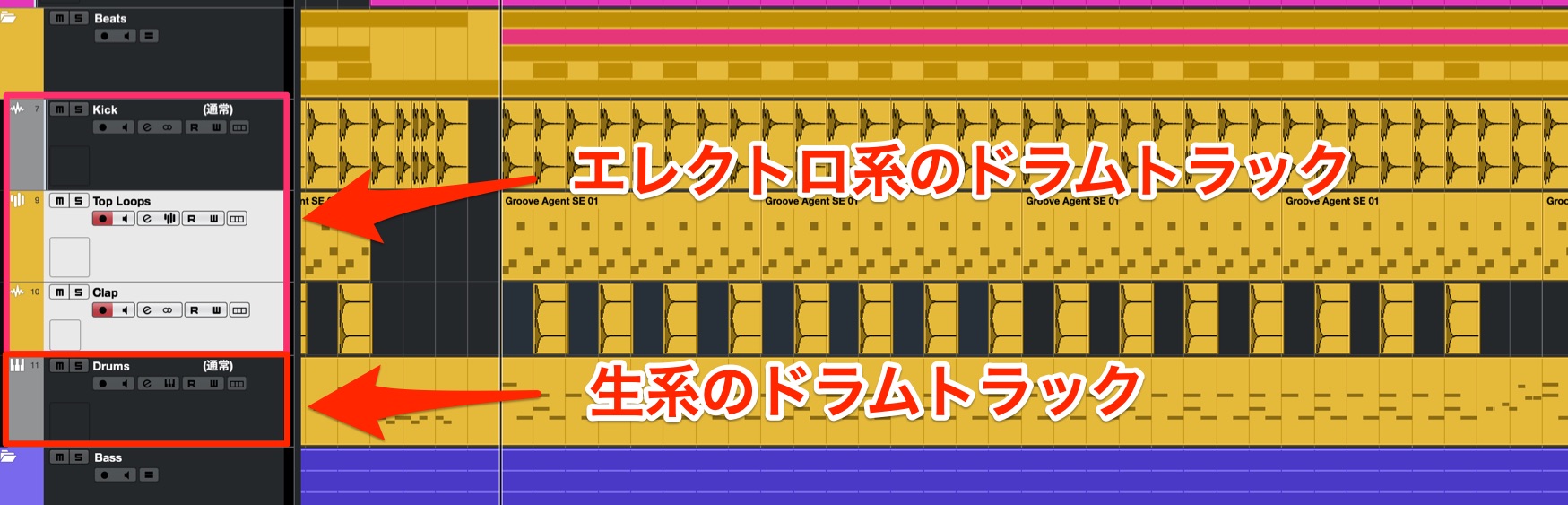
Compared with a live kick drum, electronic kick samples offer a much wider range of sounds to choose from.
This makes it possible to shape a sound that fits a four-on-the-floor dance beat.
- Electronic kick
Electronic kick
- Live kick drum
Live kick drum
The clap, which accents beats two and four, uses wide stereo placement to give the track a sense of width.
- Electronic clap
Electronic clap
- Live snare
Live snare
Here, the kick and clap samples are placed directly on audio tracks.
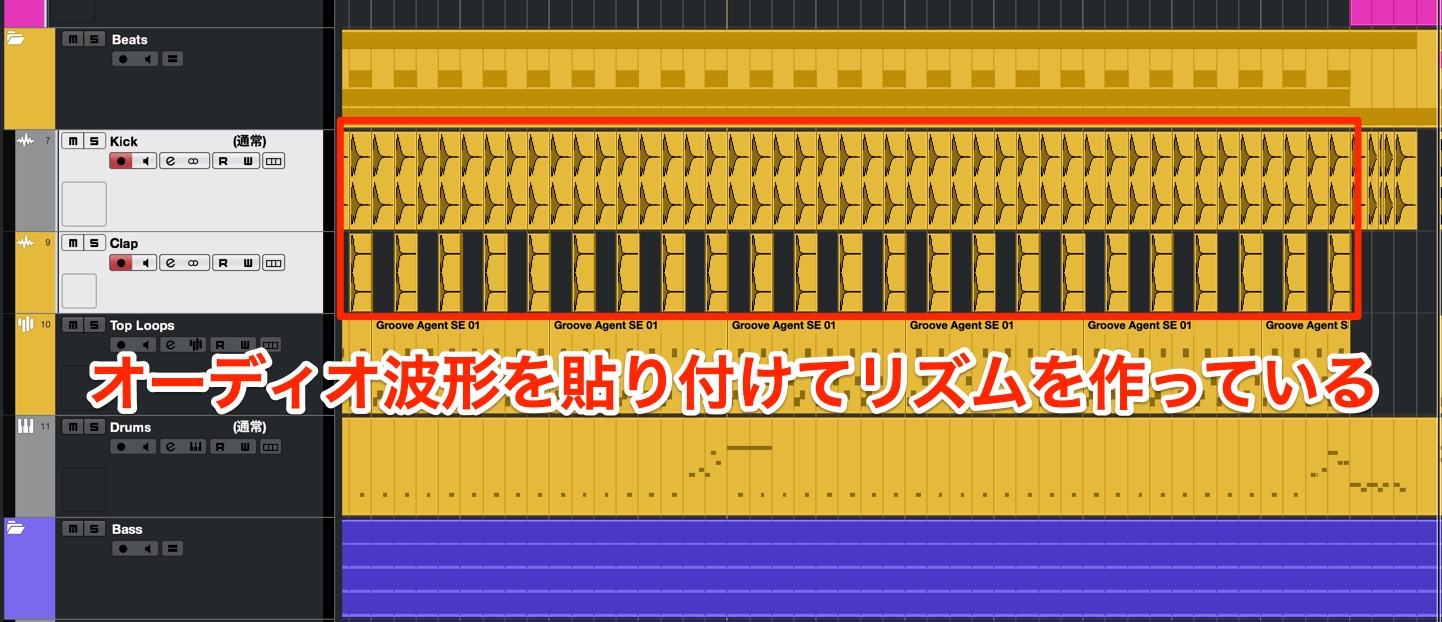
This makes it easier to see the rhythm at a glance than when working with MIDI.
It’s a technique that suits electronic music, where detailed dynamic expression is often less central.

The track also uses “tops,” a staple of club music.
These mid- and high-frequency rhythm loops make it possible to use fine rhythmic details that are difficult to play with live drums.
- Tops
Tops loop
Live Drums Add Body to the Sound
Live drums with room and overhead microphones capture ambience and can give the song a satisfying sense of weight.
Placed behind the dry electronic drums, they also add depth to the drum track.
The ambience of live drums also tends to blend naturally with bass and guitar tracks in arrangements built around a band sound.
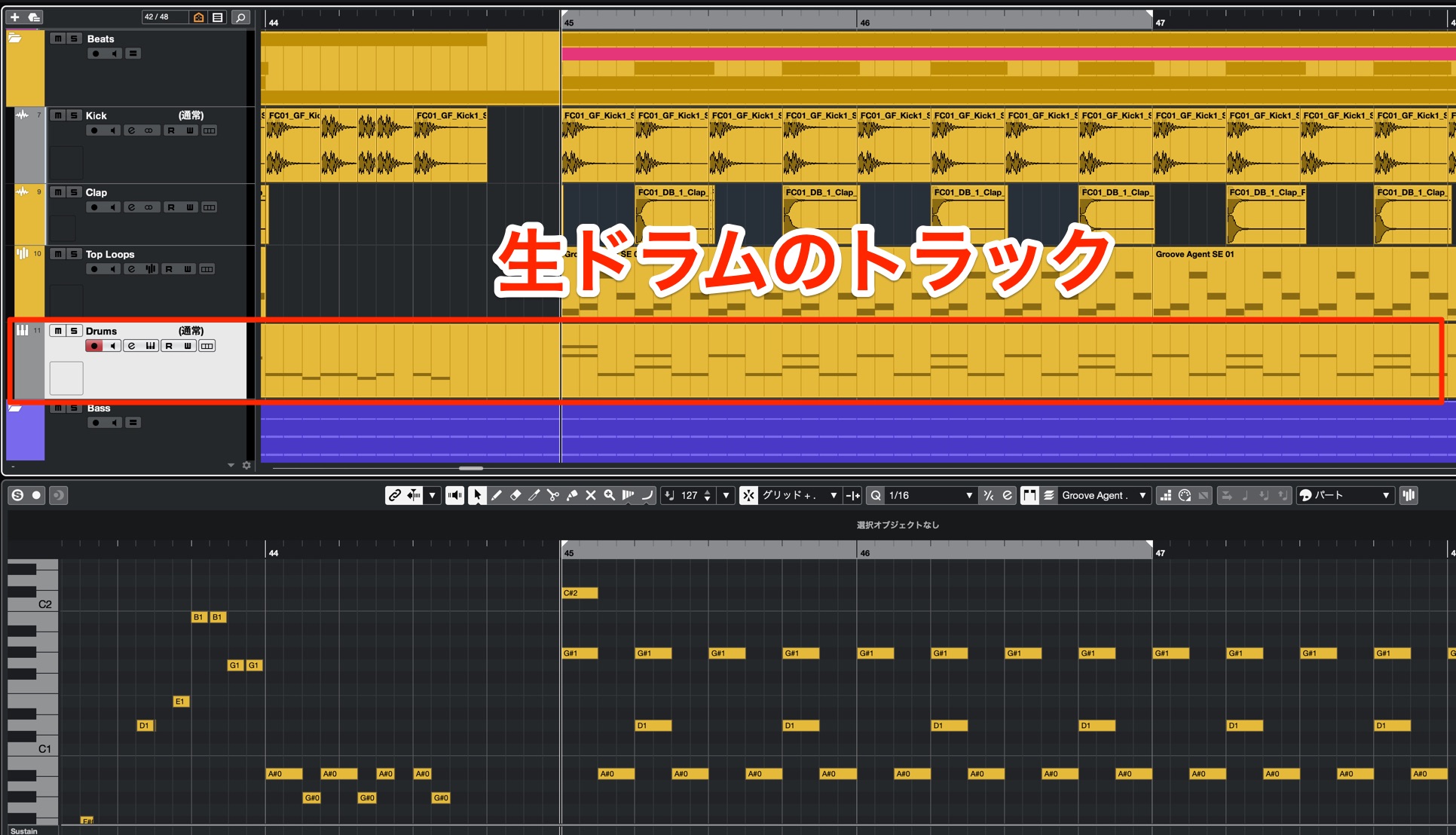
In this song, live drums are layered in for the hi-hats, cymbals, fills, and the snare in the chorus.
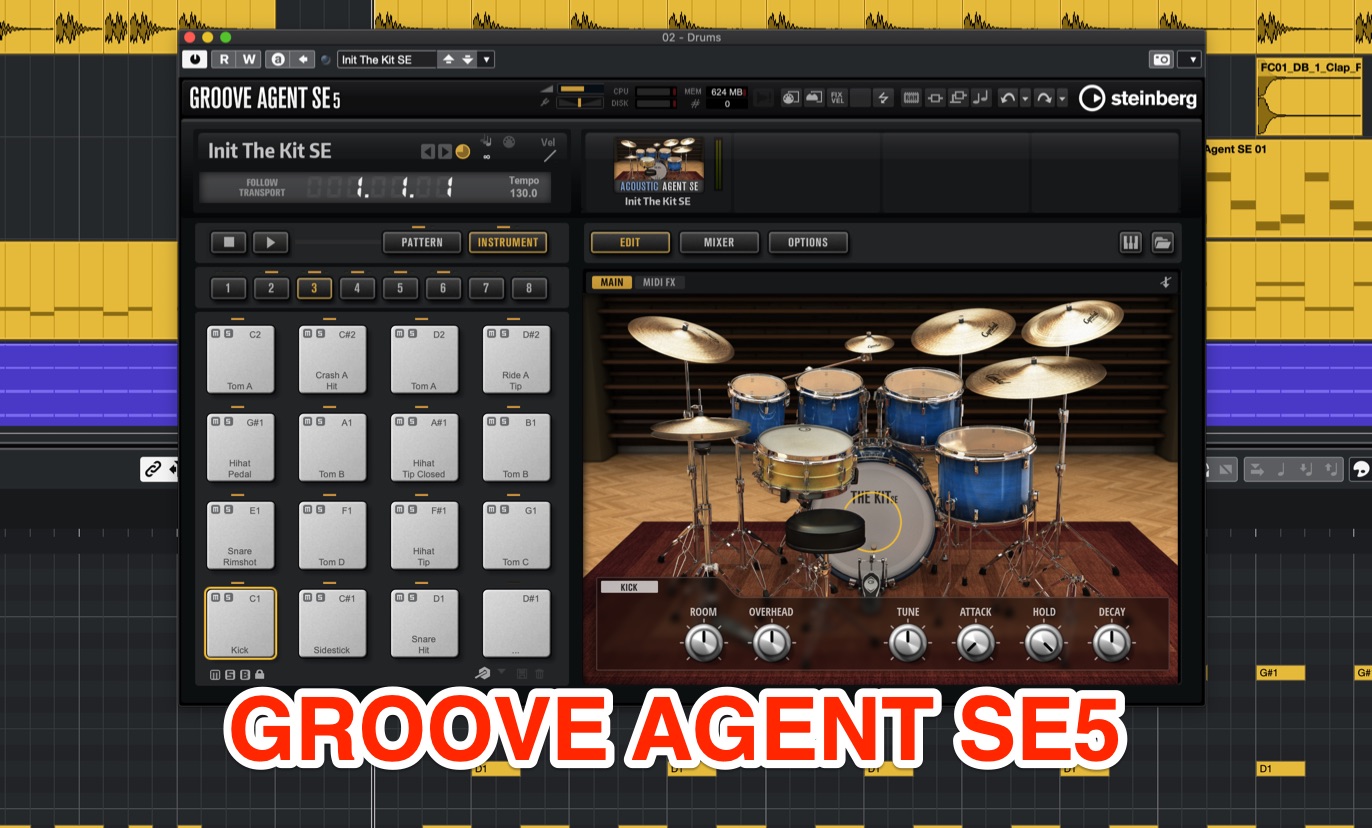
Groove Agent SE’s “The Kit SE,” included with Cubase, is a capable drum instrument that recreates the ambience of a multi-mic recording.
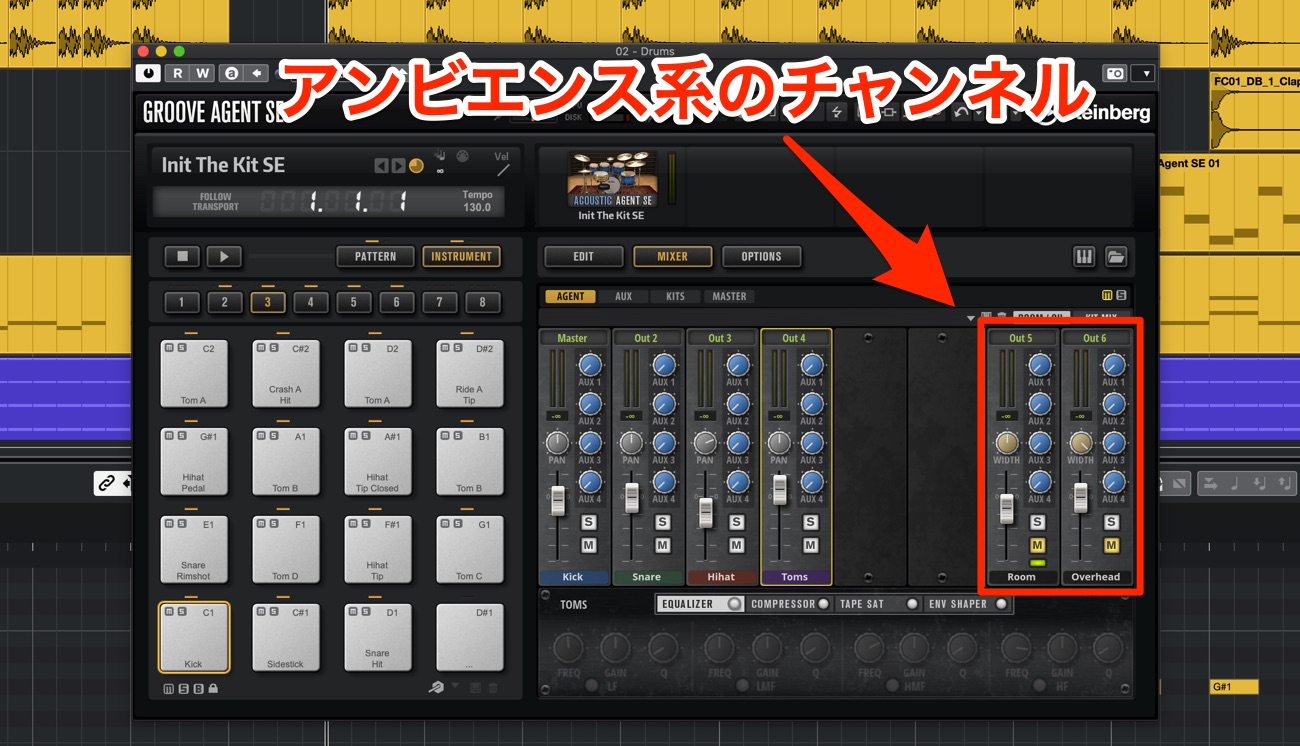
You can easily adjust the level of that ambience with the [OH] and [Room] faders in the mixer section.
Tips for Building Drum Patterns
The drum pattern is built around dance-music-style loops throughout the song.
If you listen to the drum track on its own, you may find it repetitive.
That’s why fills are essential: they clearly set up transitions between sections.
In a song like this, the most important part of a fill in a dance beat (four-on-the-floor) is how the kick changes from the basic pattern.
Let’s look at some effective ways to create fills, including those used in this song.
Create Variation by Dropping the Kick
Removing the kick just before the next section interrupts the beat and makes the transition feel more pronounced.
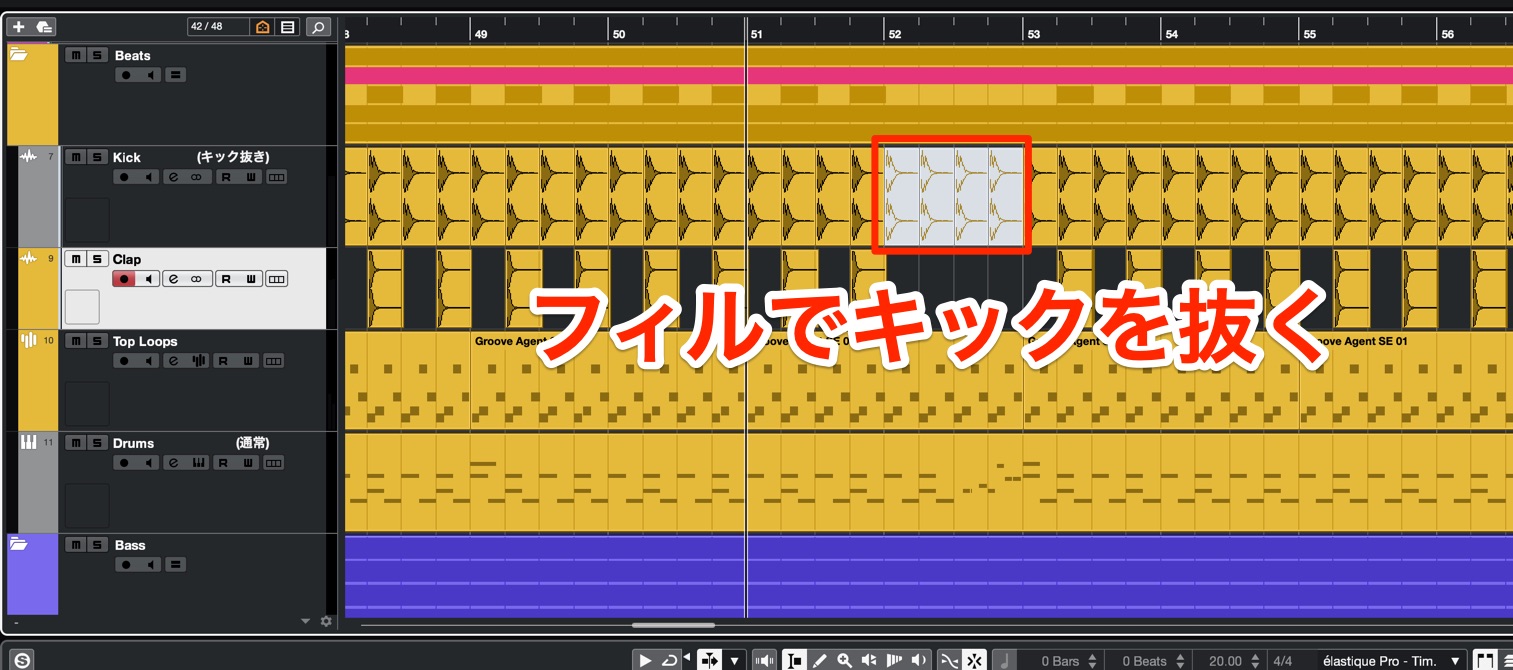
At the midpoint of the chorus, the kick is dropped for one bar to create a stronger contrast.
Here’s what that sounds like.
- With the kick removed
Kick removed
This reduces the repetitive feel, but the change still feels incomplete.
That’s because the bass, which occupies the same low-frequency range, is still playing.
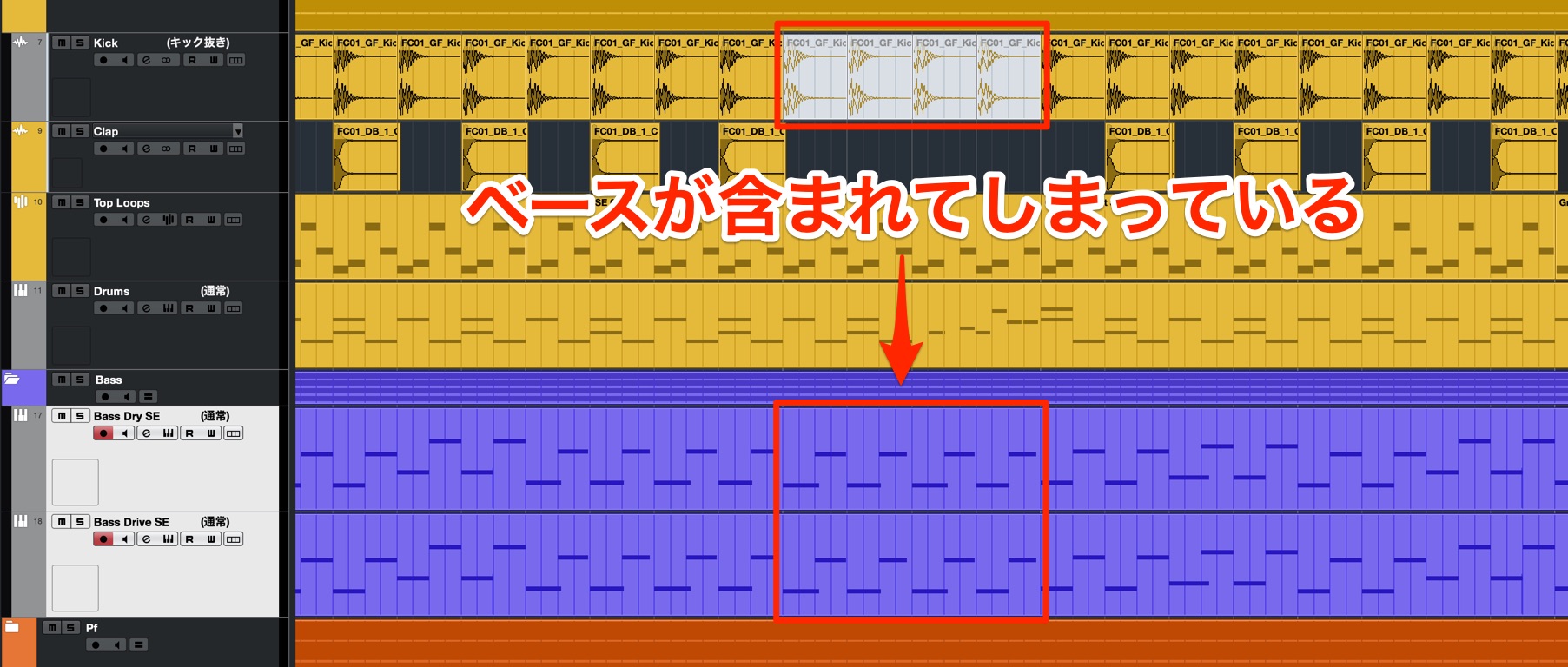
If you also drop the bass for one bar, the result sounds like this.
- With both kick and bass removed
Kick and bass removed
When the kick and bass return, the transition feels much more emphatic.
To make the change even bigger, try dropping other tracks along with them.
It’s an easy way to create variation.
For parts other than the melody, dropping the most prominent and attention-grabbing sounds first often gives you a more natural result.
This example drops the parts for one bar, but a longer break can build more anticipation for the next section.
Try a longer break where you want a bigger transition, such as just before the chorus.
Add a Kick Fill to Create a Rhythmic Hook
Next, let’s look at a technique used in this song: creating a rhythmic hook with the kick.
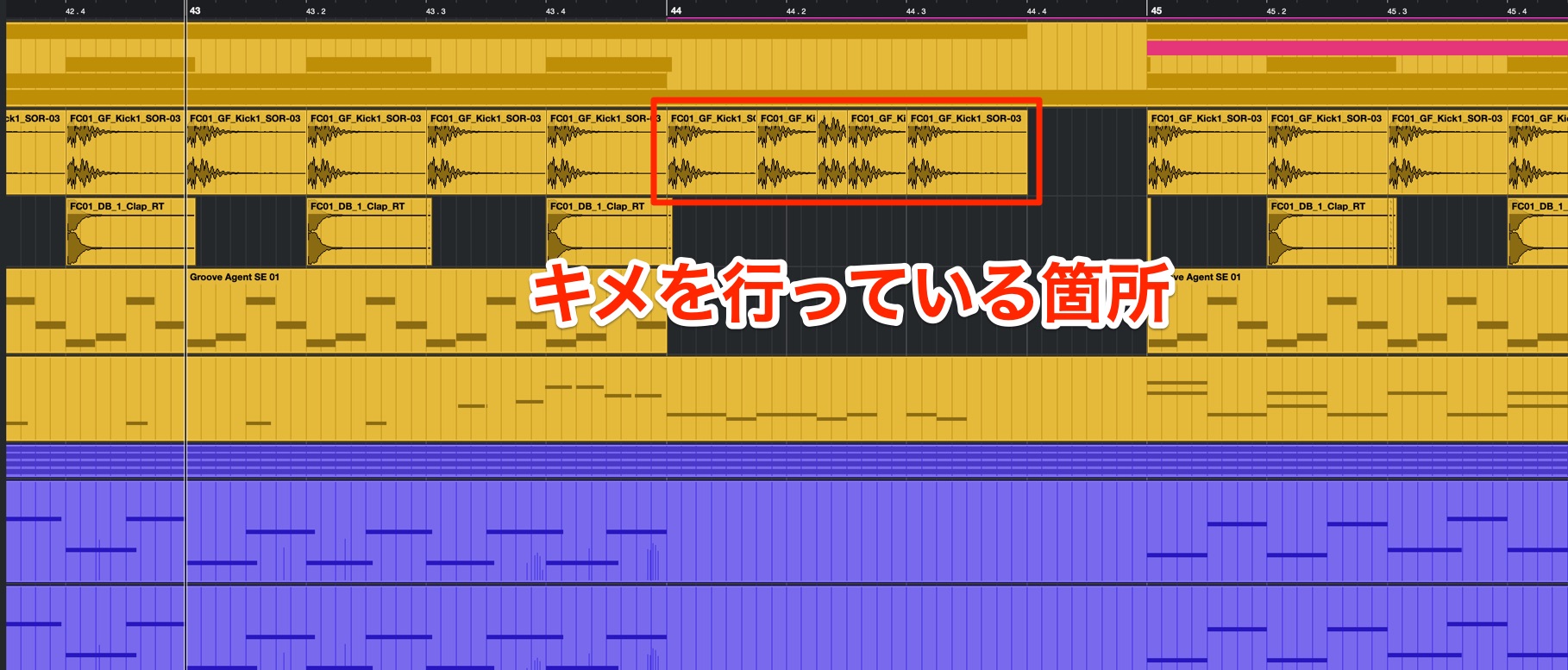
Listen to these two distinctive kick patterns from the song.
- B-section kick fill
B-section kick fill
- A-section kick fill
A-section kick fill
Both depart from the standard four-on-the-floor pattern and use their own rhythms as fills.
There’s an important difference between the two.

The B-section fill follows the accents in the melody,

while the A-section fill uses a rhythm independent of the melody.
Using different variations like these helps keep the song from feeling repetitive.
Bass Lines Create Movement
In four-on-the-floor music, the kick repeats a steady rhythm, which can make the song feel short on contrast.
That’s why actively varying the bass line is important for shaping the song’s sense of movement and development.
Switch the Accents Between Eighth and Sixteenth Notes
The A section is 16 bars long.
The arrangement changes between the first and second eight bars.
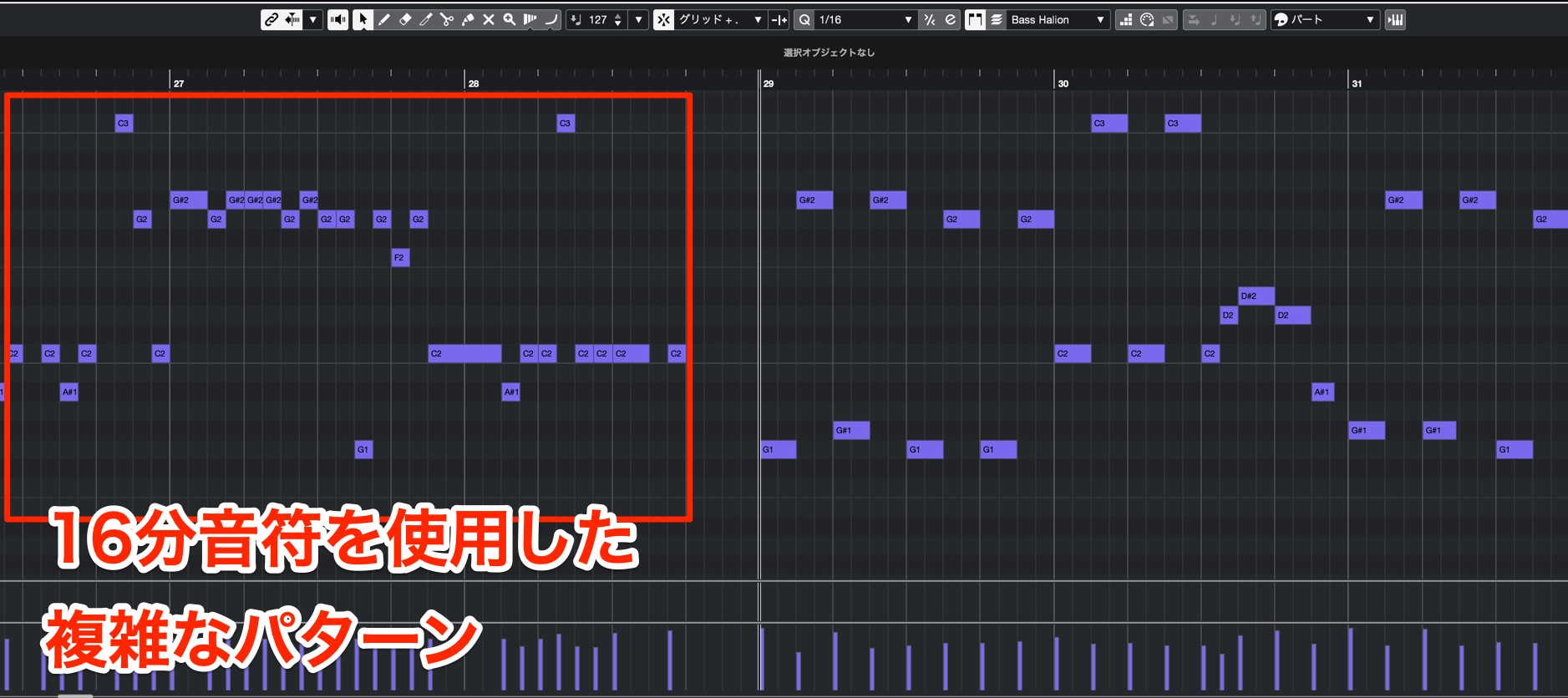
The first half is a busier, more complex pattern with many sixteenth notes.
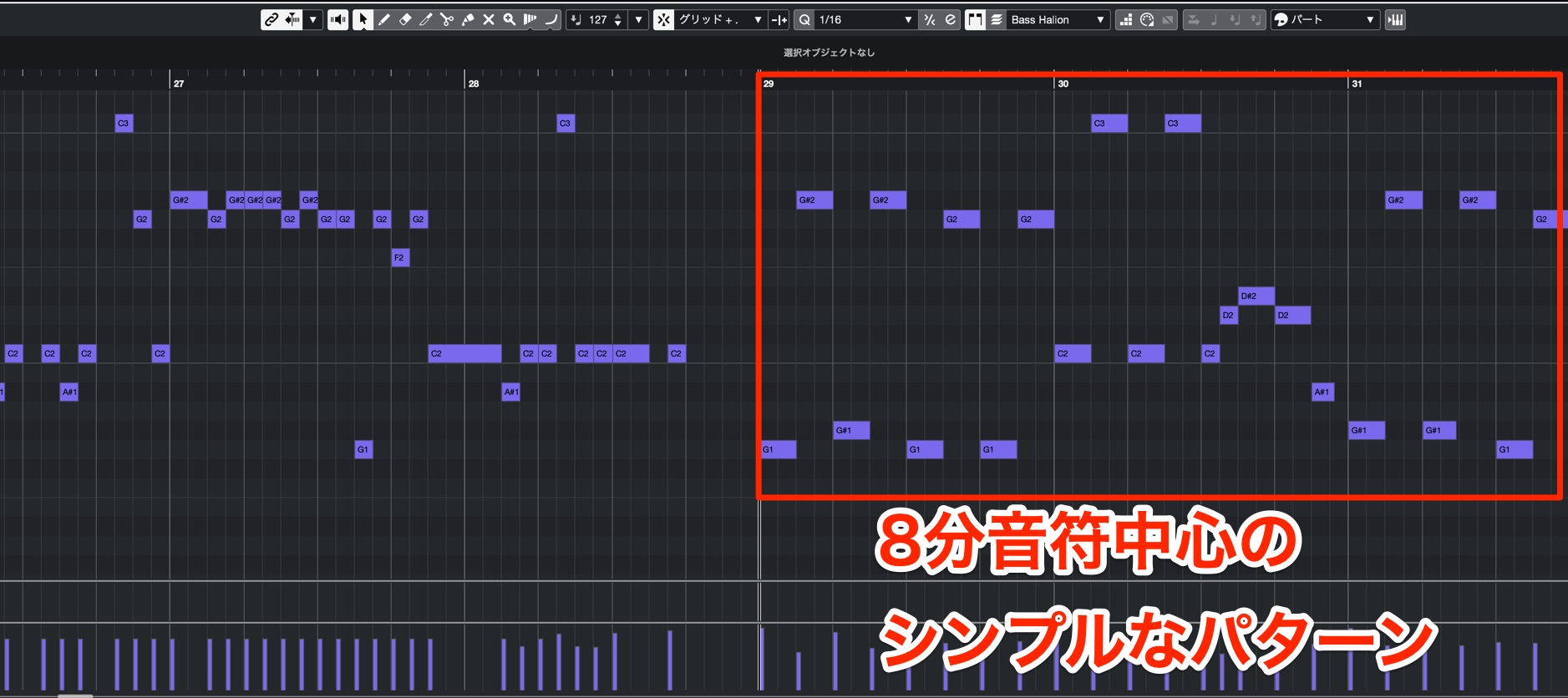
The second half uses a simple octave phrase in eighth notes.
It’s a very clear change in the pattern.
- How the Bass Line Changes in the First and Second Halves of the A Section
A-section bass: first and second halves
Against a steady four-on-the-floor kick, the bass shifts from a complex rhythm with offset accents to a simple rhythm whose accents lock in with the beat. This creates a stronger groove.
A busier pattern often feels more energetic, but the bass has a close relationship with the beat. In many cases, simplifying it deliberately can make a section feel more exciting.

What would it sound like if the first half of the A section used a phrase centered on eighth notes?
Listen for the contrast between the two versions.
- Original bass line
Original bass line
- Bass line played in eighth notes
Bass line in eighth notes
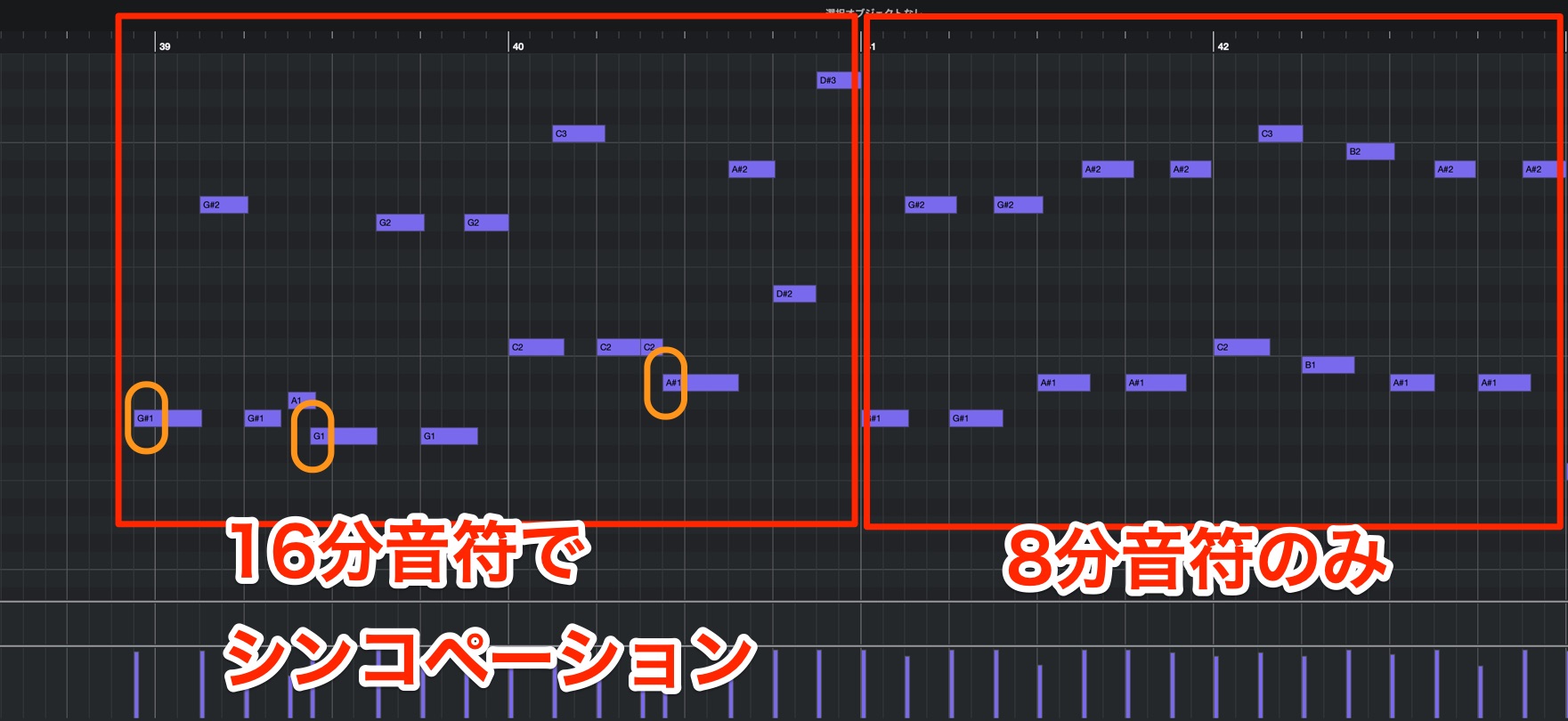
The B section uses the same idea, connecting a pattern with sixteenth-note accents to one with eighth-note accents to create a sense of flow.
- How the Bass Line Changes in the B Section
B-section bass variation
Like the kick, the bass supports the low end. Even a small change in the bass can shape the groove of the entire song.
When building your own bass lines, look for ways to keep the arrangement from feeling repetitive.
Let the Bass Drop Out During a Fill
As discussed above, the bass line has a strong influence on how the song develops.
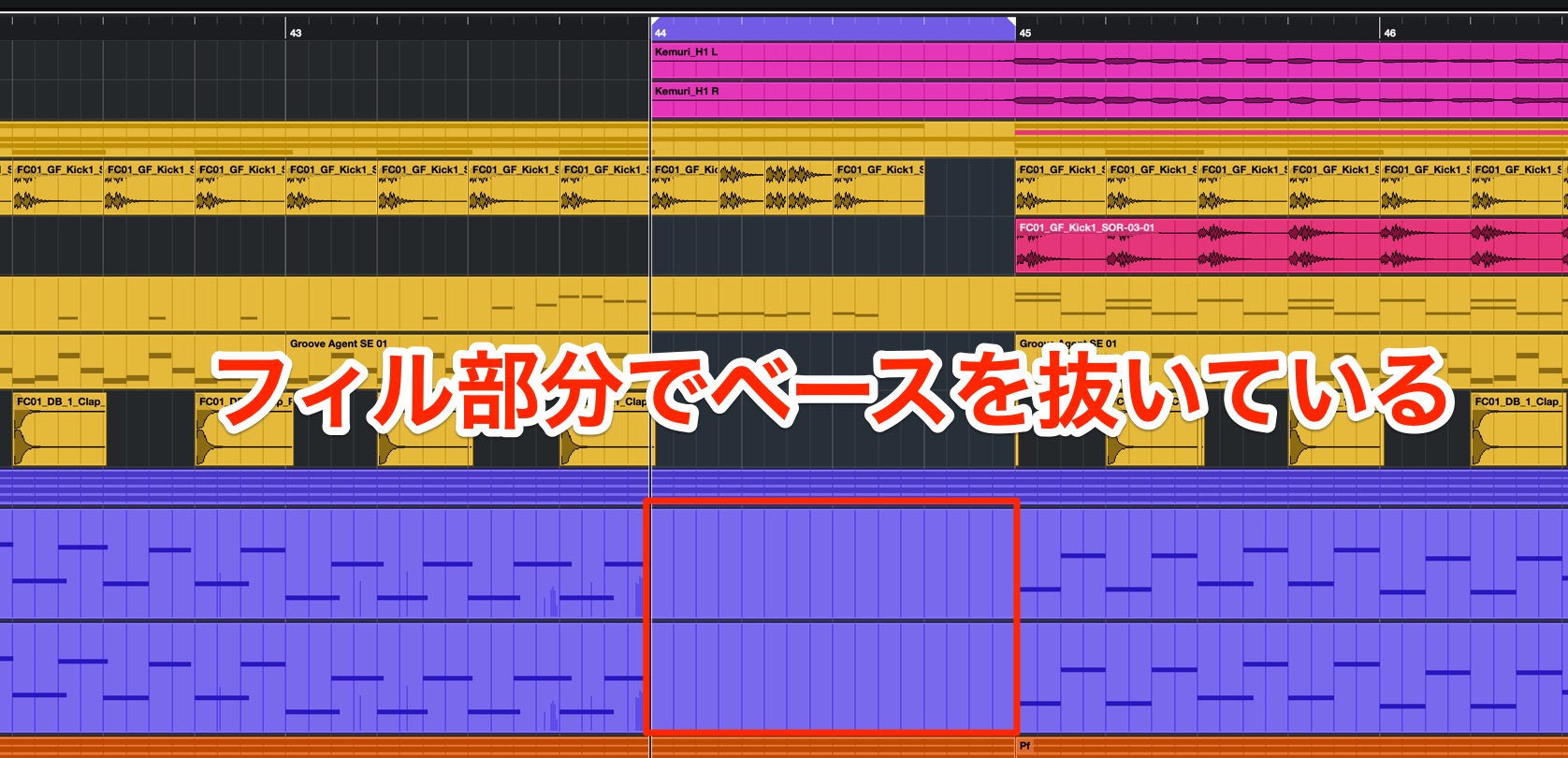
For the song’s most important fill, just before the chorus, the bass is deliberately muted.
This briefly thins out the low end before the chorus.
As a result, the bass hitting again on the first beat of the chorus has a stronger impact.
What would it sound like if the bass kept playing through the fill?
Let’s compare the two versions.
- Original (bass muted)
Original fill: bass muted
- With the bass playing
Fill with bass playing
When you compare them, muting the bass as the low end changes makes the chorus entrance feel more impactful.
Dropping out and bringing back the low end is common in dance music, but it can also work naturally in pop and rock arrangements.
What did you think?
A few thoughtful changes to a rhythm track can make the arrangement feel much more compelling.
Try applying these techniques to your own music.
Next time, we’ll look at tips for creating supporting melodic parts.
Stay tuned!
Frequently Asked Questions
Q1. What are the benefits of combining electronic and live drums?
Electronic drums give you a wide choice of kick and clap sounds, with easy control over frequency response and attack. Live drums add ambience that works well with band sounds, bringing depth and weight to the full track. Combining them can balance the modern edge of dance music with the warmth of a band.
Q2. Why can a four-on-the-floor drum pattern sound repetitive?
Because the same rhythm repeats throughout, a four-on-the-floor pattern can feel repetitive when the kick and bass do not change. Techniques such as dropping the kick, adding a rhythmic hook, and shifting accents can create a sense of movement within the loop.
Q3. How do bass-line changes affect the development of a drum track?
In four-on-the-floor music, the kick repeats a steady rhythm, so the bass line plays an important role in creating contrast across the song. Adding or removing notes and shifting accents between eighth and sixteenth notes can add movement that the drum track alone cannot provide.
NEW ARTICLES
Latest English Articles