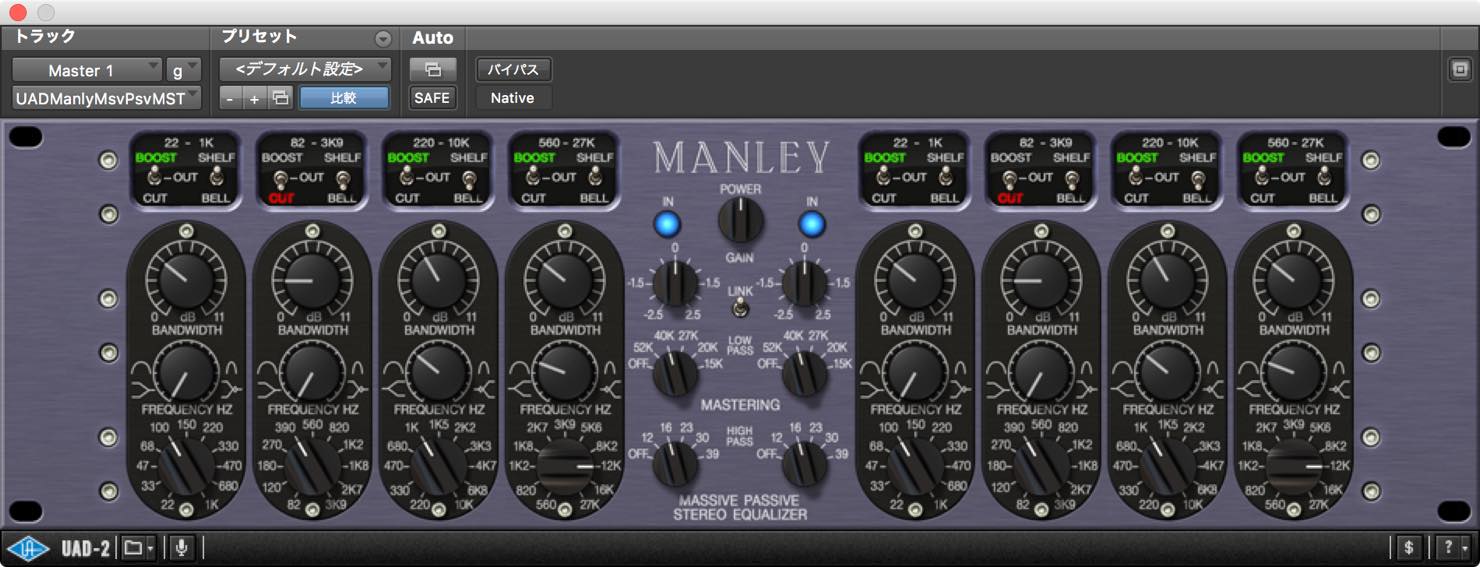
The UAD Manley Massive Passive is a premium equalizer plug-in modeled on a passive-circuit hardware unit. The article quotes approximate Japanese prices of ¥600,000 for the hardware and ¥30,000 for the plug-in; these historical figures should not be taken as current prices. Its defining quality is a natural, musical response even with substantial gain changes. It includes standard and mastering versions, with bandwidth controls and shelf and bell filters for creative mixing and precise mastering adjustments.
An EQ with remarkable transparency and a musical response

In the third part of our series exploring UAD, we look at the Manley Massive Passive equalizer plug-in.
So far we have discussed the distinctive character of analog-modeled plug-ins. In a sense, the Massive Passive takes the opposite approach: its defining characteristic is a very natural response.
An EQ is designed to change a sound, of course, but the Massive Passive can produce a musical result while preserving the balance even with large gain changes.
This kind of response is especially well suited to mastering and vocal treatment.
First, listen to the master before and after equalization with the Massive Passive.
- Before
- After
The midrange through high frequencies have been boosted fairly substantially, yet the balance remains intact.
The accompanying video explains how the parameters work and how to operate them in greater detail.
Exploring the UAD Manley Massive Passive Equalizer
Recommended product for using UAD plug-ins
Frequently Asked Questions
Q1. How does the UAD Manley Massive Passive differ from a DAW’s included EQ?
The Massive Passive models a hardware design with passive EQ bands and can sound natural and musical even with strong boosts. The Japanese article contrasts this with the balance of a DAW’s included EQ at the same settings. That comparison is not a general rule: stock EQs can also be suitable for mastering, and results depend on the EQ, settings and material.
Q2. When should I use the standard or mastering version?
The standard version is suited to creative sound shaping, while the mastering version provides a more restrained range for finer adjustments. The article cites maximum boosts of 20 dB and 11 dB respectively; the actual response depends on bandwidth and filter settings. The mastering version is recommended here for more subtle, precise mastering adjustments.
Q3. Can a beginner use the Massive Passive?
Its intuitive interface includes controls for linking, switching between boost and cut, gain, Q and frequency, so beginners can learn the basic operation. To make the most of the modeled passive-circuit behavior, practice while referring to the detailed video explanation.
NEW ARTICLES
Latest English Articles