
Do you need music theory to compose in a DAW? In this discussion, experienced musicians explain why the answer depends on your goals, genre and working style. Basic knowledge such as diatonic chords can make production faster and less frustrating, while an intuitive approach can also lead to original music. The key is to use theory flexibly in a way that supports the music you want to make.
Common questions about composing and producing music
Making music in a DAW is enjoyable—you can become so absorbed that you lose track of time.
But it can also involve creative struggles, impatience and stress.
Those moments often bring the questions discussed here to mind.
We invited experienced composer Hidetoshi Takumi to join us for a conversation about composing and producing music.
Video: Answering Common Questions About Music Production
Do you need music theory to compose in a DAW?

Kanaya
Do you need music theory for composing and producing music?
Takumi
If you make music in a DAW, you probably combine notes—do, re, mi, or letter names such as C, D and F—to create melodies and chords.
And when you program a four-on-the-floor rhythm, you are working within a meter, aren't you?
At that point, in a broad sense, you are already working with music theory.
Kanaya
So music theory is a broad field that includes things like chord progressions and melody.
Takumi
Exactly.
Imagine that writing a song is a journey to a destination. You could fly, take a train, drive or walk. What would you choose if you were short of time?
Miyakawa
I would fly.
Takumi
Using established patterns with a reasonably predictable level of quality is a little like that: it gives you a dependable route.
But if the deadline is farther away and you want to experiment, you can take your time and walk.
Kanaya
You might explore a side street.
Miyakawa
Walking lets you explore and pick up new knowledge along the way.
Takumi
That is a valid way to write music too. Any of those approaches can work.
You can choose whether to use a particular piece of theory according to the song you want to make and the situation. You do not have to be tied to a simple necessary-or-unnecessary position.
Kanaya
Is it enough to know the basics, such as diatonic chords?
Takumi
Those ideas appear in the popular music you listen to every day. Knowing how they work helps you understand what makes that style sound the way it does.
Kanaya
So at least some knowledge is useful?
Takumi
It helps to know the theory relevant to the music you want to make.
Kanaya
That seems faster and less likely to lead to frustration.
Takumi
Yes.
Kanaya
Some people think learning theory dulls their instincts and makes their music less interesting. What do you think?
Takumi
Theory is not something you must always obey. Sometimes you need to break away from it.
But knowing it helps you understand what you are breaking away from.
Kanaya
There is a big difference between deliberately doing something unusual and simply choosing at random.
If you know the framework, you can return to it after departing from it, and you know when you are stepping outside it intentionally.
Miyakawa
Theory matters as a way of controlling what you do.
Understanding it gives you that control.
Takumi
Exactly.
Kanaya
Musicians often pick up things like diatonic chords intuitively, don't they?
Takumi
Yes. The difference is whether you can define those ideas in words.
Kanaya
So someone getting started would benefit from learning a few basic principles.
Takumi
They are useful to know.
Miyakawa
Even without knowing the theory, you can hear whether a chord feels odd or pleasing and keep adjusting the notes until you like the result.
Takumi
That is the walking approach we mentioned earlier.
Miyakawa
It can lead to interesting music that differs from established approaches.
Takumi
Yes.
Miyakawa
People define theory and its usefulness differently, so I do not think everyone must formally study it before making music. I see arguments about this on social media, but debating whether it is universally necessary seems unproductive to me.
Takumi
That is a reasonable place to land.
Kanaya
One thing I enjoy about those discussions is seeing how much everyone loves music.
Miyakawa
And you can discover new ideas through the discussion itself.
Kanaya
Rather than forcing an approach on someone else, if they have made a good song, isn't that what matters?
Takumi
Absolutely.
Miyakawa
Yes.
Kanaya
To sum up, a few basics are useful. They are not especially difficult—it is more a matter of learning a few common patterns.
Takumi
Exactly.
Miyakawa
Yes, some of it is simply learning those patterns.
Do you need perfect pitch to compose in a DAW?
Kanaya
Would it help to have perfect pitch?
First, what do we mean by perfect pitch?
Takumi
People often describe it as being able to hear everyday sounds, such as an air conditioner, as named musical notes.
Kanaya
Or when an ambulance passes.
Takumi
Right—hearing its alternating siren as notes, for example.
Miyakawa
That sounds useful.
Kanaya
People often say that perfect pitch can only be developed through training before the age of three. [Editorial note: This should not be read as a strict age limit. Research has found that some adults can learn absolute-pitch identification, with substantial individual differences (Van Hedger, Heald and Nusbaum, 2019).]
I have also heard that some people hear sung notes as note names rather than focusing on the lyrics, and that this can feel distracting or make it harder for them to simply enjoy a song.
Takumi
I think of perfect pitch as a memory for pitches developed early in life. Being able to identify those pitches is a particular skill.
Relative pitch, by contrast, means recognizing the relationships between notes once you have a reference—for example, being told that one note is do, then recognizing the interval to re.
You also hear the terms movable do and fixed do.
As an analogy, fixed do keeps do attached to the same note name, while movable do lets do shift to the chosen reference or tonic. These are note-naming systems; using fixed do is not itself proof of perfect pitch.
Kanaya
That reference is related to what we call the key.
Now that we have an outline of perfect pitch and relative pitch, do you need perfect pitch for music production?
Takumi
It depends on the task, but if you want to compose, you do not need perfect pitch.
Miyakawa
For example, I can recognize a melody in my head, or one someone sings, in do-re-mi terms.
For me, that is relative pitch: I hear the same scale relationships whatever the key. It does not cause me any difficulty when composing.
Takumi
Perfect pitch can be convenient when transcribing by ear. If you recognize the note names directly, reproducing the notes can be quicker. It is a useful tool—a situation where that particular skill helps.
Kanaya
So for making music, it makes sense to focus on relative pitch and our sense of relationships between sounds rather than worrying about perfect pitch.
Takumi
That is the main point.
Kanaya
Training relative pitch seems worth doing and useful in its own right.
Do you have a recommended way to practice?
Takumi
Perfect pitch is commonly associated with early learning, whereas you can work on relative pitch at any age.
Playing the piano or another instrument is valuable, but I think one of the most effective tools is your own voice.
For example, sing an interval such as do–sol and practice finding those pitches.
Kanaya
So start by trying to sing a phrase.
Takumi
That is very important.
Miyakawa
I did that around high-school age, and it can really develop your ear.
Kanaya
So it does improve with practice. Try singing some phrases yourself.
Do you need to read sheet music to compose in a DAW?
Kanaya
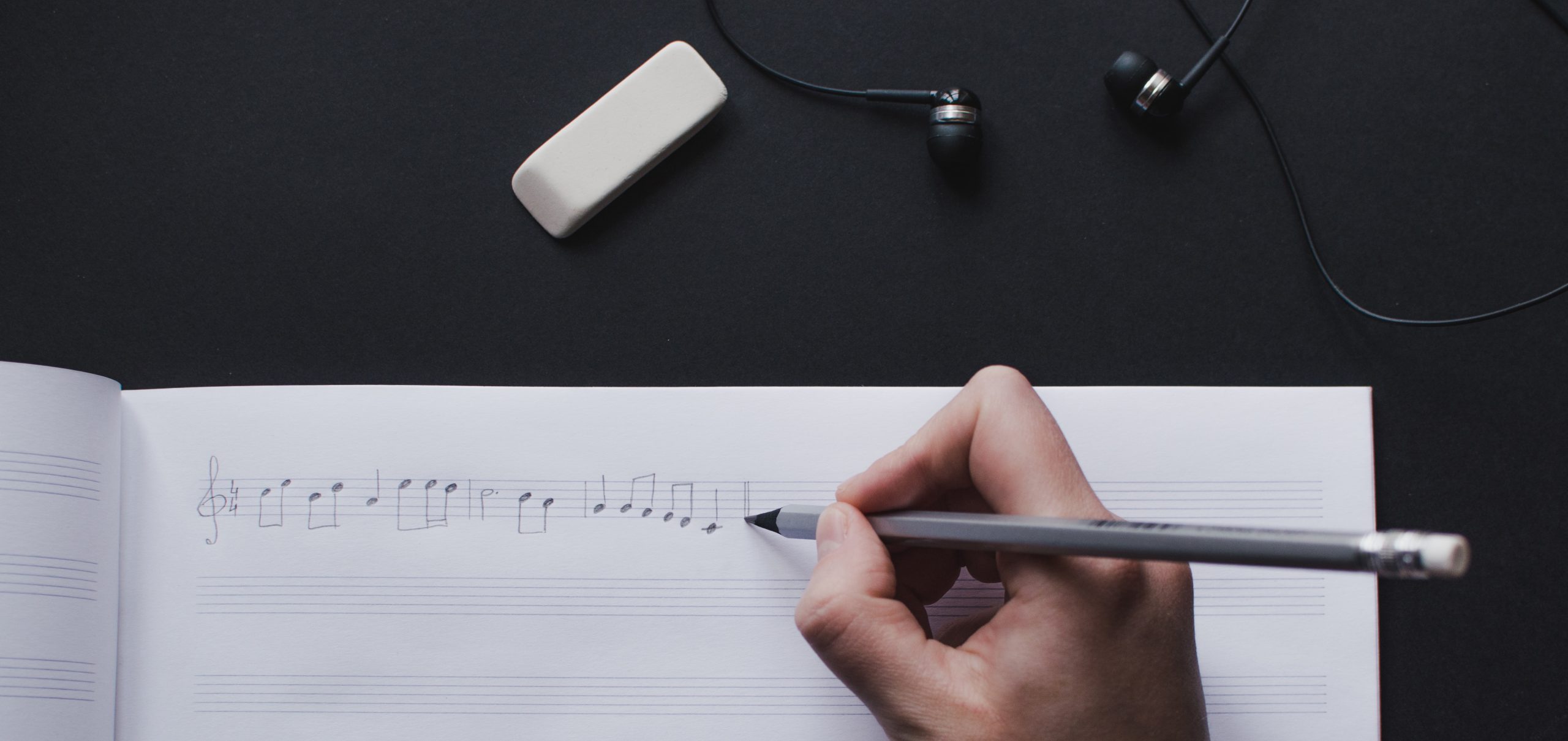
Do you have to be able to read music?
Miyakawa
It really depends on the situation.
What would you say to someone who is just starting music production?
Takumi
The piano roll—also called a key editor—can serve in place of a score.
Kanaya
I am an example of someone who can compose without reading notation. But who does need to work with scores?
Takumi
With a large number of tracks, such as an orchestral arrangement, viewing everything in piano rolls can be cumbersome. Organizing and controlling the music in score form from the start can be more efficient and effective.
A score can make that kind of work easier.
Kanaya
It also matters when your work involves telling other people what to play.
Takumi
In that setting, it can be essential.
I think of it as a shared language, a little like English: musicians around the world communicate through notation. A shared language lets you work across countries.
Miyakawa
Seen that way, notation is very useful.
Kanaya
So you can make music without it, but it is useful to have and essential for some kinds of work.
Takumi
Exactly.
Kanaya
I have heard people say that a good-looking score often means a well-written piece. What do you think?
Takumi
Even in a piano roll, when you see how one instrument enters here and another enters there, you can sometimes tell that the arrangement is well constructed, can't you?
Miyakawa
Yes, certainly.
Takumi
It is the same idea.
With a score, you can see those relationships at a glance.
Kanaya
When you look at a score, do you hear the music in your head?
Takumi
People have different levels of skill, but someone experienced can hear the piece internally just by reading it.
Miyakawa
So you can compose and communicate music without using a computer.
Kanaya
That must take a great deal of practice and experience.
Takumi
Yes. It is a trained ability.
Do you need to play an instrument?

Kanaya
Does being able to play an instrument help with composing and music production?
Miyakawa
I once suggested piano study to someone working on chord progressions and complex music. About six months later, their songs had improved significantly.
Others have followed the same suggestion without such a noticeable change, so it depends on the person.
Aptitude is a factor, but if you have the time and resources, it may be worth trying because it could help you develop.
Takumi
It certainly can be an advantage.
But consider Vocaloid music: some approaches go far beyond conventional singing, yet have become an established musical culture.
Kanaya
Programming, and the fact that you are not physically playing the part, can lead to distinctive styles.
Sometimes an artist pushes the forms of expression available to them, and that is how the music takes shape.
Takumi
If you want to recreate the nuances of instrumental performance, having played the instrument is a clear advantage.
Kanaya
You can make music in a DAW without playing an instrument. If you later feel that you need one, try it and keep practicing.
Miyakawa
A keyboard can also make the work faster because you can play an idea immediately. The time-saving benefit can be substantial.
Takumi
Yes. Like our discussion of theory, it comes down to deciding whether and how to use that tool.
Should you go to music college?

Kanaya
Is it better to attend a music college?
Takumi, you graduated from one and also teach at music colleges and vocational schools. What is your perspective from that experience?
Takumi
From my position, it is hard to imagine what my experience would have been without going.
I would like to hear your views first, then speak from the perspective of someone who attended.
Miyakawa
Looking back, I sometimes think it would have helped me save time.
If it offered an environment where I could learn what I wanted intensively over a short period, I think I would have benefited.
Kanaya
For me, beyond saving time, the relationships would have been a reason to go.
Connections with people matter throughout a career. If you can learn music while building relationships with friends and teachers, I can see the value, although the cost is high.
Miyakawa
Music colleges may offer scholarships or financial support, so people who want to study there can explore those options. Availability and conditions depend on the institution.
Takumi
From my experience, you can study theory and instruments outside a music college too. Much depends on your own effort and interest. But when you study alone, you can reach a point where it is hard to judge your own progress.
Kanaya
You need a third-party perspective.
Takumi
Exactly.
In that sense, an environment where someone can give you objective feedback can be valuable; it does not have to be a music college.
For me, the environment and fellow students were major benefits. I met many instrumentalists and performers, made connections in the music industry and learned professional and communication skills through those relationships.
Miyakawa
So there are many benefits beyond the actual music studies.
Takumi
I felt those were among the biggest advantages. If those things matter to you, a music college can be worth considering.
Miyakawa
If you compare people of the same age—say, nineteen—do music-college students tend to have stronger skills than people who are self-taught?
Takumi
That is difficult to say.
Miyakawa
So it depends on the individual's effort.
Kanaya
Some music-college students also study music production elsewhere.
For example, they may learn theory at college and develop their DAW skills in another setting.
Takumi
A college focused on classical music may not teach much DAW production, so students sometimes learn that elsewhere.
College provides an intensive learning environment, and the structure can push you to study regularly.
Miyakawa
That could help someone who struggles with motivation.
Kanaya
The environment can support your development, but relationships with people matter too, whether or not you work in music.
What did you think of the discussion?
Some of these questions were substantial enough that we could have talked about them for hours.
There is no single qualification or skill that determines whether you can make music. But some abilities can become necessary, or give you an advantage, depending on your goals.
What is your goal, and what kind of music do you want to make?
Think carefully about whether a particular skill or educational path will help you get there, and make your choices accordingly.
We hope this discussion is useful to anyone starting out in composing and producing music.
Thank you for reading to the end.
Frequently asked questions
Q1. Do I need to study music theory to compose in a DAW?
It is not a prerequisite, but knowing the basics relevant to your chosen genre is useful. Understanding ideas such as diatonic chords can make the process faster and less frustrating. An intuitive approach can also lead to original music.
Q2. Will learning theory dull my musical instincts?
The discussion suggests the opposite: understanding a framework lets you depart from it intentionally and gives you greater control over your expression. Theory can support your instincts rather than replace them.
Q3. Can I start composing in a DAW without previous musical experience?
Yes. As you learn basic ideas such as notes and chord progressions, you can experiment and develop your own style. That process may lead to interesting music that differs from established approaches.
Q4. What theory should a beginner learn first?
Start with basic patterns common in popular music, such as diatonic chords and meter. These foundations need not be difficult, and learning them can make production smoother.
NEW ARTICLES
Latest English Articles














































































