Waves Berzerk is a creative distortion plugin that ranges from straightforward distortion to distinctive sound design. Shape the basic distortion in the Drive section, then combine feedback, dynamics, and EQ in the Processing section to create complex, unpredictable changes in sound. The Output section lets you make final tonal adjustments. Apply it to vocals, drums, synths, and other sources to experiment with production techniques and greatly expand your sound-design options.
A Creative Distortion Plugin
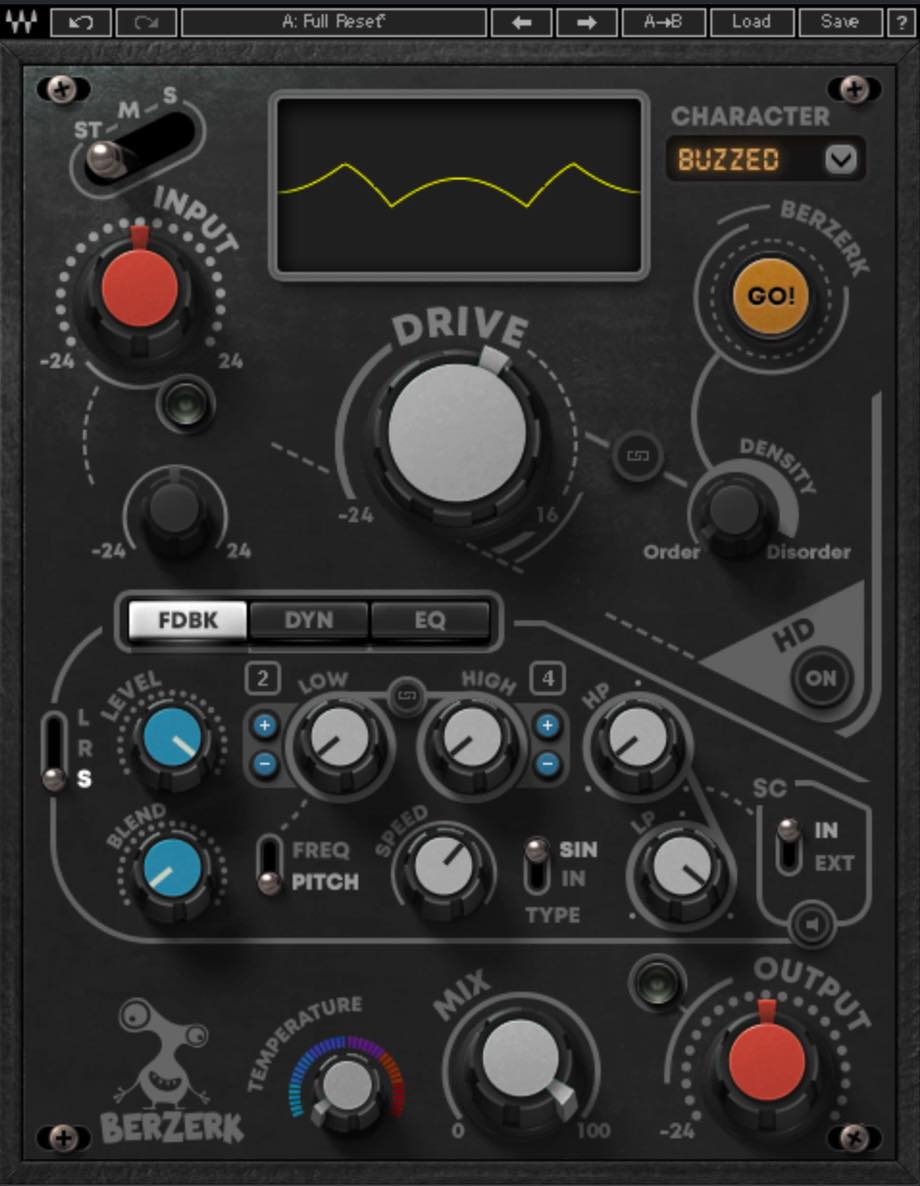
In this tutorial, we will look at Berzerk, a new plugin from Waves at the time of this article.
Berzerk is a distortion effect that can produce anything from simple distortion to highly unconventional sounds.
How to Use Berzerk: Video Tutorial
Product URL: https://bit.ly/3aVCldb
Drive Section
Let’s start with the Drive section at the top. This is where you shape the basic distortion sound.
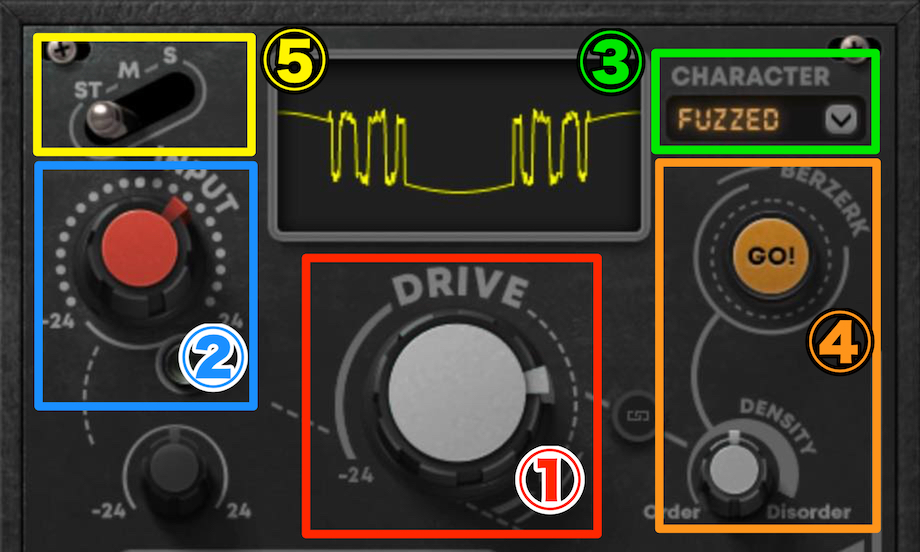
- ① DRIVE: Sets the amount of distortion.
- ② INPUT: Sets the input level. Raising it moderately makes the distortion more pronounced.
- ③ CHARACTER: Selects the type of distortion.
- ④ GO!/DENSITY: Introduces random changes to the distortion character. The DENSITY knob below controls the strength of this effect.
- ⑤ STEREO INPUT MODE: For a stereo source, you can apply distortion to the entire signal, or limit it to the mid or side component.
Processing Section
The Processing section offers three functions: FDBK (feedback), DYN (dynamics), and EQ.
FDBK (Feedback)
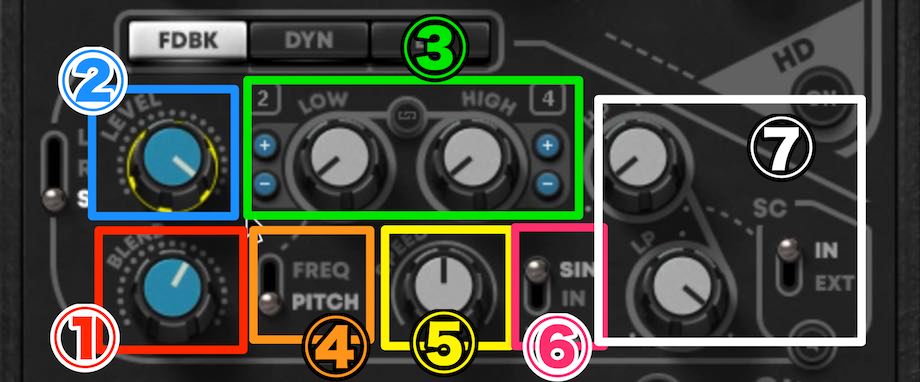
The feedback section uses an oscillator to generate a sine wave that follows the rhythm of the source, allowing you to create unusual sounds.
- ① BLEND: As you increase this control, more of the pitched sound is gradually introduced.
- ② LEVEL: Controls the feedback level.
- ③ LOW/HIGH: Controls the range of the feedback’s pitch movement. The pitch moves from HIGH toward LOW.
- ④ FREQ/PITCH: Sets the units used by the LOW/HIGH knobs: frequency in FREQ mode, or musical pitch in PITCH mode.
- ⑤ SPEED: Controls how quickly the pitch moves from HIGH to LOW.
- ⑥ TYPE: Selects what the modulation affects: the generated sine wave in SIN mode, or the source sound in IN mode.
- ⑦ SIDECHAIN: With the IN/EXT (external) switch set to IN, you can filter the signal used for modulation. Raising HP (high-pass) excludes frequencies below the selected value, while lowering LP (low-pass) excludes frequencies above it.
Setting the IN/EXT switch to EXT (external) lets you use a send signal from another track as the sidechain source, allowing even more complex modulation effects.
DYN (Dynamics)
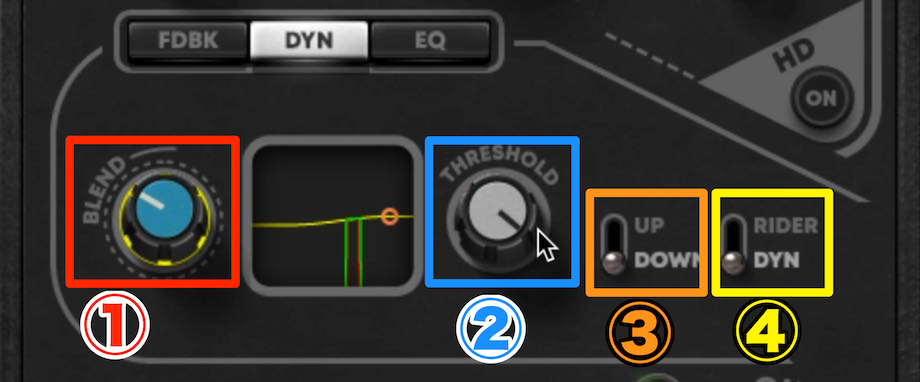
The dynamics section works somewhat like an expander. It adds distortion in response to changes in the source level, giving the sound more dynamic expression.
- ① BLEND: Sets the strength of the dynamic expression. Turn it clockwise for a stronger effect.
- ② THRESHOLD: Adjusts the level threshold that determines which parts of the signal receive distortion.
- ③ UP/DOWN: Selects whether distortion is applied above or below the threshold.
- ④ RYDER/DYN: When switched to RIDER, DOWN applies distortion above the threshold and leaves the signal below it dry. UP does the reverse.
EQ
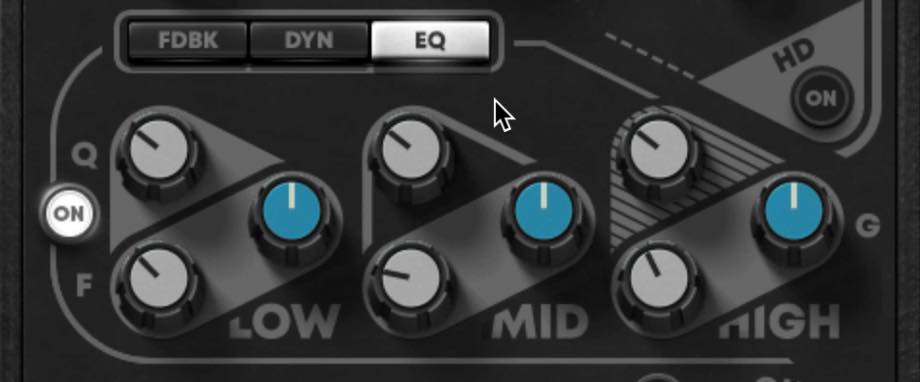
As its name suggests, the EQ lets you shape the tone with three bands: high, mid, and low.
Output Section
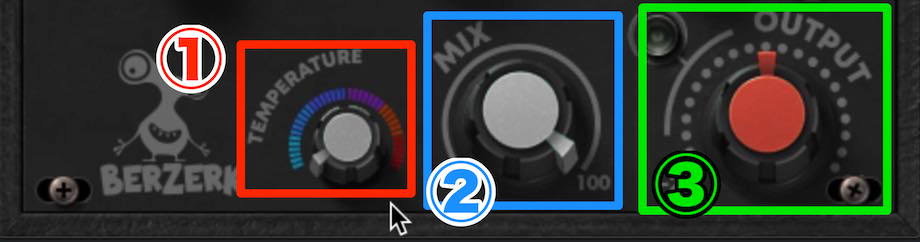
- ① TEMPERATURE: Sets the tonal color. Turn it clockwise for a warm, smooth sound, or counterclockwise for a clear, crisp sound.
- ② MIX: Sets the balance between the dry and effected signals.
- ③ OUT: Sets the final output level.
As you can see, BERZERK is more than a simple distortion effect: it is a plugin that invites highly creative sound design.
Try it on a variety of sources and see what unexpected combinations of sounds you can discover.
Here is how to use the new Waves distortion plugin that was offered for free during Black Friday in 2019!
How to Use WAVES Berzerk for Unexpected Changes in Sound
📝 Article: https://t.co/NQ9CcjLmM5🎥 YouTube: https://t.co/EnWzsCT5Dr pic.twitter.com/ikSplHASJQ
— SLEEP FREAKS (@SLEEPFREAKS_DTM) December 5, 2019
Frequently Asked Questions
Q1. What is Waves Berzerk best suited for?
It works with many sources, including vocals, drums, and synths, and covers everything from straightforward distortion to experimental sound design. It is particularly well suited to unusual, distinctive sounds.
Q2. How should I use DRIVE and INPUT together?
Use INPUT to raise the input level moderately so that the distortion becomes more pronounced, then use DRIVE to adjust its intensity. Combining the two allows finer control over the sound.
Q3. What kinds of sounds can the feedback function create?
The oscillator generates a sine wave that follows the source’s rhythm. Changing the pitch and speed lets you create electronic sounds reminiscent of synth leads, as well as modulation effects.
Q4. What are some practical uses for the dynamics section?
Adding distortion in response to the changing level of vocals or drums can give a sound natural dynamic expression and a greater sense of loudness. The processing responds dynamically, much like an expander.
Q5. What does the TEMPERATURE knob adjust?
It controls the tonal color: turn it clockwise for a warm, smooth sound, or counterclockwise for a clear, sharp sound. It plays an important role in the final tonal adjustment.
NEW ARTICLES
Latest English Articles