Choosing an EQ for music production involves more than the plug-ins supplied with your DAW: a third-party EQ may offer a sound or workflow that suits you better. This 2020 comparison examines three general-purpose EQs: McDSP FilterBank, established in professional studios; Sonnox Oxford EQ, derived from the Sony OXF-R3 console; and Waves H-EQ, which combines analog-inspired and digital filter designs. The review describes their different characters, from warmth to a sharper, cleaner sound and flexible analog-style curves. Choose according to your music and the way you like to work. The listening impressions and interfaces shown reflect the versions used in the original article.
Choose the EQ That Suits You
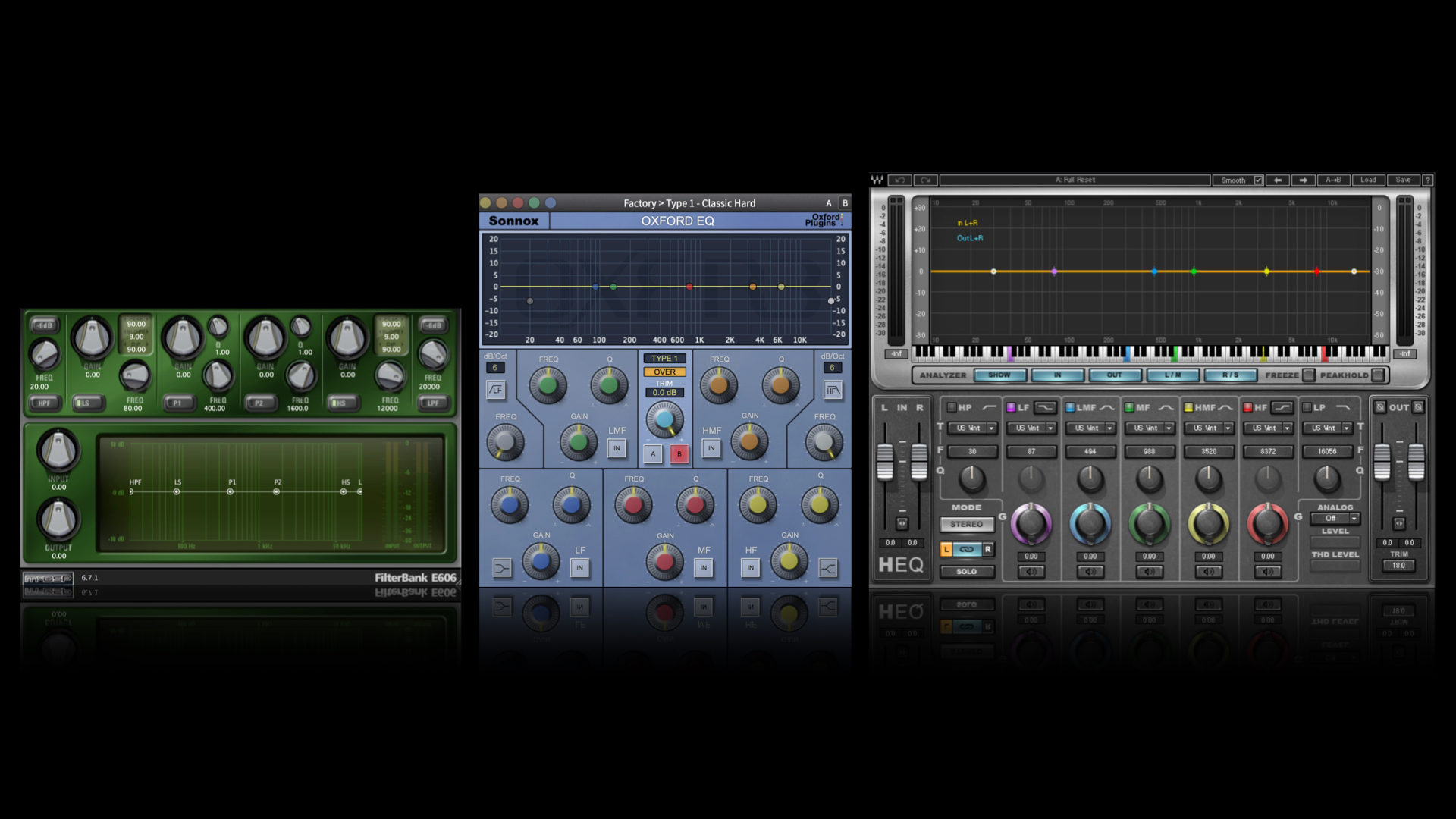
In this EQ special, we will introduce and compare the features of EQs from three well-known manufacturers.
Here are the three plug-ins we will cover.
All three are versatile enough to serve as your main EQ.
Every DAW includes an EQ, and you may feel that yours is all you need. Even so, an EQ’s capabilities and how well it fits your working style can make a substantial difference to your results and efficiency.
They are worth trying, and we hope the video gives you a reason to explore them.
Let’s look at each one.
Improve Your Mixing: Comparing Three EQ Plug-ins
McDSP FilterBank
First up is McDSP FilterBank.
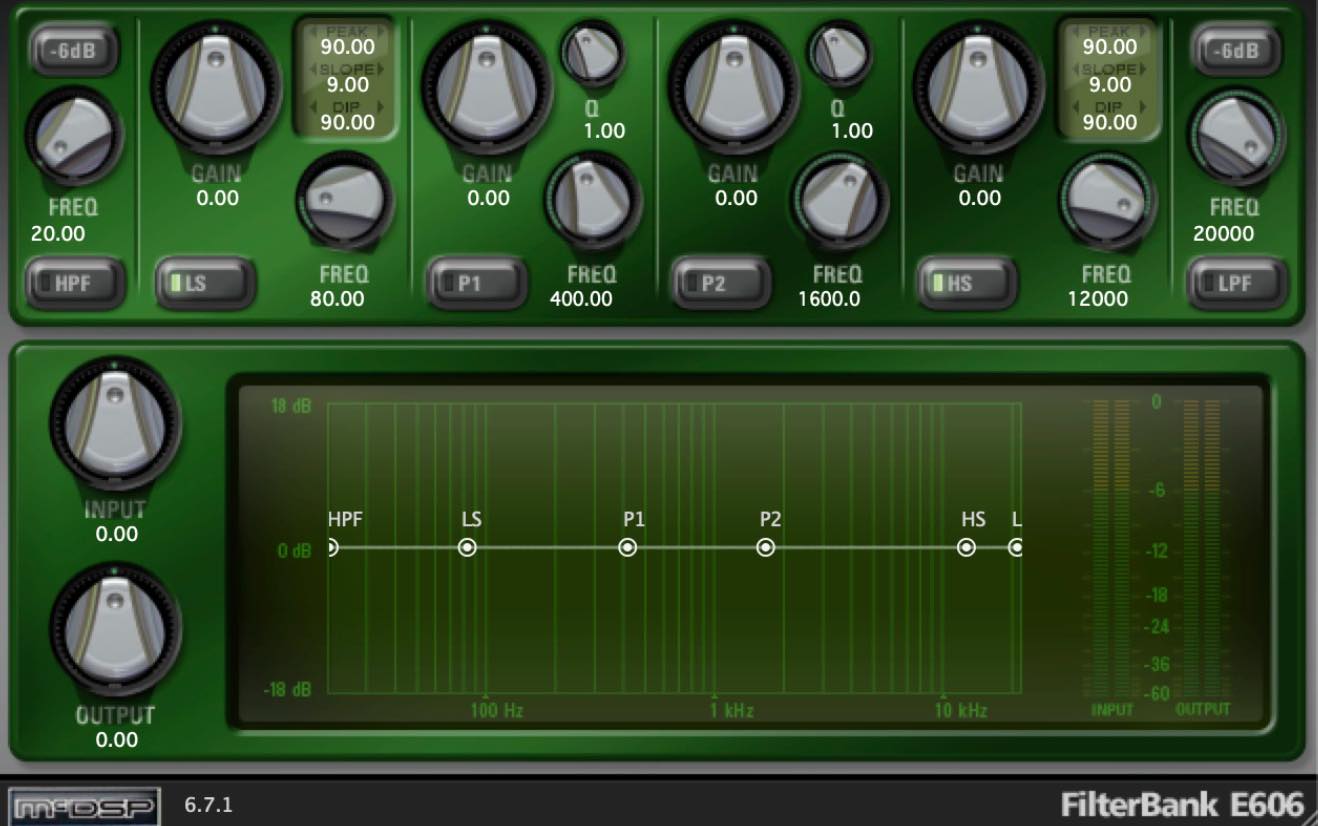
FilterBank has long been a familiar choice in professional studios, with a well-established reputation for reliability.
Its 64-bit floating-point internal processing provides ample precision for EQ adjustments while retaining the detail of a recording.
The version examined also uses analog saturation modeling when driven internally. Rather than producing abrupt digital clipping within the modeled stage, it can respond in an analog-like way even at extreme settings. This does not remove the need to manage output levels and avoid clipping elsewhere in your signal chain.
Feature 1: Responsive Controls
Moving the EQ points feels exceptionally responsive, with very smooth adjustments. That distinctive feel is easy to get used to and can be a real advantage when searching for the right frequency.
Feature 2: Analog Saturation
The reviewer hears a warm character. Raising the input to drive the plug-in harder produces a pleasing distortion, which can also be interesting as a creative effect.
Feature 3: Flexible Shelving Curves
Another distinctive feature of FilterBank is how freely you can shape its high- and low-shelving curves.
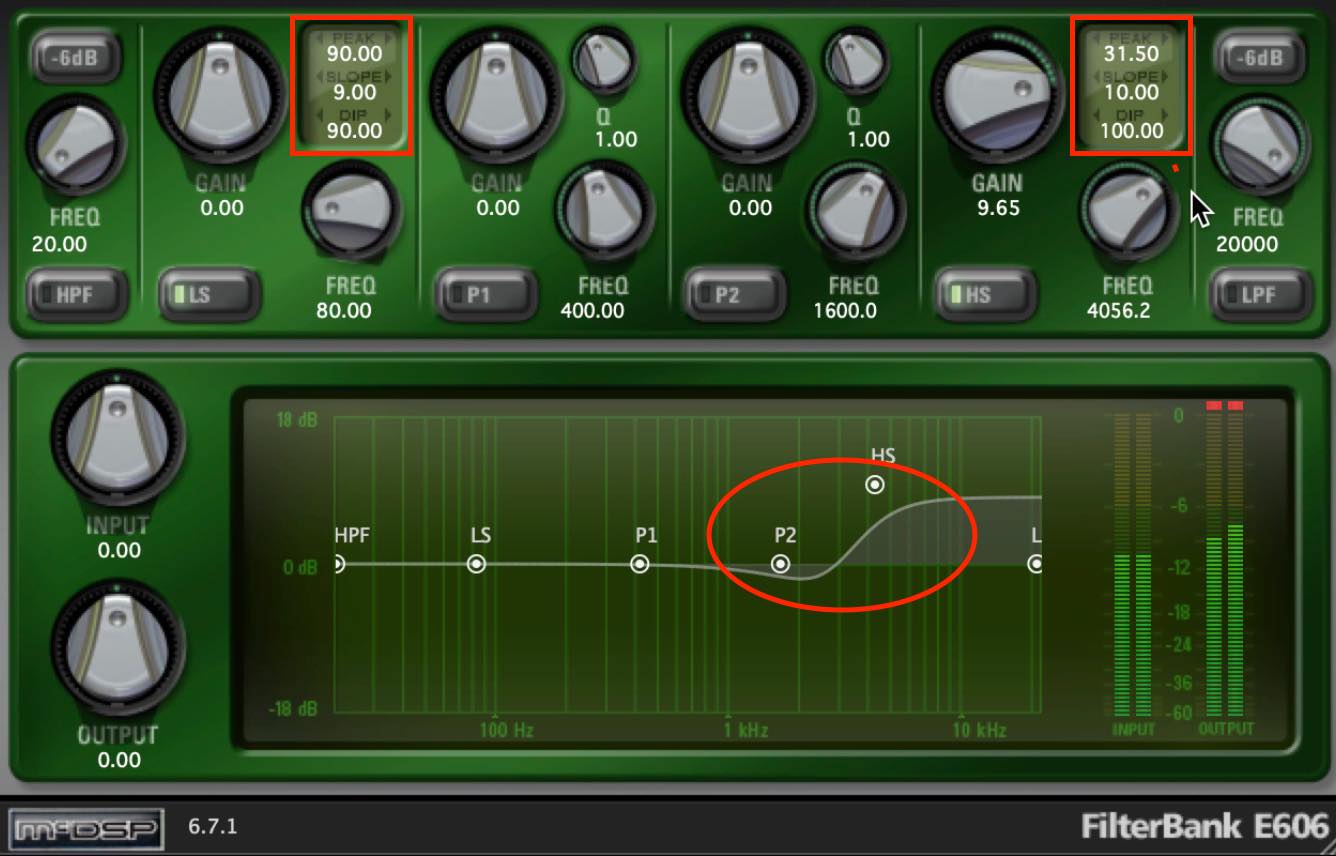
Each shelving section has three controls: from top to bottom, PEAK, SLOPE and DIP.
These let you design the shelf’s shape. Many EQs fix these characteristics as part of their individual sound; FilterBank lets you create a range of different responses yourself.
- PEAK: Higher values emphasize the overshoot around the shelf transition, giving the reviewer a brighter, punchier impression. Lower values produce a smoother curve and a milder, more natural result.
- SLOPE: This sets the steepness of the shelving transition. Lower values give a broader, gentler response; higher values focus the transition more tightly around the chosen frequency.
- DIP: This controls the undershoot beside the shelving transition. Increasing it makes the dip more pronounced and can make the overall EQ effect more distinctive.
Despite these strengths, some users may want more bands or greater flexibility from the high- and low-pass filters.
You can address that by chaining the included P606 and F202 plug-ins.
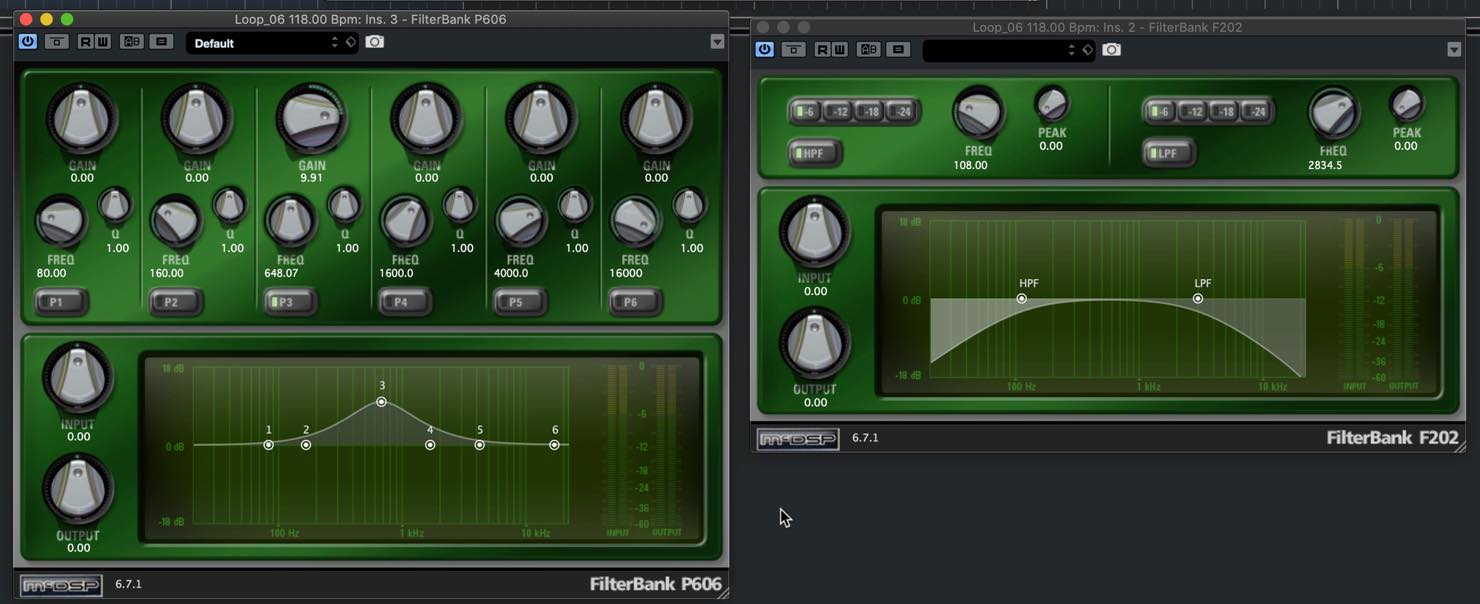
P606 provides six peaking bands and can use narrower Q settings than the E606 we have looked at so far.
F202 provides high- and low-pass filters, each with four slope options. Its resonant response can create a peak near the cutoff frequency.
Whether combining these separate plug-ins feels useful or cumbersome is a matter of preference.
Sonnox Oxford EQ
Next is Sonnox Oxford EQ.
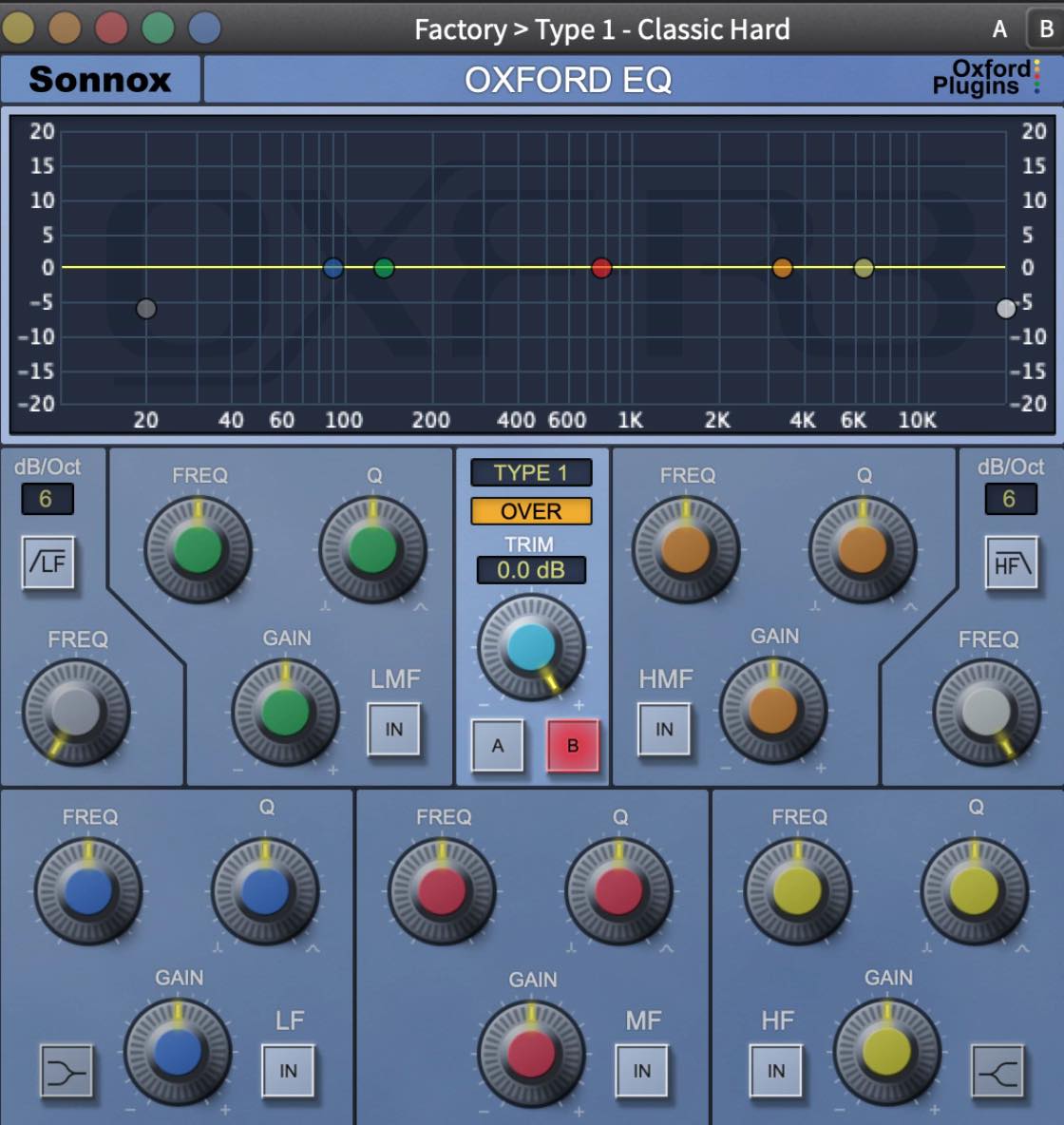
This five-band EQ is based on the EQ section of the renowned Sony OXF-R3 professional console. It has a reputation for precise cuts and a clean sound.
The HF and LF bands can switch between shelving and peaking. In shelving mode, Q can introduce an overshoot or dip around the transition.
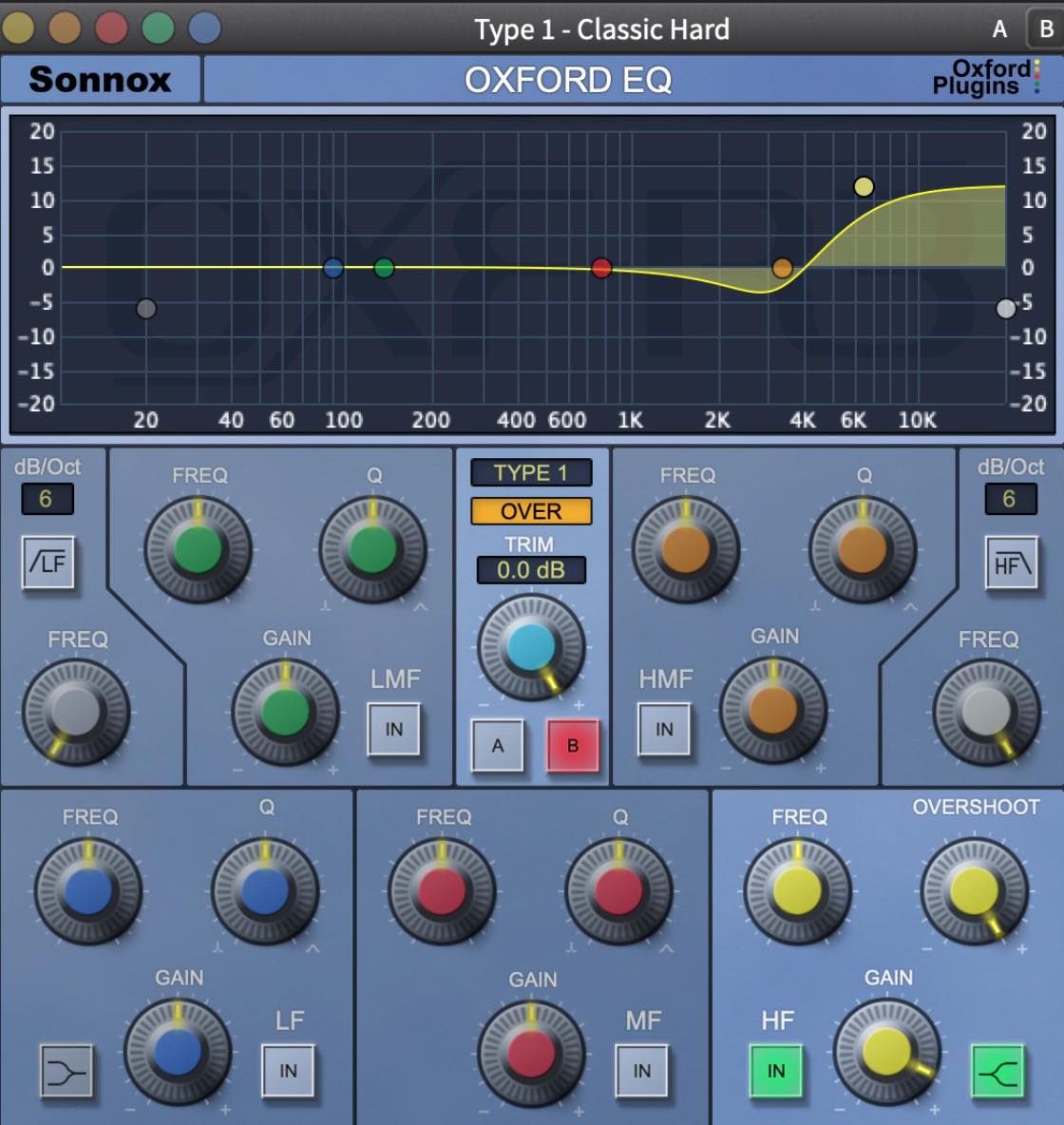
Feature 1: A Sharp, Clean Sound
With a substantial boost, the reviewer hears a sharper, more clearly defined sound than FilterBank’s warmer character.
The dip is also pronounced, giving the adjustment a distinctly separated feel.
Feature 2: Precise Cuts
Another highlight is how precisely the peaking bands can cut when you narrow the Q.
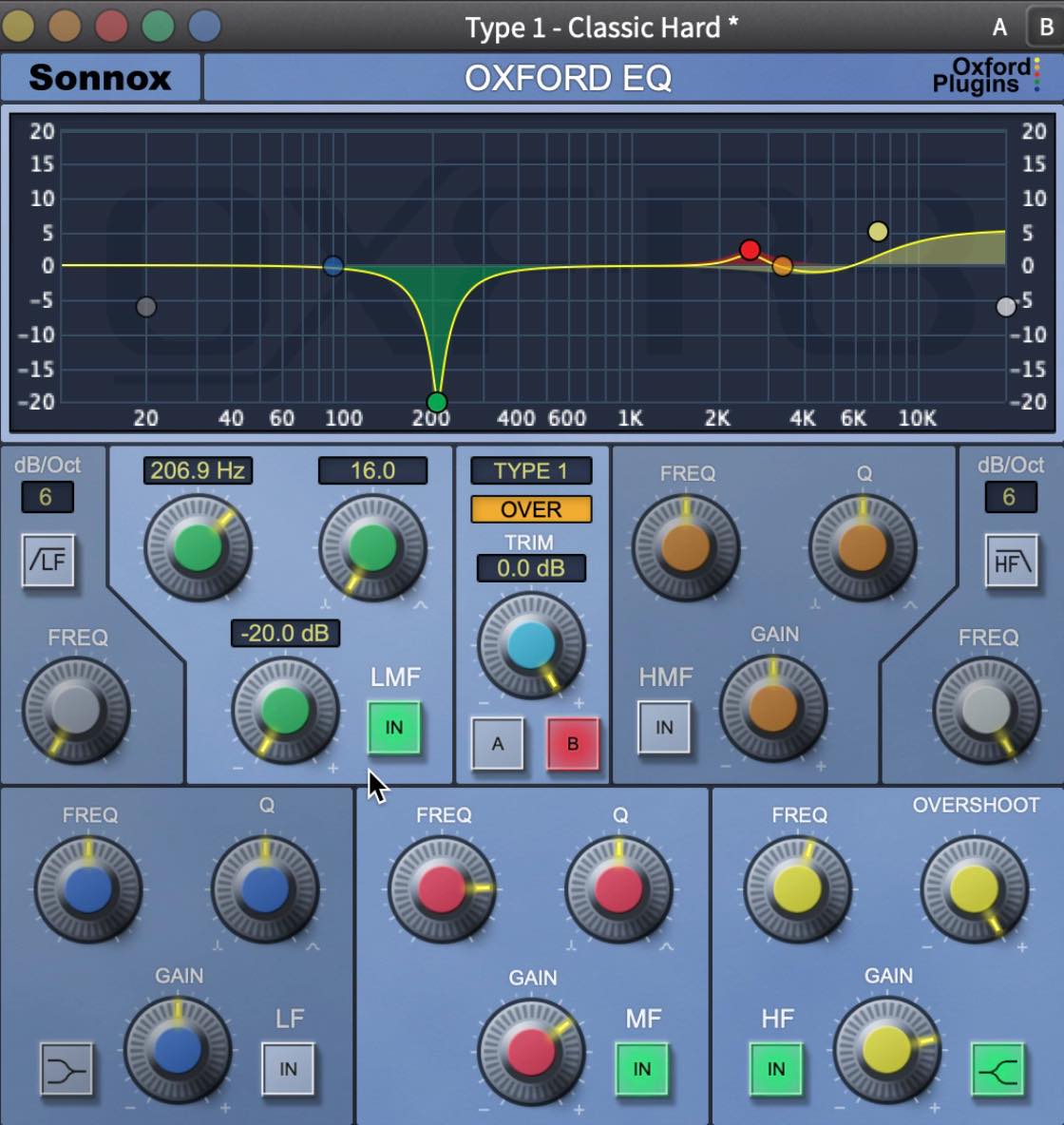
It feels as though the cut targets just the intended area, with relatively little effect on surrounding frequencies.
The reviewer finds this degree of separation difficult to achieve with some other EQs. It could be useful for removing unwanted vocal resonances or muddiness.
Feature 3: A Choice of Curve Types
For high- and low-cut filtering, Oxford EQ offers a wider choice of slopes than the FilterBank configuration shown here: settings range from 6 dB/octave to 36 dB/octave.
The central TYPE selector also changes the response of the peaking bands.
- TYPE 1: Minimal interaction between gain and Q, for a relatively consistent, precise response.
- TYPE 2: The boost response follows Type 1, while cuts use a constant-Q response that can make low-gain cuts more focused.
- TYPE 3: A gentler, gain-dependent response, with broader curves at smaller boosts or cuts.
- TYPE 4: An even stronger gain/Q relationship, producing especially gentle curves for subtle adjustments.
Practical features such as A/B comparison and undo/redo are also welcome.
In this comparison, FilterBank comes out ahead for the feel of its controls, while Oxford EQ has the advantage in focused frequency selection and the reviewer’s impression of clarity.
Waves H-EQ
Our final plug-in is Waves H-EQ.
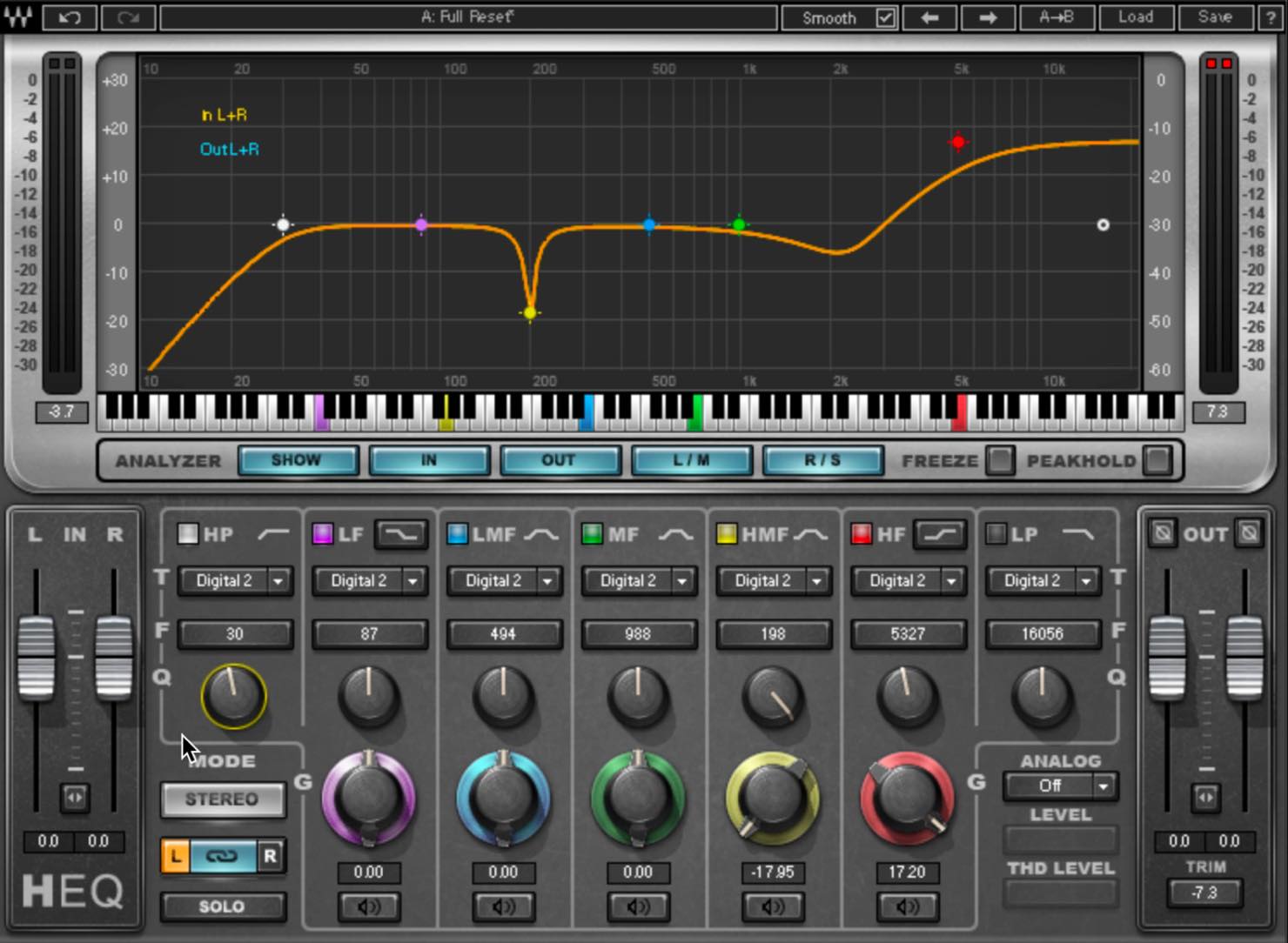
The H in Waves’ H series stands for Hybrid, combining analog-inspired and digital approaches. H-EQ fits that description well.
The controls feel responsive, although not quite as immediate as FilterBank’s. The reviewer finds its sound less clear than Oxford EQ’s but entirely capable for general EQ work. Its focused cuts also compare favorably with Oxford EQ.
With the Digital 2 type discussed below, Q can change the dip around the high- and low-shelving transitions. Q also shapes the resonance around the high- and low-cut filters; it should not be confused with a separate filter-slope selector.
Feature 1: Analog-Inspired Curve Types
The T parameter on each band selects its EQ type.
The Modern and Vintage options use analog-inspired responses, while the Digital options provide digital filter designs.
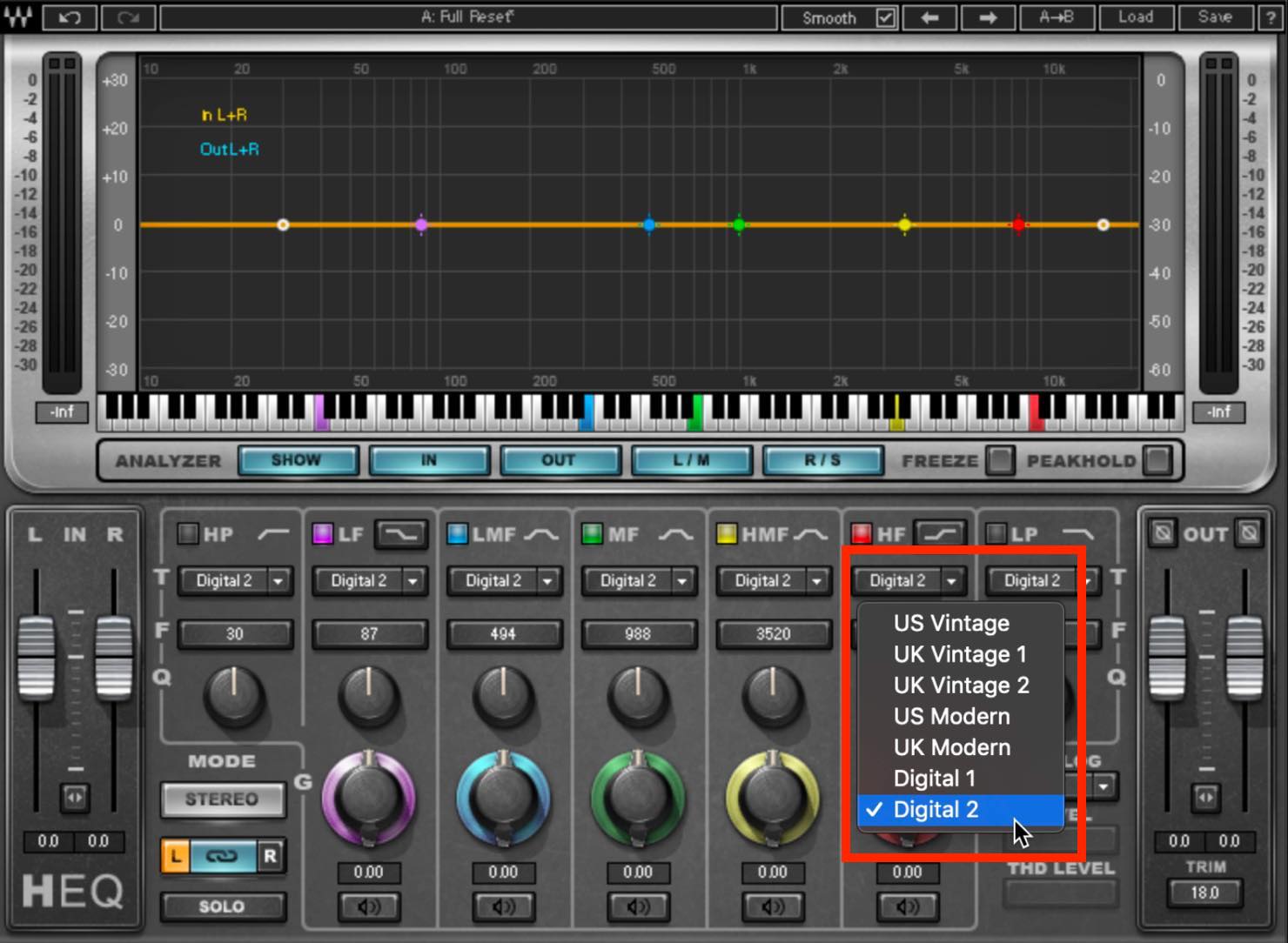
The original article associates US Vintage with Pultec, UK Vintage 1 with Neve 1073, UK Vintage 2 with Neve 1081, US Modern with API, and UK Modern with SSL. These are the article’s reference points; Waves describes the curves more generally as British- and American-inspired types rather than confirming those exact models in its manual. If you know the responses you like, try the corresponding analog-style options. Q availability and behavior vary by band and type, so experiment with each one.
If you want a flexible general-purpose EQ without choosing an analog-style response, the article suggests Digital 2. It offers Q control across the bands and allows narrow, focused adjustments.
Feature 2: A Spectrum Analyzer
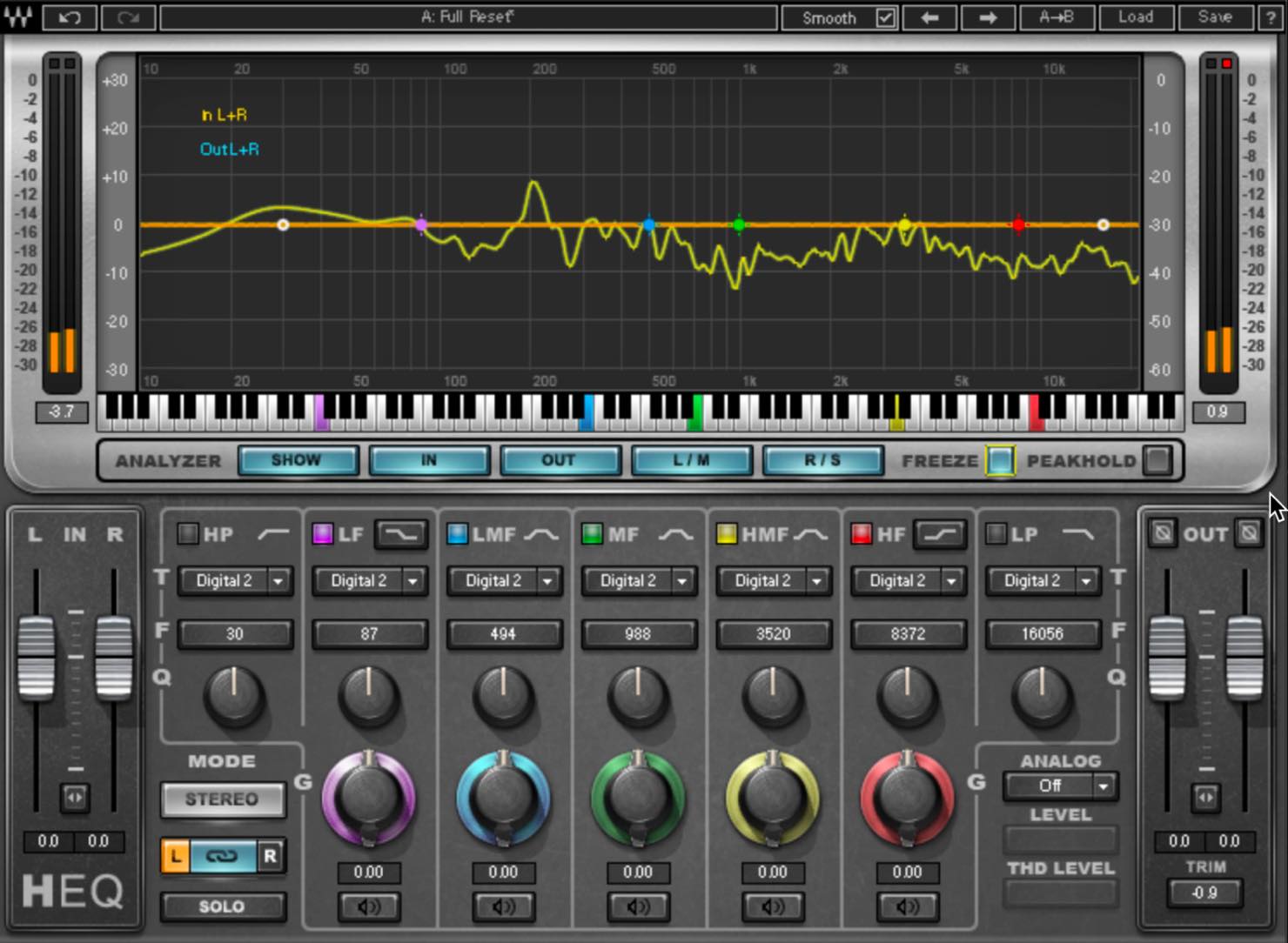
As shown, H-EQ includes a spectrum analyzer. It is a useful visual reference, especially when your monitoring setup makes certain frequency ranges difficult to judge. The full component shown here includes the analyzer; H-EQ Lite does not.
Feature 3: Band Solo
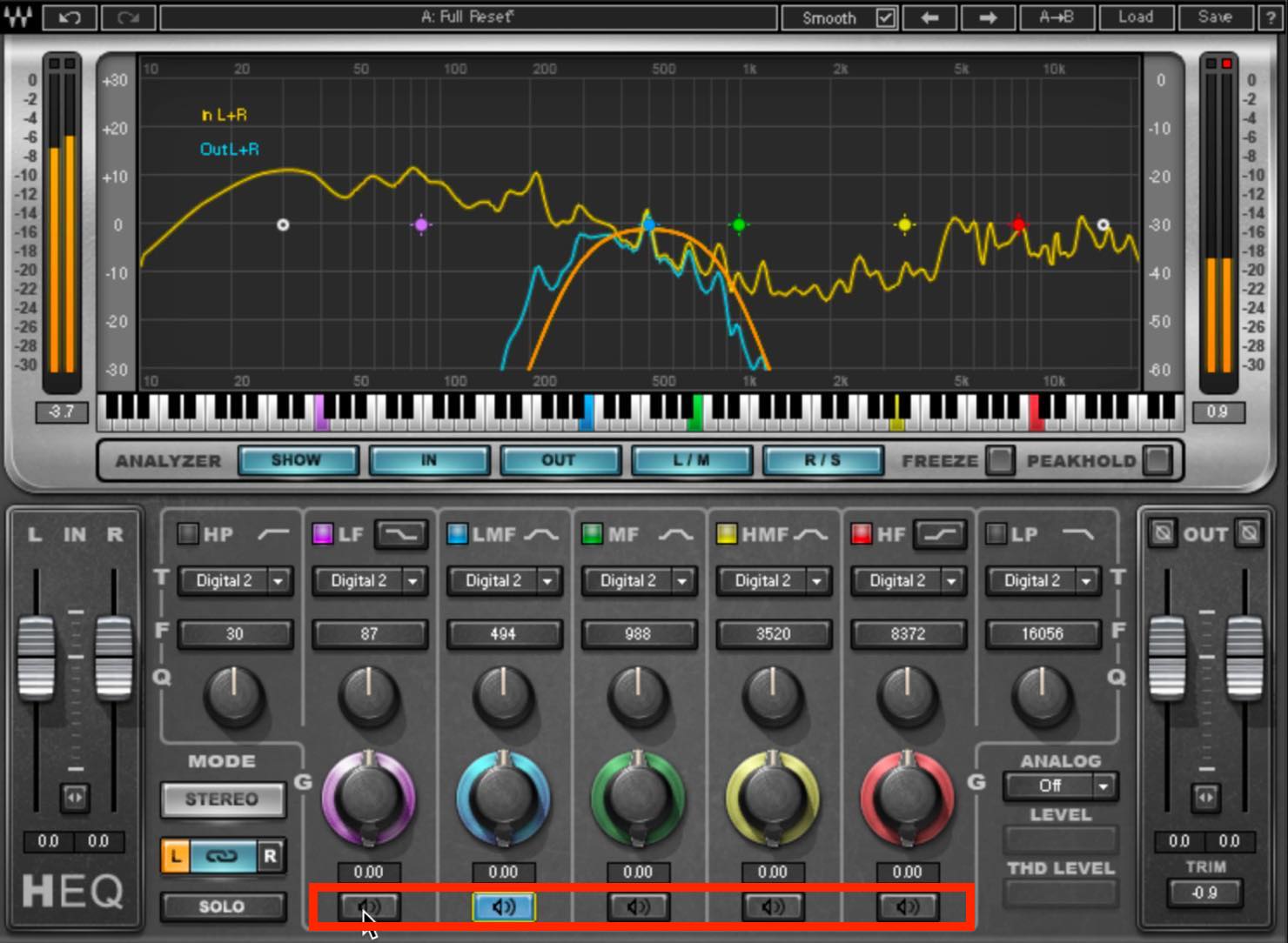
You can audition individual bands to hear the material in each frequency range. Combining that listening check with the analyzer is also a useful way to learn.
Feature 4: Mid/Side Processing
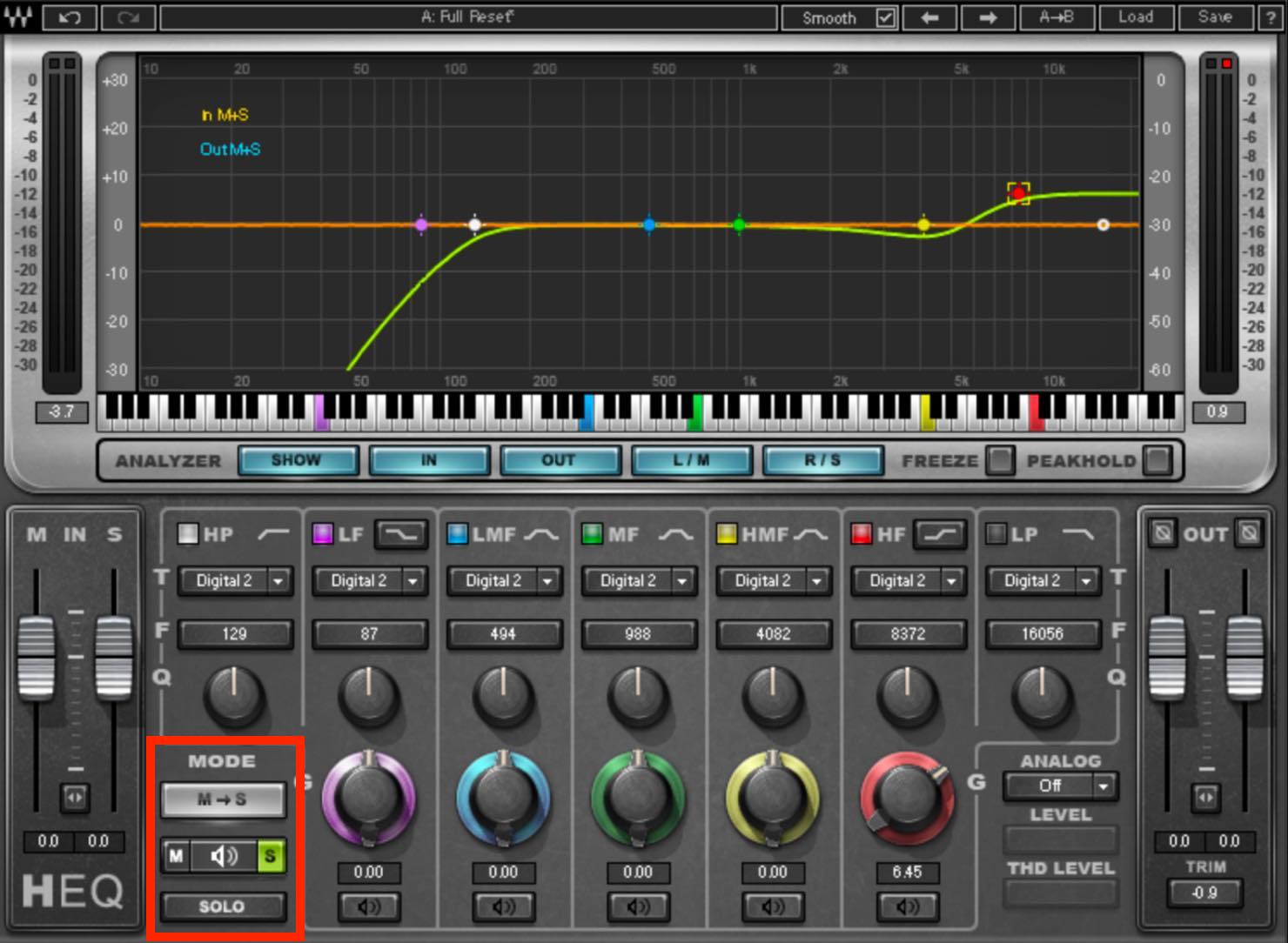
Also look at the mode section at the lower left. With stereo material, unlinking the channels lets you EQ the left and right separately, much like the function familiar from Waves’ Q series.
Clicking the mode switch labeled STEREO lets you select M/S mode. You can then apply separate EQ to the Mid component, associated with the stereo center, and the Side component, which carries the difference between left and right.
For example, reducing low frequencies in the Side signal can tighten the stereo low end around a centered kick. Boosting only the Side high shelf can emphasize the width of hi-hats or other off-center high-frequency material. These frequency-specific M/S adjustments can also be useful in mastering; the effect depends on what is present in the stereo recording.
Compared with the versions of FilterBank and Oxford EQ demonstrated here, H-EQ brings together several more modern workflow features. The reviewer also considers it approachable for beginners.
That completes our comparison of the three EQs, including their features, strengths and limitations.
Even general-purpose EQs can have surprisingly different controls, response curves and perceived sound.
Try to find an EQ that fits your own needs. As your skills develop, you may also find it useful to choose between two or three EQs for different tasks.
▶ Buy the products (the following include affiliate / promotional links)
• McDSP FilterBank: https://bit.ly/3gdAu5E
• Sonnox Oxford EQ: https://bit.ly/34fSQ3q
• Waves H-EQ: https://bit.ly/3gfMsLO
Frequently Asked Questions
Q1. Is an expensive EQ plug-in worthwhile for a beginner?
You can learn the fundamentals with your DAW’s stock EQ. A specialist EQ may later improve your workflow or offer curves and coloration that suit a particular task, as illustrated by these three products. It is worth trying them as your needs grow, rather than assuming that buying one will automatically improve a mix.
Q2. What is the main difference between McDSP FilterBank and Sonnox Oxford EQ?
In this review, FilterBank stands out for its warm, analog-like character and responsive controls, while Oxford EQ is praised for its clean sound and focused frequency selection. Your preference will depend on the response and working style you find most useful.
Q3. What does “hybrid” mean in Waves H-EQ?
It combines analog-inspired characteristics with digital processing. H-EQ lets you choose analog-style curves alongside digital filter types, bringing character and precise adjustment into one EQ.
Improve Your Mixing: Comparing EQs from Three Leading Manufacturers
In this EQ special, we introduce three general-purpose plug-ins and compare their functions and characteristics.• McDSP FilterBank
• Sonnox Oxford EQ
• Waves H-EQRead more: https://t.co/cSGzp7Yqri pic.twitter.com/WITJeUAqsl
— SLEEP FREAKS (@SLEEPFREAKS_DTM) August 22, 2020
NEW ARTICLES
Latest English Articles