“Heavenly Flight” from Dragon Quest III uses a Picardy third: although the piece is in a minor key, its final chord is major. This article examines the use of harmonic and natural minor, the change in dominant harmony, and the 13th on a dominant chord that may foreshadow the ending. Understanding these choices can provide ideas to explore in your own compositions.
Concluding the analysis of “Heavenly Flight”

This is the eighth and final installment of our practical music theory analysis of “Heavenly Flight” from Dragon Quest III: And into the Legend....
We will examine the Picardy cadence, also known as a Picardy third, in which a piece in a minor key ends on a major triad.
The music analyzed

Tutorial video
1. Song structure
2. Key and tonality
3. Chord progression
4. Looking at the bass line
5. Substitute dominants
6. Bass-line cliché
7. Pedal point
8. Picardy cadence (this article)
A Picardy cadence preceded by a minor dominant

The four-bar sections follow A → B → A → B′. The final cadence in the second B section (B′) differs from the earlier one.


At first this may look like a ii–V, but because A is the final chord of the piece, the analysis here is “Vm → I”.
In either interpretation, the bass descends by a fifth, producing a clear, strong progression.
A conventional cadence might use the dominant from the harmonic minor scale, “V7 → Im”, or E7 → Am, as in example 1. Here, as in example 2, the minor-key piece ends on a major chord.
This can also be viewed as borrowing the tonic chord from the parallel major. The resulting cadence, common in Baroque music, is called a “Picardy cadence”.
Further, as shown in example 3, the harmonic-minor dominant V7 is replaced by a dominant built from the natural minor scale, “Vm7”.
This avoids the insistent resolution of the dominant’s leading tone G♯ to the tonic A, producing a softer, more open and gentle sense of closure.
That may be one of the elements contributing to the sense of a vast sky.
How the dominant 13th may foreshadow the ending


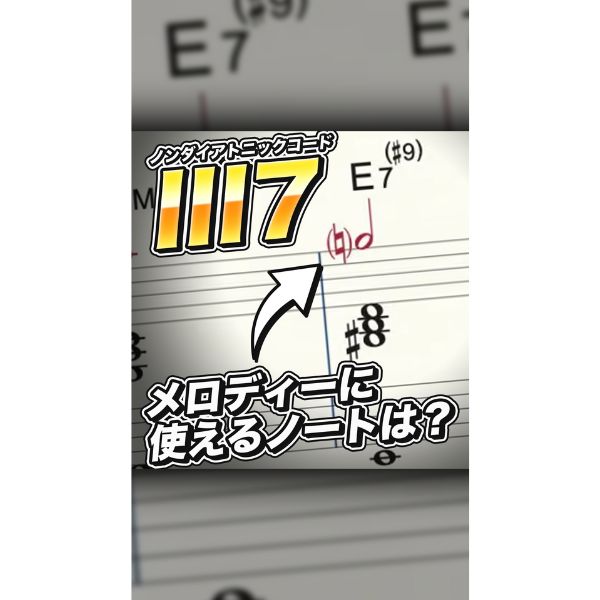
In the previous installment we discussed the dominant E7(9,13) at the end of the first latter section. Its C♯ is the 13th, an extension outside the A natural minor diatonic scale and therefore somewhat distinctive.
It is also the characteristic note C♯ that changes the final minor tonic to major in the Picardy cadence. Could it hint at the destination of the piece, or is that reading too much into it?
We have now explored “Heavenly Flight.” Only the composer knows whether these devices and their implications were consciously intended during composition.
Analysis means identifying techniques in the finished music, organizing and classifying them, and giving them names.
Having names for these ideas makes it possible to apply them in our own work later.
Frequently Asked Questions
Q1. What is a Picardy cadence?
A Picardy cadence ends a piece in a minor key on a major tonic chord. This classical technique was used frequently in Baroque music and can give a minor-key piece an open, gentle ending.
Q2. What is the difference between harmonic and natural minor?
Harmonic minor raises the seventh scale degree by a semitone, creating a leading tone and a stronger dominant pull toward the tonic. Natural minor retains the unraised seventh, which can produce a softer cadence.
Q3. Why study music analysis?
Identifying and classifying techniques in completed music helps you understand their theoretical context and gives you practical ideas to apply in your own compositions.
NEW ARTICLES
Latest English Articles