In music production, choosing a common tuning reference is essential to keeping instruments in tune with one another. A at 440 Hz is the international standard, but even a difference of a few hertz can cause beating or dissonance when instruments play together. From adjusting a software synthesizer’s master tuning to checking tuning during audio recording, each stage deserves attention. This article covers the basics and practical settings to keep in mind when producing music.
Choose a Pitch Reference and Use It Consistently
In music production, you may have heard terms such as “instrument tuning” or “440 Hz”.
Even if you do not play an instrument, you have probably heard them before.
What do they mean?
And how do they affect a song?
Let’s review the basics of tuning and what to watch for when producing music.
Video: Basic Tuning for Music Production
- 1MIDI Basics
- 2MIDI Parameters and Values
- 3Software Synthesizer and Plug-in Formats: DAW Compatibility
- 4Choosing an Audio Interface
- 5Samplers, Part 1: Sampling Sounds to Make Rhythm Instruments
- 6Samplers, Part 2: Making Pitched Instruments from Samples
- 7Reading Piano Rolls and Rhythm, Part 1
- 8Reading Piano Rolls and Rhythm, Part 2
- 9Reading Piano Rolls and Rhythm, Part 3
- 10Basic Tuning for a Song
- 11Understanding Tuplets
Tuning an Instrument Means Matching Its Pitch
Simply put, tuning means matching pitch.
- String instruments such as guitars and basses
- Wind instruments such as trumpets and flutes
- Keyboard instruments such as pianos and keyboards
Most instruments, including these, are designed so their pitch can be adjusted,
making it possible to create pleasing harmonies between instruments.
What Does 440 Hz Mean?
You will often see 440 Hz used as a reference when tuning.
First, hertz (Hz) represents the number of vibrations per second.
At 440 Hz, the air vibrates 440 times per second; regular vibrations are heard as a steady pitch.
The higher the frequency, the higher the pitch.
The pitch associated with 440 Hz is A.
In many DAWs this is labeled A3, while other DAWs and equipment label the same pitch A4.
Using it as the reference, middle C below it is approximately 261.63 Hz in equal temperament, and the A an octave above is 880 Hz.
These frequencies follow from the chosen reference.
However, some bands or sessions use A = 441 Hz,
while others use 438 Hz.
The reference can also vary with the humidity and temperature at the performance venue.
The essential requirement is that all instruments use the same tuning reference.
A difference of a few hertz is usually subtle and can be hard to identify without comparing sounds.
Listen to the audio examples below.
- 440
- 438
- 442
Each sounds only slightly different on its own, but when played together:
- All three at once
The sound takes on an effect-like quality, with noticeable beating.
In chords, the differences can make the harmony sound dissonant and have other effects.
This is why a consistent tuning reference matters within a song.
Tuning Considerations in Music Production
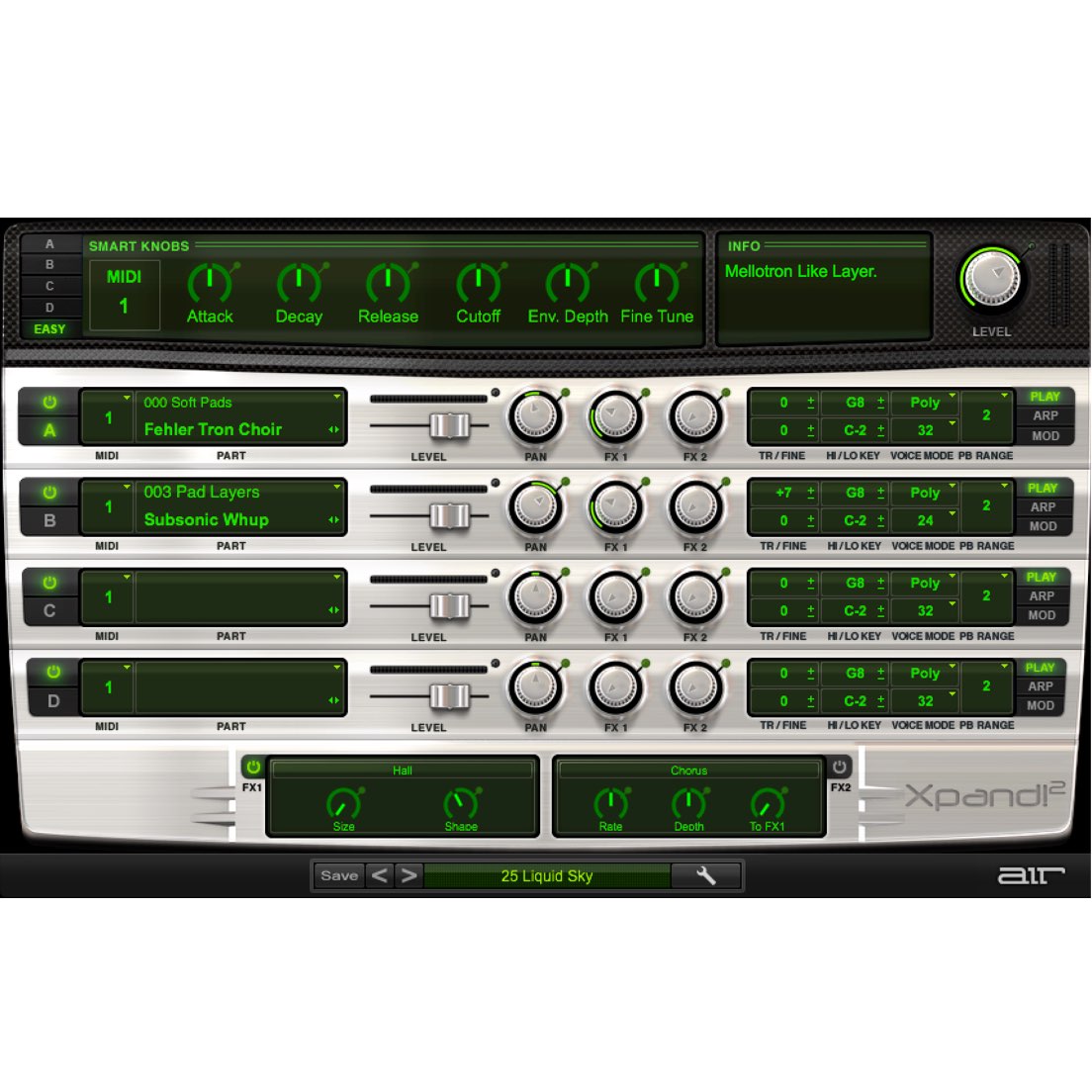
When working entirely with programmed parts in a software synthesizer,
you can change its tuning at any time.
Look for the master tune control in your synthesizer and be aware of its setting.
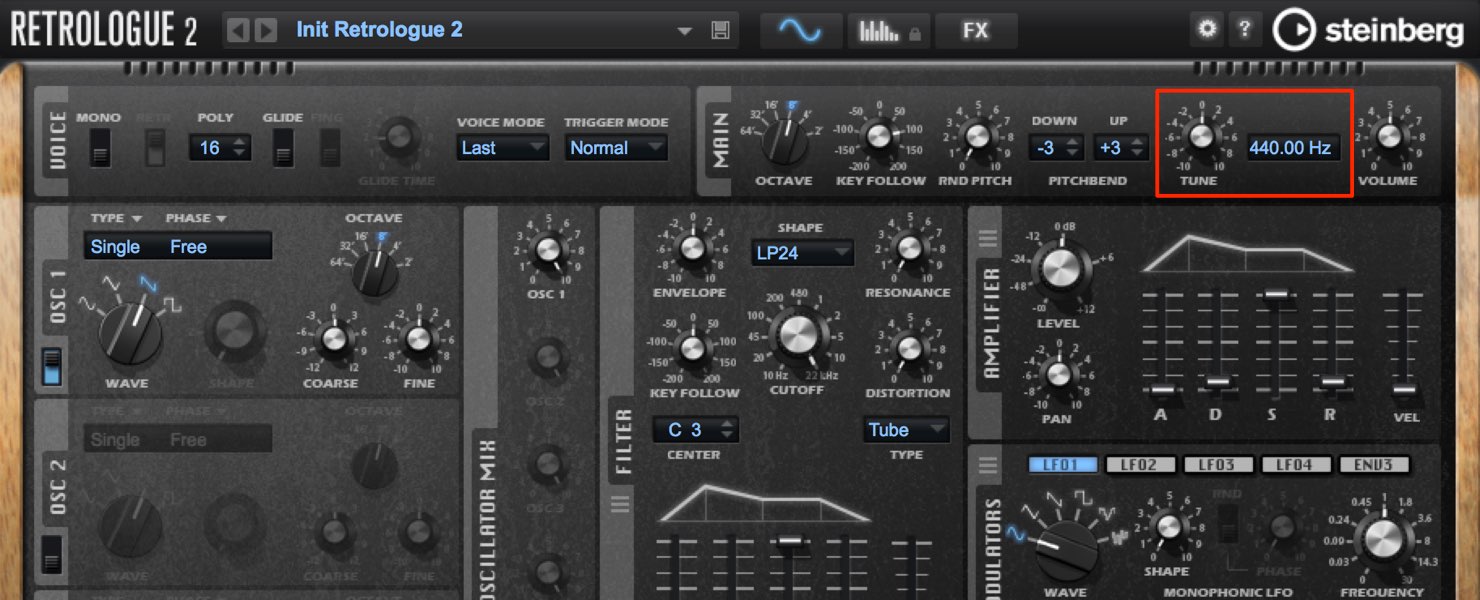
In this product, the relevant control is shown above.
Some products can be confusing because they use cents (one hundredth of a semitone), as shown below.
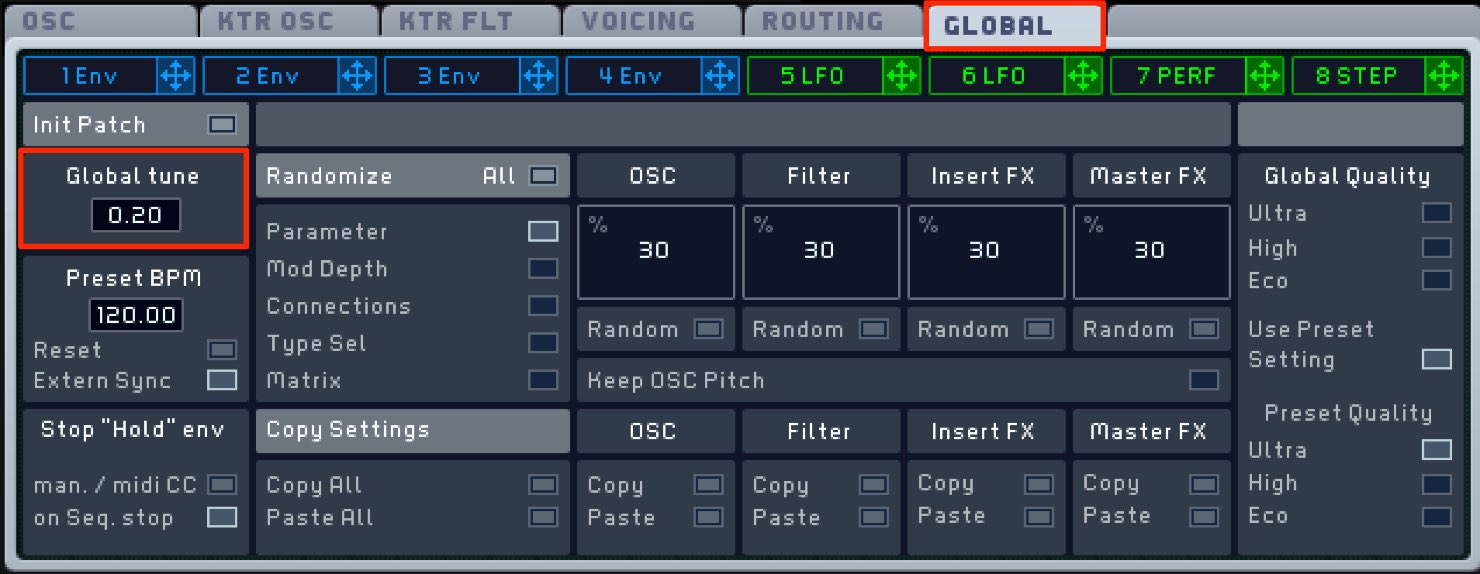
For example, use approximately +4 cents for 441 Hz or −8 cents for 438 Hz relative to 440 Hz.
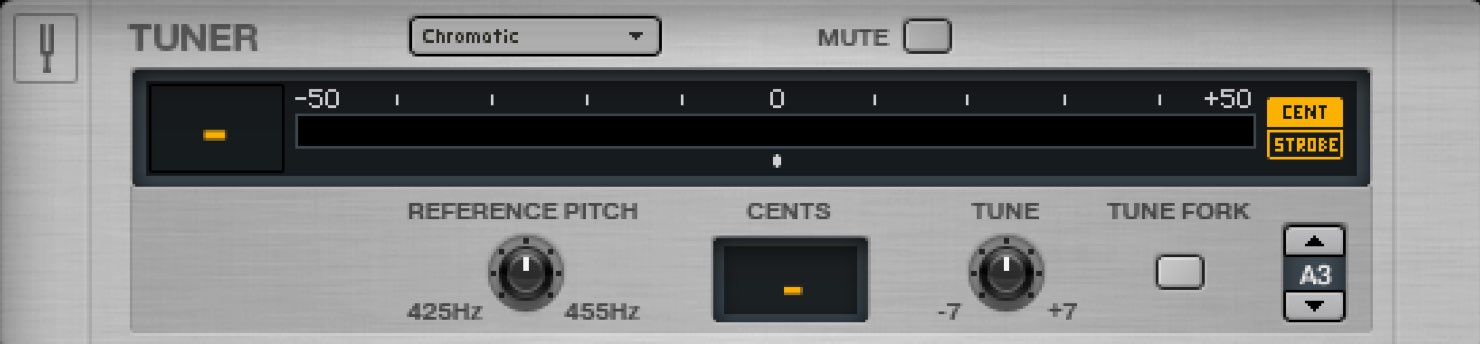
Because a one-hertz change does not correspond to a fixed number of cents at every frequency, using a plug-in tuner is another option.
(Example: the tuner built into Guitar Rig.)
For reference, there is also a table here:
“Cents-to-Hertz Conversion Table”
http://b3a4s4s.web.fc2.com/03bassists/centhertz_table.htm
You need to be especially careful when a song includes audio recordings.
If you record an acoustic guitar tuned to 442 Hz over a song made at 440 Hz,
the harmonies and unisons may not sound clean. Fixing this later takes work and can also degrade the sound.
Whether you play the part yourself or ask someone else to play it, pay attention to the tuning reference
and make sure the performer knows it clearly in advance.
Frequently Asked Questions
Q1. What happens if instruments in a production use different tuning references?
Even a small frequency difference can cause beating when instruments play together, making harmonies sound muddy or dissonant. This can be especially noticeable in chords.
Q2. Can a song use 441 Hz or 438 Hz instead of 440 Hz?
Yes. Bands and sessions may choose another reference, including in response to the performance environment. The important thing is for all instruments in the song to use the same reference.
Q3. What should I check when recording audio?
If a performance is recorded at a pitch reference different from the DAW arrangement, correcting it later can be difficult and may degrade the sound. Tell the performer the tuning reference clearly before recording.
NEW ARTICLES
Latest English Articles