Waves H-Reverb’s expanded controls offer detailed ways to shape a reverb. This article covers EQ and Damping, Density, Input and Output Echoes, Dynamics and Global settings, including de-essing, ducking and vintage-style coloration. Presets can also serve as starting points for creative sound design.
Parameters for Creative Sound Design
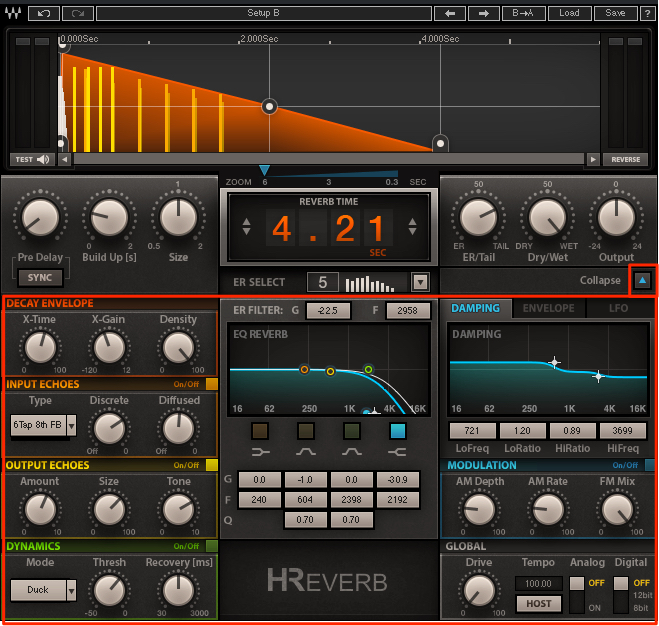
In the second part of our H-Reverb tutorial, we look at the expanded controls revealed by the Expand button.
These allow finer settings and more creative sound design than those covered previously.
H-Reverb Tutorial Video
Buy the product: https://bit.ly/2y2ssvI
Shaping the Sound with EQ and Damping
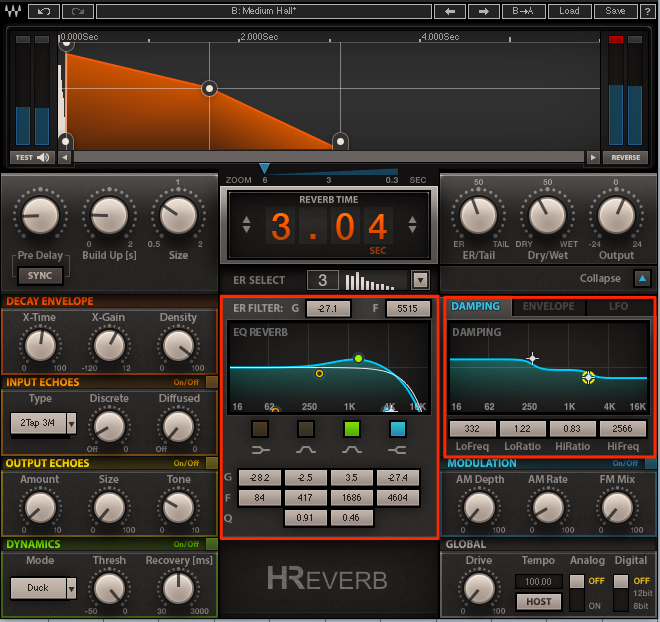
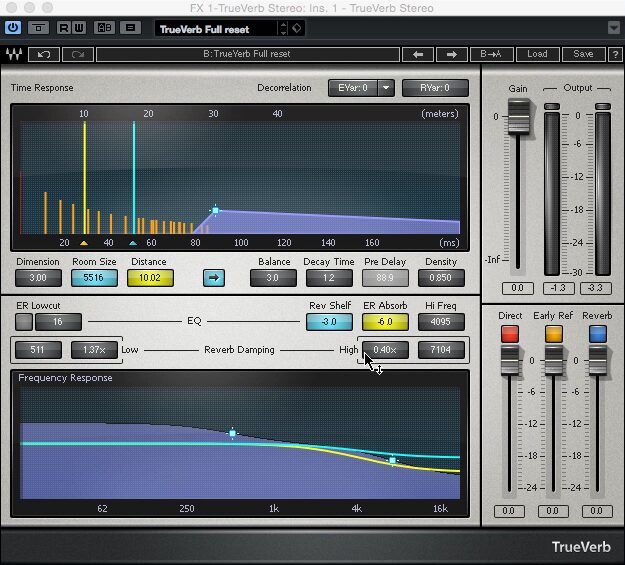
As with earlier Waves reverb plug-ins, you can shape the sound with EQ and Damping.
The clear display allows more detailed adjustments.
- Early reflections (ER) have a one-band high-frequency EQ; the tail has its own four-band EQ.
- The two bell bands, LoBell and HiBell, also offer Q adjustment.
- Damping lets you set the frequency range and ratio separately for low and high frequencies to adjust the reverb time.
Adjusting Reverb Density

Density adjusts the density of the reverb tail.
At 100%, the reverb is dense and smooth; lower values produce a more echo-like sound.
Input Echoes: Adjustment and Special Effects
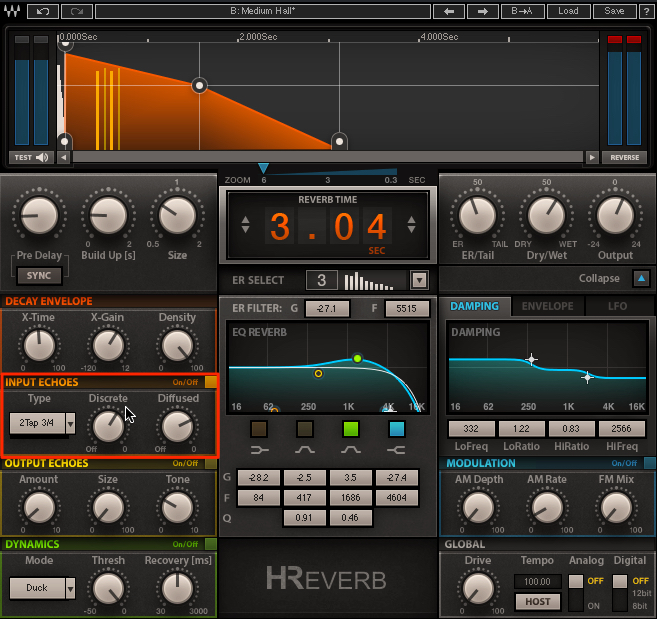
Enabling Input Echoes generates tempo-synced echoes from the incoming signal.
You can mix the dry echoes and the reverb-tail echoes independently.
A moderate blend can thicken the reverb, while extreme settings can create special effects.
- Type: Sets the timing of the tempo-synced echoes.
- Discrete: Sets the level of echoes of the unprocessed input signal.
- Diffused: Sets the level of echoes generated from the reverb tail.
Output Echoes: Shaping the Space

Output Echoes generates echoes from the dry signal and the wet early reflections and tail.
Its parameters let you control the width and character of the sound field.
- Amount: Sets the echo level.
- Size: Adjusts the spacing between echoes.
- Tone: Adjusts the frequency character, or brightness, of the echoes.
Dynamics: Compression, De-Essing and Ducking
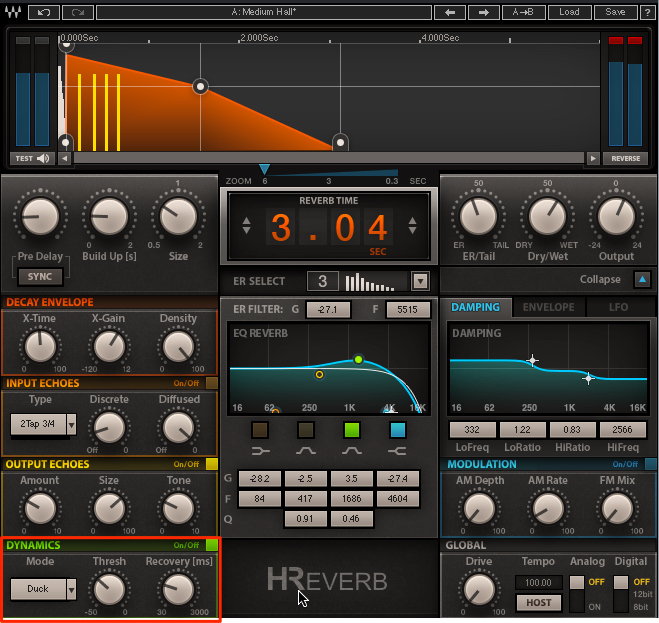
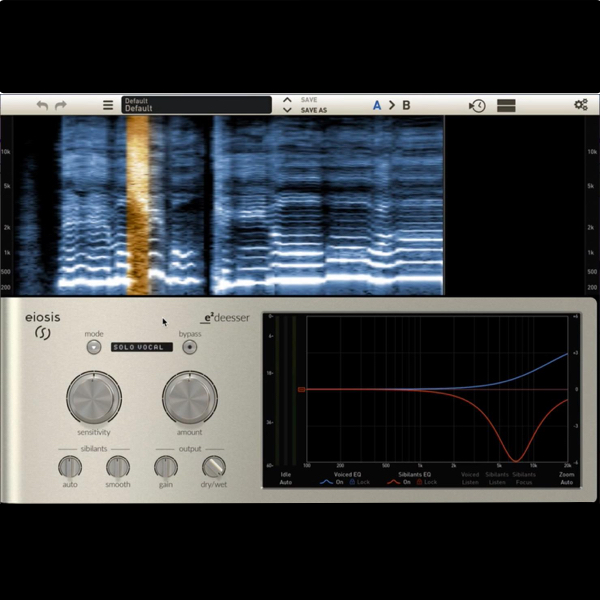
The Dynamics section can compress the reverb
and also act as a de-esser or ducker.
DeEss reduces only the high frequencies of the reverb,
while Duck uses the dry signal as a sidechain to compress the reverb.
- Mode: Choose Comp, DeEss or Duck.
- Thresh: Sets the level threshold at which the effect acts.
- Recovery: The source description for Comp and Duck modes is incomplete.
- Range: In DeEss mode, sets the lower limit of gain reduction.
Global: Vintage-Style Reverb Character

The Global section’s Drive knob and Analog/Digital switch
can create a texture reminiscent of processing through vintage hardware.
Explore the Hardware series of presets for examples of the parameter settings.
More Effects and Presets
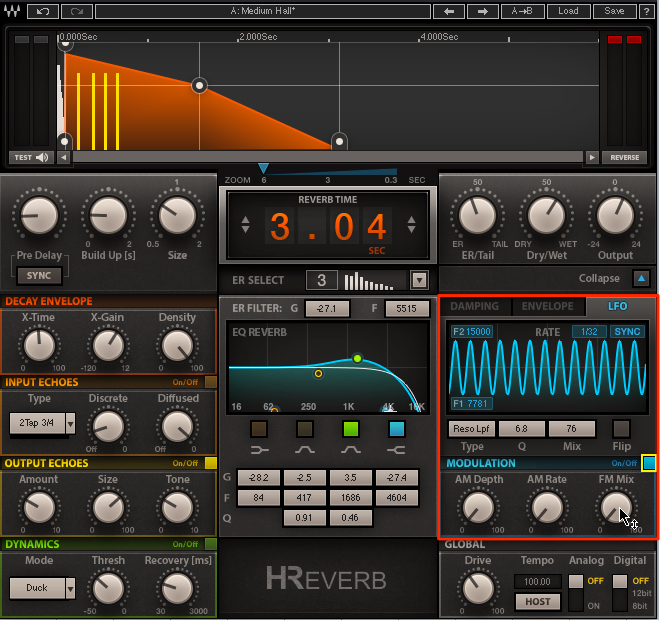
There are also resonant filters using envelopes and LFOs,
modulation capable of flanger-like effects,
and many other effects. H-Reverb is a creative processor
with possibilities beyond a basic reverb.
A wide selection of presets is also included, so beginners can use their settings
as a reference.
The video introduces several examples.
Frequently Asked Questions
Q1. What does the Density parameter do?
Density adjusts the density of the reverb tail. At 100% it is dense and smooth; lower settings make it sound more like echoes.
Q2. What is the difference between Input Echoes and Output Echoes?
Input Echoes generates tempo-synced echoes from the input, with independent levels for the dry and reverb-tail echoes. Output Echoes generates echoes from the dry signal and wet early reflections and tail, allowing you to shape the sound field.
Q3. What else can the Dynamics section do?
Alongside compression, it can act as a de-esser or ducker. DeEss reduces high frequencies in the reverb; Duck uses the dry signal as a sidechain to apply dynamic processing to the reverb.
Q4. Where should beginners start?
The presets, including the Hardware series, are useful starting points. Study their settings to learn what the parameters do.
Q5. Can H-Reverb create a vintage-style reverb sound?
Yes. The Global section’s Drive knob and Analog/Digital switch can create a vintage-hardware-like texture. The Hardware presets provide examples to explore.
NEW ARTICLES
Latest English Articles