The oscillator (OSC), the foundation of synthesizer sound design, determines the character of a sound by letting you choose from four waveforms. The sine wave is a soft sound with no harmonics, the triangle wave has only odd harmonics and a round feel, the sawtooth wave contains all harmonics and is the most frequently used, flashy sound, and the square wave has a nostalgic, retro video game sound. Understanding the sound and character of these four waveforms precisely lets you create the tones you want efficiently and identify which waveforms are used in existing songs.
Oscillator _ Choosing the Waveform That Forms the Basis of a Sound
What generates the sound itself is the oscillator (OSC).
To play a synthesizer sound, you always need to choose a waveform here.
There are four main waveforms.
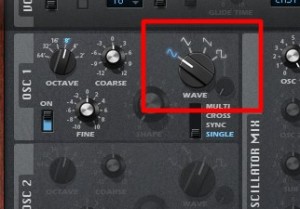
↑ As shown, the OSC section has a knob for choosing the waveform.
Once you have learned the names of the four waveforms along with their sounds,
when you hear a synth sound, you will be able to tell which waveform is being used.
These shapes are also what you see
when the sound is converted to audio: the waveform takes that shape. In other words, it is exactly what it looks like.
Now let's introduce the four waveforms.
You have probably heard every one of them at some point.
Sine Wave
It is a pure waveform that contains no
harmonics.
Its characteristic is a round sound.
It is often used for soft pads or single-note counter-melodies.

Triangle Wave
This is the triangle wave.
Its harmonics are only the odd ones: the first, third, fifth, and so on.
Because it has very few harmonics, it has a round feel like the sine wave.
It is often used for gentle bass lines and pads.

Sawtooth
This is the sawtooth wave.
It contains all harmonics,
so the sound is bright and edits have a clear effect.
It is the quintessential synthesizer sound and the most frequently used waveform.
It is used for many sounds, such as buzzy basses, leads, pads, and arpeggios.
The flashy sounds of trance are also this sawtooth wave.

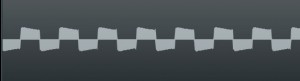
Square Wave
This is the square wave.
Its harmonics are only the odd ones: the first, third, fifth, and so on.
This is the same as the triangle above,
but because it has much more harmonic content, it sounds very different.
It is the sound made famous by the Famicom (NES).
Many of you probably find it nostalgic.
The sound has a bit of character, but it can be used for many things, such as backing, leads, and arpeggios.
Memorize the Four Characteristics
If you remember the four sounds above well,
they will be a great guide when designing sounds.
Keep at it.
In the next lesson, we will explain the oscillator's pitch.
You Can Apply It Like This
A Buzzy Bass
We create the buzzy bass everyone has heard using a sawtooth wave. The key point is strengthening its thickness with pitch tricks.
An Obbligato Using a Sine Wave
Using the soft tone of a sine wave lets you play a counter-melody without getting in the way of the main melody. Glide, which connects pitches smoothly, is also an important point.
Famicom Sounds and Arpeggios
We recreate the famous Famicom (NES) sound. Varying the note lengths gives it more expression.

Perfume "Chocolate Disco" Bass
We create a bass sound using a pulse wave. You can hear the distinctive sound of a pulse wave.
Frequently asked questions
Q1. Which waveform is used most on synthesizers?
The sawtooth wave is used most often. Because it contains all harmonics, it sounds bright, responds clearly to editing, and can be used for many sounds such as basses, leads, and pads. Many of the flashy sounds in trance music are also sawtooth waves.
Q2. What is the difference between a sine wave and a triangle wave?
A sine wave is a pure waveform with no harmonics, while a triangle wave contains only odd harmonics. Both sound soft, but the triangle wave has some harmonics, so it sounds slightly more complex.
Q3. What is the square wave suited for?
The square wave is known for its nostalgic sound, famous from the Famicom (NES). Because it contains many odd harmonics, it has character, but with some creativity it can be used in many situations, such as backing, leads, and arpeggios.
Q4. Why are the waveforms named after shapes?
Because when these four waveforms are converted to audio, the waveform graph takes those shapes. You can see the sine wave as a smooth curve, the triangle as triangles, the sawtooth as slanted lines, and the square as squares.
NEW ARTICLES
Latest English Articles