Avenger is a versatile synthesizer with more than 900 presets that can be put to immediate use in many genres of music production, such as EDM and Dubstep. This article explains practical operating skills from beginner to advanced level, from loading presets and fine-tuning sounds with the Macro parameters to using the drum kits and sequence functions and saving your own presets. A major attraction of Avenger is that it works not only as a synthesizer but also as an excellent rhythm instrument, making complex sound design easy.
A versatile synthesizer with high-quality presets ready to use right away
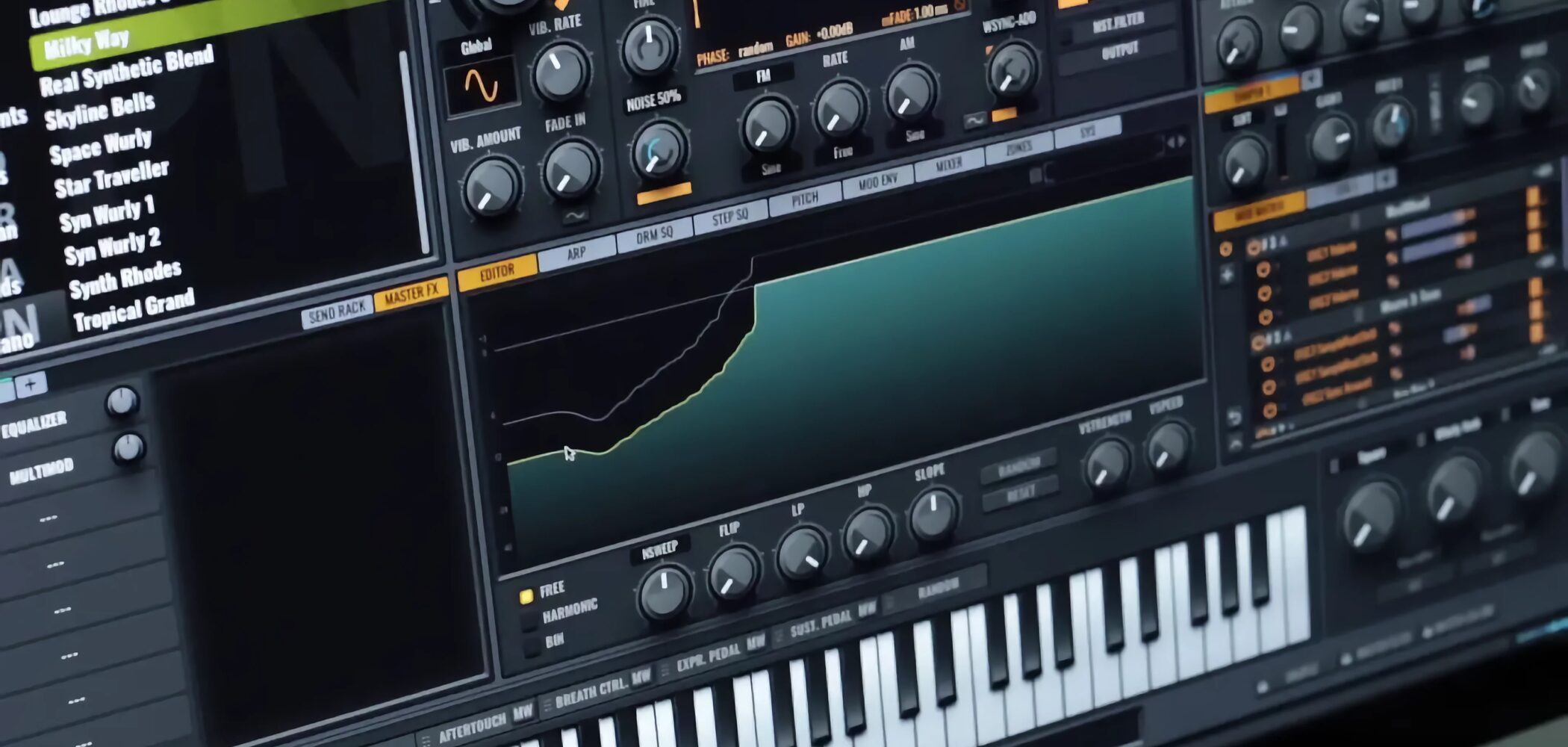
The enduringly popular "Avenger" comes with more than 900 presets and is a versatile synthesizer instrument that can be used right away in many genres of music production, such as EDM and Dubstep.
This time we explain Avenger's features, appeal and how to use it.
For the steps to start using the product, see the article below.
The new features of Avenger 2 are explained here.
Avenger video: Overview and loading presets
Selected Questions and Answers from the YouTube Video

Hello. Normally a song's A1, A2, B1 and B2 sections each need a separate drum pattern. But since Drum SQ has only one pattern, I find it inconvenient. Do I have to use four Avengers for the drums? Or is there another way? Please let me know. Thank you.

We tested this. Multiple OSCs can be loaded, but only one Drum can be loaded. Therefore, you need to load as many Avengers as the number of drum parts you need.
Unlike a multitimbral instrument, I'd have to load several of them, right? I'd like an explanation of a song where one chorus is made with only Avenger.
Within Avenger, you can route to multiple outputs like a multitimbral instrument. We plan to create an article or video on this soon. Thank you.
I bought it, but I guess you can't bring the drum patterns into the DAW. It would be great if I could export them as MIDI and paste them into the DAW.
Yes. Unfortunately, it seems they cannot be brought into the DAW.
There are several items to download for the Avenger demo version. Which ones should I download for Windows?
The items to download are "download WINDOWS installer" and "download CONTENT file".
Thanks as always! I bought it after watching this video. Is there a way to favorite these huge numbers of presets or organize them into folders? Basically, I want to recall my favorite presets quickly. Thank you.
We have added the method at the bottom of the article. The subheading is marked (added 2018/02/08). https://sleepfreaks-dtm.com/softsynth/avenger_preset/ Thank you.
Using Avenger's wealth of sounds
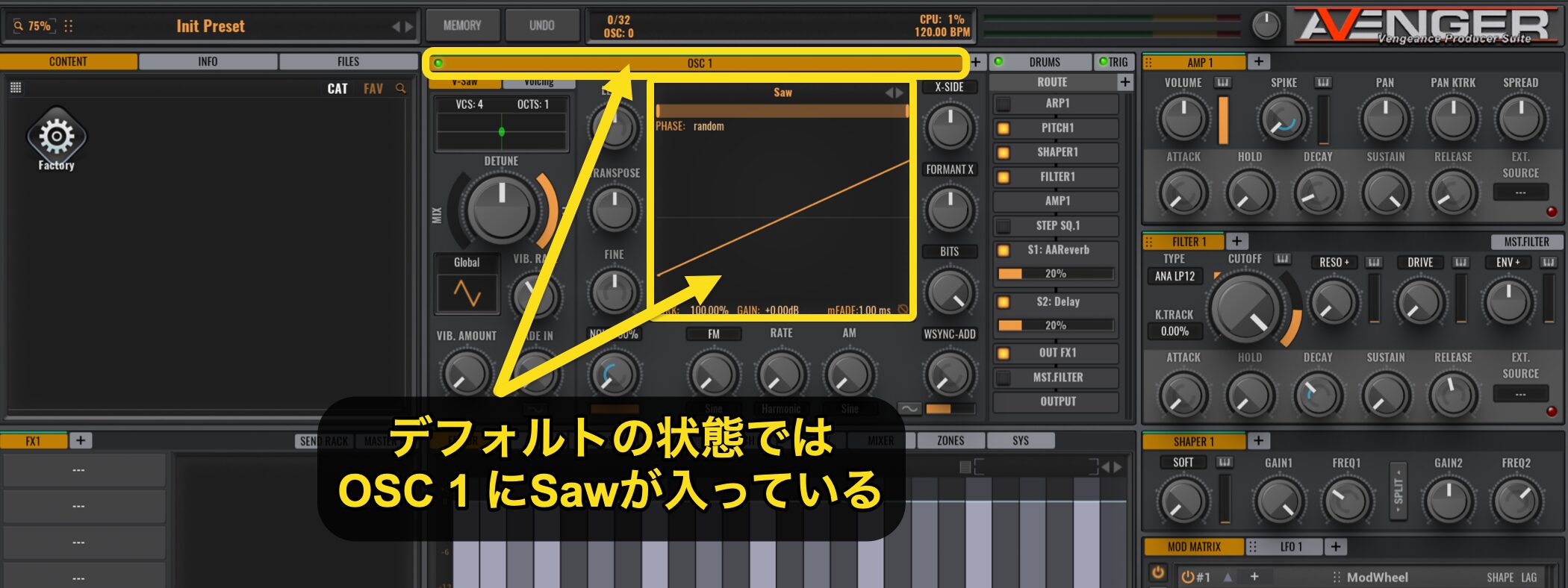
When you launch Avenger, it starts with "Saw" loaded in "OSC1".
A little reverb and delay are also applied.
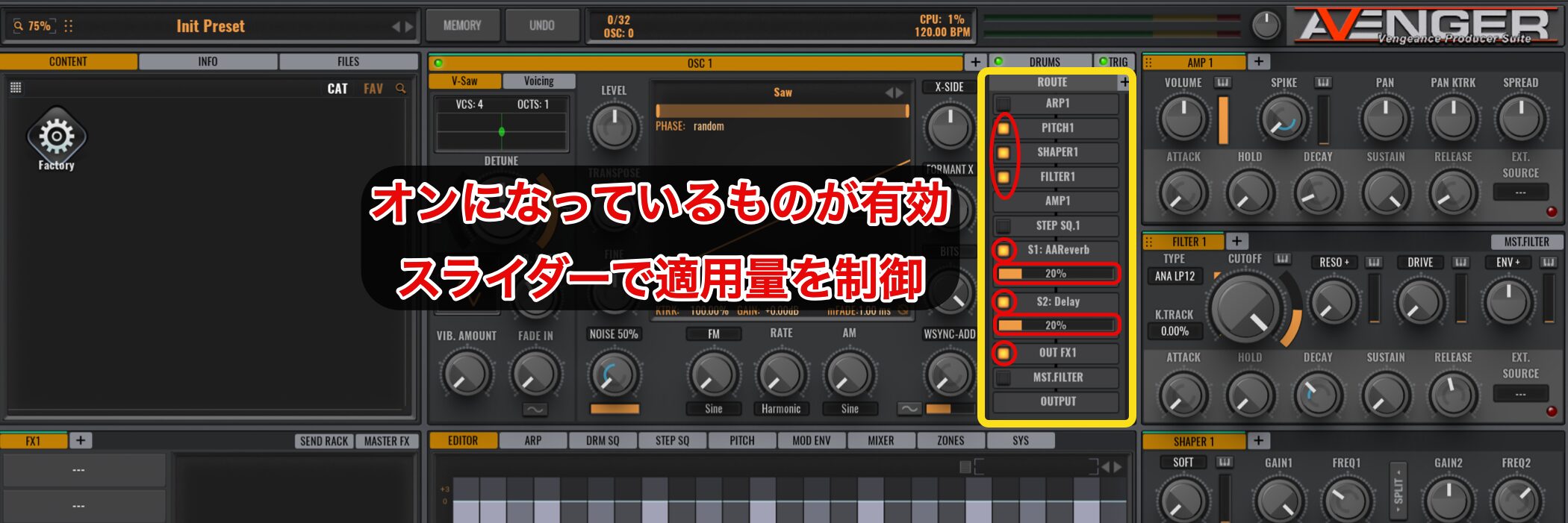
You can turn the reverb and delay on and off from "ROUTE" to the right of the OSC (oscillator) area in the center.
Dragging the slider below it left and right adjusts the amount of effect applied.
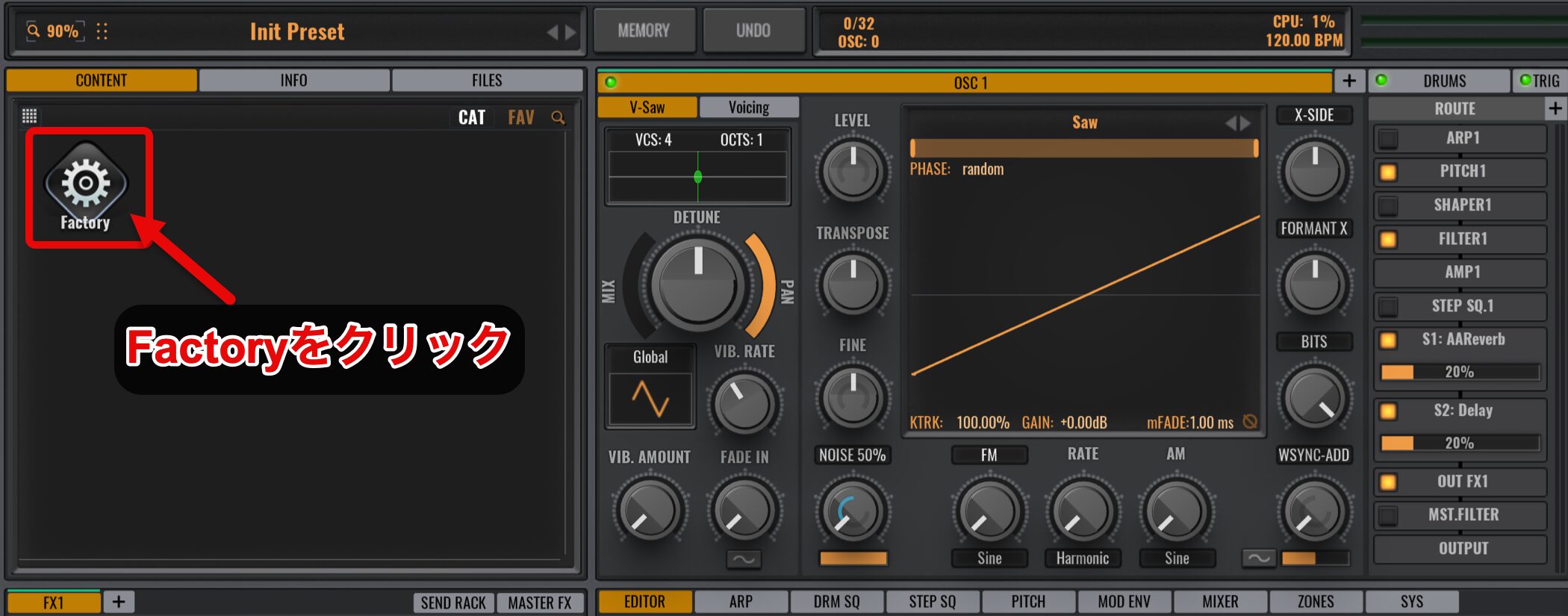
Now let's choose a preset.
First, click the icon labeled "Factory".
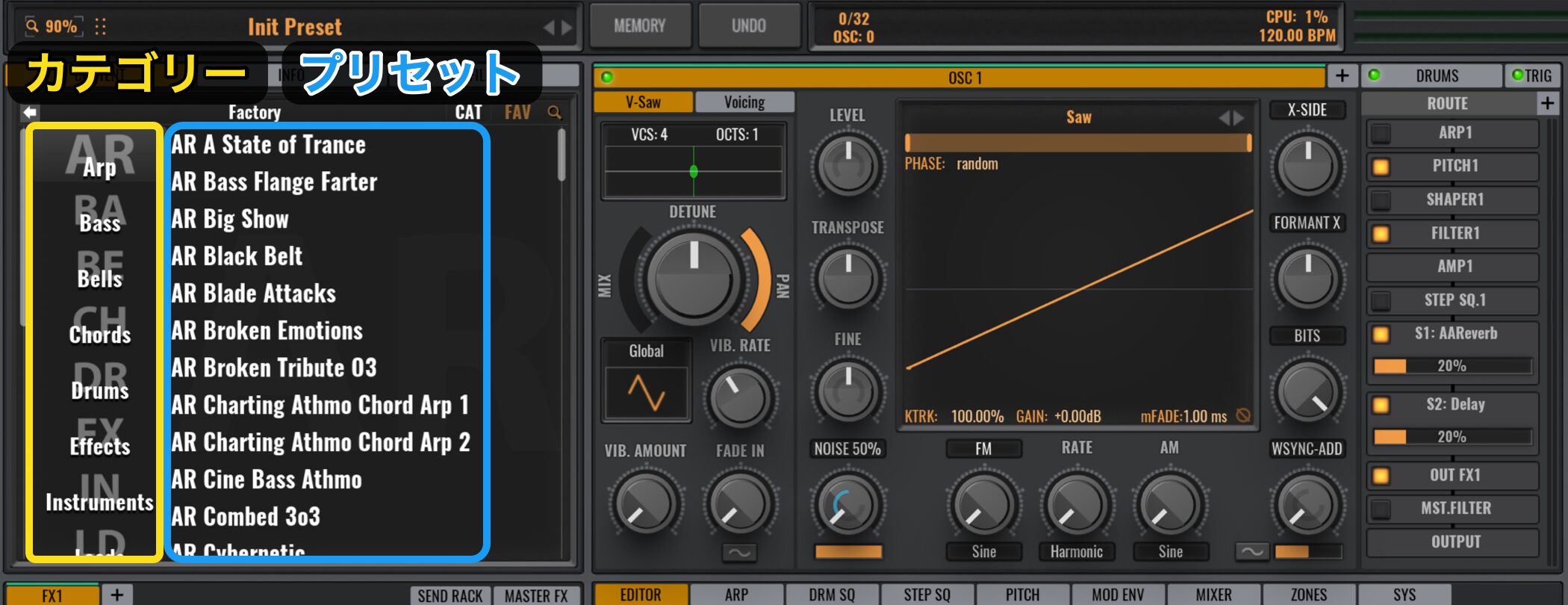
Categories are shown on the left and presets on the right.
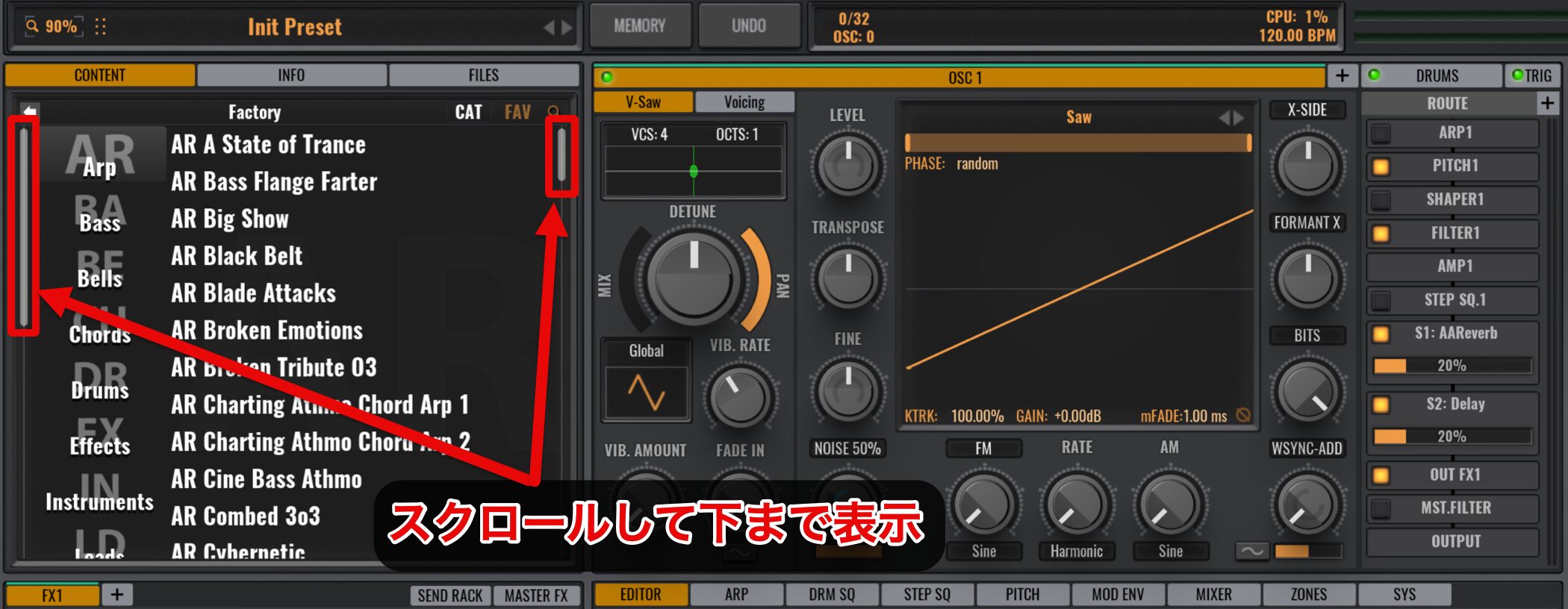
You can scroll through categories and presets by dragging the slide bar up and down.
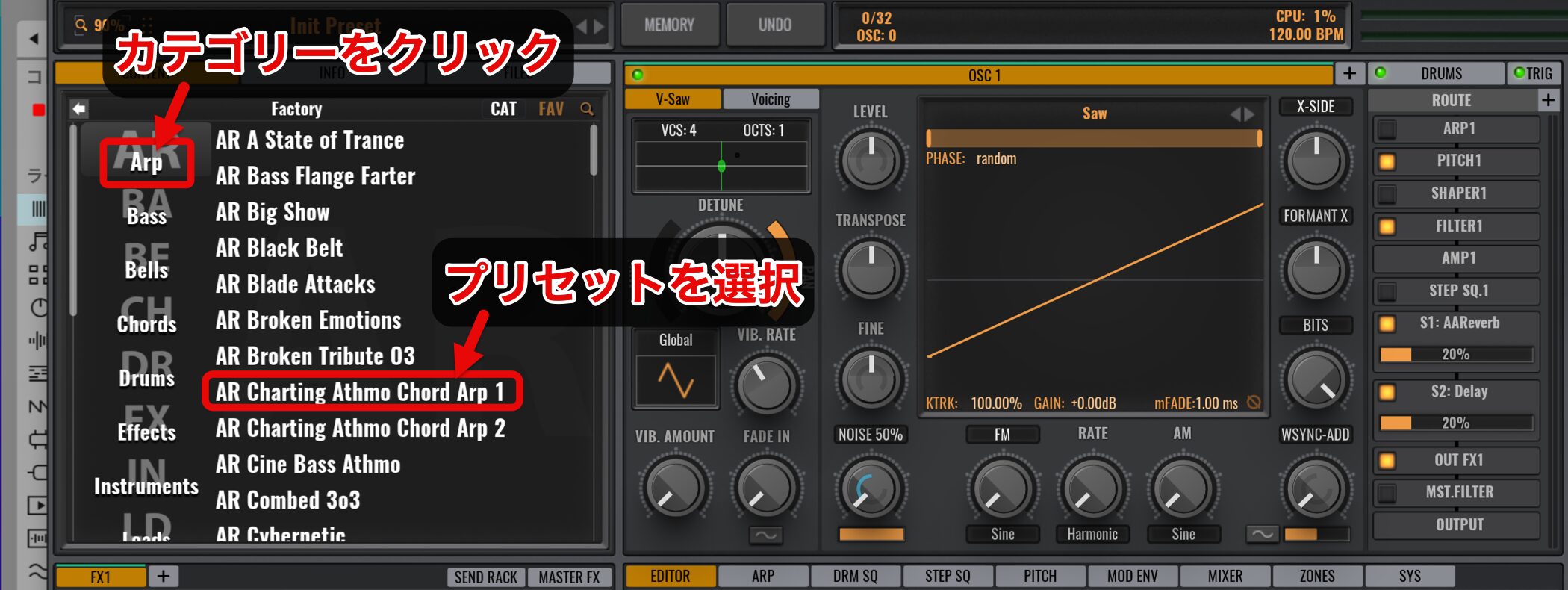
Click a category and select a preset.
Controlling the sound with Macros
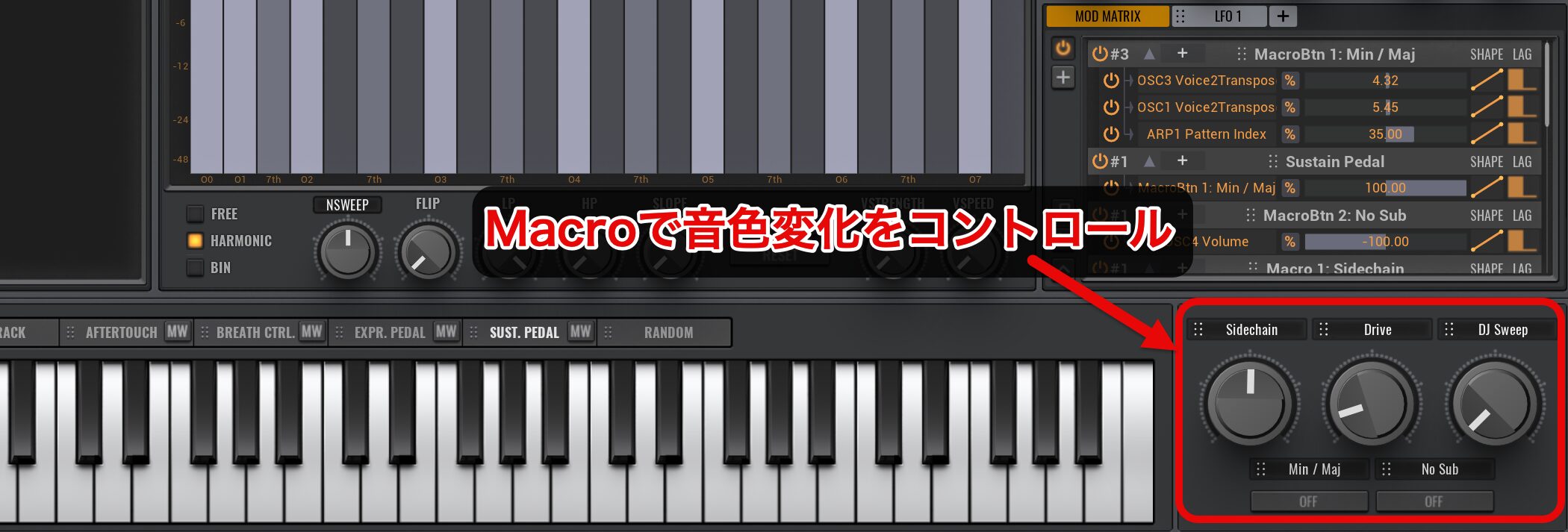
In "Macro" at the bottom right of the loaded preset, parameters that give suitable tonal changes for each preset are assigned.
This lets you easily fine-tune the sound.
For this preset, they are "Sidechain", "Drive" and "DJ Sweep".
As its name suggests, Sidechain is the staple club music technique of adding pumping to the volume.
How to use side-chaining in each DAW is explained in detail at the links below.
 Logic
 Cubase
 Ableton Live
 Studio One
 FL Studio
DJ Sweep is one of the techniques often used in DJ sets, something like an HP filter and a phaser combined.
Turning the knob cuts the lows and adds a light sweeping movement.
Loading presets by category
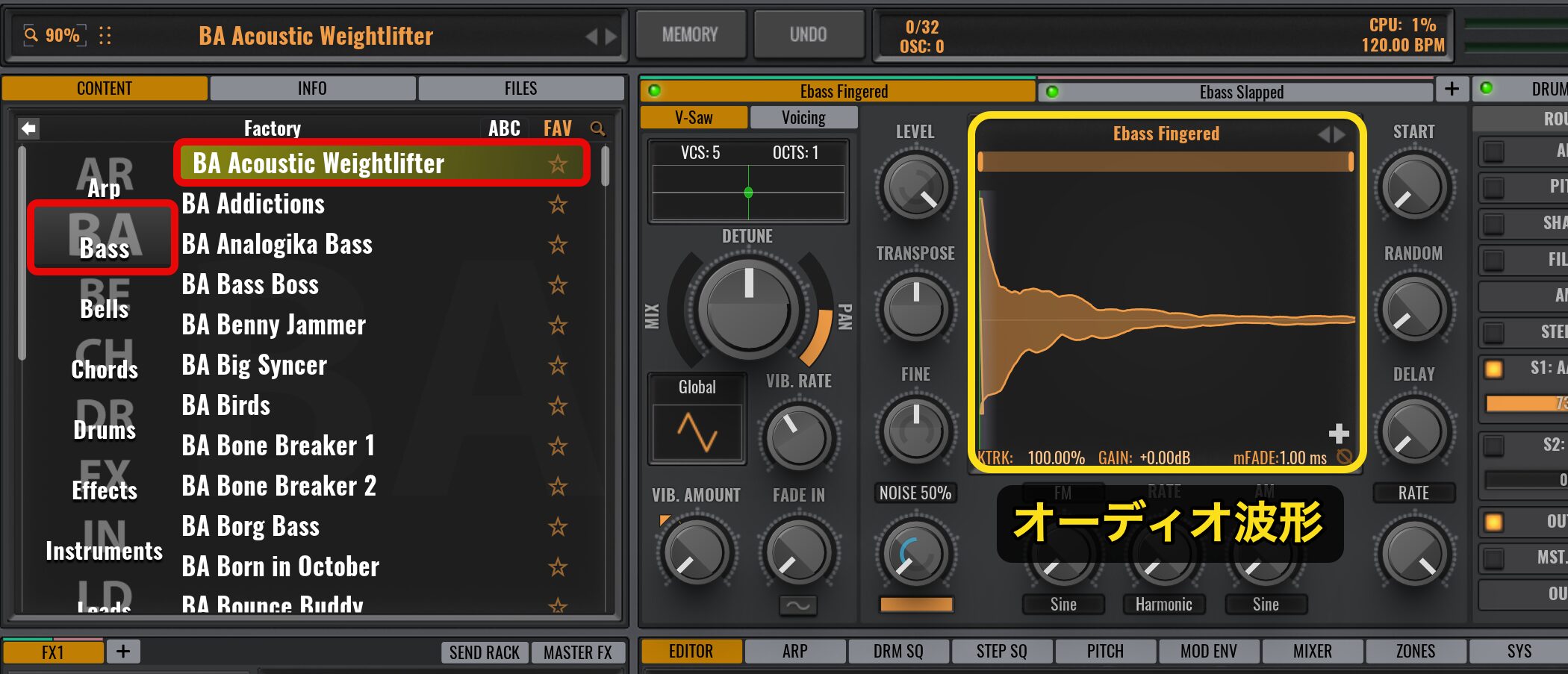
Next, select "Bass" in the categories and look at the top preset.
In this preset, an audio waveform is loaded.
Avenger is sample-based, meaning its presets include samples of real sounds, so it also handles acoustic instrument sounds that are hard to create with a synthesizer.
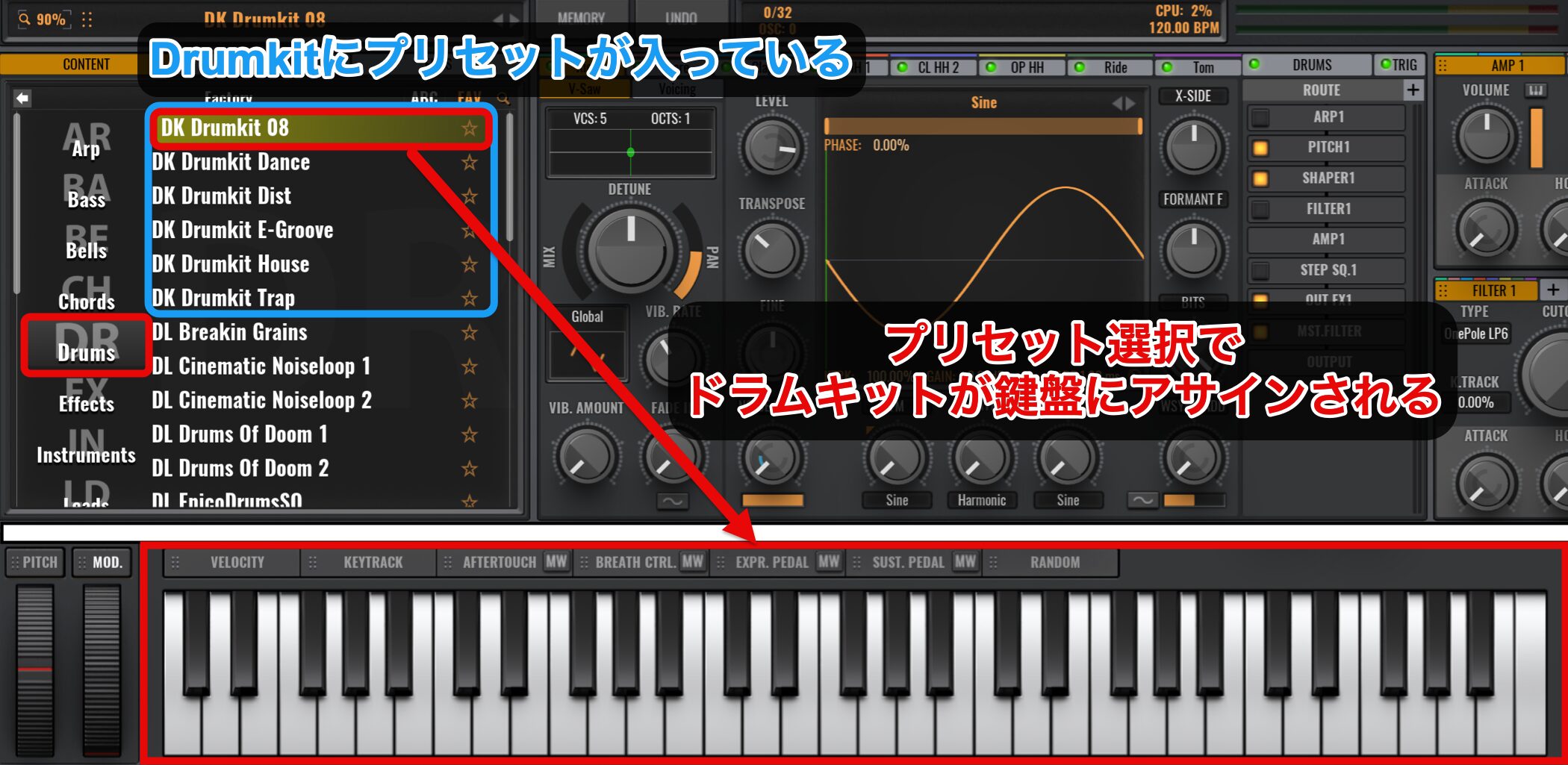
Avenger also includes drum kits with a drum sequencer.
If you select the "Drums" category, presets are provided in the folder labeled "Drumkit".
When you select a preset, the drum kit, including kick and snare, is mapped to the keys, so you can program the patterns you like.
However, some of you may find it tedious to program patterns yourself.
In that case, what is very handy is the "Sequence" category.
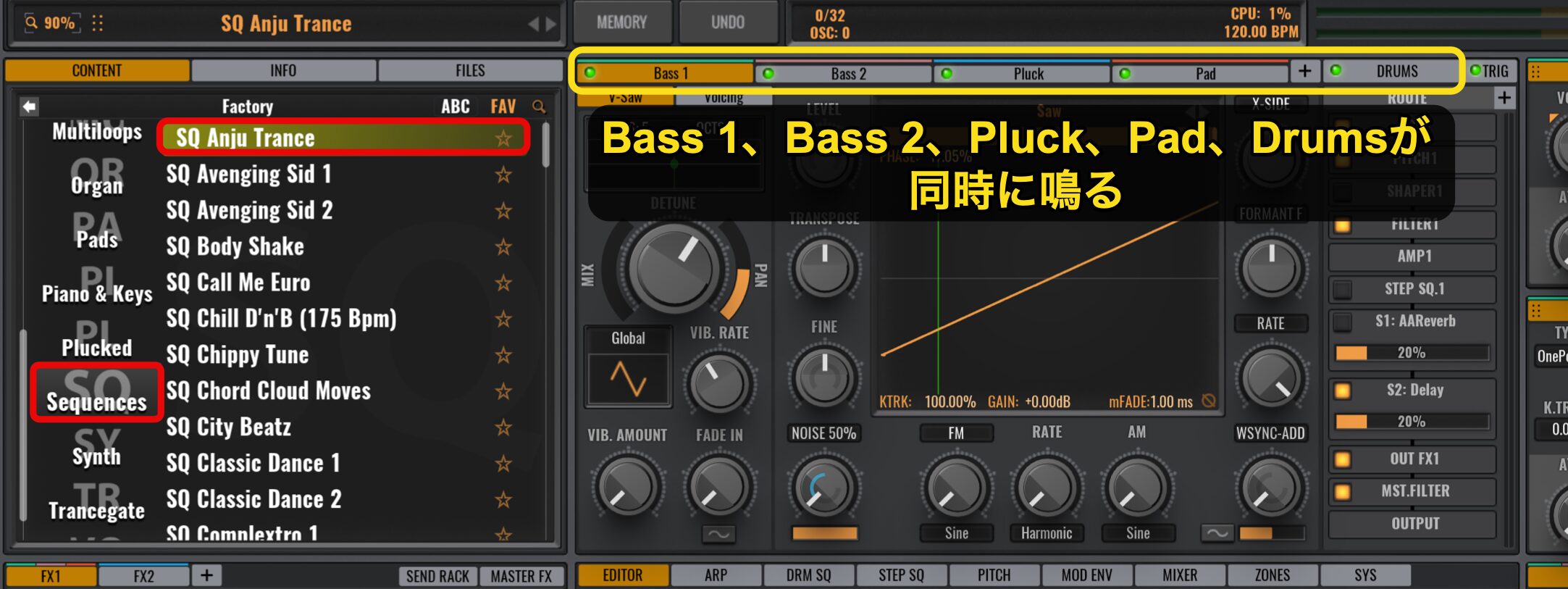
Let's choose the top preset from Sequence.
Looking at the OSC area, "Bass 1", "Bass 2", "Pluck", "Pad" and "Drums" are set to play at the same time.
What's more, with this preset, playing high on the keyboard gives only the Pluck.
The sounds are split by Zone.
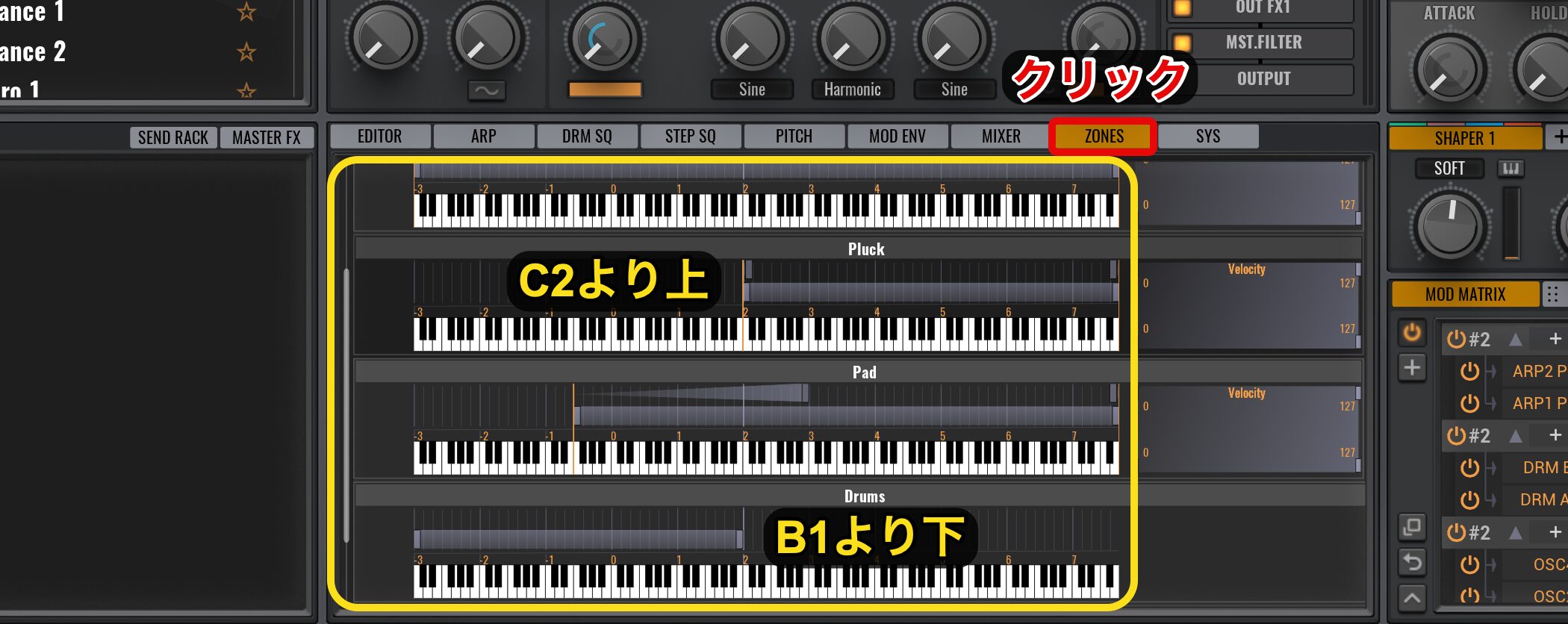
If you click the "Zones" tab, you can check which sound is assigned to which keys.
Pluck is above C2 and Drums is below B1.
Depending on the DAW, these may be shifted by an octave, so you need to check the layout while playing.
If you hold down C1 to play the drums and bass and program the Pluck above C3, you can easily make something that sounds like a song.

When you move the cursor over the tabs at the top of the OSC area, mute and solo buttons appear, so you can also solo just the Drums and use them.
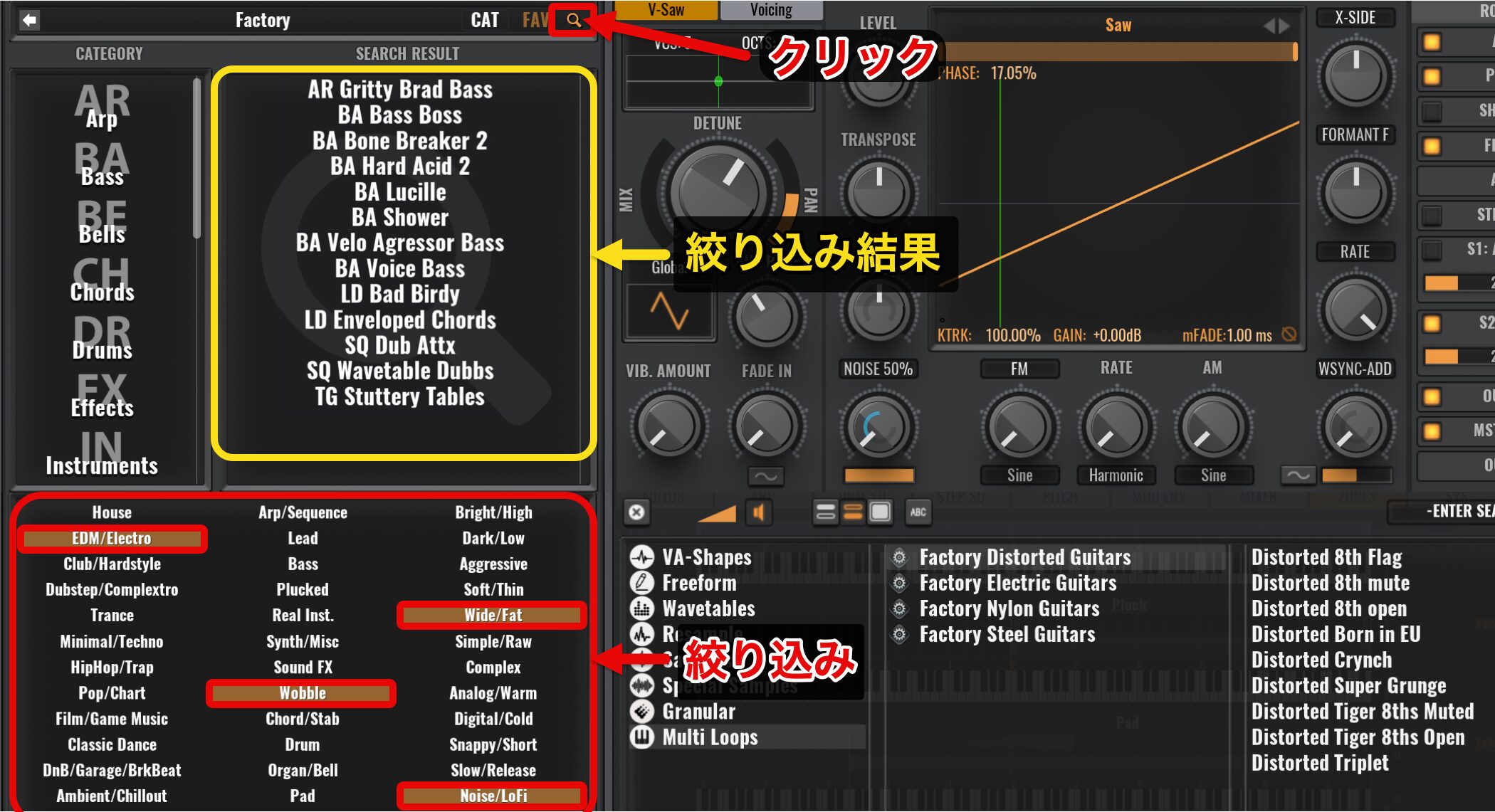
This time we selected presets from the categories on the left, but if you click the "magnifying glass" icon on the right, you can use tag cloud search for more precise and comfortable searching.
Just check the items you want to search for in the area below.
Favoriting presets
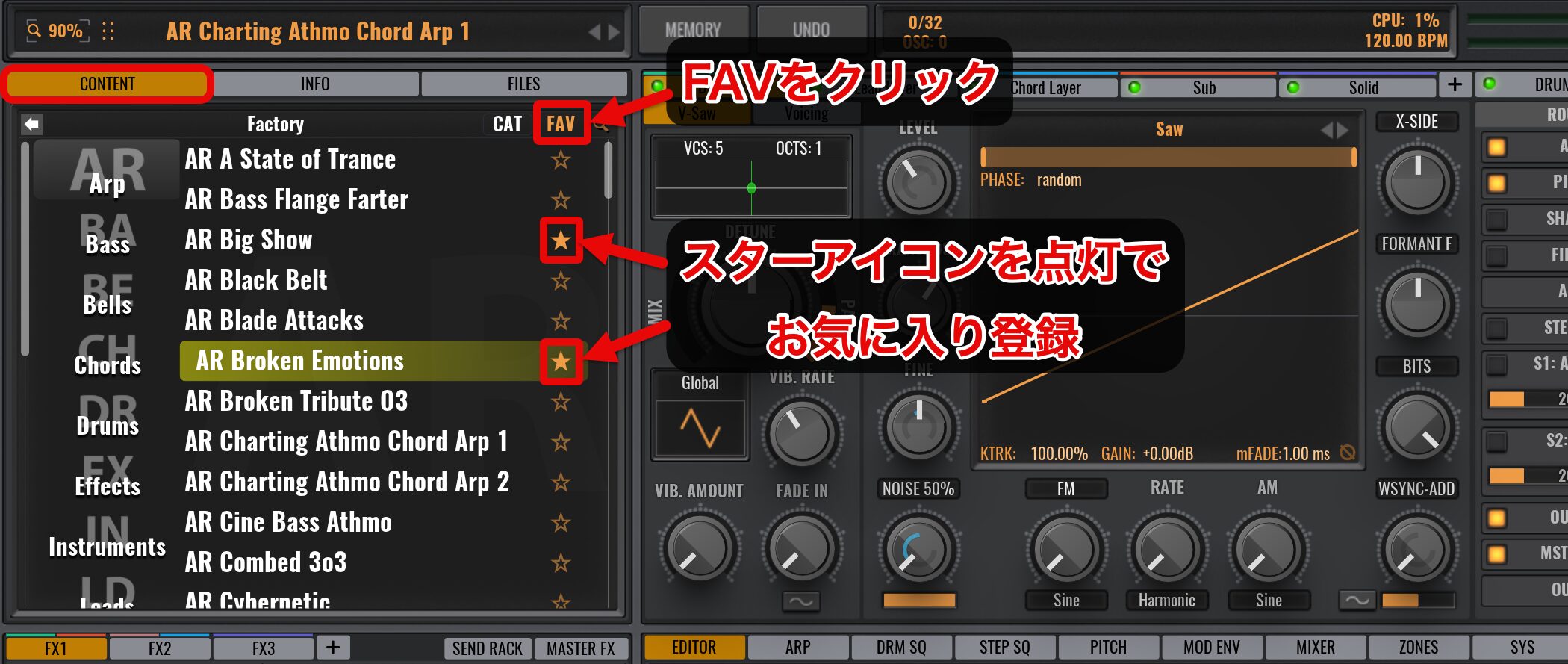
You can register favorites from among the many presets.
Click "FAV", then click the "star" icon on your favorite preset to light it up.
This is handy for quickly finding your favorite presets.
Saving as your own preset
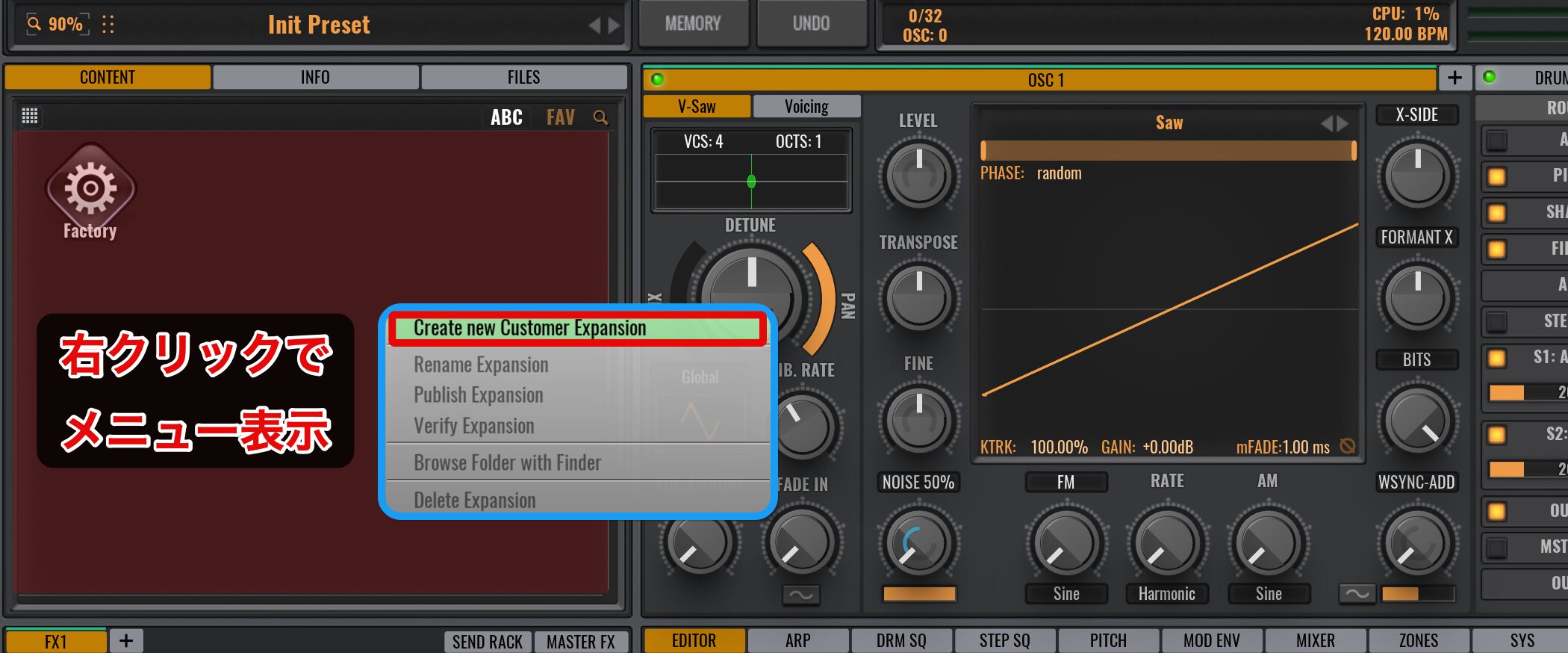
You can create a content folder, which is handy for freely grouping existing presets or saving your own sounds.
Right-click the content area and select "Create new Customer Expansion".
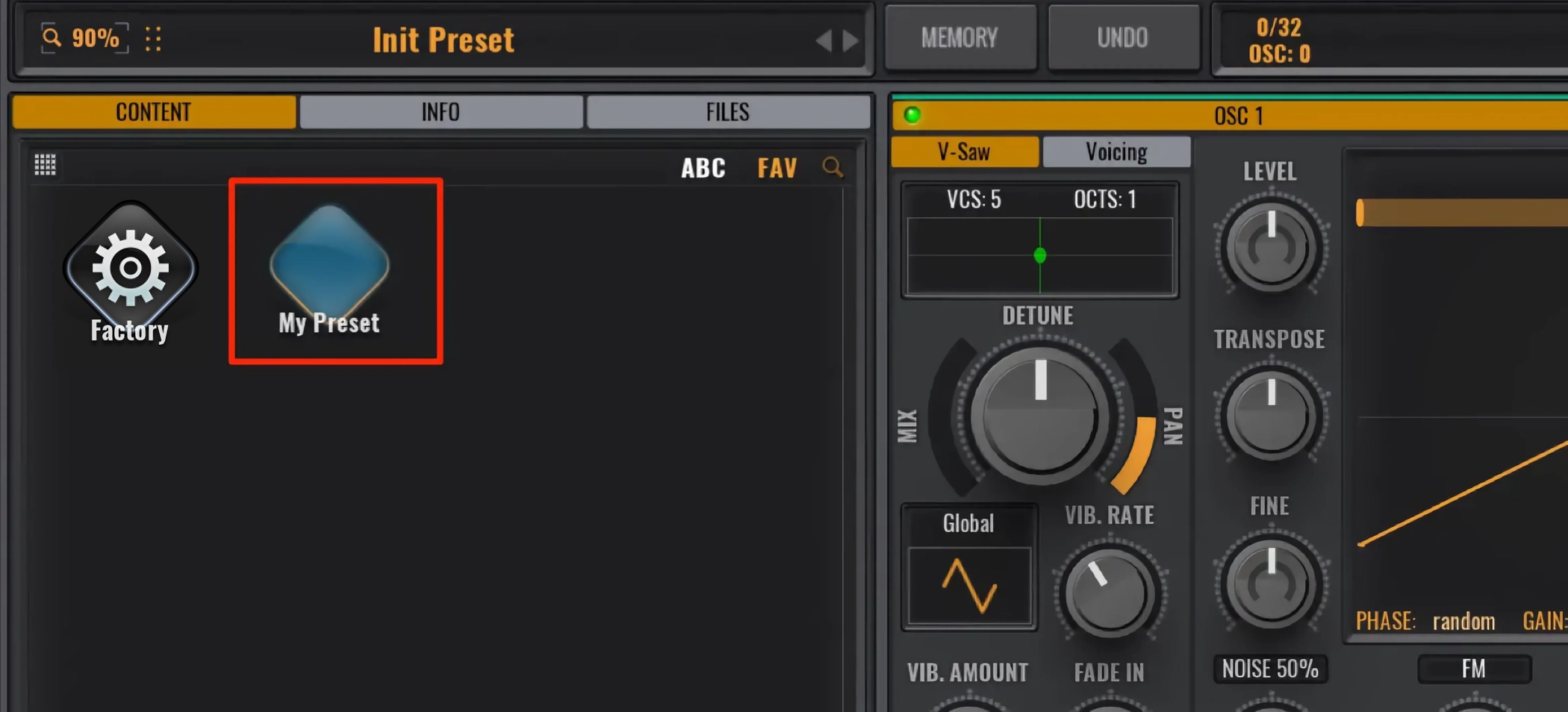
The content is created like this.
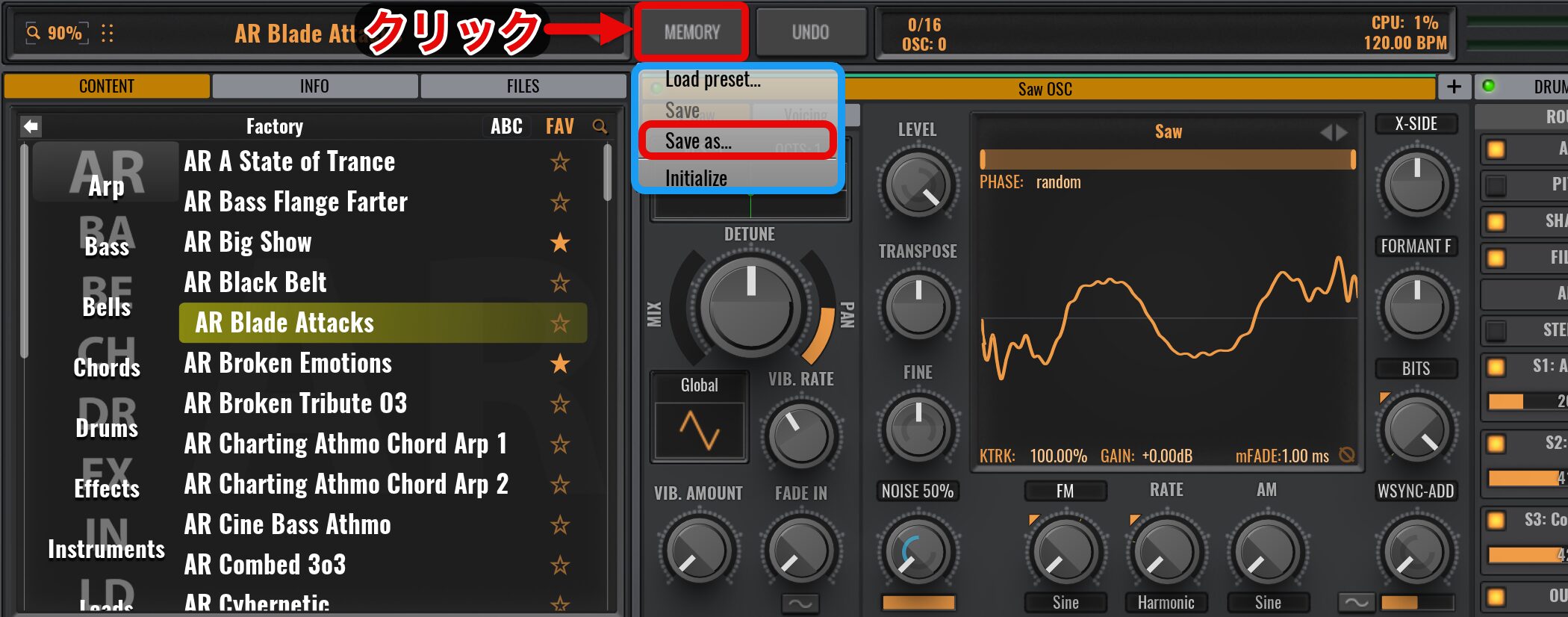
Create the presets or original sounds you want to group, and click "MEMORY".
Select "Save as" from this menu.
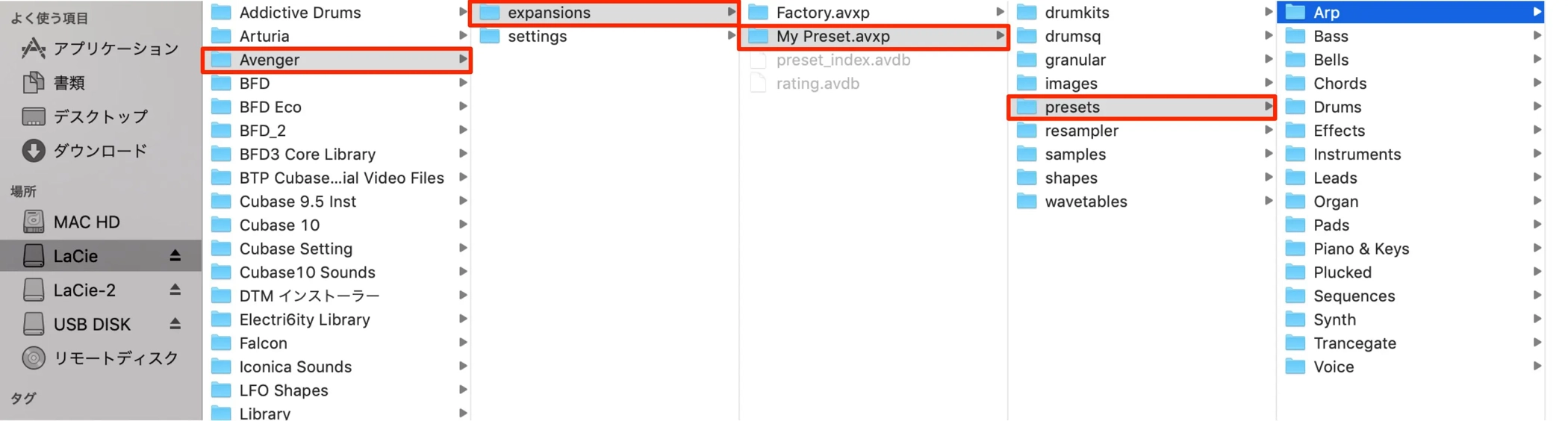
Select "Avenger" → "My Preset.avxp" → "presets", where the factory presets are stored.
Select the preset category you want to save to and save.
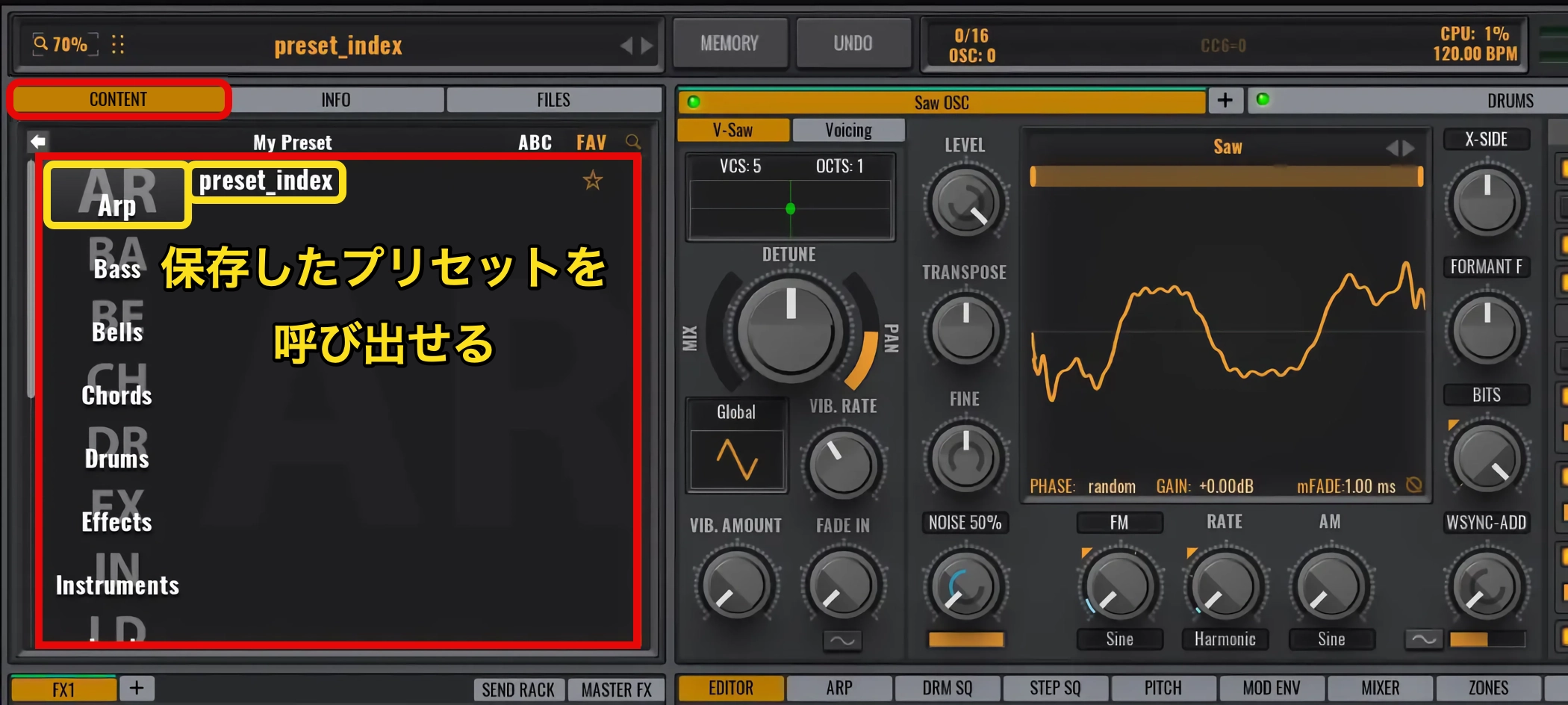
You can recall the saved presets from your own content folder.
As you can see, Avenger's presets are very ready to use and highly customizable.
When you want to add a Dubstep- or EDM-style beat to the break of a typical J-pop-style song, or drop in something like a wobble bass for a moment, it is the ultimate synthesizer.
Avenger excels not only as a synth but also as a rhythm instrument
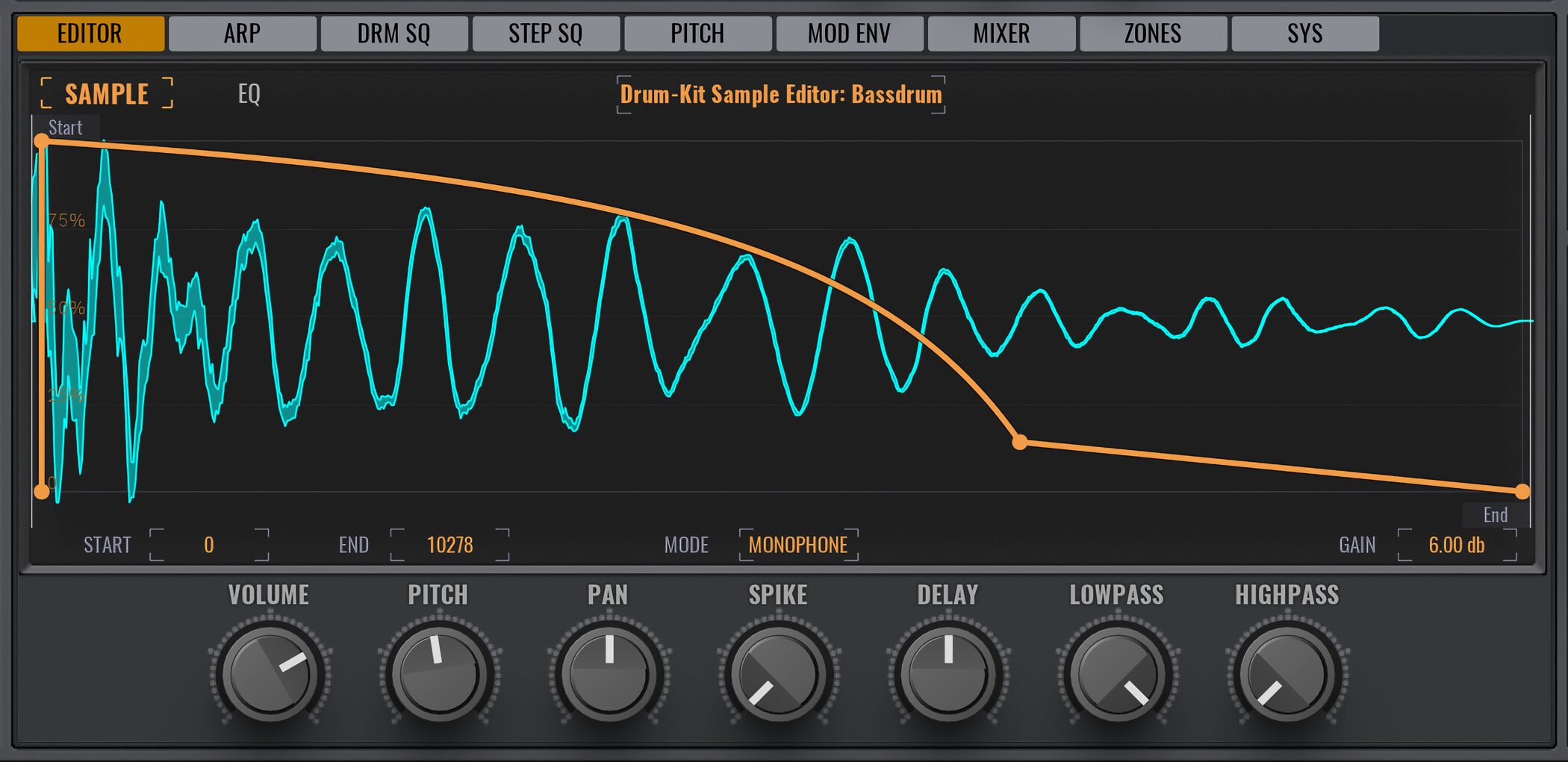
Next, we explain Avenger's OSC area and sequence editing for the Drums instrument.
Avenger has great synth sounds, of course, but it is also a very capable drum sequencer.
You can bring rhythm patterns into your song and build phrases.
Avenger video: Editing the Drums sounds and sequences
The OSC area and the drum section
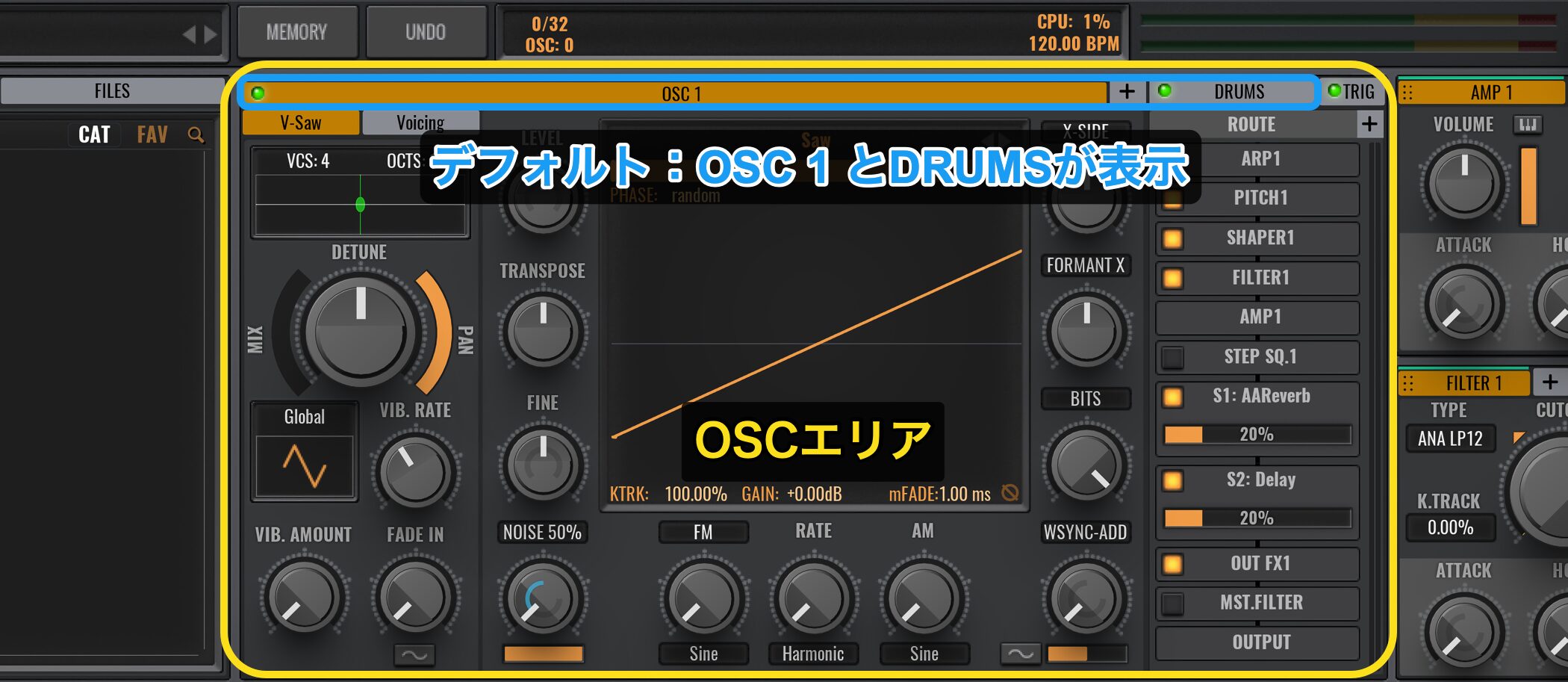
The top center of the screen is Avenger's OSC area, and by default OSC1 and DRUMS are shown in it.
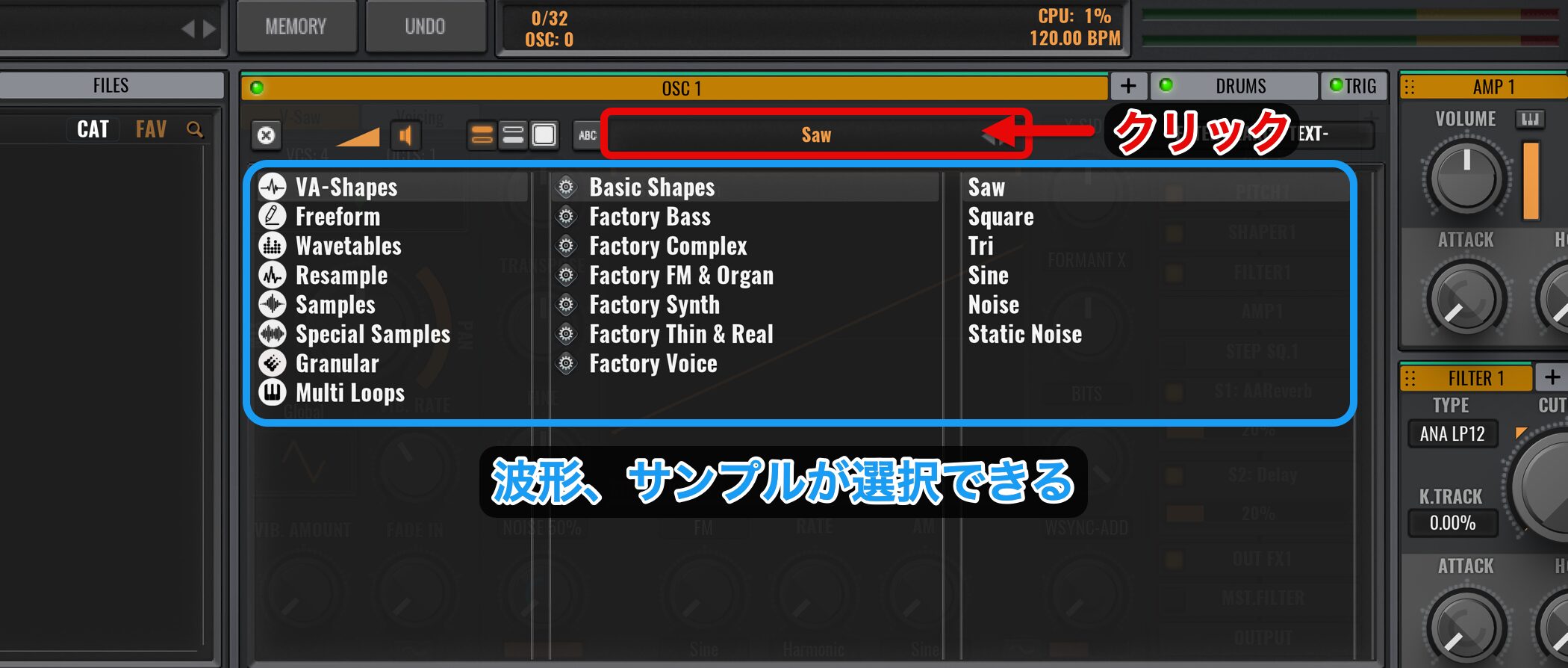
To choose the oscillator's source, click the part labeled Saw.
From the menu that appears, you can choose from a wide range of waveforms or samples.
Creating original waveforms with FREEFORM
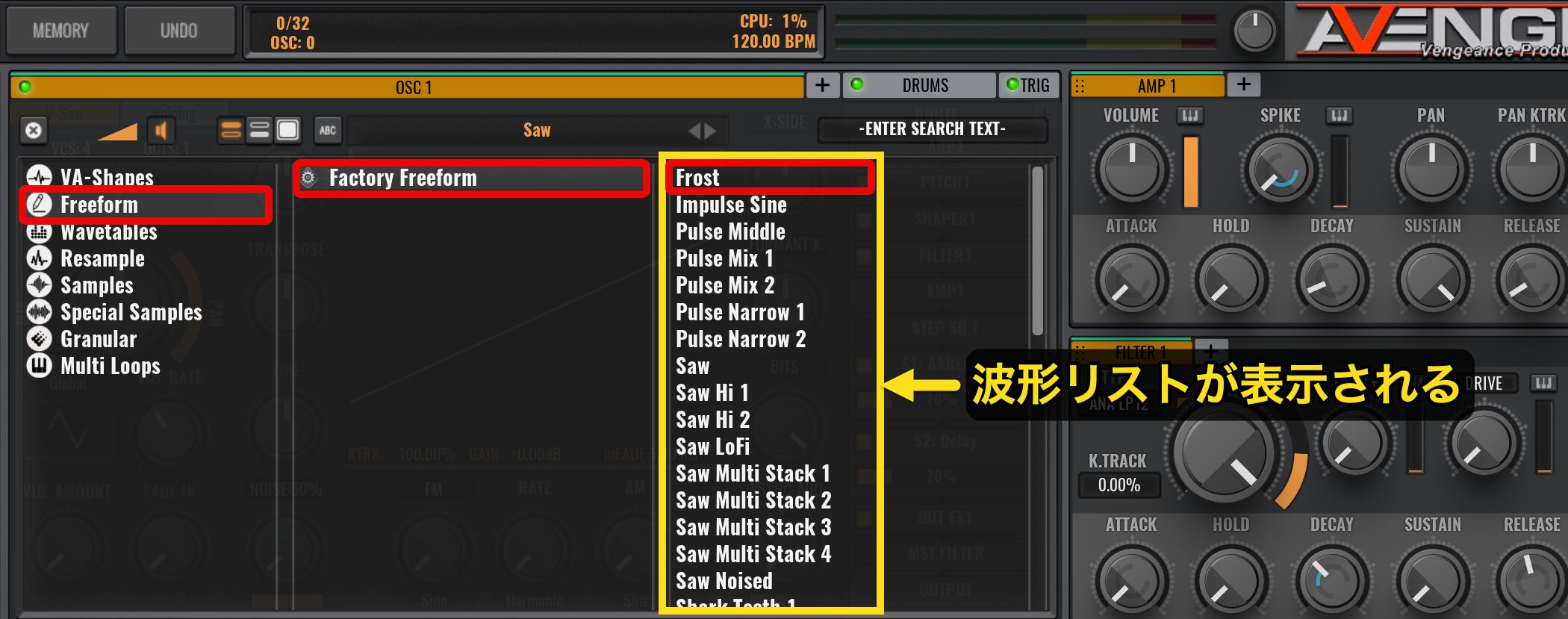
A unique feature is "Freeform".
Click "Factory Freeform" to show a list of waveforms.
As a test, let's select the top waveform.
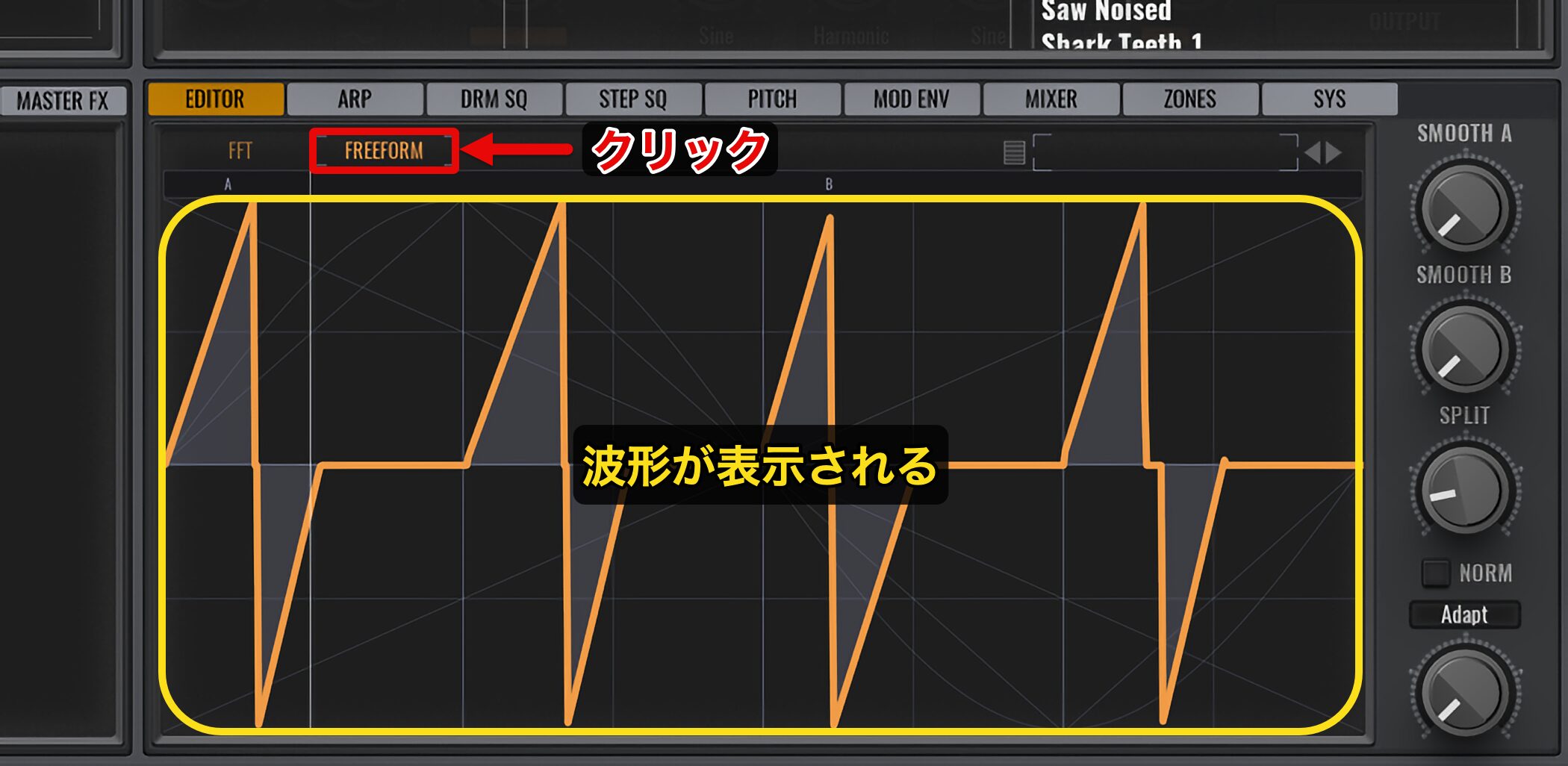
Click "FREEFORM" under "EDITOR" and the waveform is displayed.
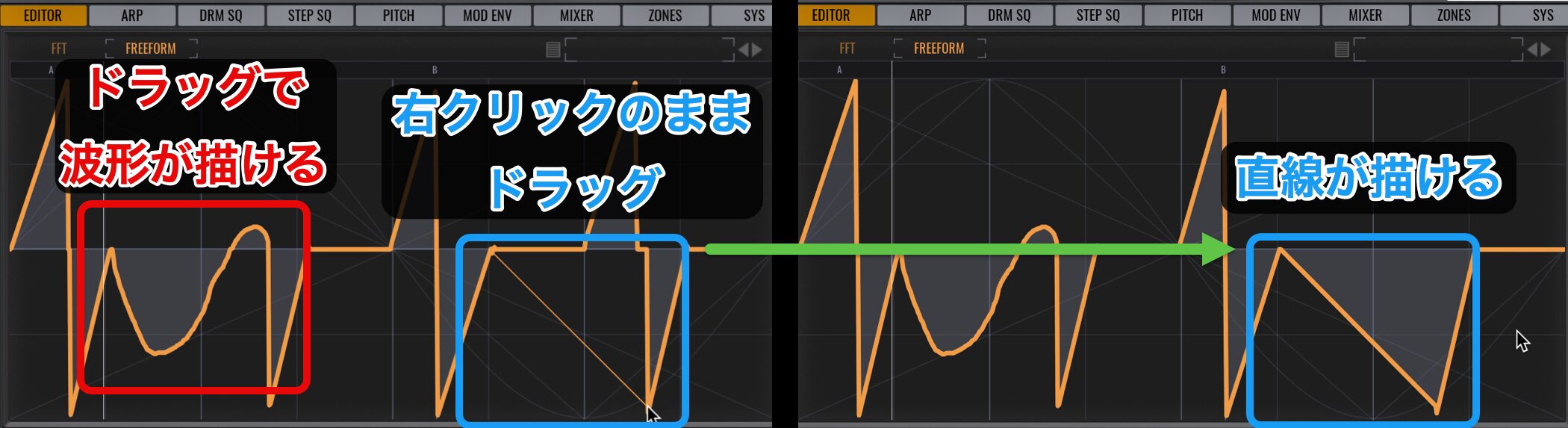
In FREEFORM mode, you can freely draw waveforms with the mouse.
Dragging while holding the right mouse button also lets you draw straight lines.
This lets you create original sounds easily and intuitively.
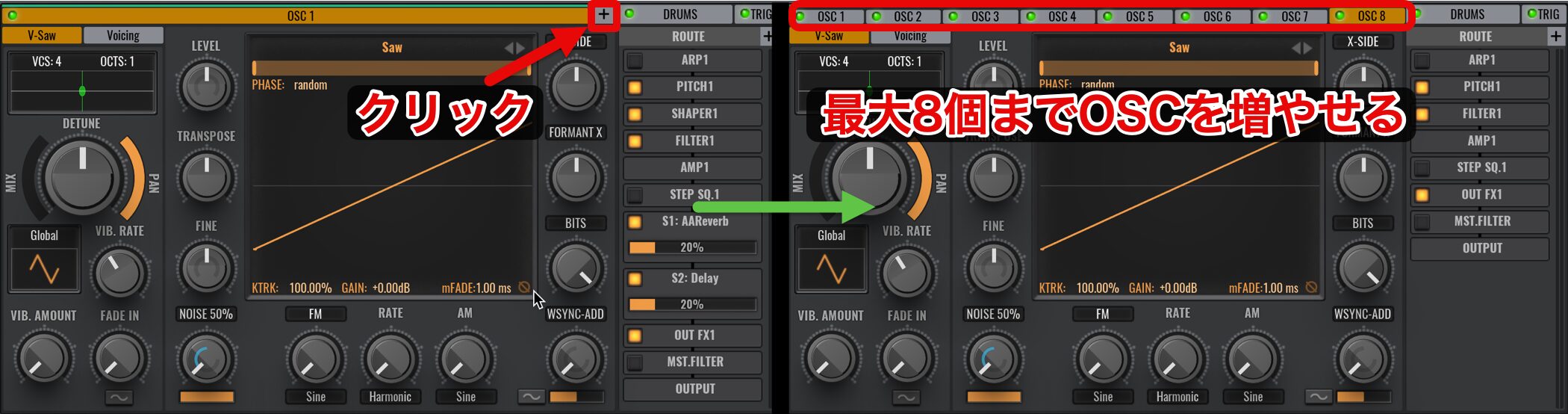
To add an OSC, click the "+ (plus)" button.
Each click adds an OSC, and you can layer up to eight.
You can easily create thick sounds.
We will explain the inside of the OSC later.
Loading Drums presets
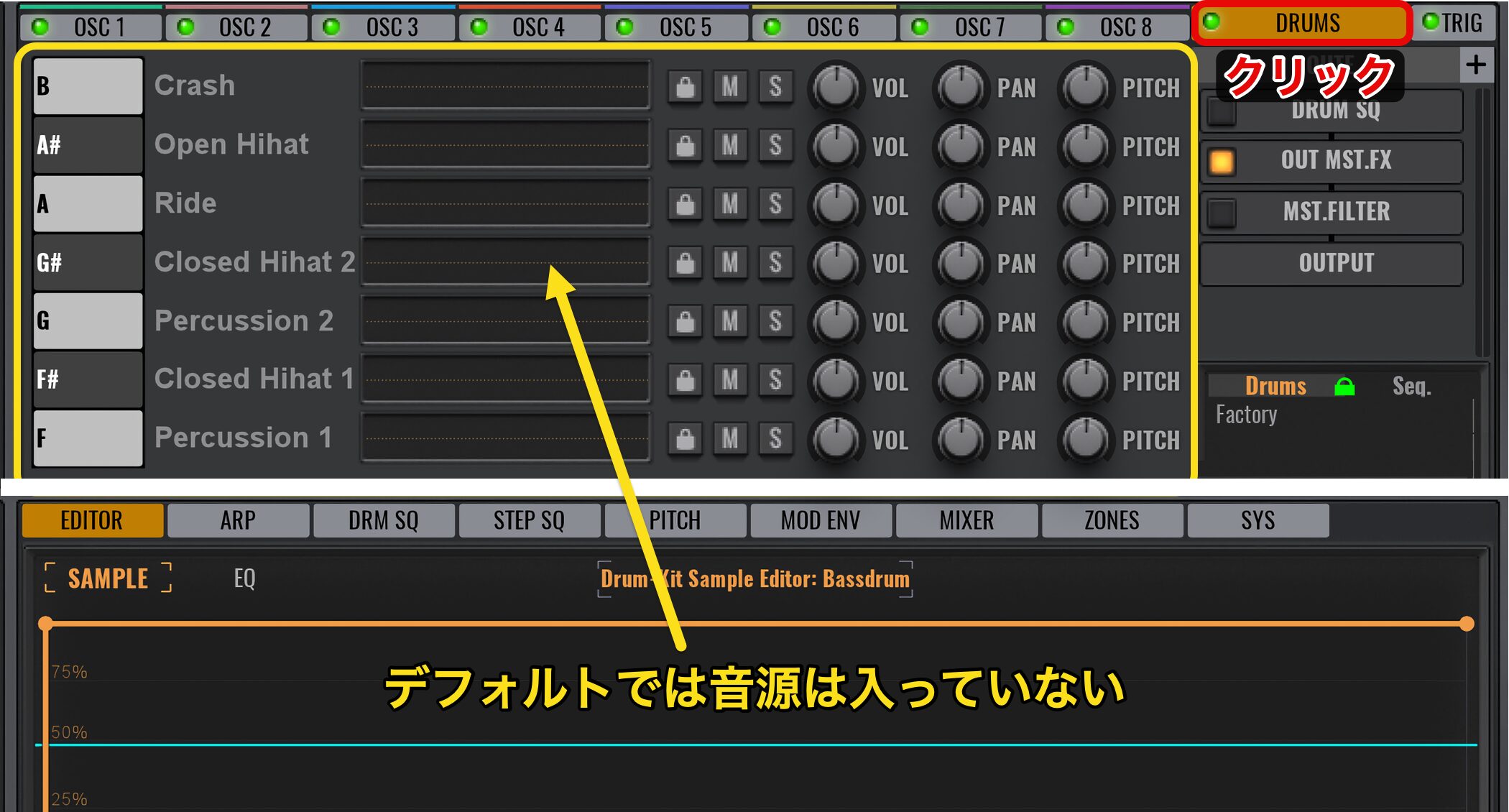
Let's check the contents in the "DRUMS" tab.
By default, no sounds are loaded.
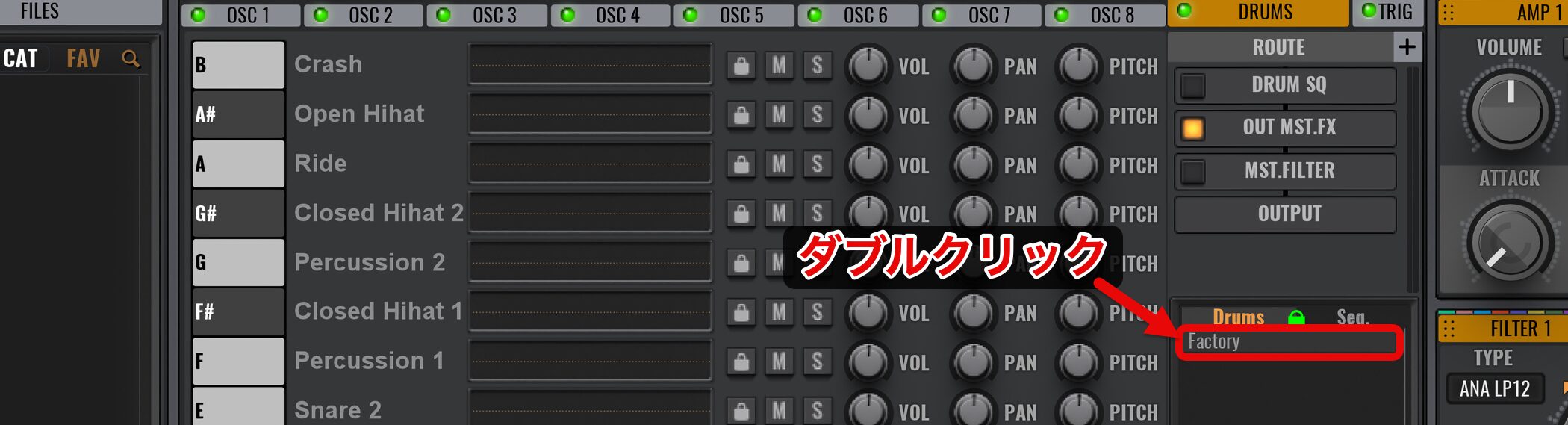
Double-click "Factory" under "Drums" on the right side of the area.
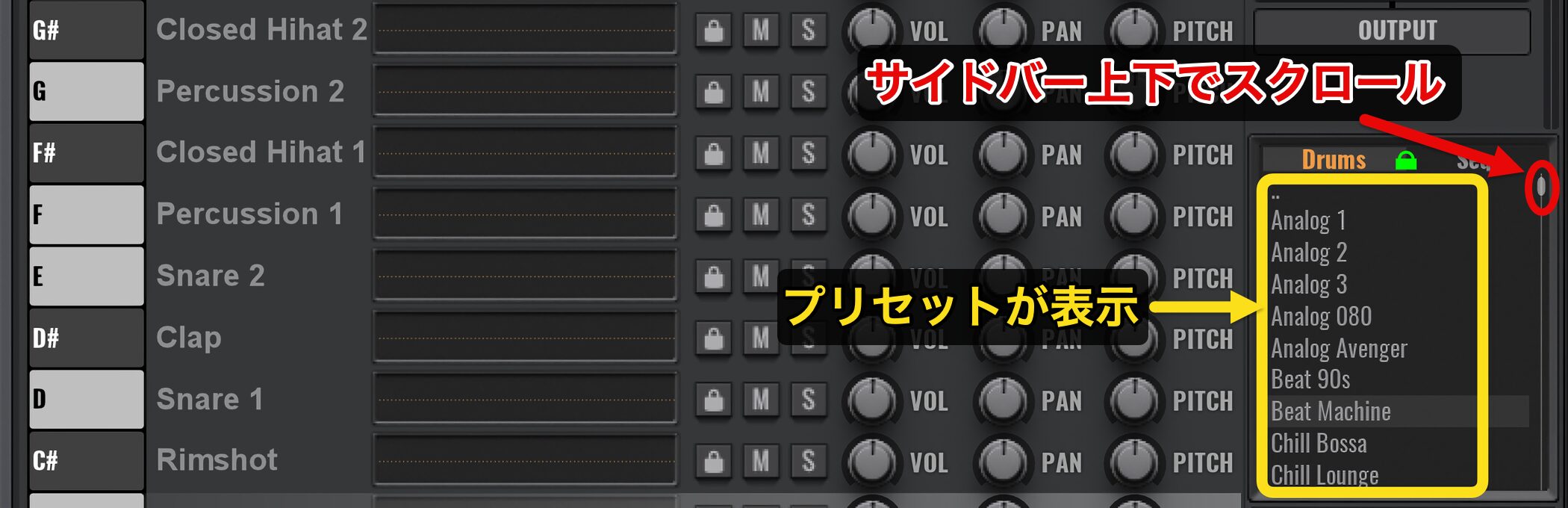
The Drums presets are displayed like this.
You can scroll with the slide bar on the right.
Even at a glance, there are lots of presets.
They are all beats you can use right away.
Select the preset you want and load it into Avenger.
At this point, you can also load just the rhythm pattern without changing the sounds.
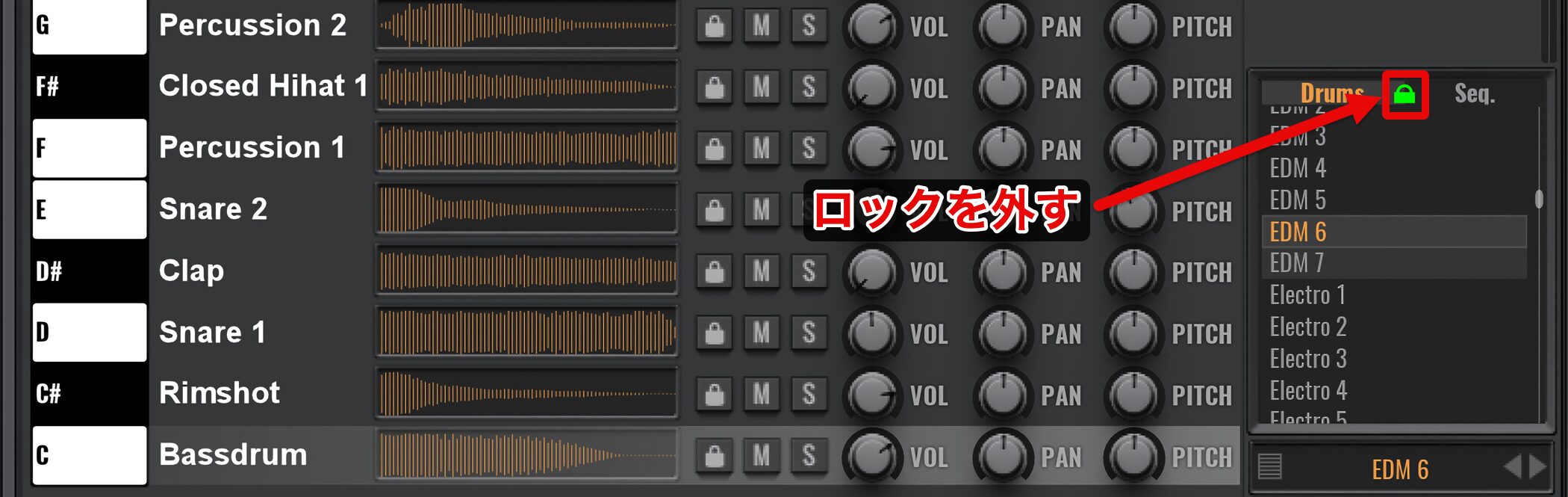
Because the sounds and pattern are locked together, they are loaded linked to each other.
By unlocking them, you can change just the sounds or just the sequence individually.
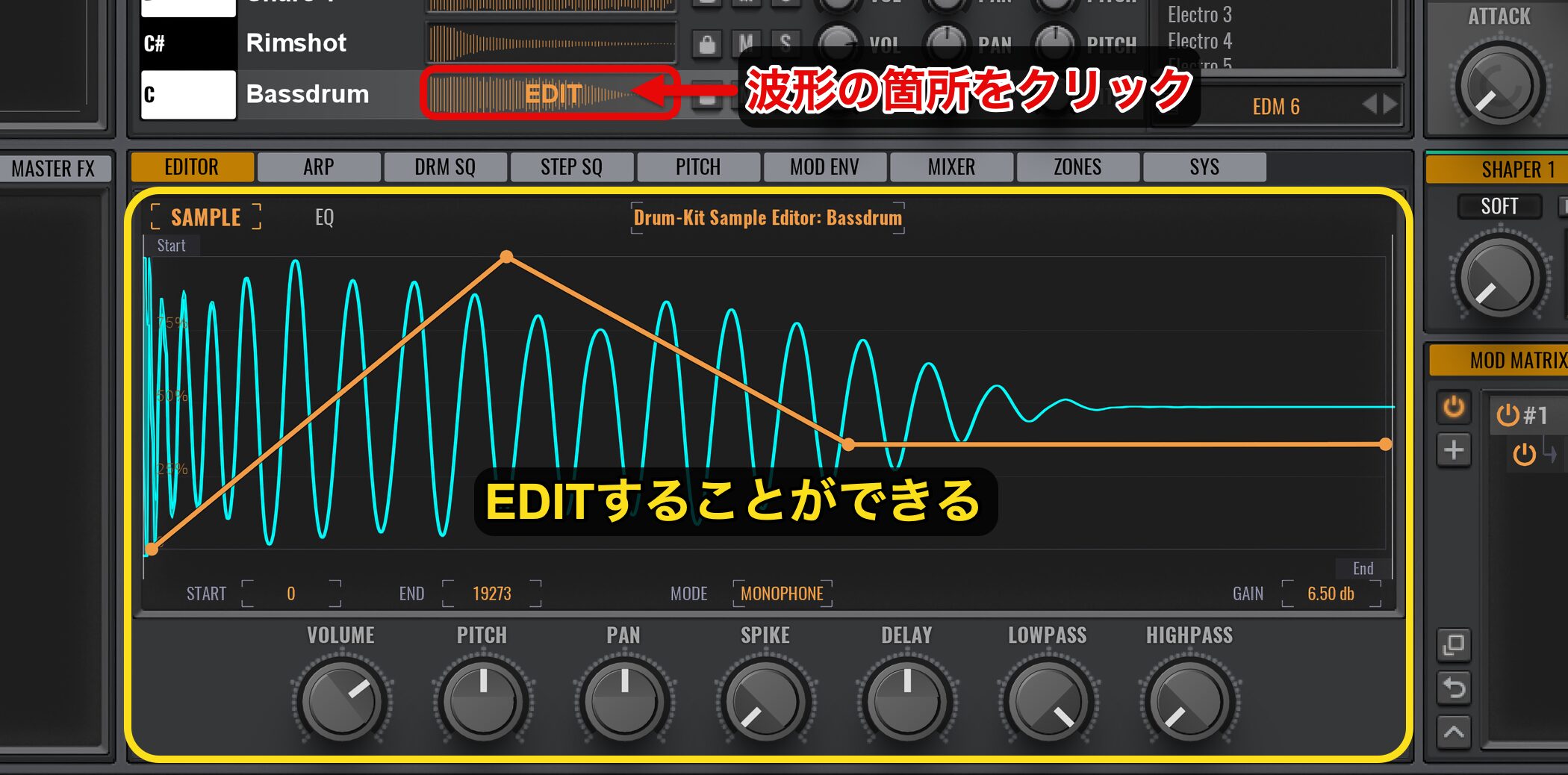
Clicking the waveform of each sound, such as the kick or snare, lets you edit details such as LowPass, HighPass, Pan, Pitch and envelopes, so you can do very detailed sound design!
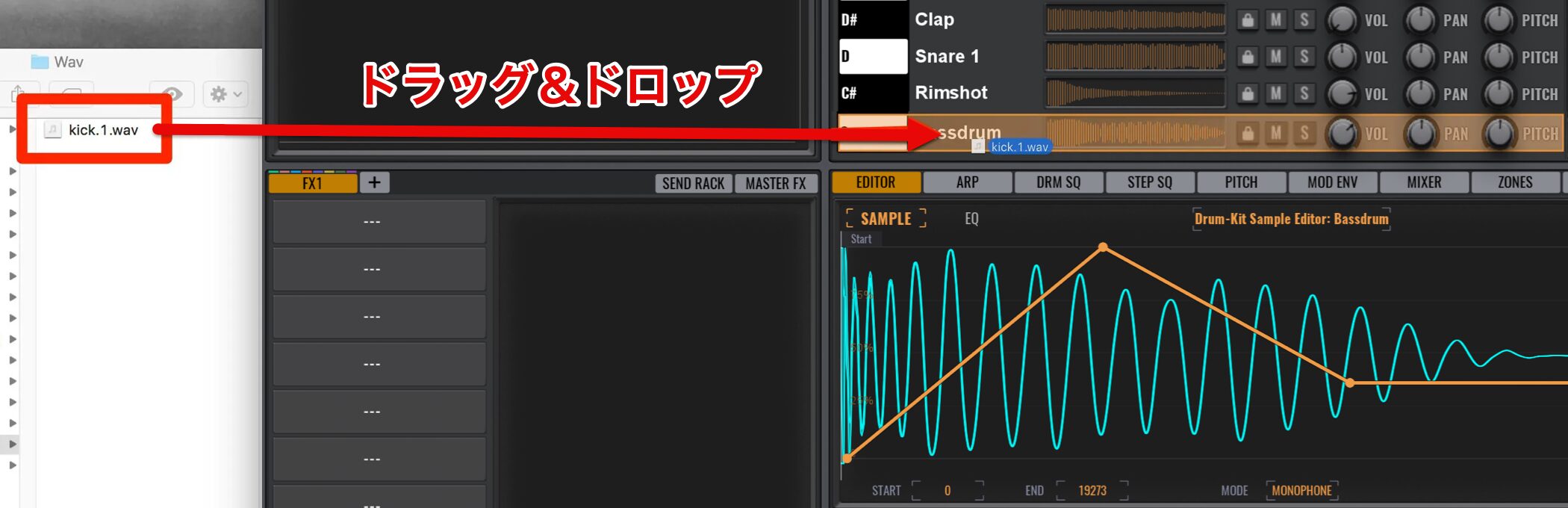
Another handy feature is that you can load WAV samples.
Just drag and drop the file you want directly onto Avenger.
Very easy.
Editing Drums sequences
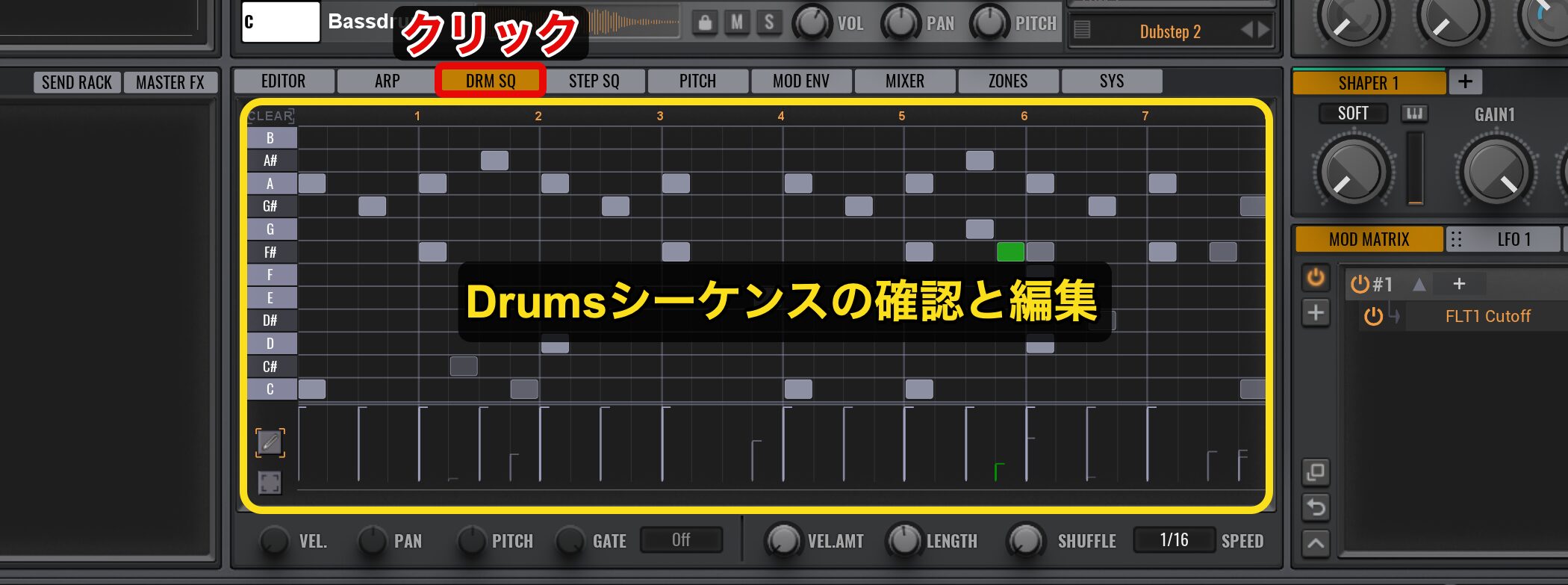
Even with plenty of presets, there are many times when you want to change the pattern to fit the song.
Next, let's move on to editing the Drums sequence.
Click the "DRM SQ" tab at the bottom center to check and edit the Drums sequence.
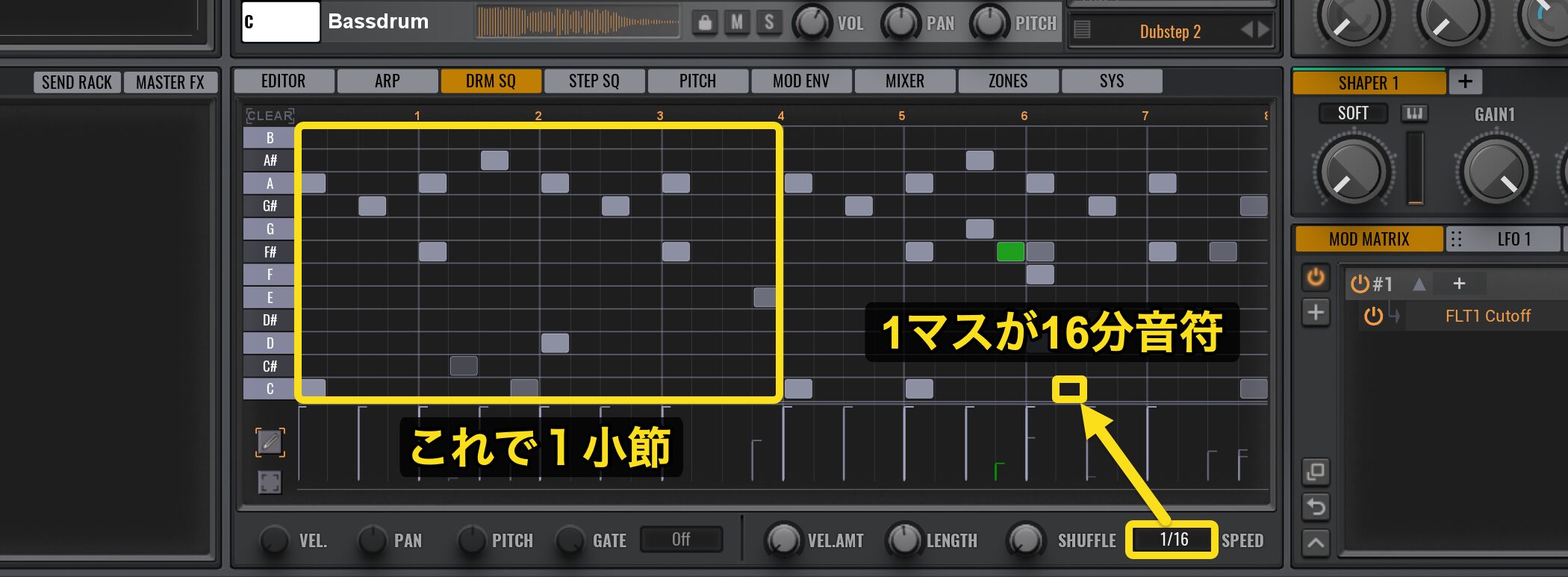
Speed at the bottom right is currently 1/16, so each square represents a 16th note.
Of course, you can also choose other note values (the length a note has) to change the display.
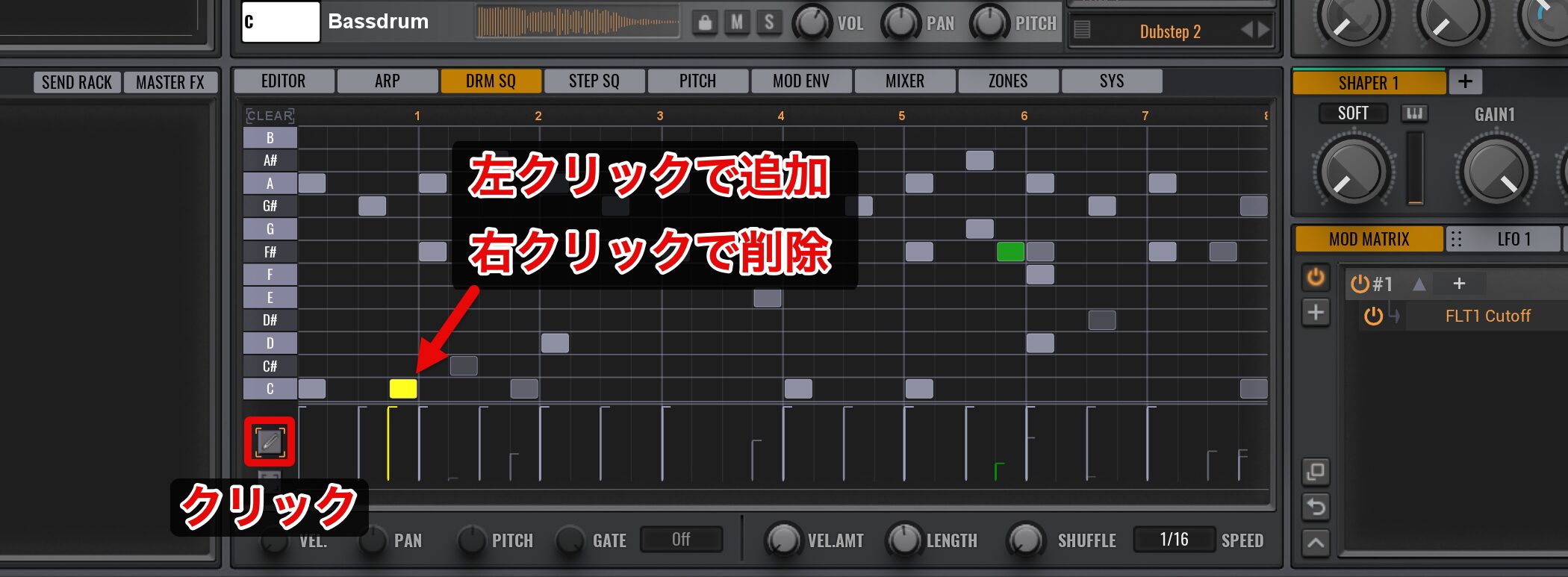
To add notes, click the pen icon below the keyboard and left-click where you want to enter notes.
To delete a note, right-click the target note with the pen tool still selected.
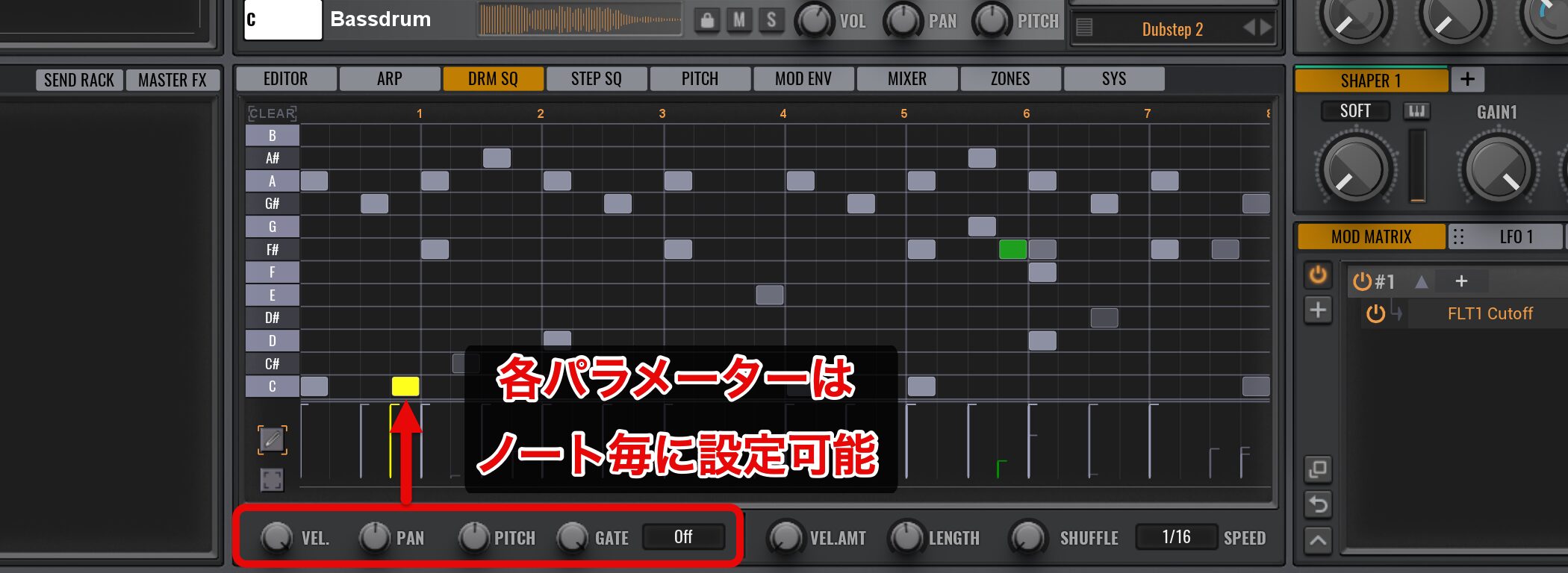
Of the parameters below, the four on the left plus Reverse and Roll (where it says Off) can be set individually for each note you enter.
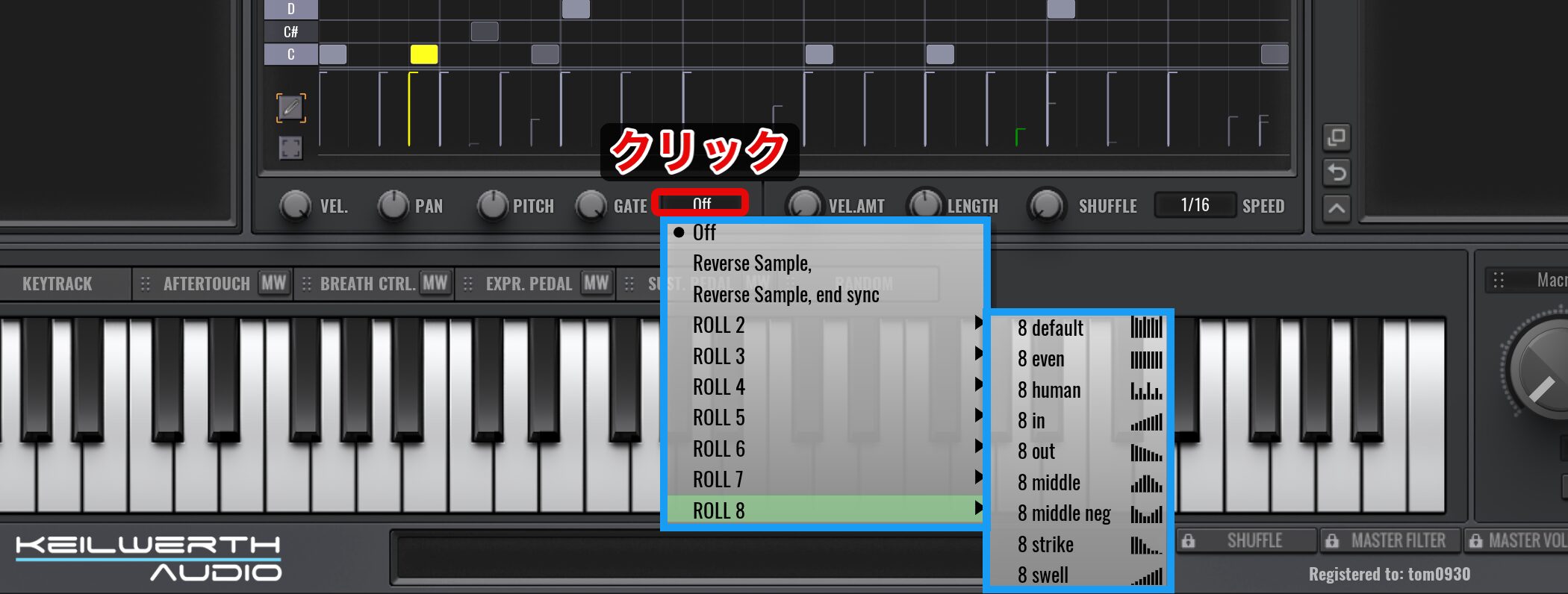
Click where it says Off to apply Reverse and Roll.
With Roll, you can specify the number of repeats and fine nuances.
You can easily create rolls.
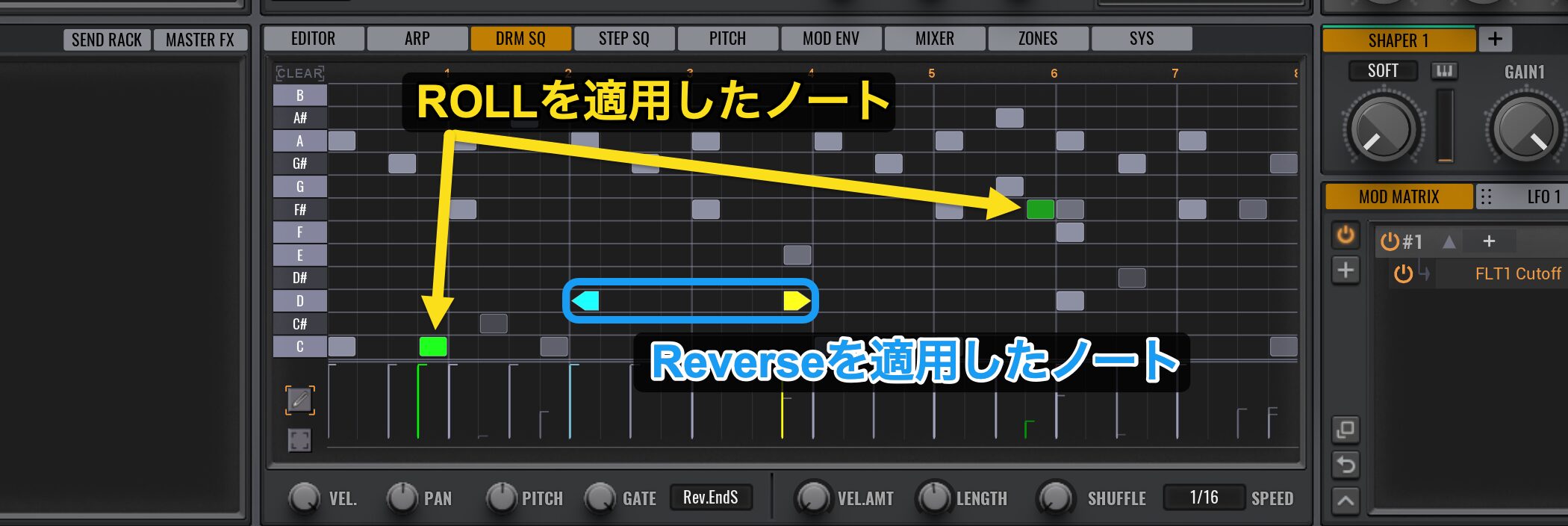
When Roll is on, the note is shown in green.
For Reverse, the shape of the note changes, so it is easy to tell.
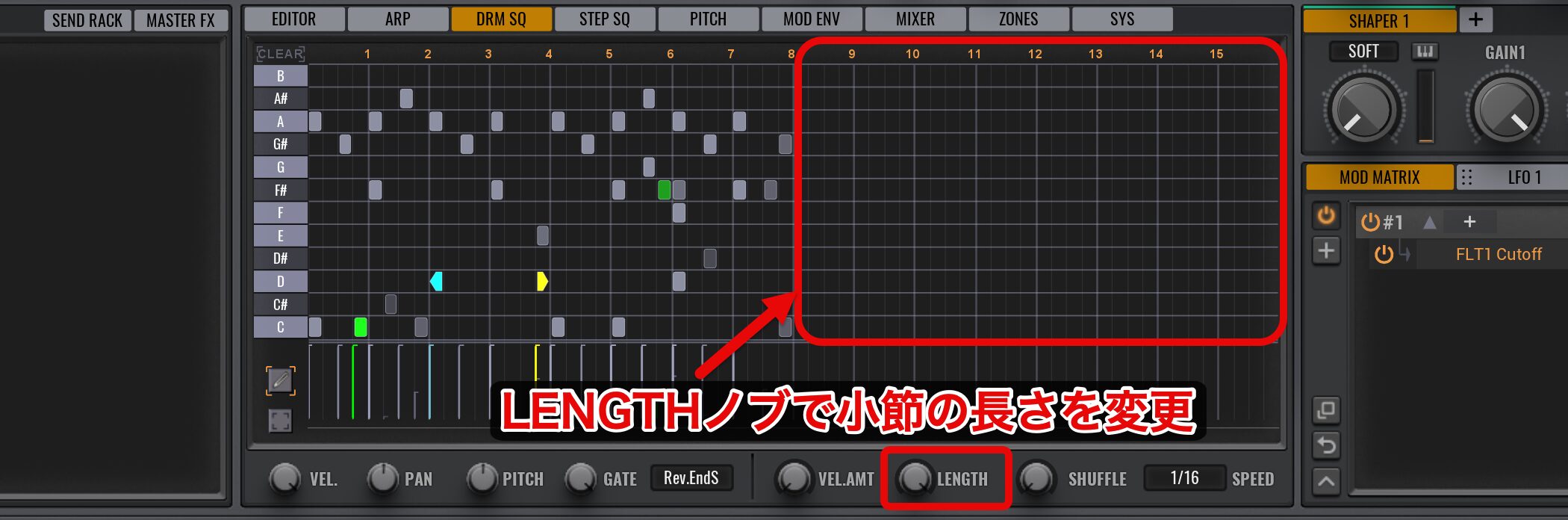
The current pattern is two bars long, but sometimes you may want to change the length.
From "LENGTH" below, you can easily change the number of bars.
Duplicating patterns (the Repeat function)
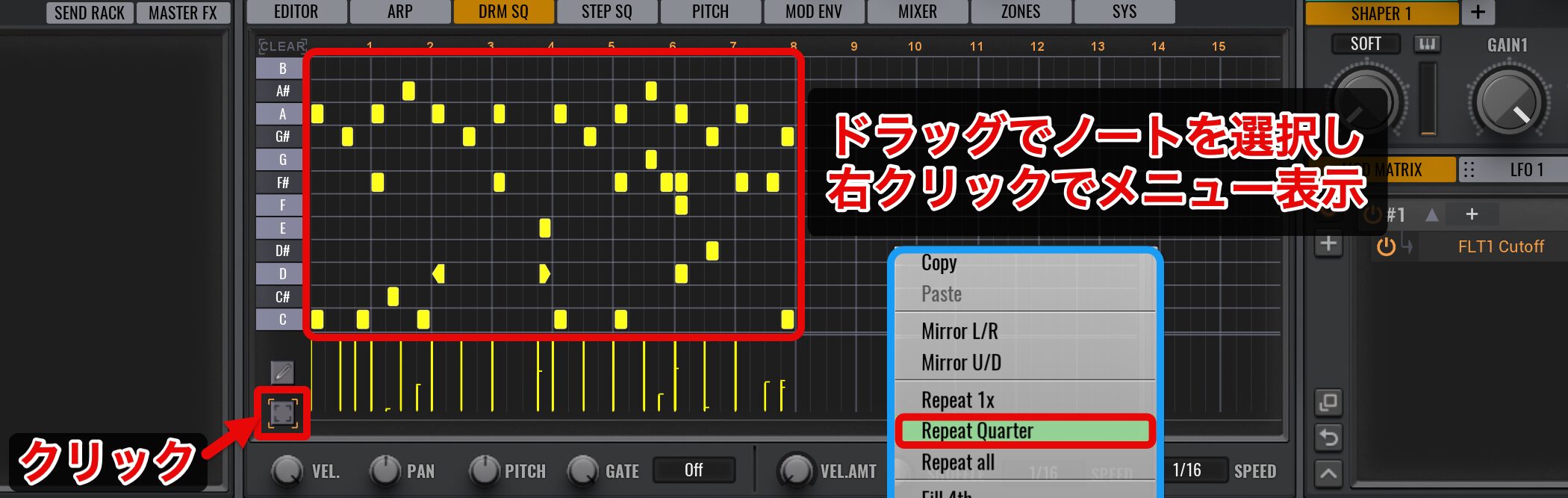
To duplicate a pattern you have created, click the box below the pen tool and drag over the range you want to duplicate.
Right-click anywhere and select "Repeat Quarter".
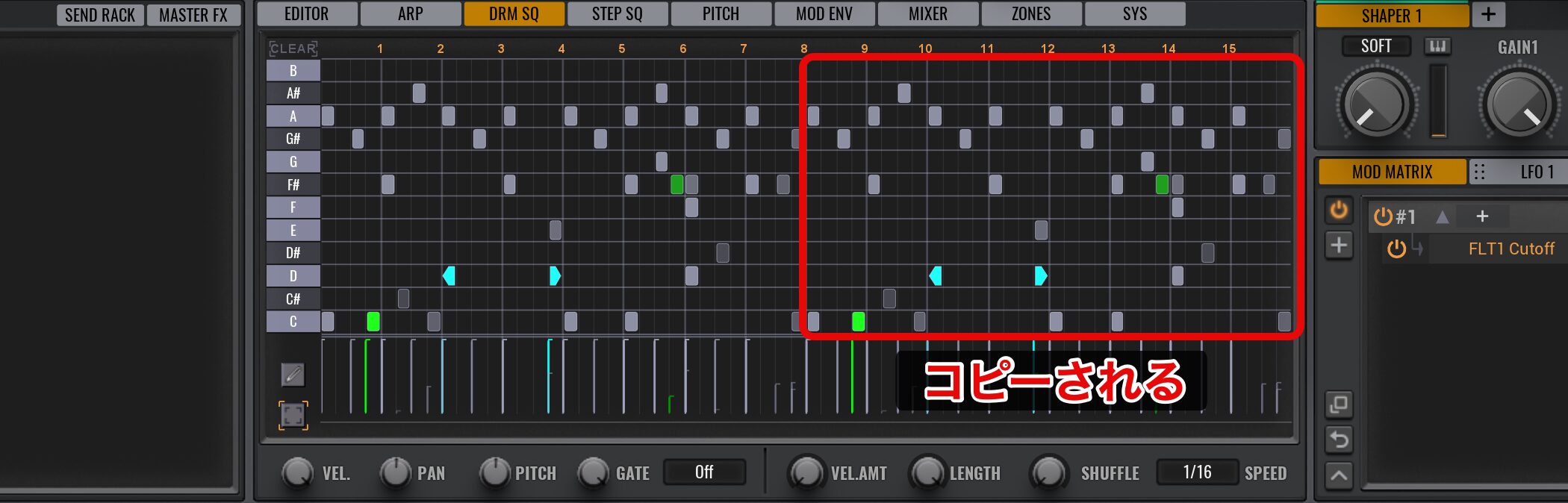
It is duplicated easily like this.
There are three types of duplication:
- Repeat 1×
- Repeat All
- Repeat Quarter
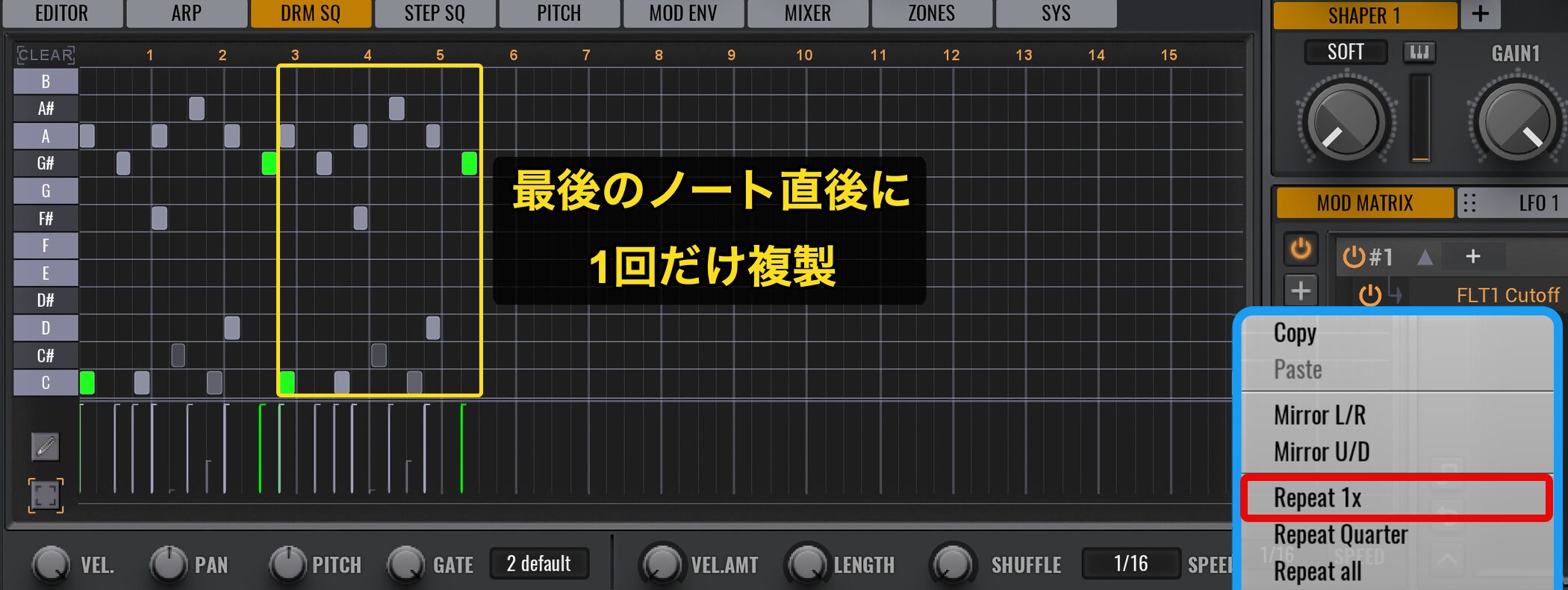
"Repeat 1×" duplicates the selection once, immediately after the last note.
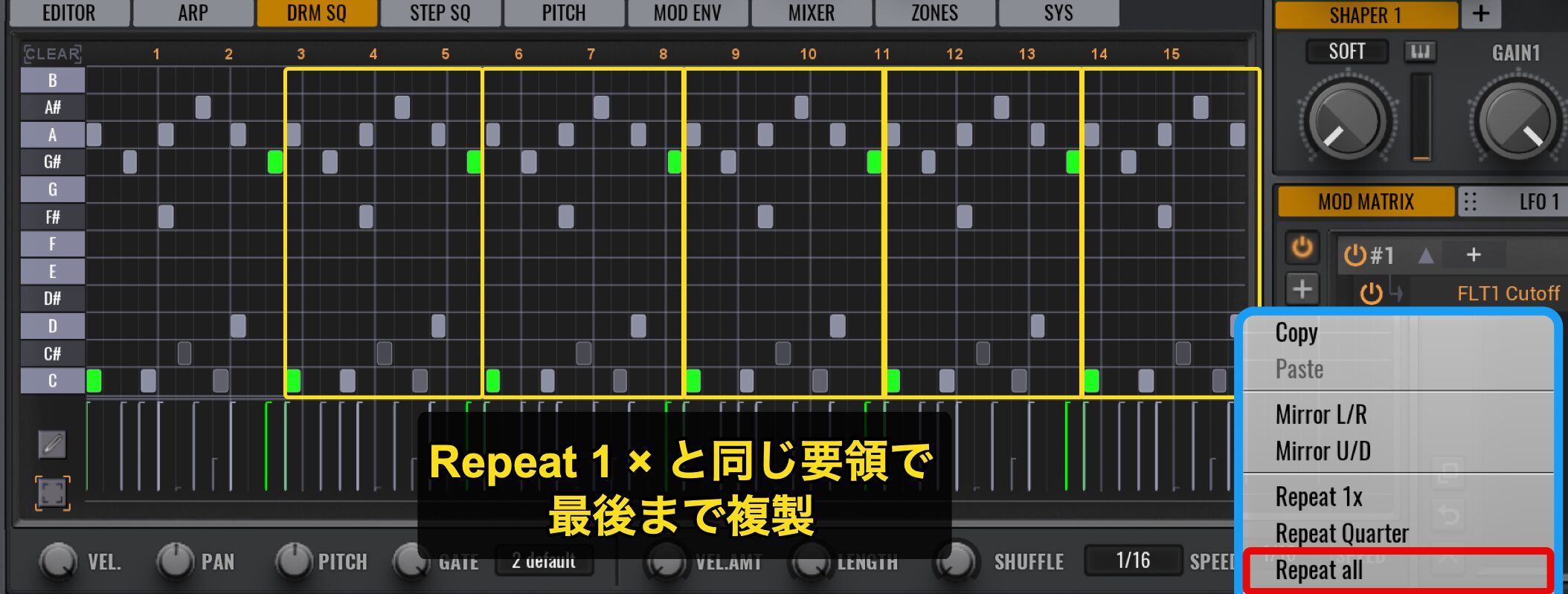
"Repeat All" works the same way as Repeat 1×, but the pattern is duplicated to the end of the bar.
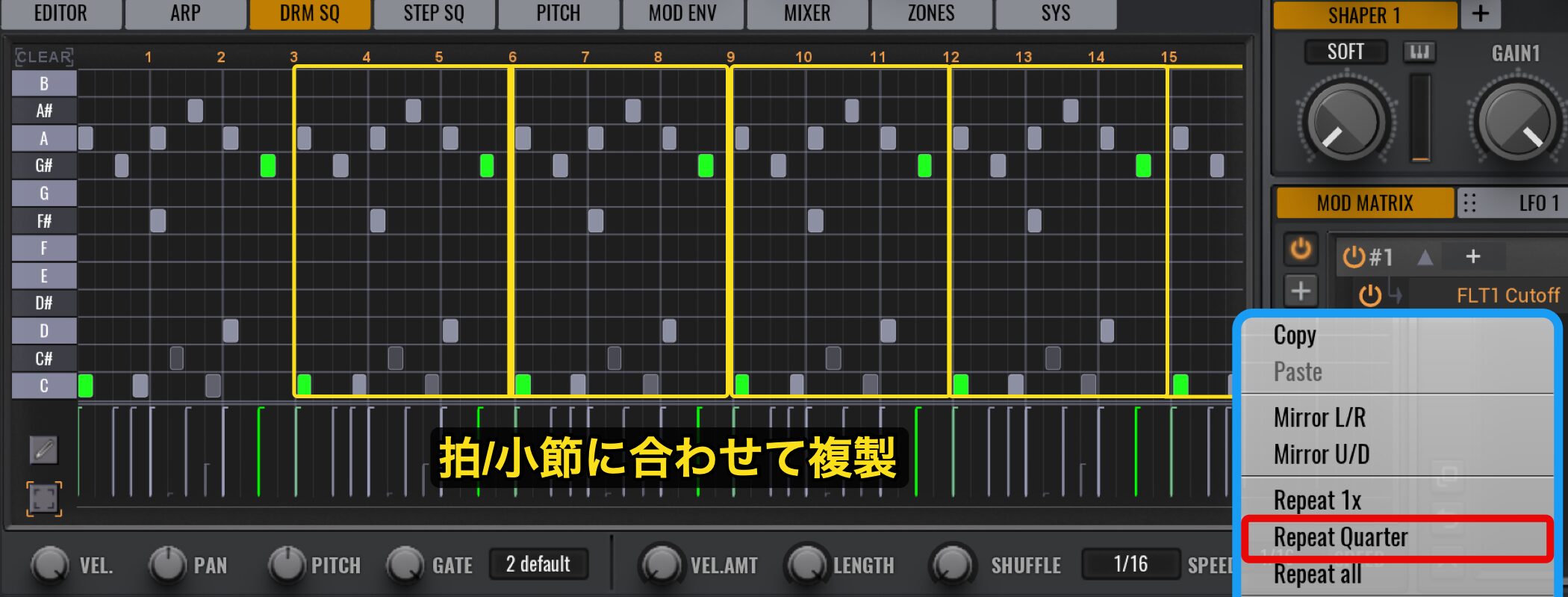
"Repeat Quarter" duplicates the pattern taking alignment with beats and bars into account.
Saving drum sounds and patterns
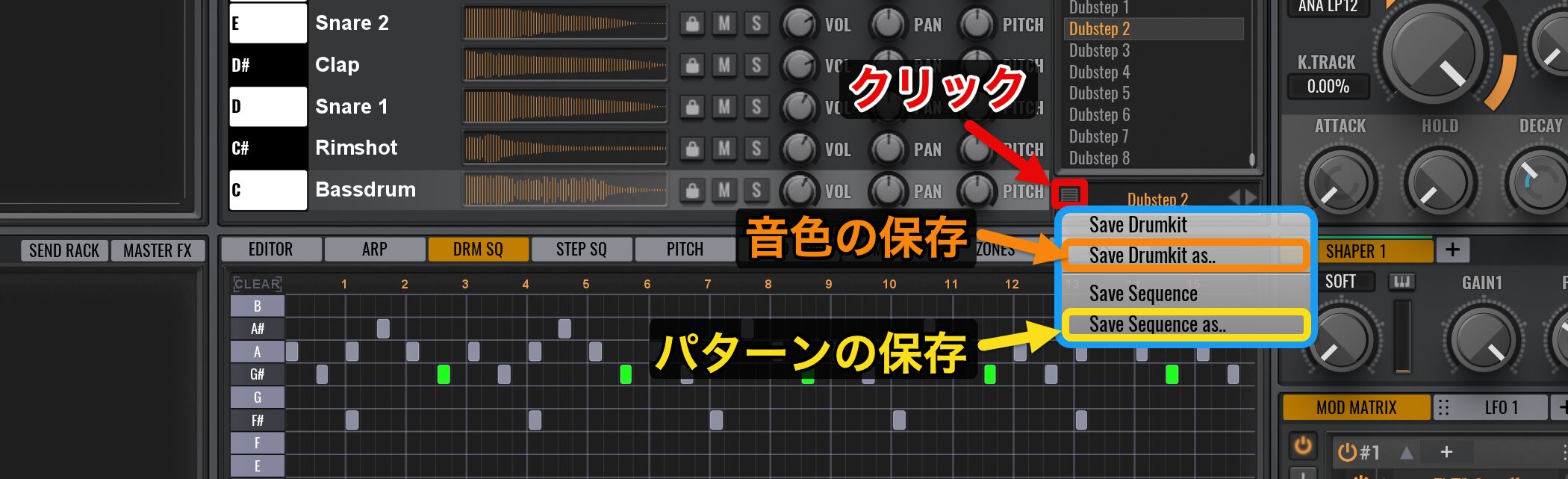
You can also save the sequences and Drums sounds you have created.
"Save Drumkit as" saves the sounds, and "Save Sequence as" saves the pattern.
Routing each kit piece to separate outputs
To polish the beat you have created, you can also apply EQ and compression to each kit piece individually.
This method is called multiple outputs.
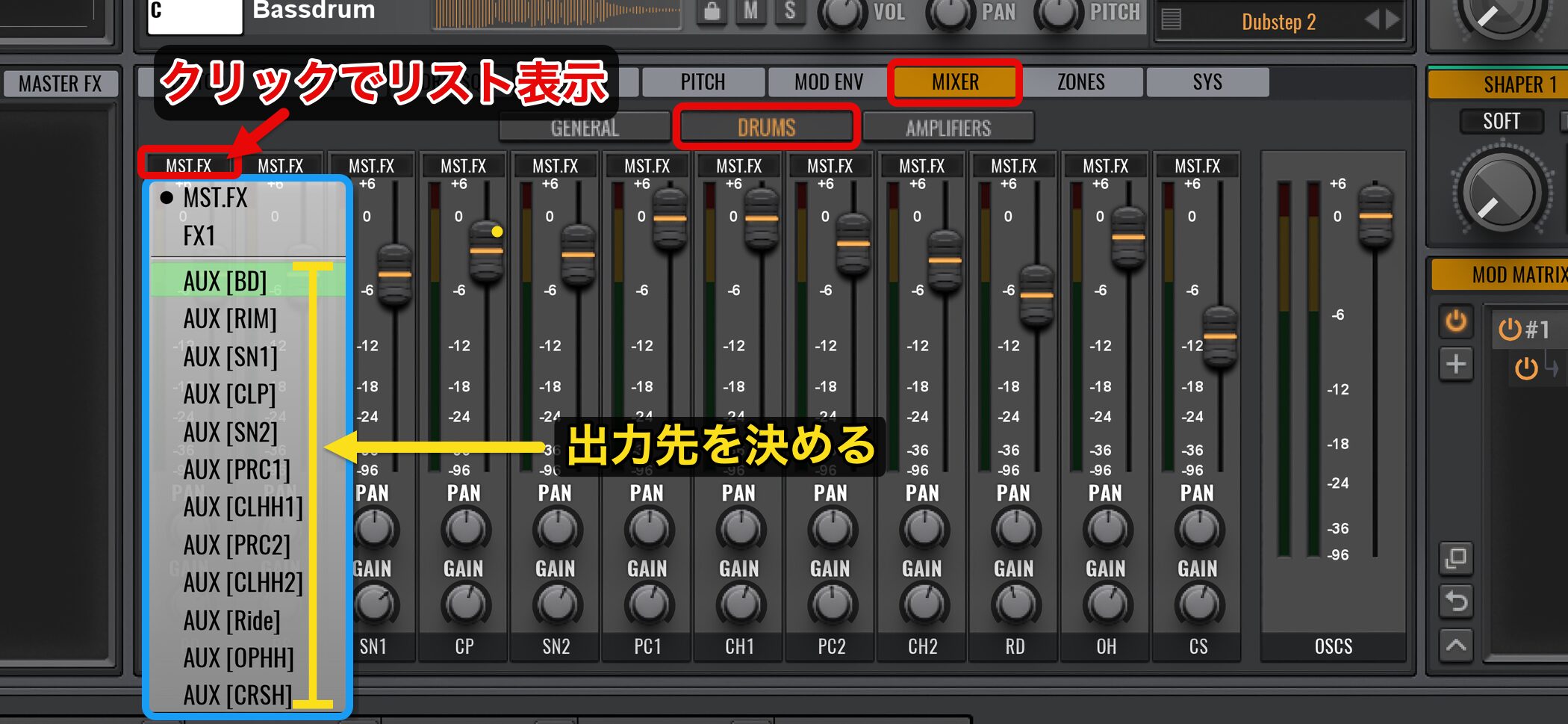
Click the "MIXER" tab and select "DRUMS" in the center.
Click where it says "MST.FX" at the top of each channel and change the output destination; that's all.
Then set up multiple outputs in your DAW.
Routing a soft synth to multiple outputs
Avenger's presets sound good, and many of its sequences can be used as they are.
Using multiple outputs also makes it easier to balance the mix.
You can use it as a loop for a whole song, as an accent in part of a song, or as a beat to shape the image in the early stages of composing; there are many ways to use it.
Control the oscillators to get closer to the sound you want
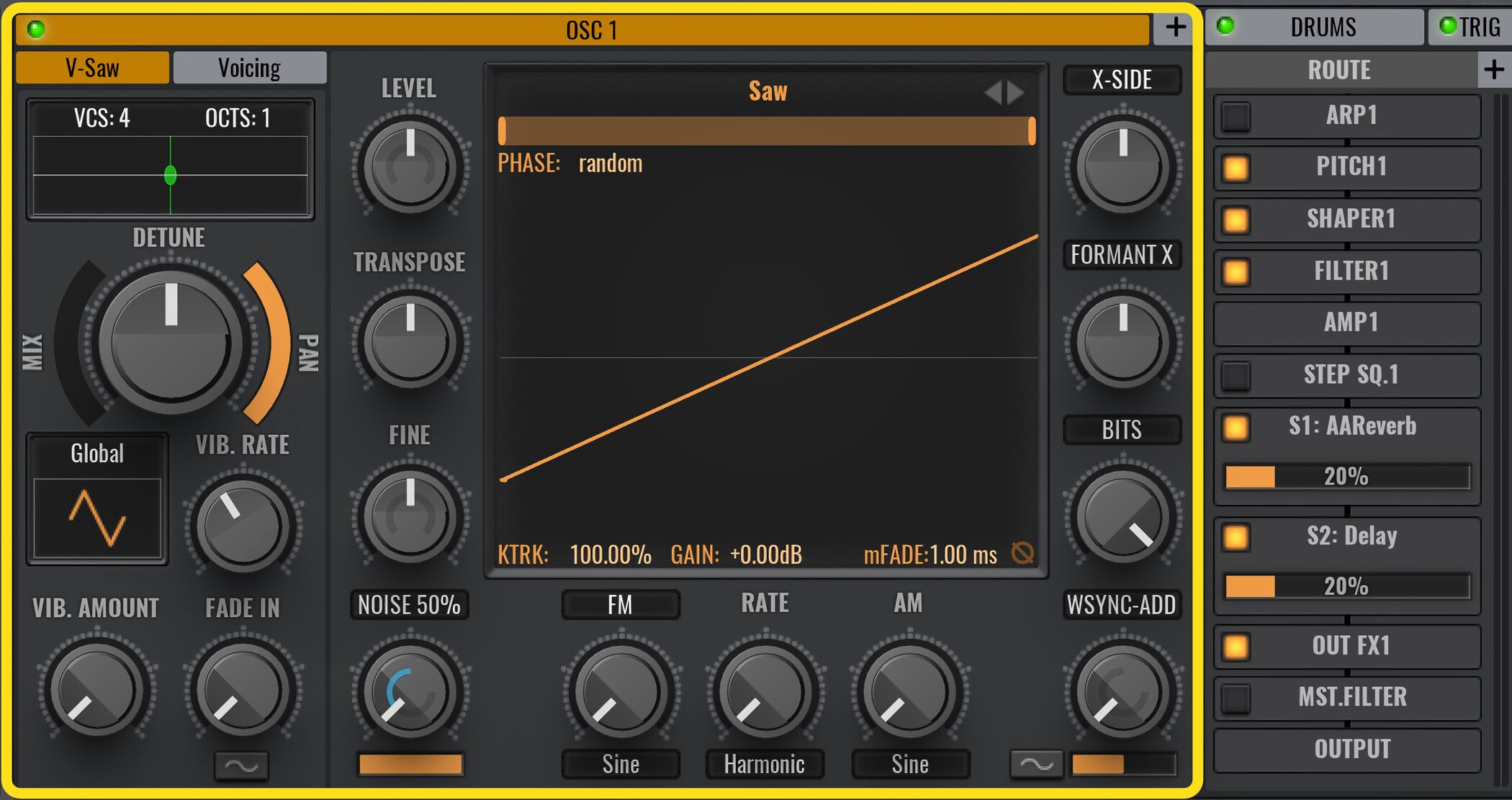
Next, we explain Avenger's powerful oscillator (OSC) section.
How you handle the oscillators, which are the basis of the sound, greatly changes the sound.
Let's learn it well so you can quickly get close to the sound you want.
Avenger video: OSC control, waveforms, voices and portamento
Choosing oscillator waveforms and unison
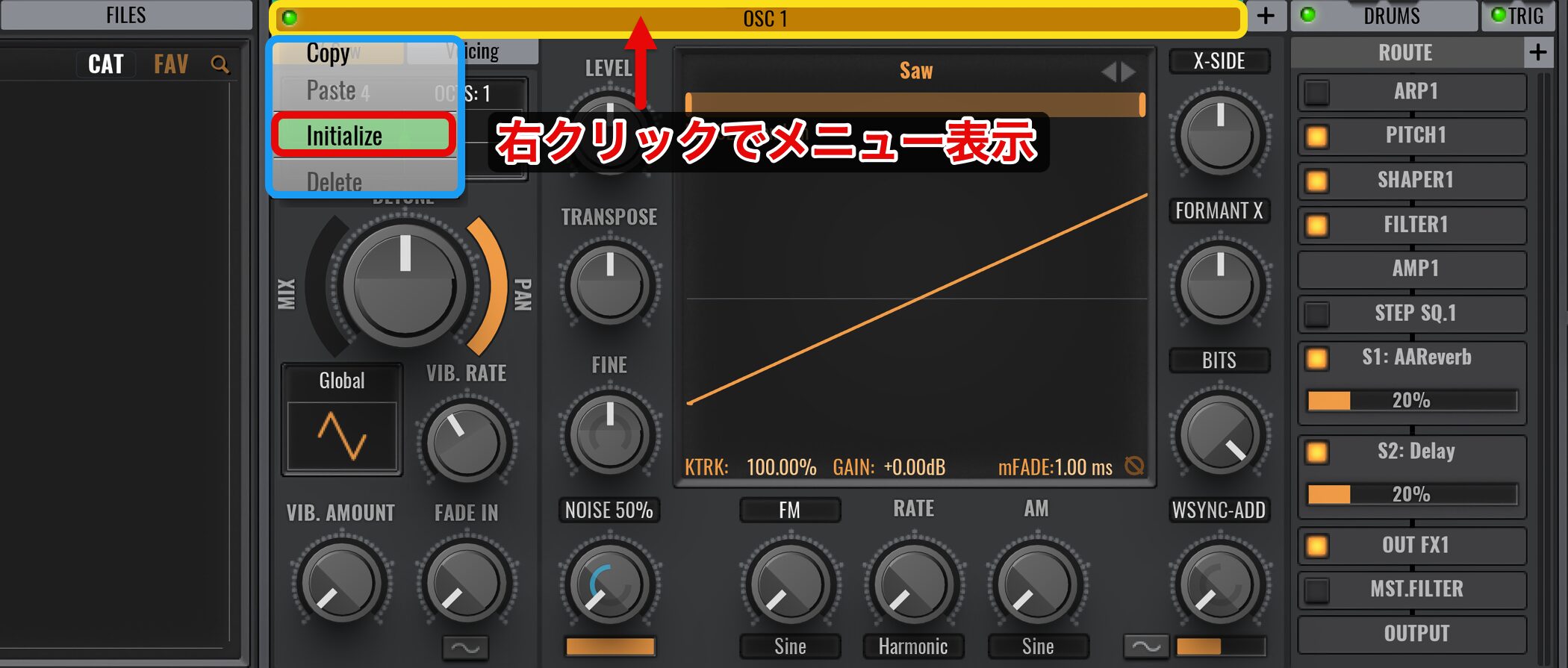
As mentioned at the start, reverb and delay are applied to the sound by default.
To remove them, right-click the "OSC" tab and select "Initialize".
Now you can play a pure, uncolored sound.
Creating a SuperSaw
The default oscillator has Saw selected, so let's use it as it is and create a SuperSaw backing part.

We have already programmed a rhythmic chord part.
In Avenger, you can easily create a SuperSaw.
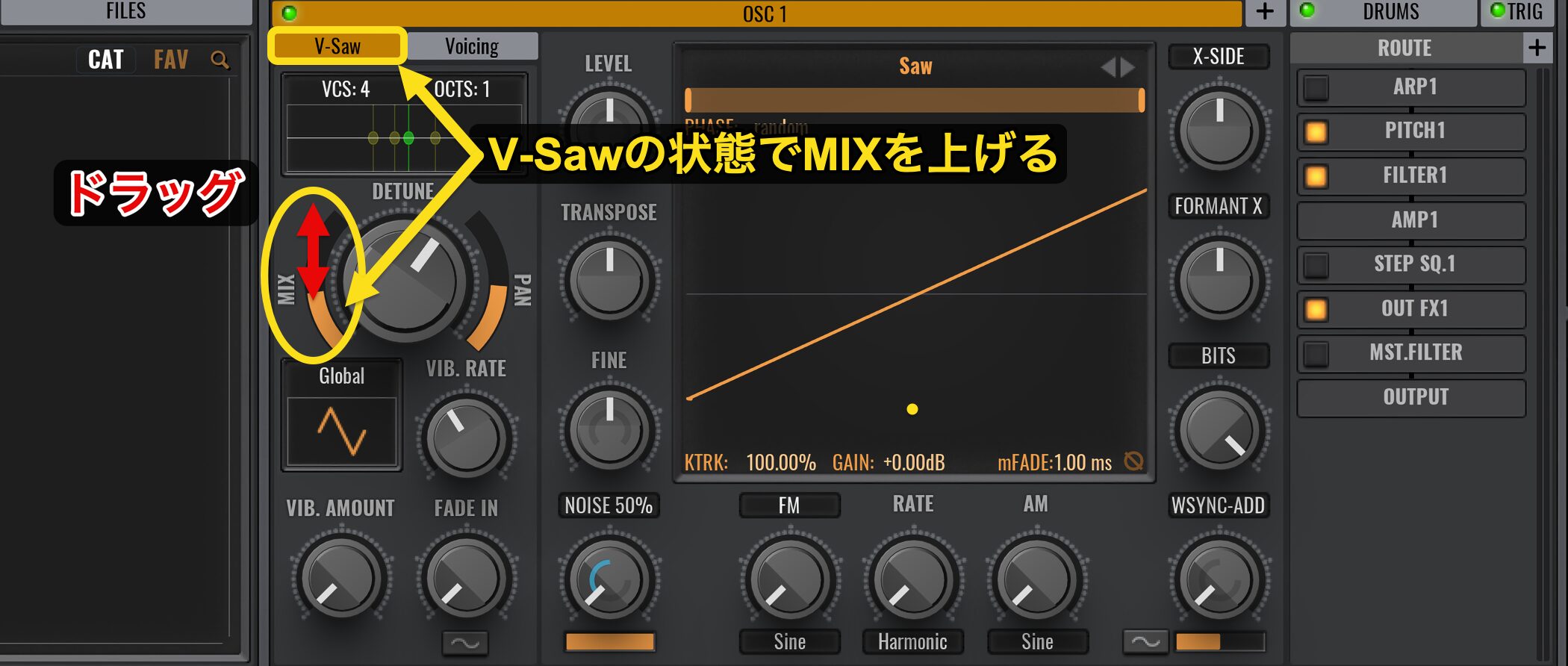
Just raise MIX with V-Saw selected.
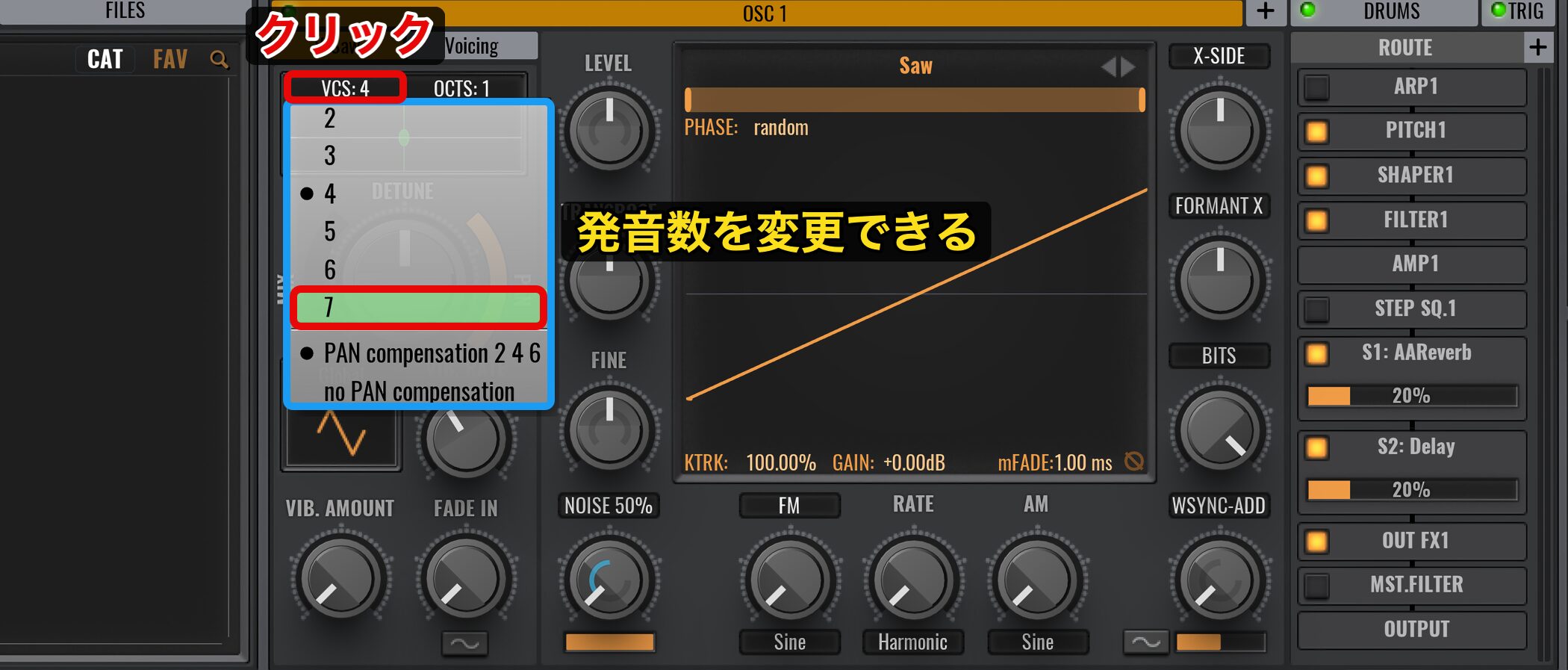
Click "VCS" to change the number of voices.
The default is 4, so let's set it to the maximum of 7.
That alone makes the sound thicker.
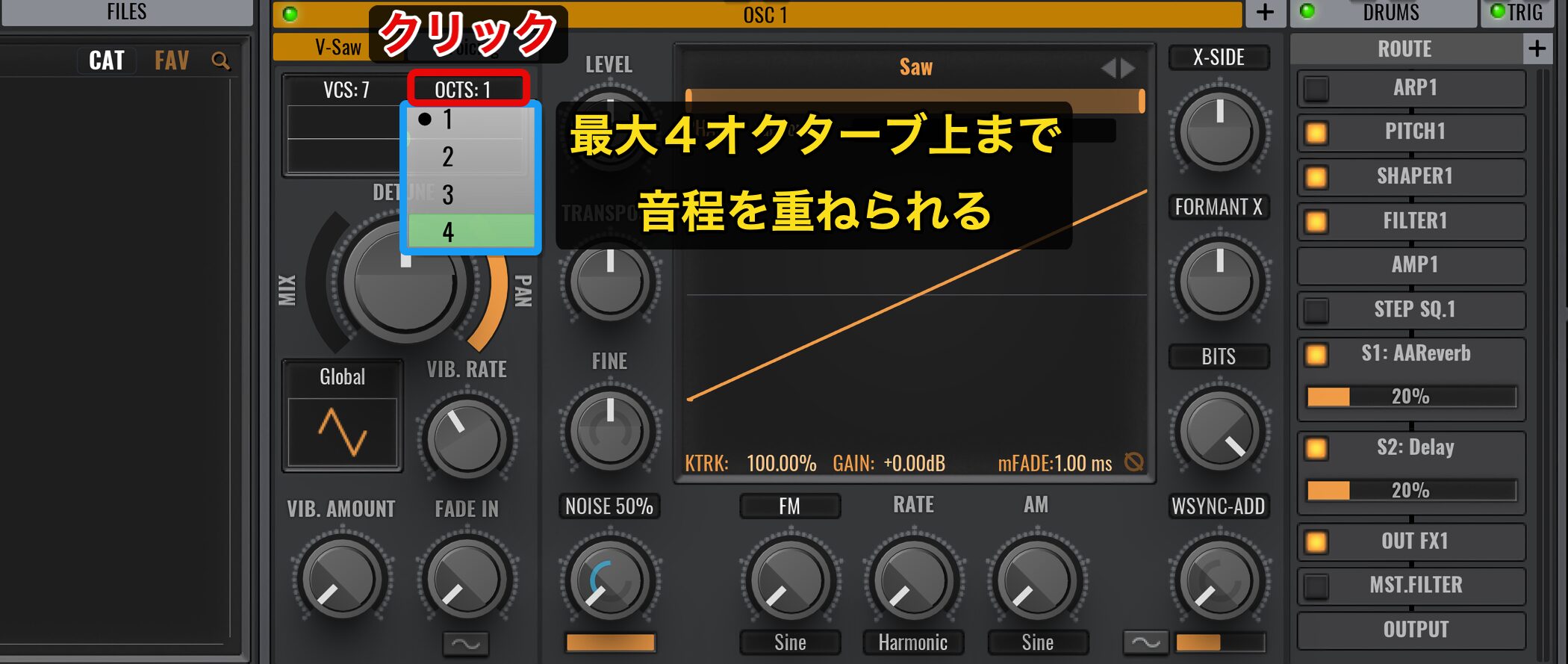
Clicking "OCTS" next to it lets you stack pitches up to four octaves higher.

"DETUNE" adds pitch deviation to the stacked sounds.
If this deviation is too strong, it can sound out of tune, so apply it moderately, somewhere between the 11 o'clock and 1 o'clock positions.
This easily gives you the classic sound.
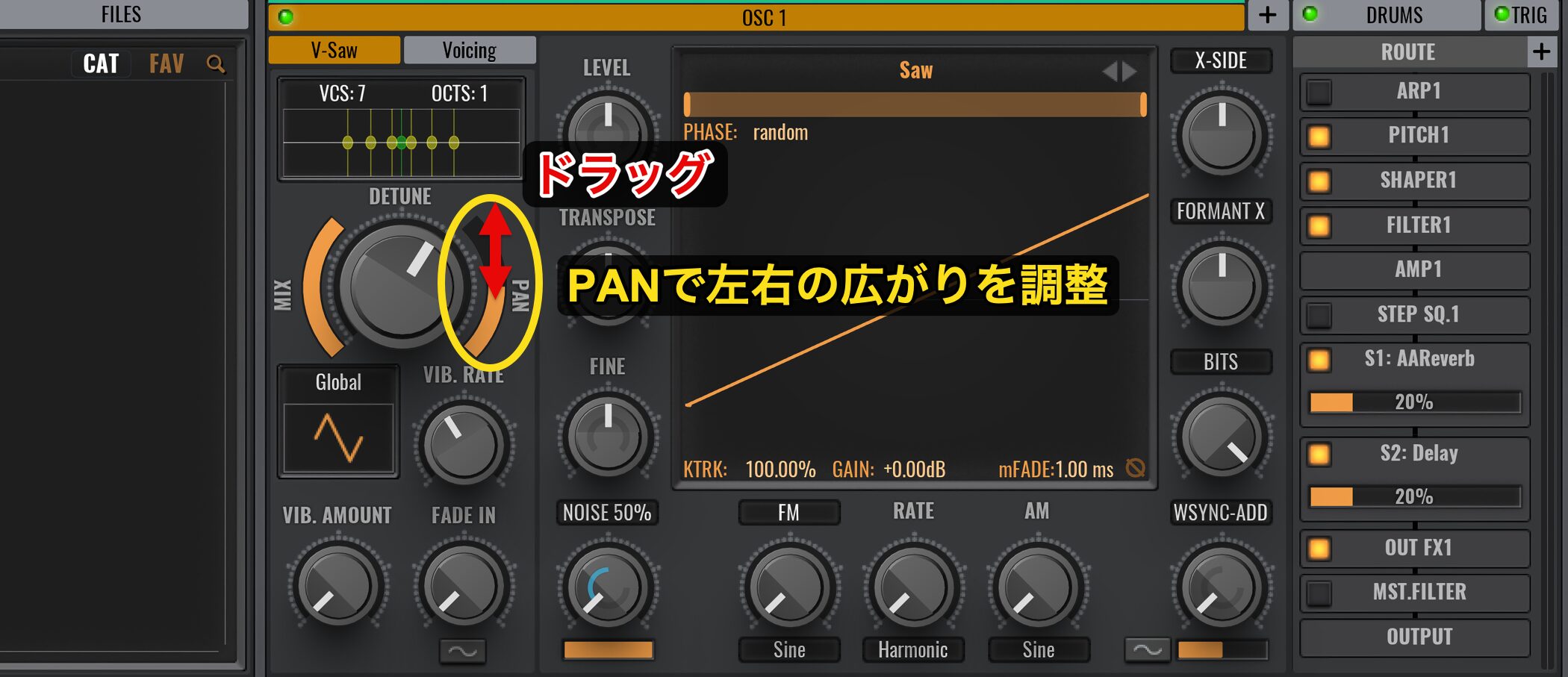
"PAN" next to it adjusts the stereo width.
It spreads out very pleasantly, so use it actively when you want the sound to feel wide.
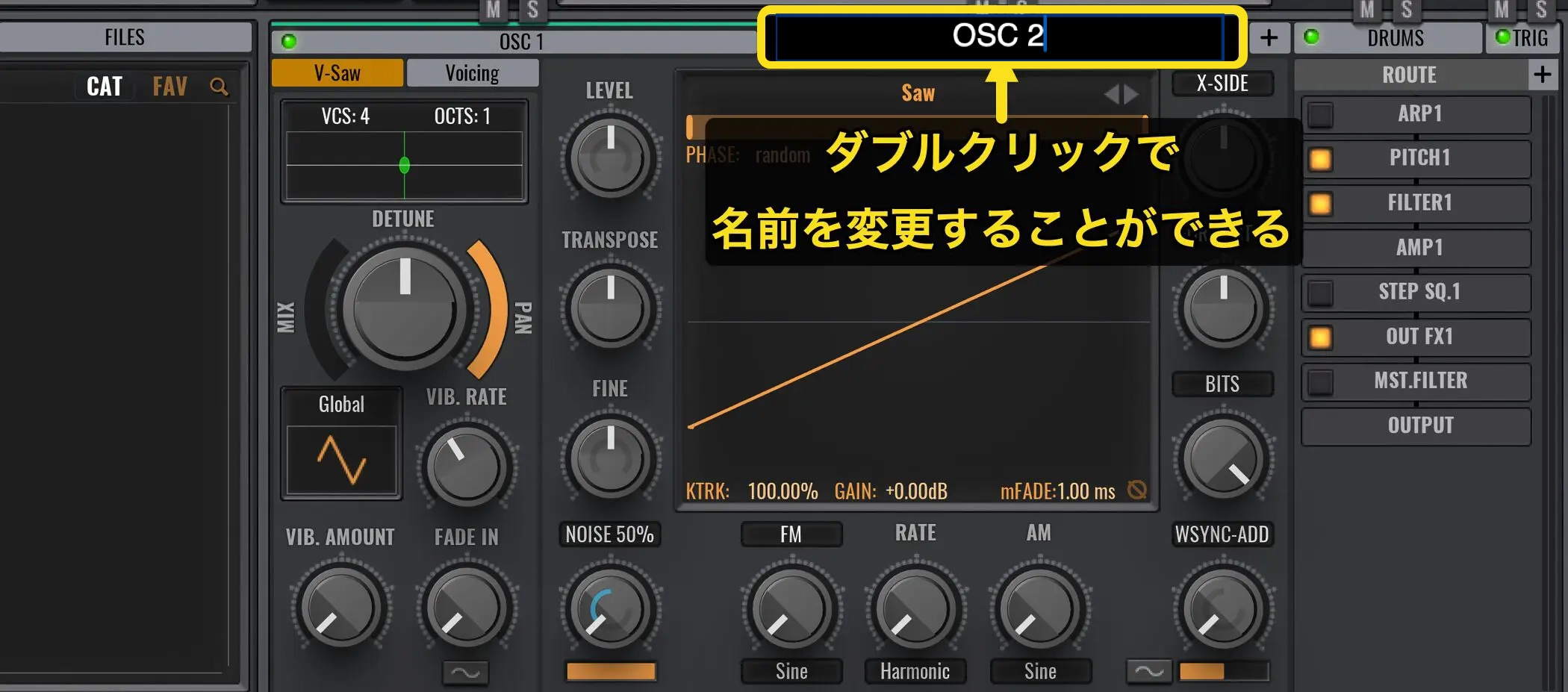
You can rename an OSC tab by double-clicking it.
Let's call it OSC 2.
Adding harmony with CHORDER
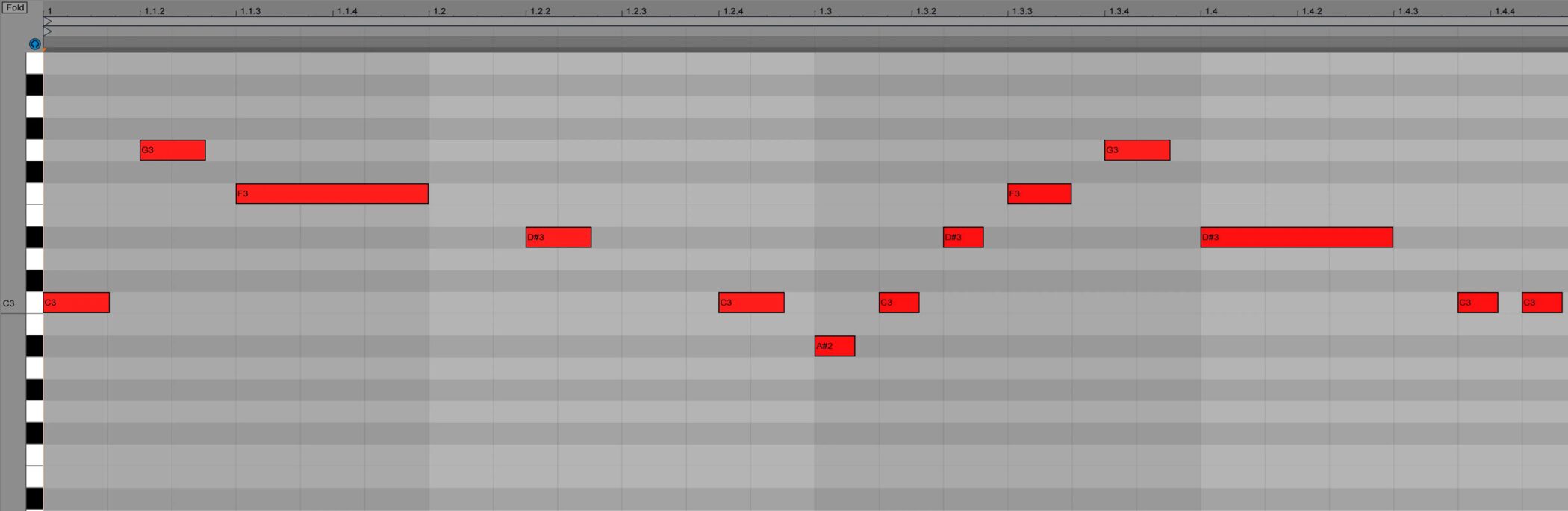
This time we have programmed a single-note lead like this.
It is a single note, but with V-Saw stacking pitches up to 4 octaves higher.
For this sound, let's use a technique that adds a sense of harmony for even more thickness.
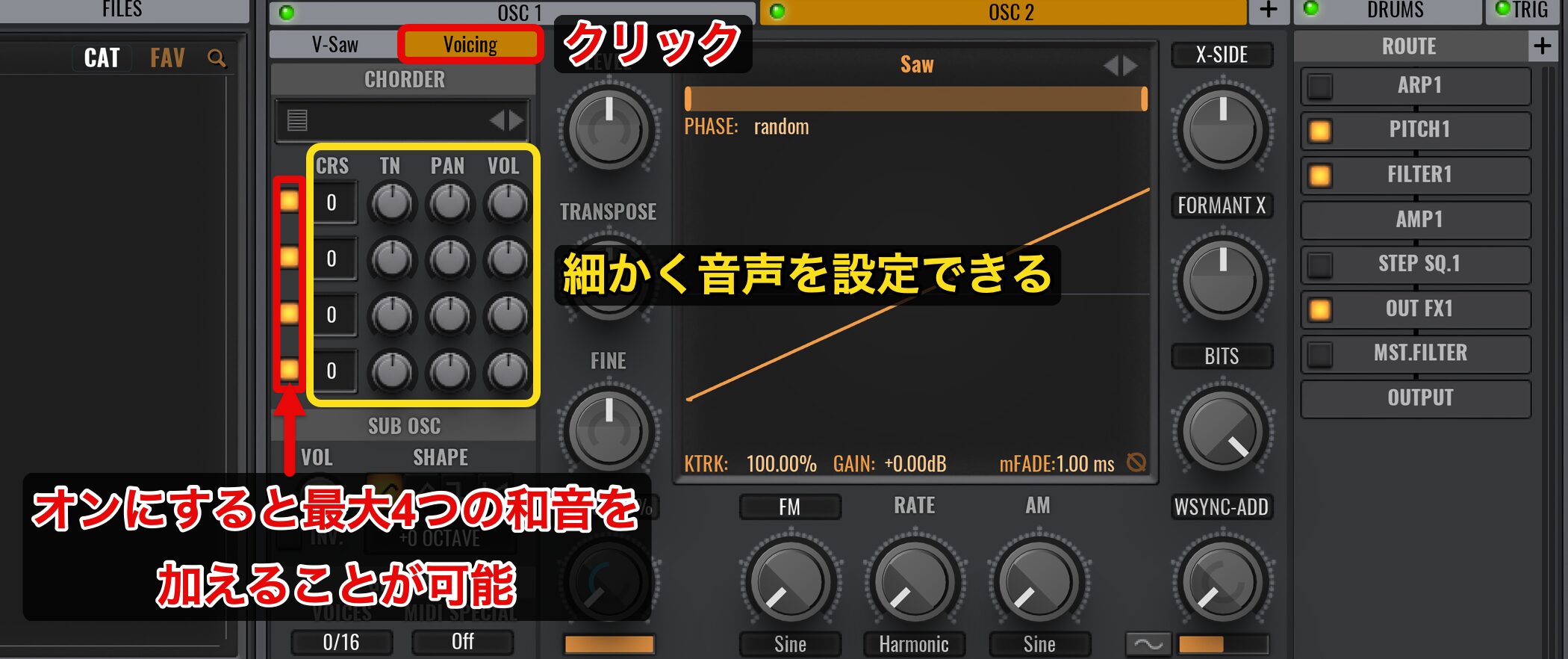
Open "CHORDER" in the "Voicing" tab next to V-Saw.
Turning on the section on the left lets you add up to four chord notes, and each voice can be set in detail.
- CRS = in semitones, changeable within ±24 semitones
- TN = in 1/100 of a semitone
- PAN = left/right panning
- VOL = volume level
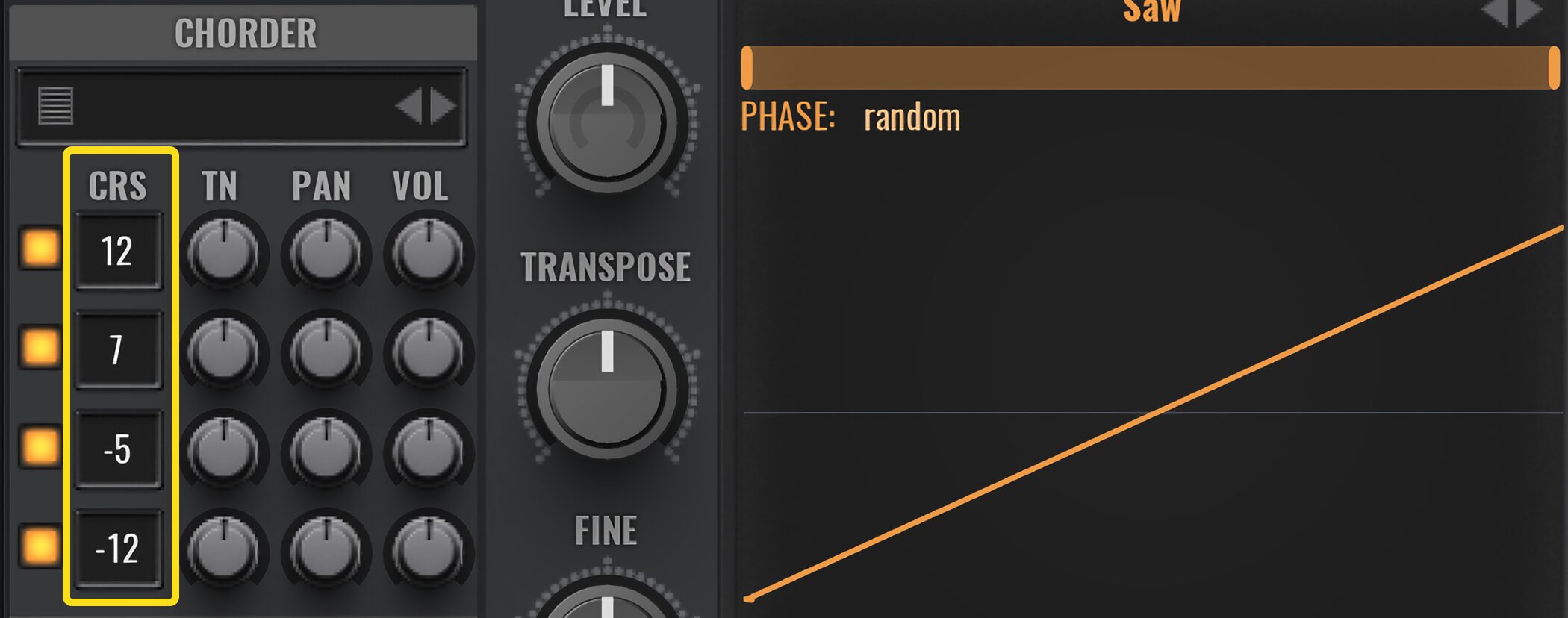
This time we set the pitches as follows.
The top one an octave up: 12
The second a fifth up, regardless of major or minor: 7
The third an octave below the second: -5
The fourth an octave below the original note: -12
Playing the sound like this, the lead also becomes much thicker.
Glide (portamento): smoothly connecting pitches
The "glide" function is used frequently on synthesizer lead and bass sounds.
This glide function refers to a technique that smoothly connects the pitches of notes.
Video: What is glide?
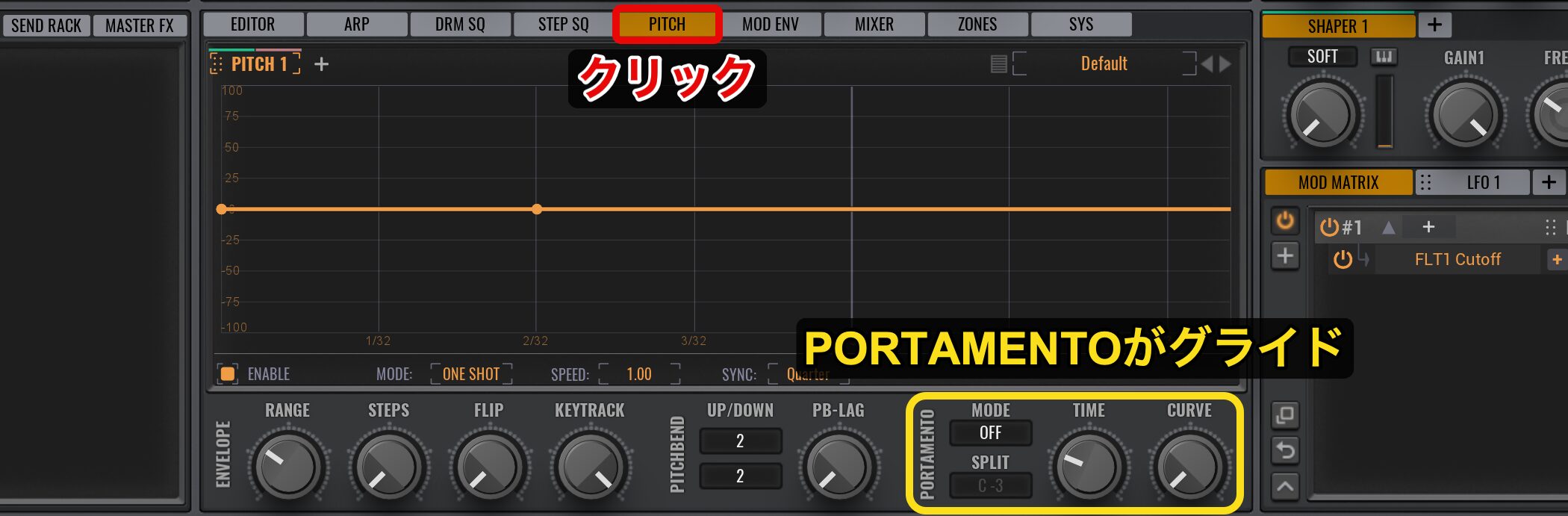
In Avenger, glide is not set in the OSC area.
Click the "PITCH" tab below the OSC area, and "PORTAMENTO" appears at the bottom right of the screen.
This PORTAMENTO performs the role of glide.
Depending on the synthesizer, it is called "GLIDE" or "PORTAMENTO", but the effect is the same.
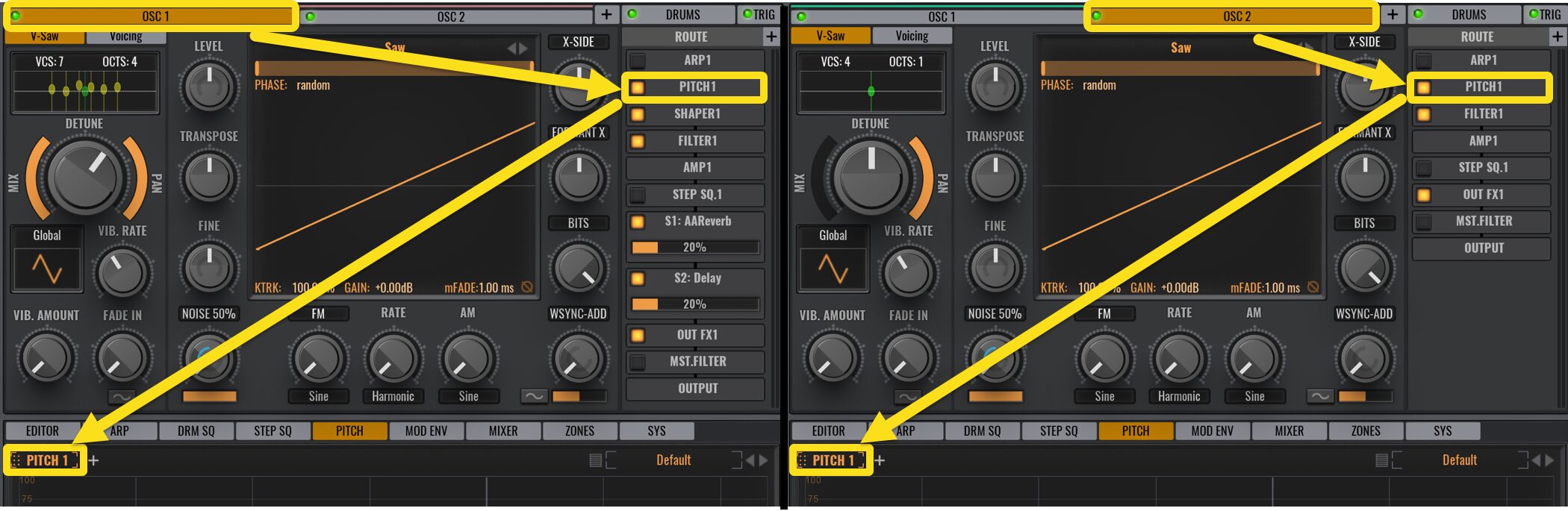
Currently, both OSC 1 and OSC 2 are routed to "PITCH 1".
Here we want to apply PORTAMENTO only to OSC 2, so let's create "PITCH 2".
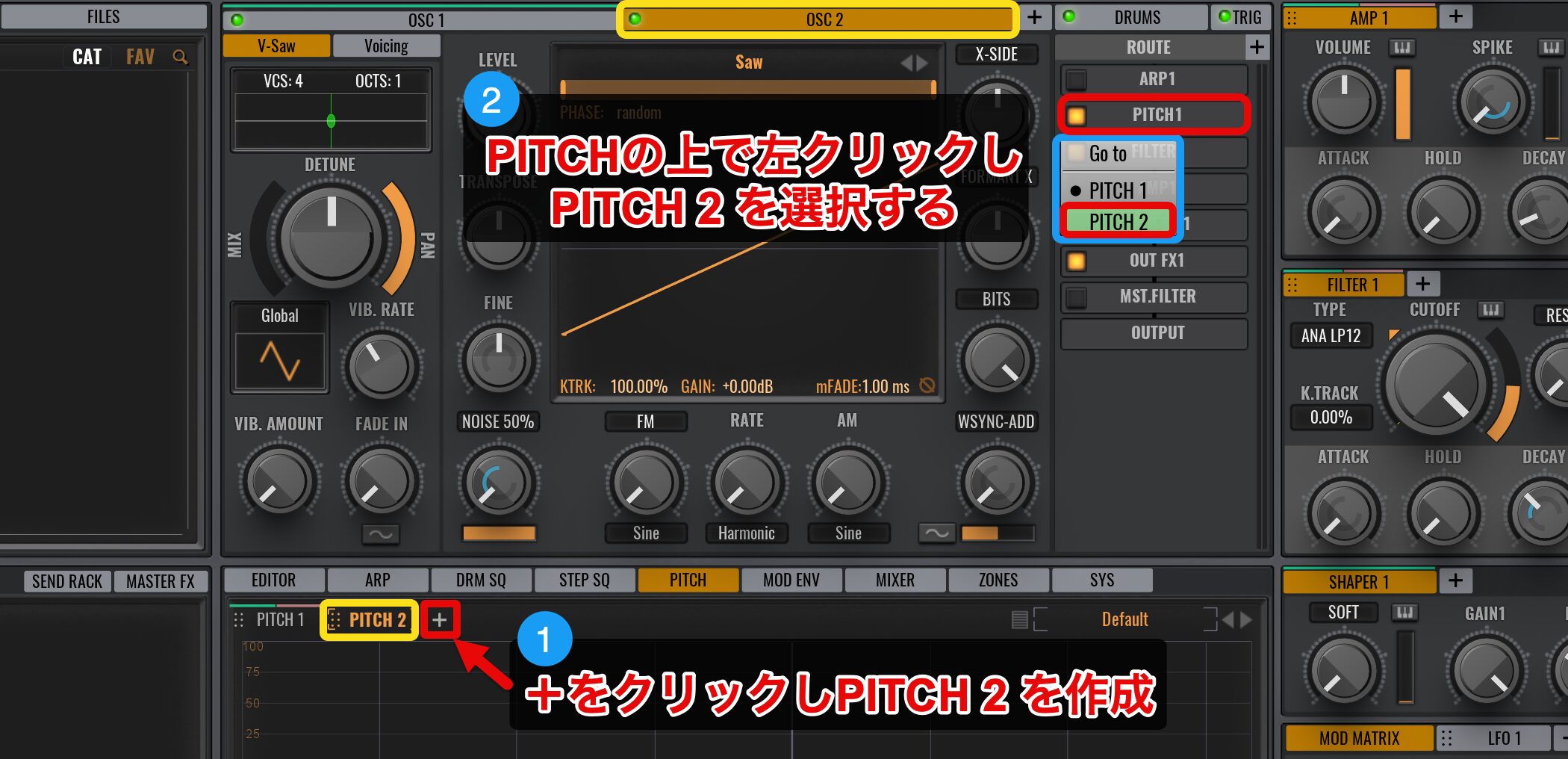
Click "+" to create PITCH 2, then left-click on OSC 2's PITCH and select PITCH 2 from the list.
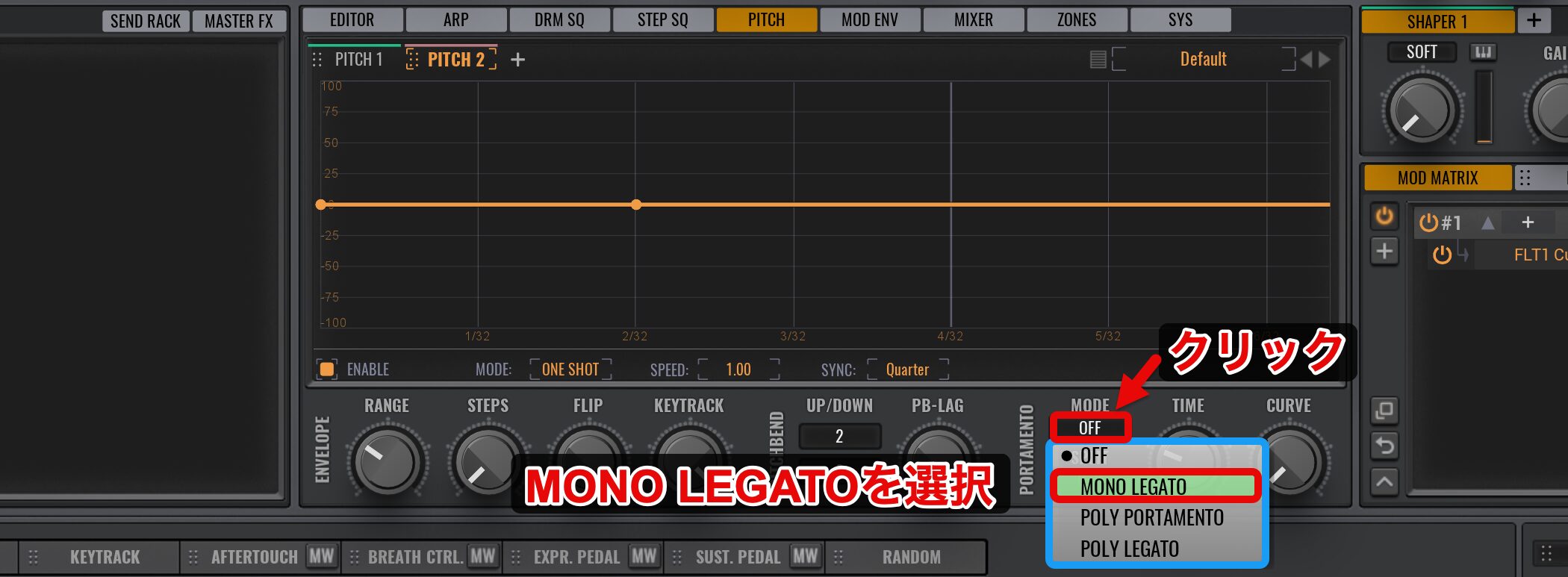
Click where it says OFF in PORTAMENTO's "MODE" and select "MONO LEGATO".
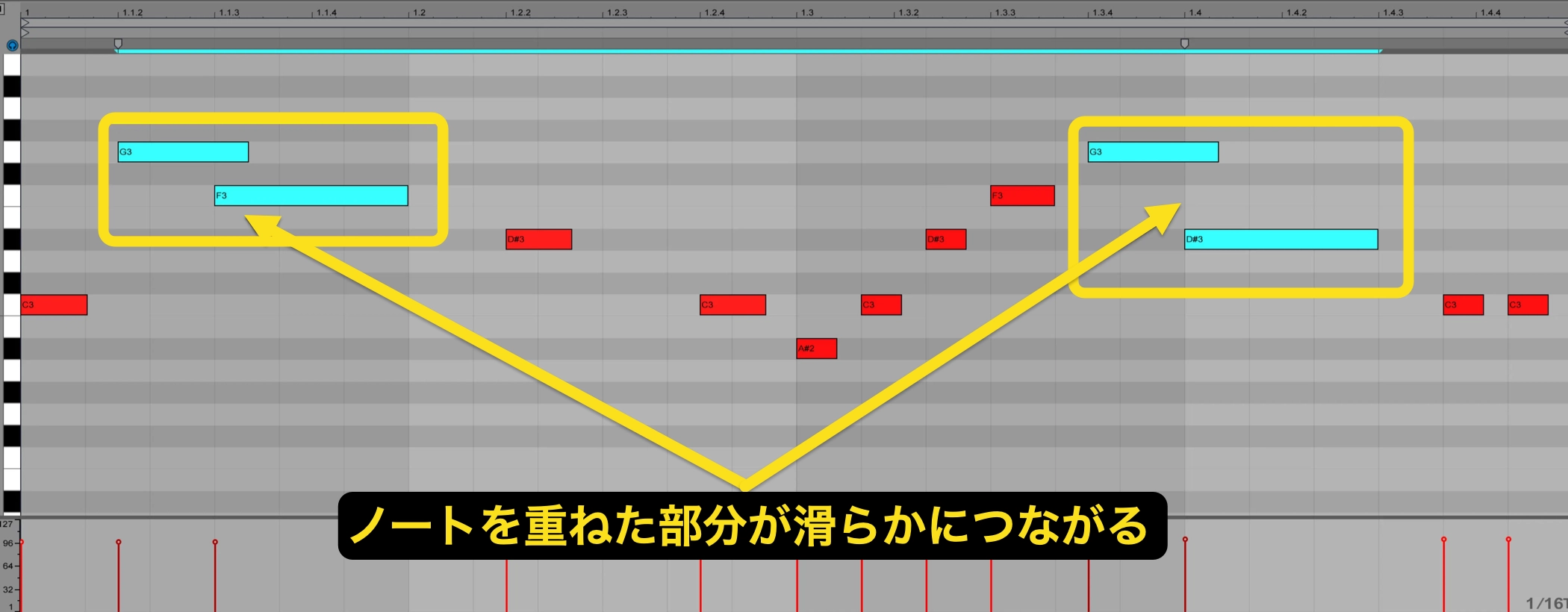
With LEGATO, only the pitches where notes overlap are smoothly connected.
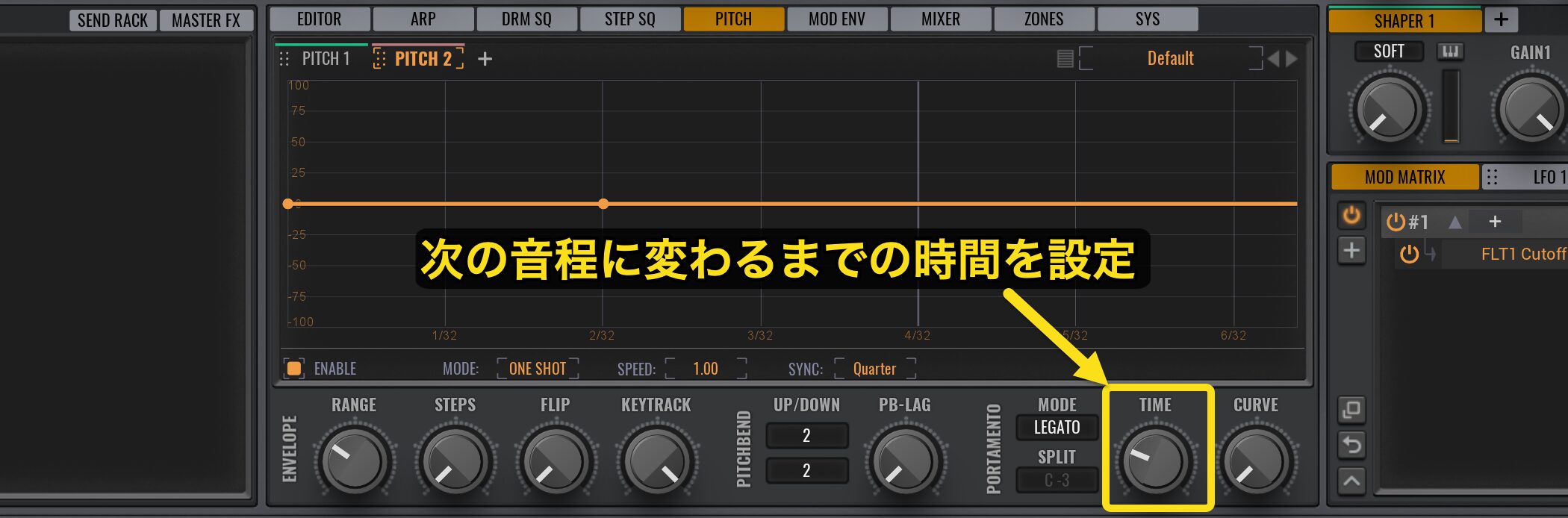
Another important point is that you need to set the time of the pitch transition.
The transition time is set with "TIME".
If you set the value too high, the pitch transition won't finish in time and the next note will sound.
Consider the song's tempo and nuance and look for the best timing.
V-Saw makes a Super Saw easy, and CHORDER adds a sense of harmony.
It's wonderful that all this can be done with a single oscillator.
Sound design using the powerful Wavetable Editor
Wavetables are indispensable in today's electronic music.
Avenger has a powerful Wavetable Editor, so you can easily create rhythmic synth sounds without using modulation such as LFOs.
Let's look at how to edit.
Avenger video: Using wavetables
How to use the Wavetable Editor
Presets are provided for wavetables.
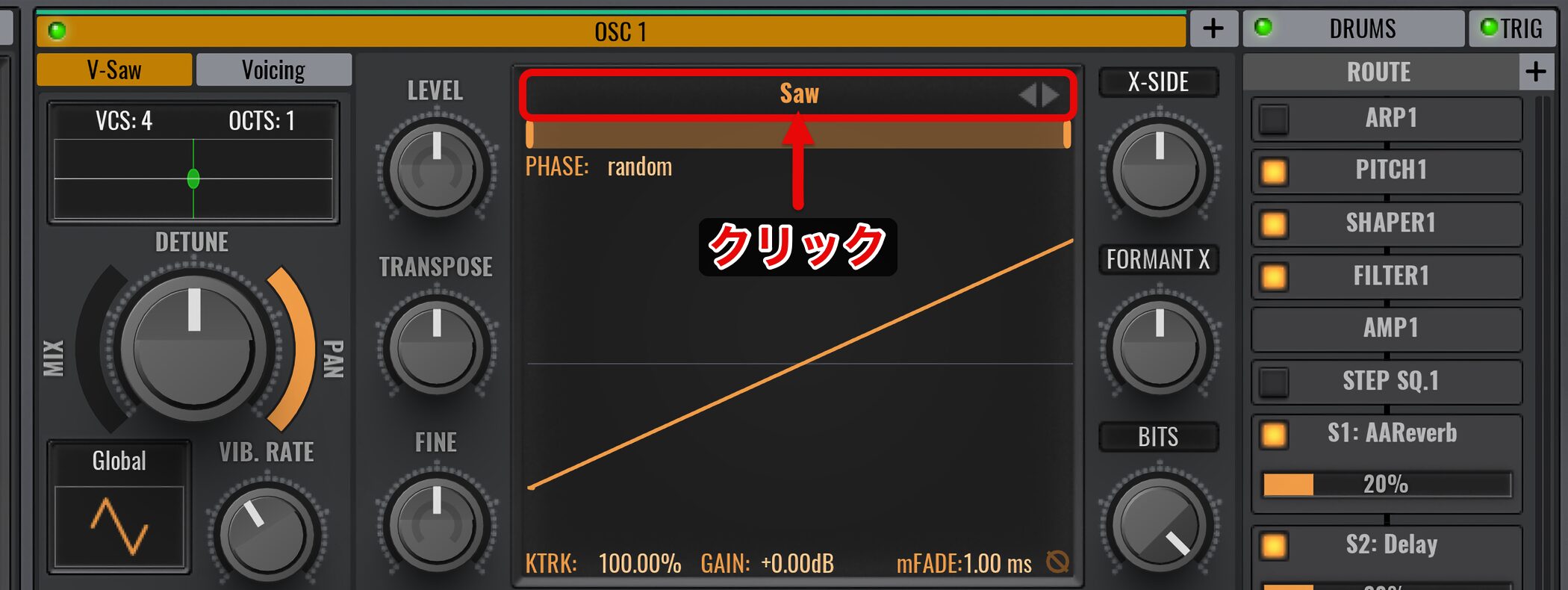
Click where it says "Saw" to bring up the presets.
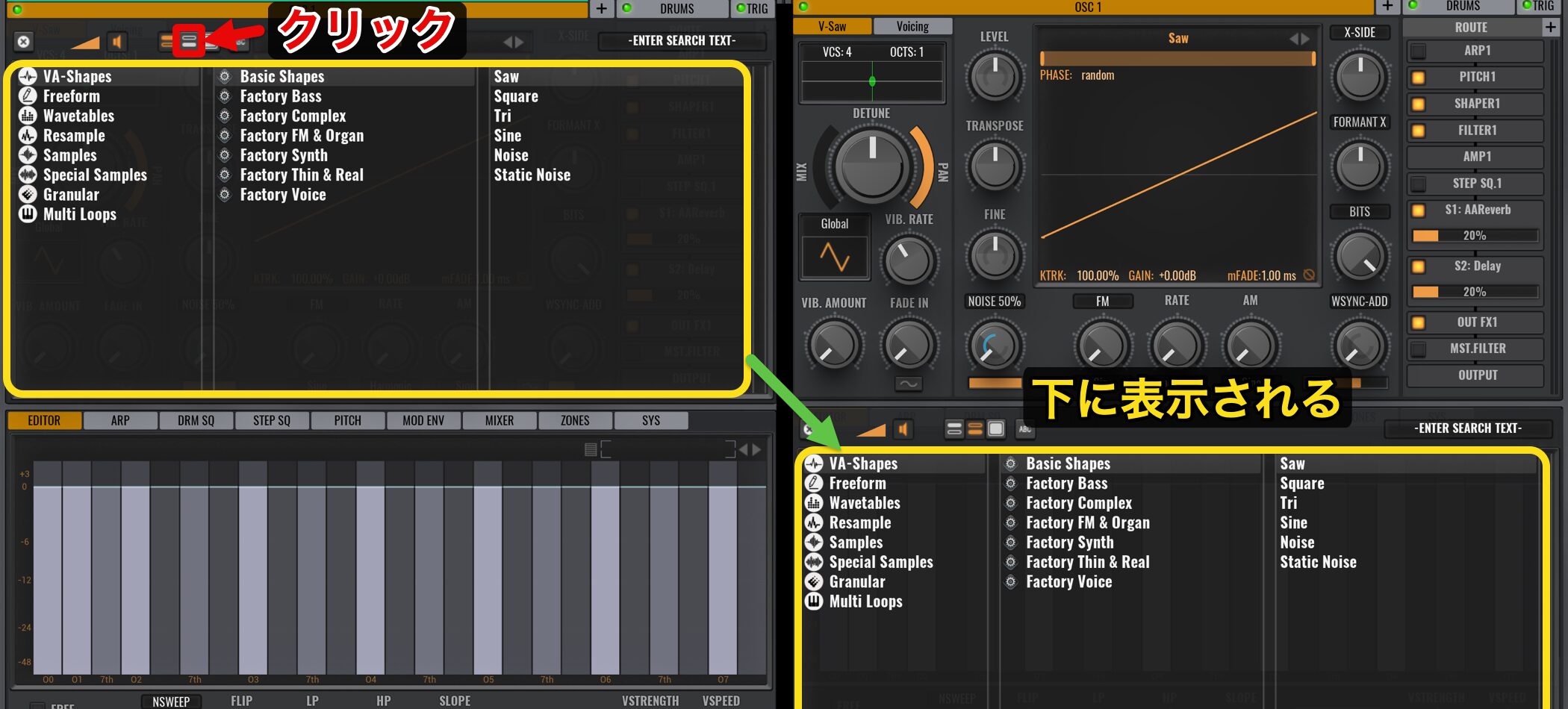
If the preset menu is shown at the top, click the display toggle icon (the icon with two horizontal lines in the middle) to switch it to the bottom.
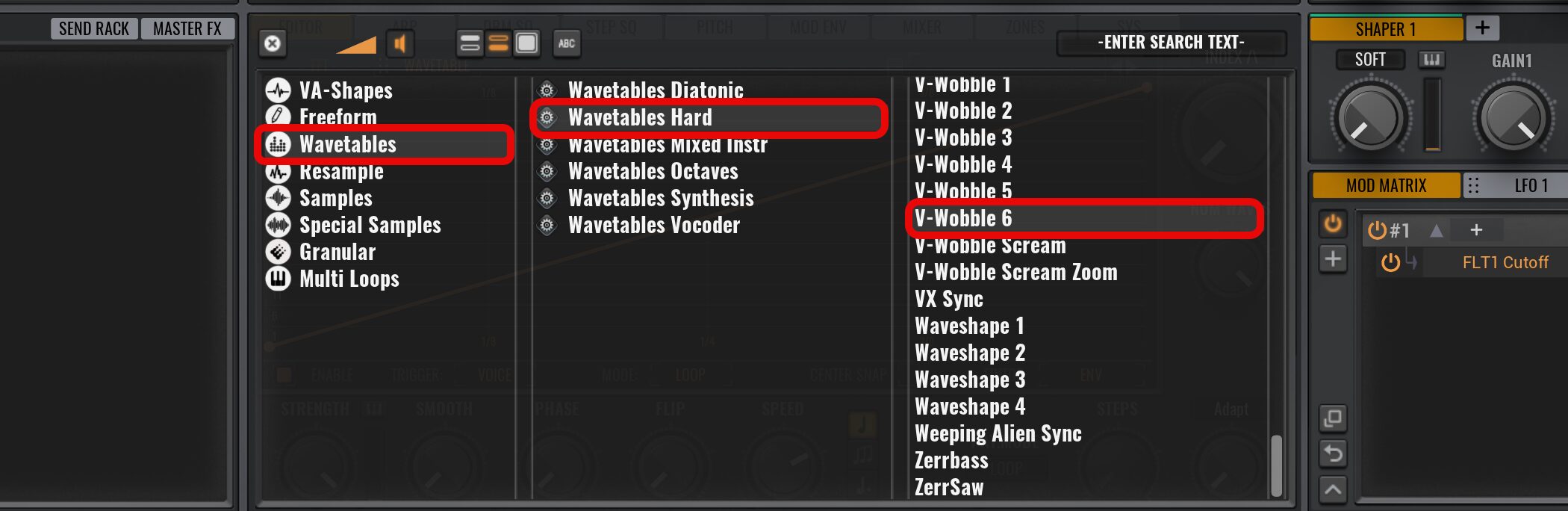
By selecting Wavetables, you can search each preset.
Double-click a preset name to load the one you want.
Here we selected "V-Wobble 6" from "Wavetables Hard".
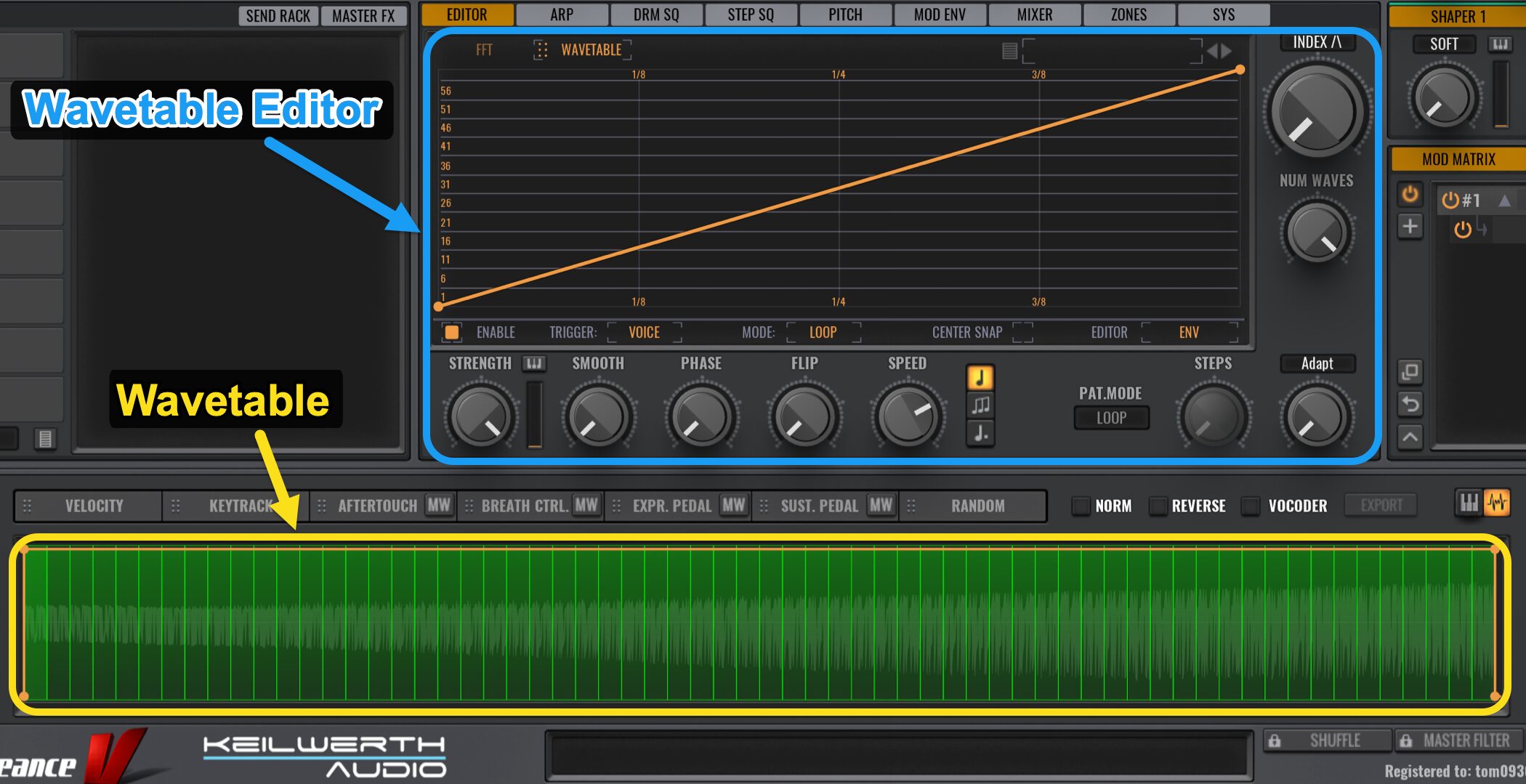
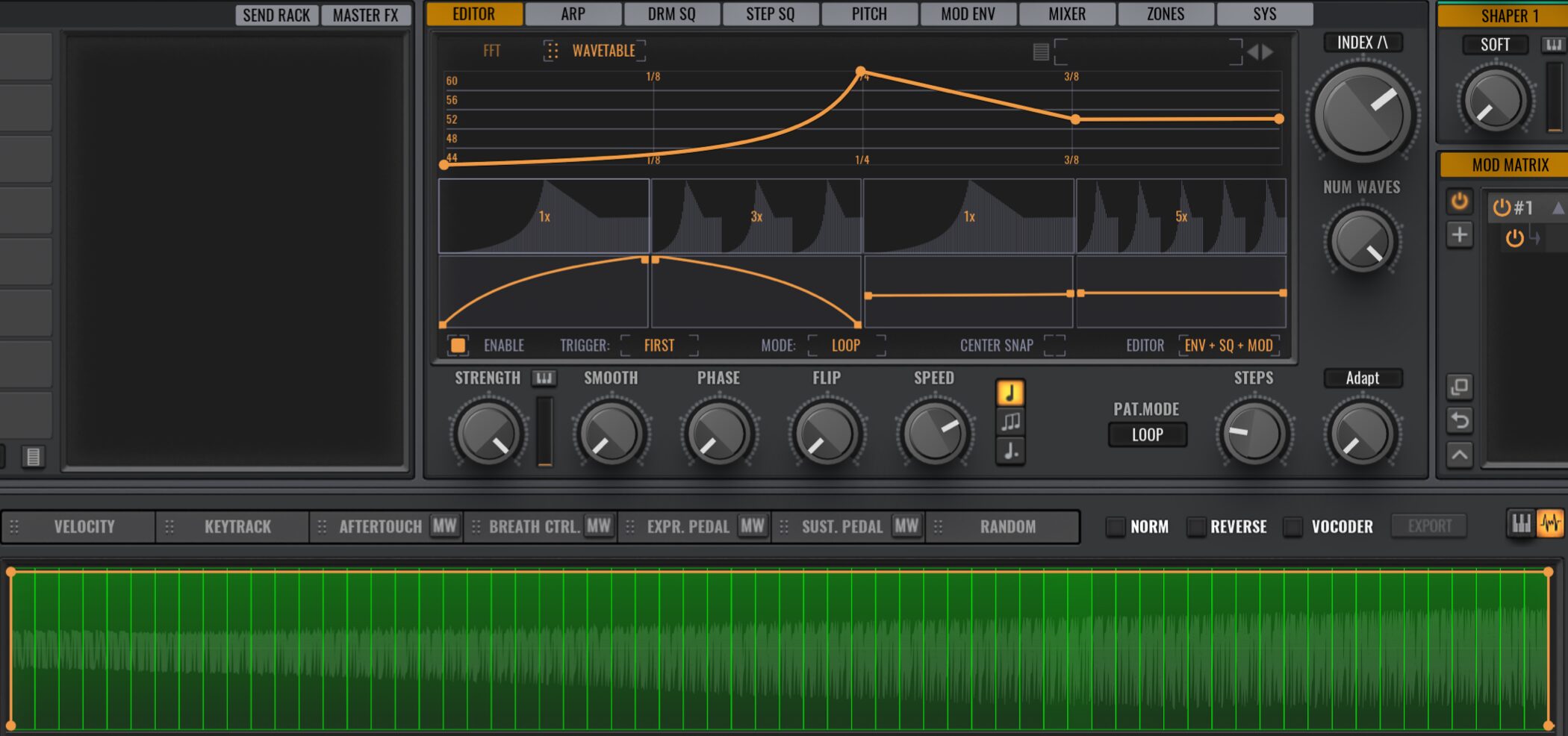
The Wavetable Editor opens, with the wavetable shown below it.
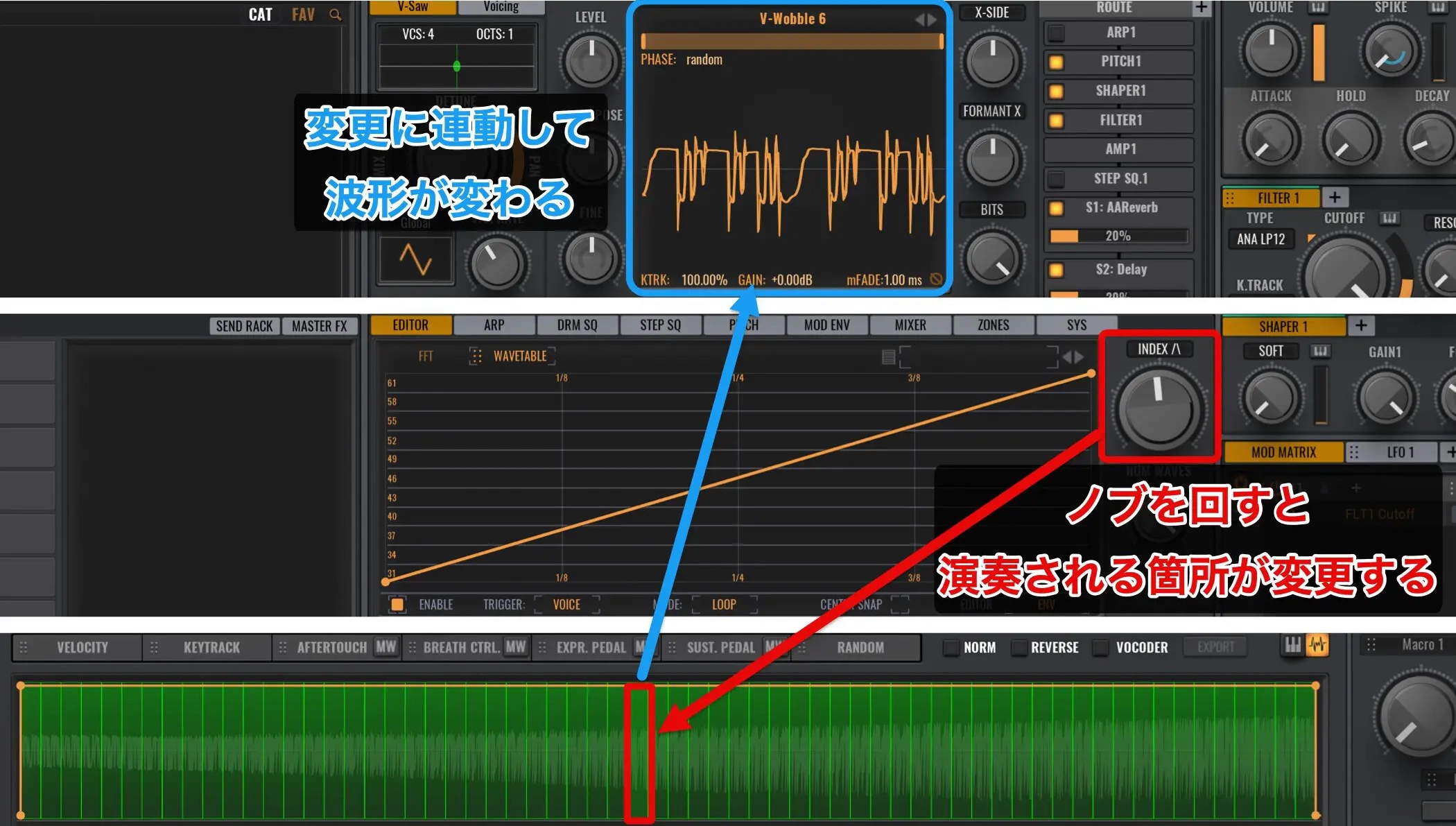
Turn the "INDEX" knob to change the playback position.
On a normal synthesizer, you add movement by applying modulation such as an LFO to this INDEX knob.
In Avenger, however, you can edit it easily with the Wavetable Editor.
The Wavetable Editor's envelope
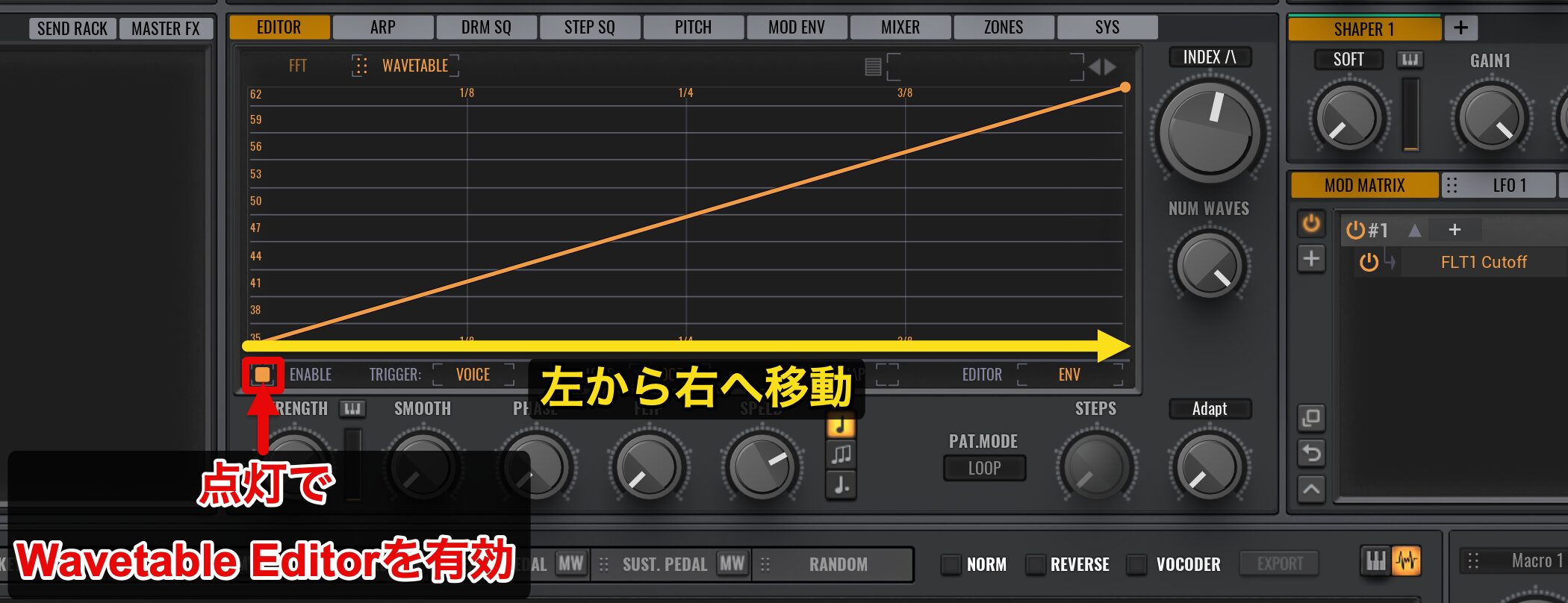
To enable the Wavetable Editor, just turn on "ENABLE" at the bottom left.
The straight line in the center of the EDITOR is an envelope that moves from left to right.
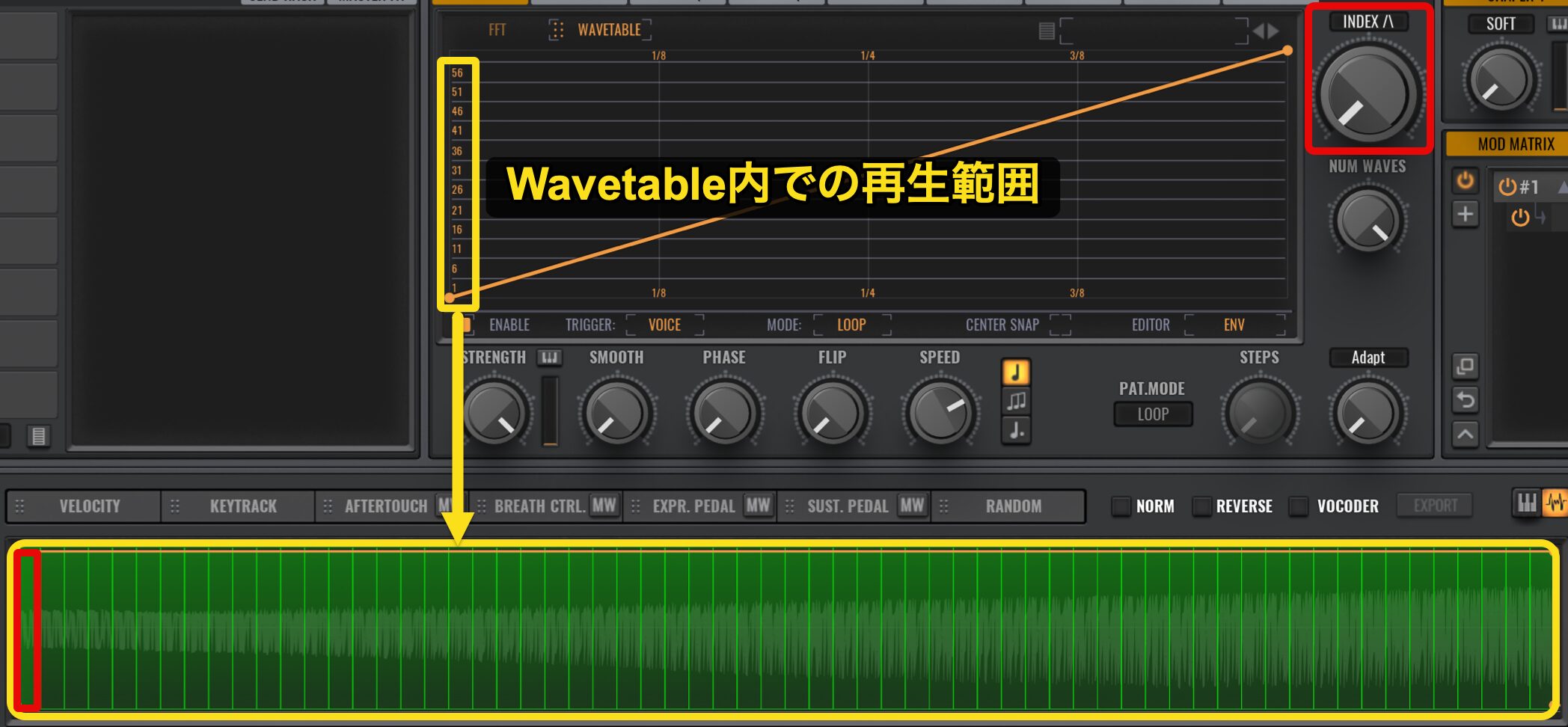
The envelope's vertical axis shows the playback range within the wavetable.
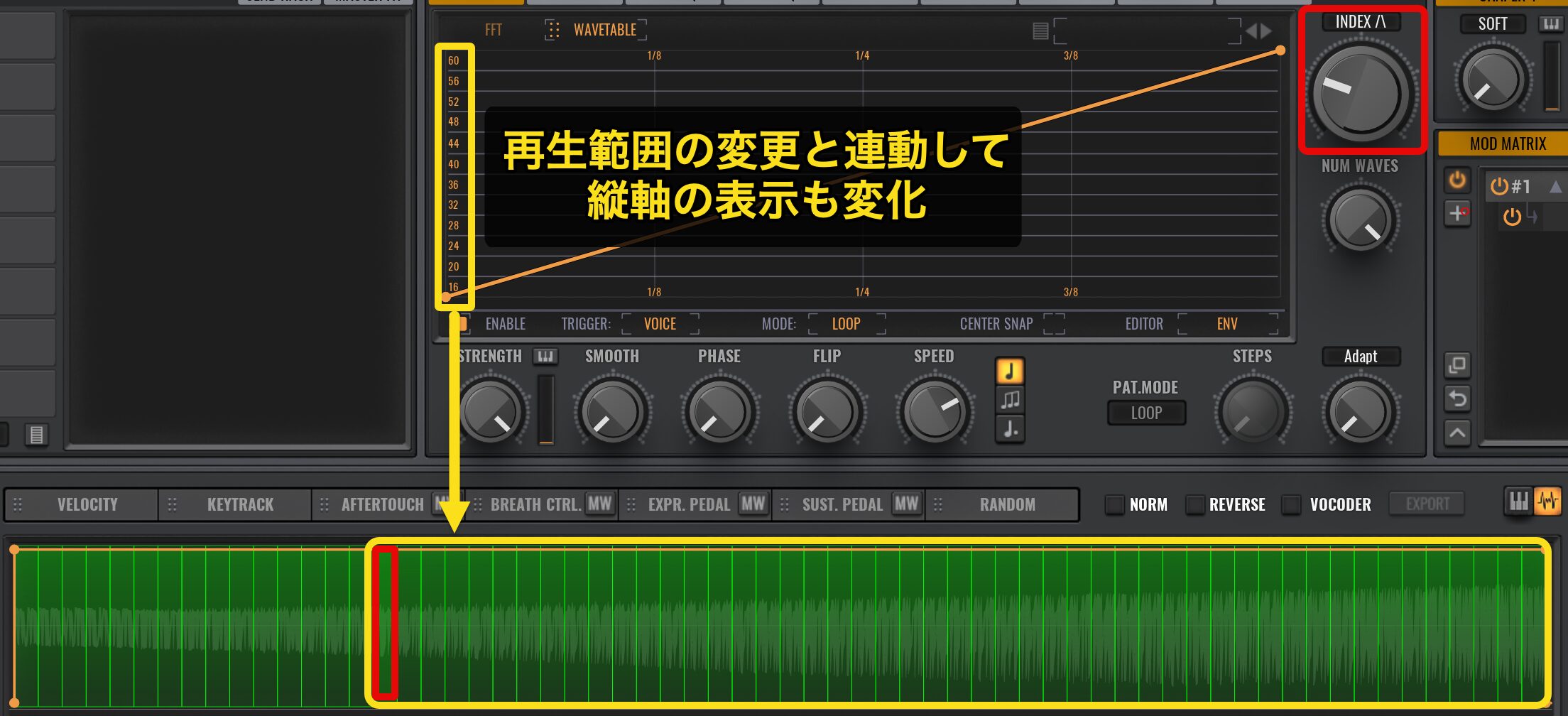
When the playback range changes, the vertical axis display changes along with it.
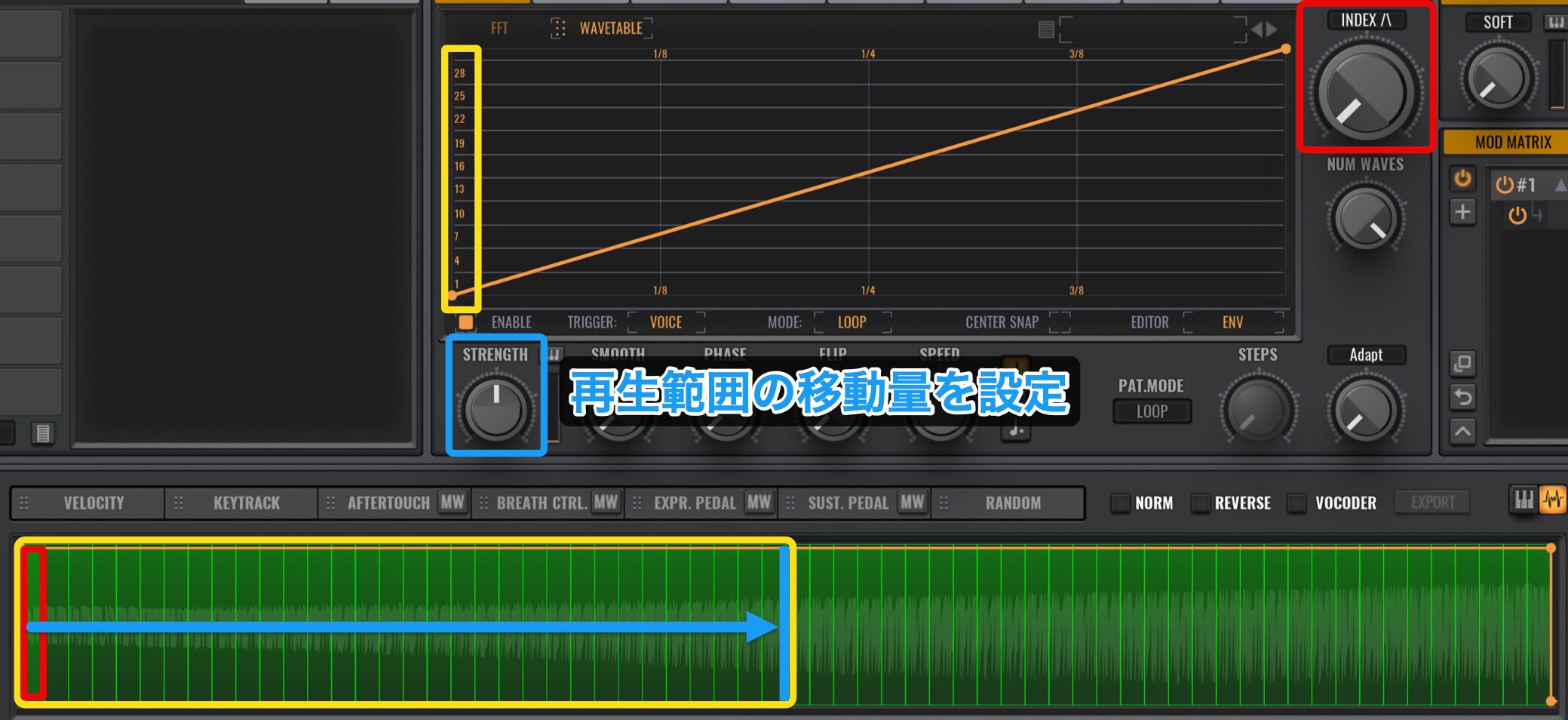
"STRENGTH" below lets you set how far the playback range moves.
By default, the STRENGTH knob is turned all the way to the right, so the whole wavetable is used.
Turning it to the left reduces how far the playback range moves, narrowing the range.
If you set the STRENGTH knob all the way to the left, the movement is disabled and the tone does not change.
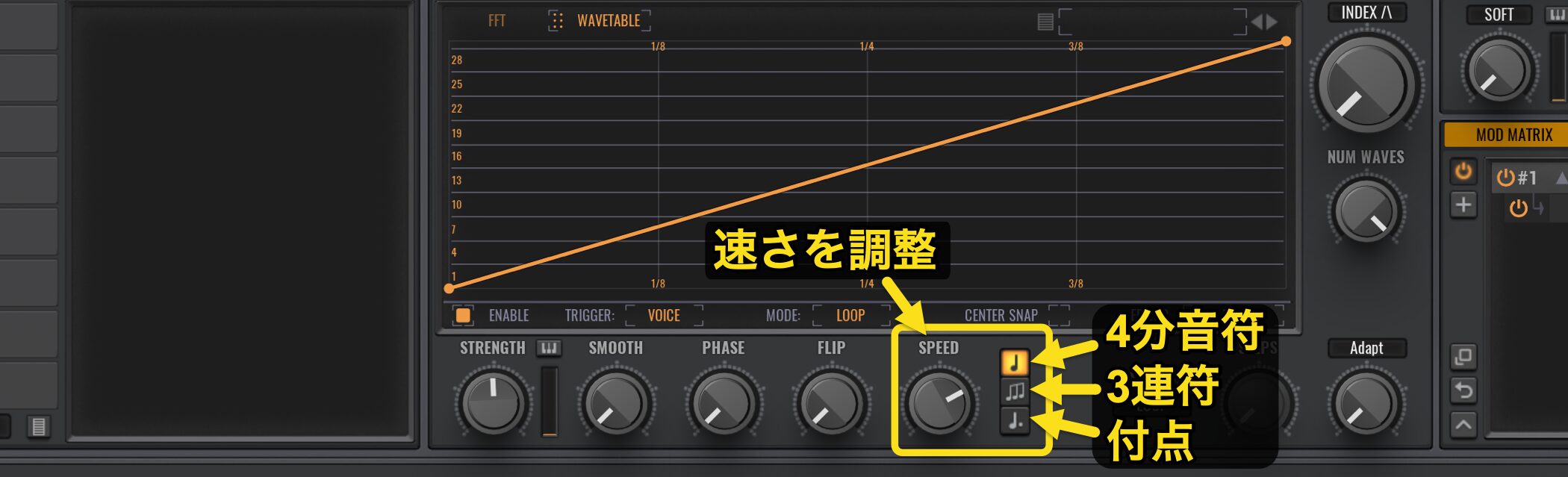
"SPEED" adjusts the speed of the envelope.
By default, quarter notes are active, synced to the tempo set in your DAW.
Changing SPEED switches the speed between quarter, 8th and 16th notes.
It also supports triplets and dotted notes, so use them to suit the song.
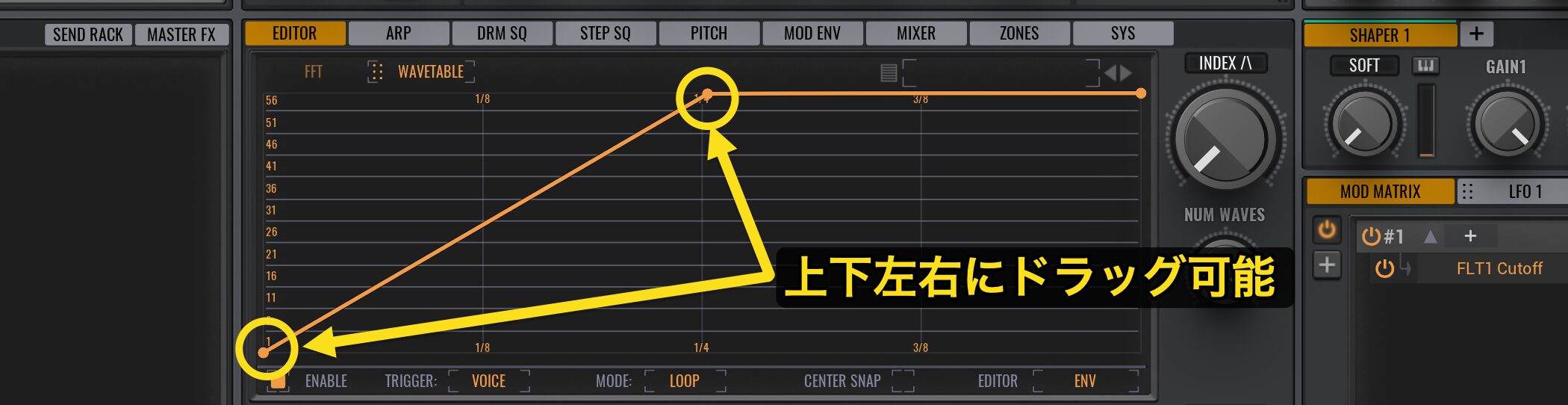
Envelope points can be dragged up, down, left and right.
It's a good idea to add fine nuances while playing back the phrase.
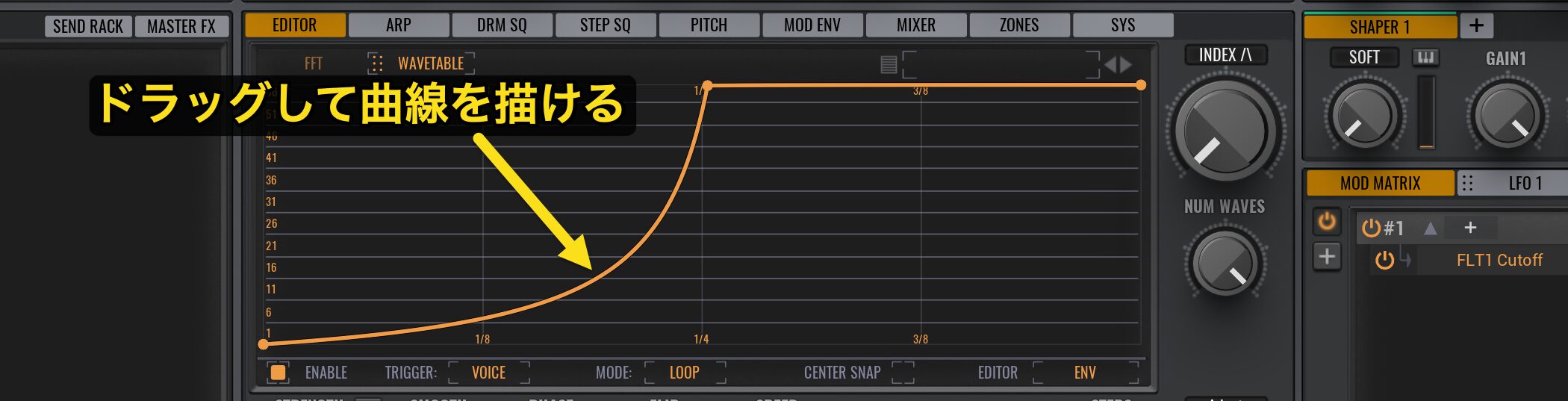
You can also draw curves by dragging on the straight line.
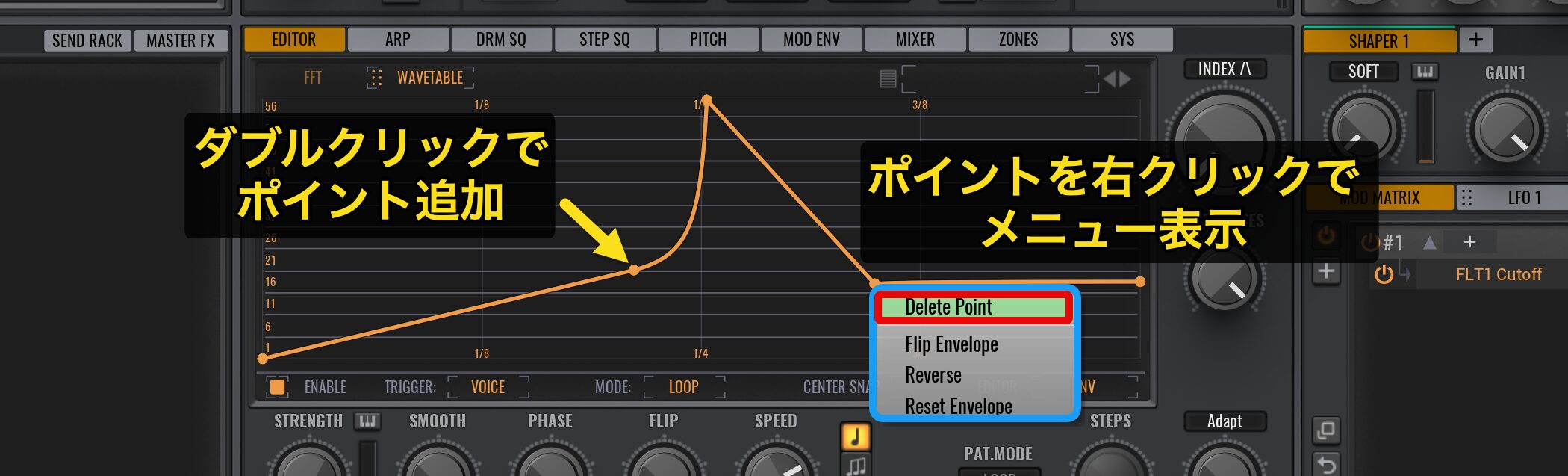
Double-click on the line to add a new point.
Right-click on a point and select "Delete Point" to delete it.
The Wavetable Editor's sequence and modulation
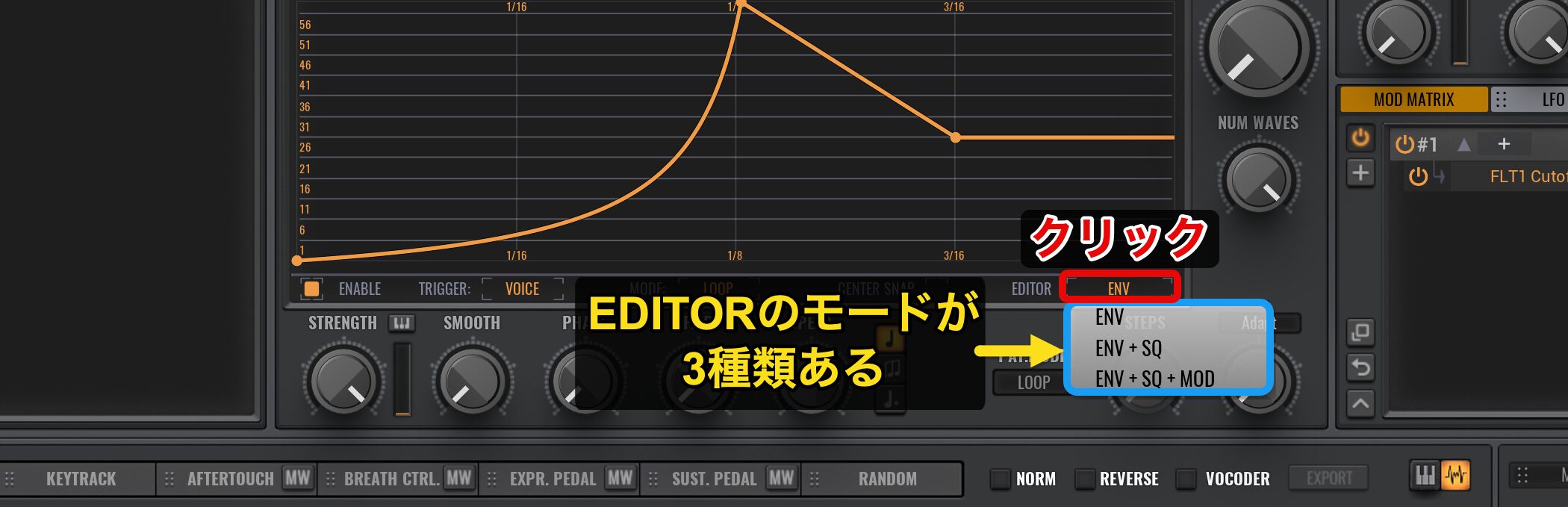
Clicking the text "ENV" switches the "EDITOR" mode.
There are three modes to choose from:
- ENV
- ENV + SQ
- ENV + SQ + MOD
The explanation so far has been about "ENV" mode.
Next, let's select "ENV + SQ".
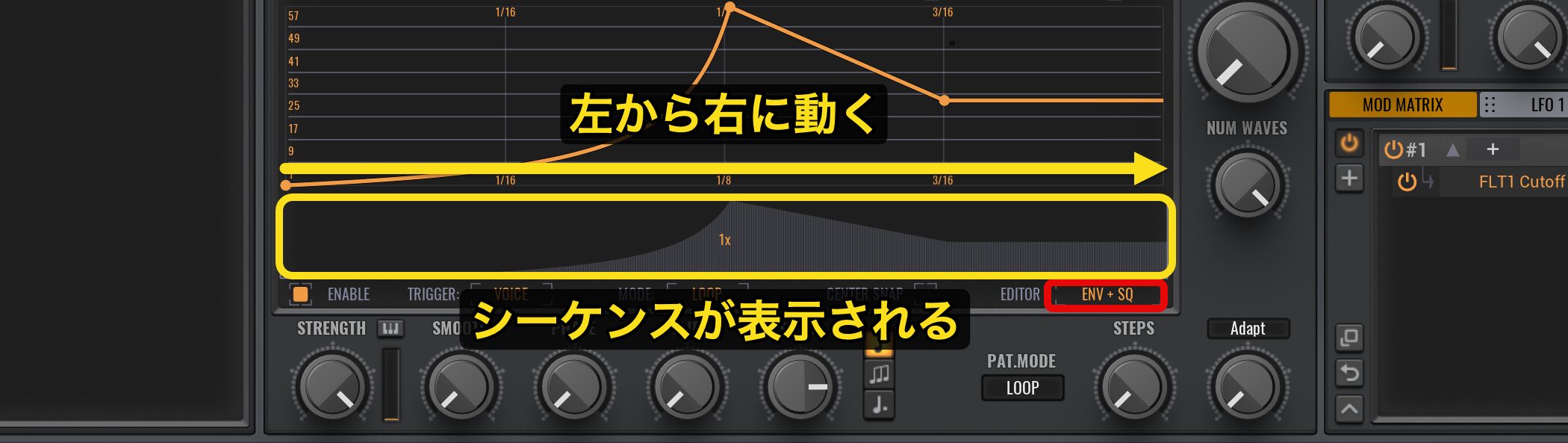
Below the envelope, "SQ (sequence)" is displayed.
As with the envelope, the sequence also moves from left to right.
As the envelope above moves, the movement of the sequence steps is added, so you can create more complex nuances.
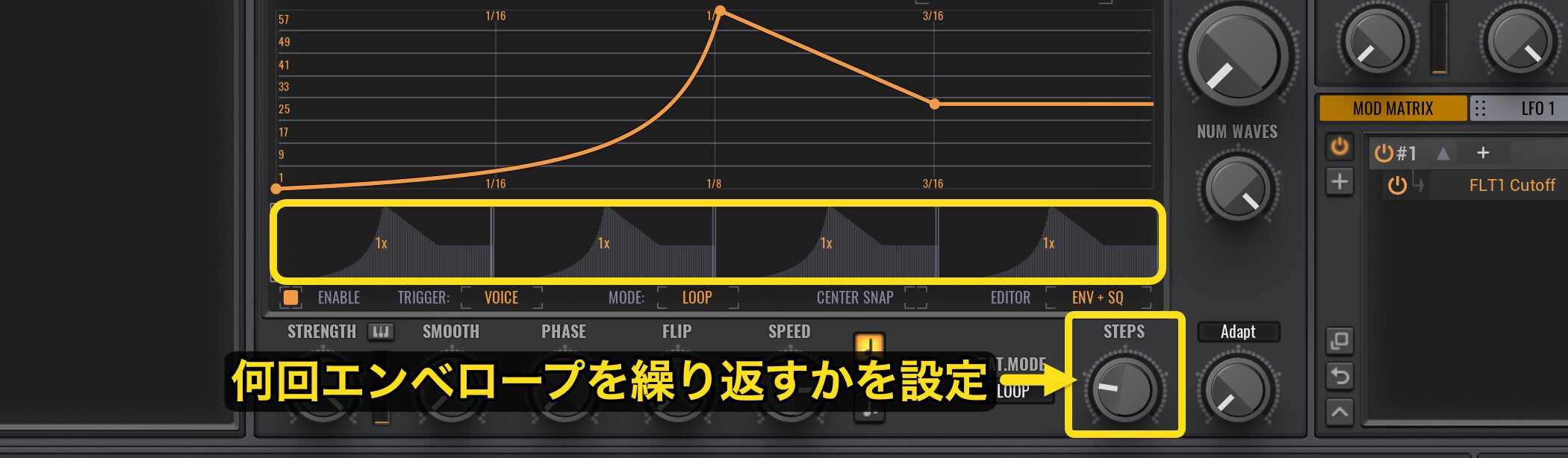
At the same time, "STEPS" at the bottom right becomes selectable.
Use STEPS to specify how many times the envelope repeats.
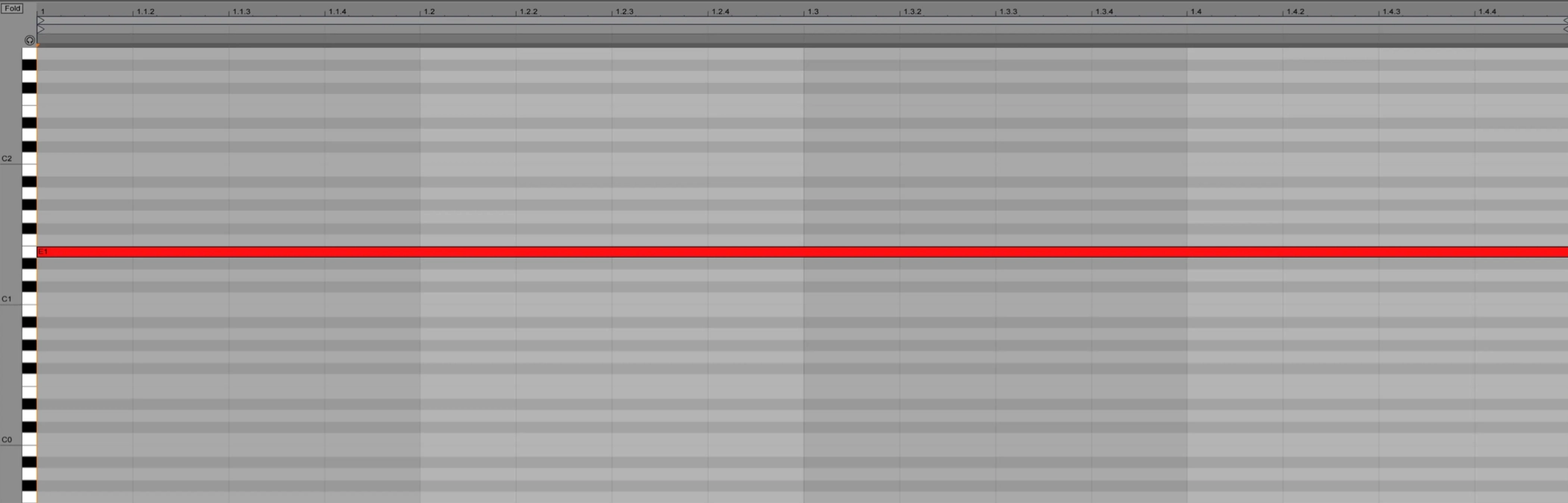
Currently one bar of notes is programmed, and STEPS moves from left to right,
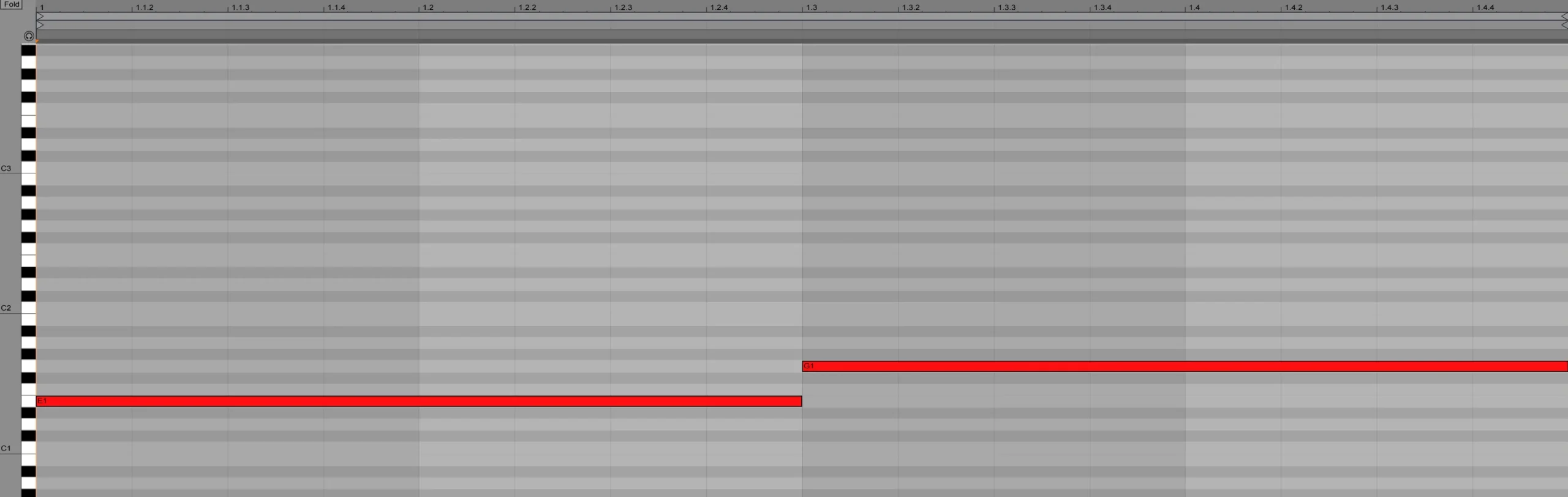
but if a new note is played partway through the sequence, its movement returns to the beginning.
In some cases, this may keep you from getting the sound you expect.
Let's set it up so that even when notes are played, the sequence keeps moving to the end.
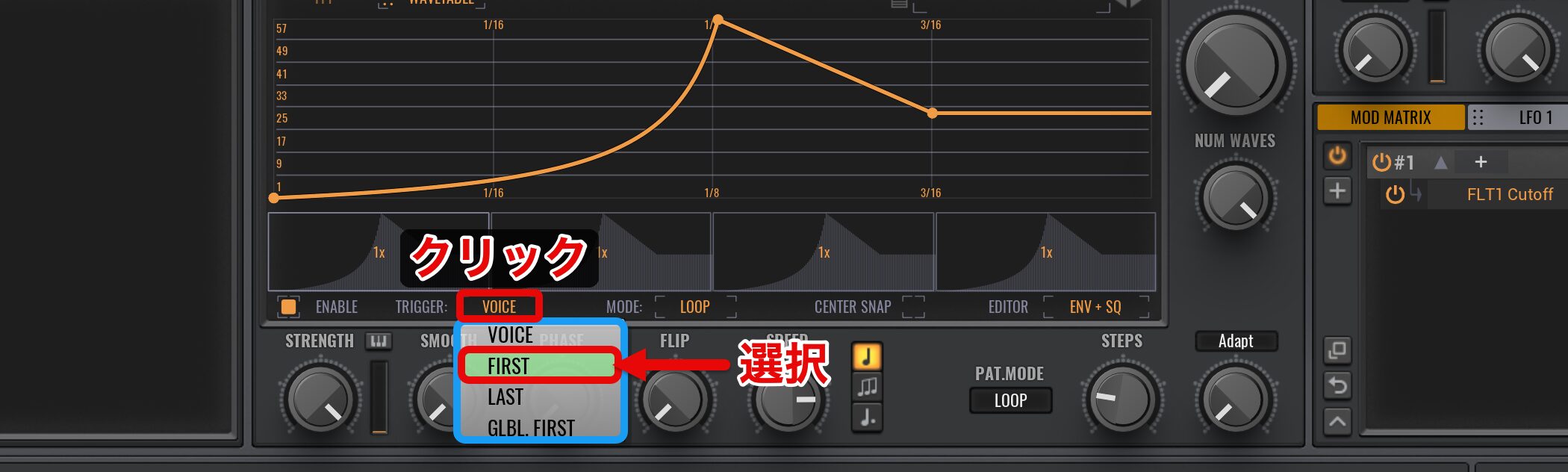
Just click "VOICE" in "TRIGGER" and change it to "FIRST".
Now, even when a new note is played, the movement of the sequence is no longer reset.
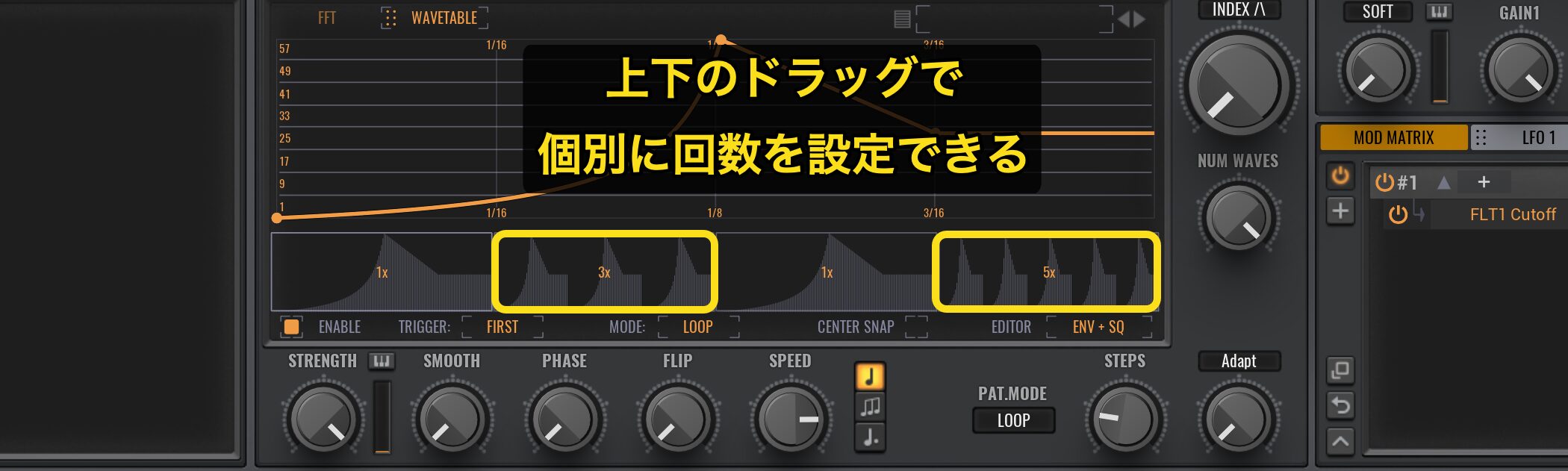
The sequence steps you added with STEPS can be dragged up and down to set the count individually.
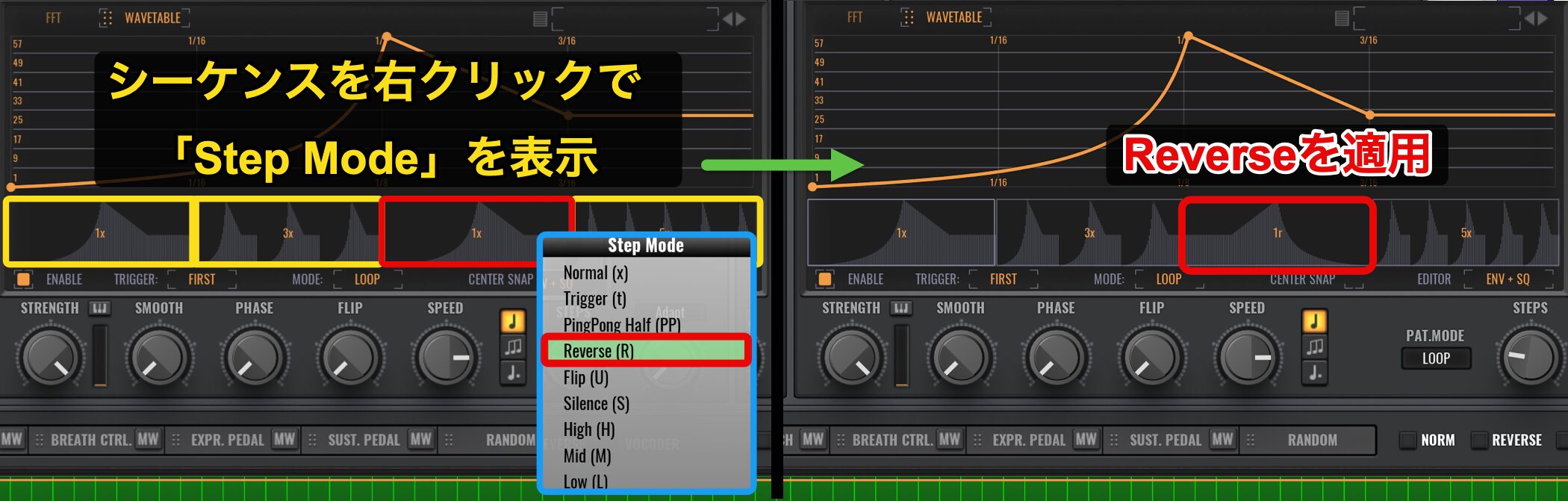
Right-click the sequence and show "Step Mode", and you can also set options such as Reverse.
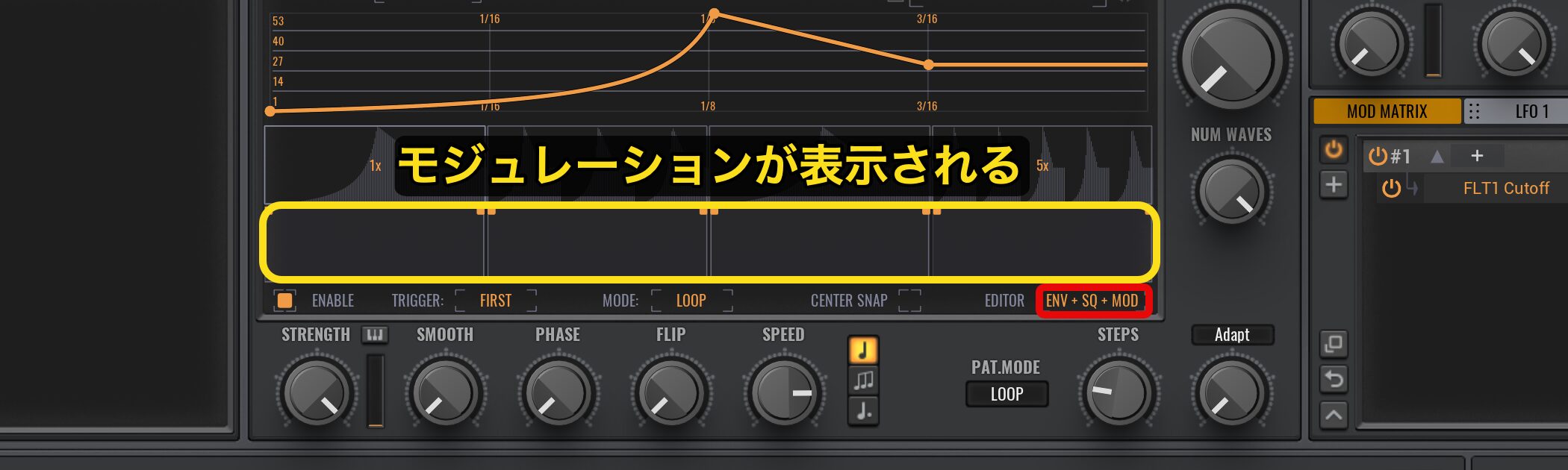
Finally, let's look at "ENV + SQ + MOD".
When you select it, below the sequence "MOD (modulation)" is displayed.
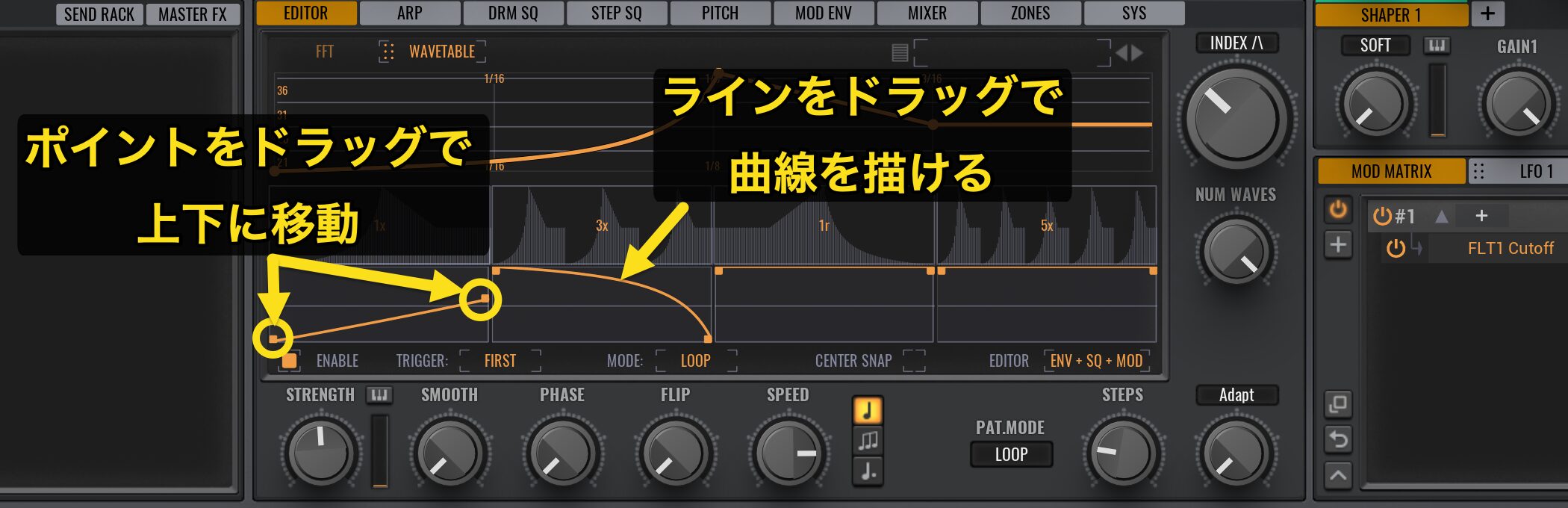
You can move the orange points up and down by dragging them.
As with the envelope, you can also draw curves by dragging the straight line.
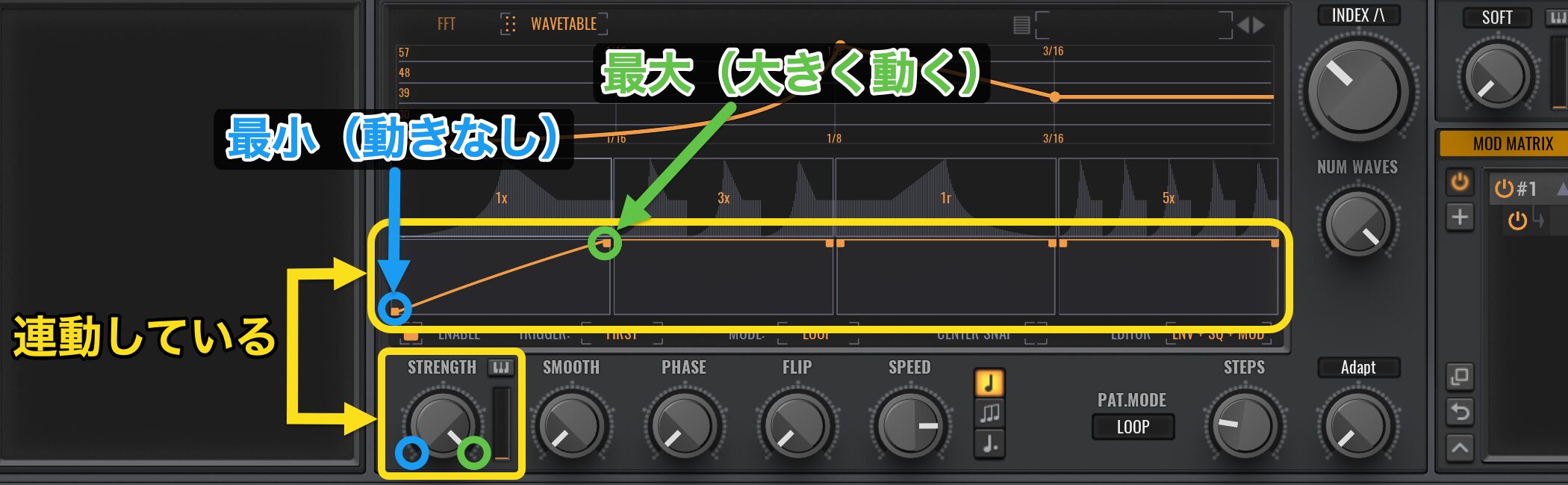
The modulation is linked to STRENGTH, and moving the orange points up and down also changes the effective range of STRENGTH dynamically.
Point at the bottom (blue circle): STRENGTH goes to the left (minimum), and the modulation movement becomes smaller. (At 0, modulation is disabled)
Point at the top (green circle): STRENGTH goes to the right (maximum), and the modulation movement becomes larger.
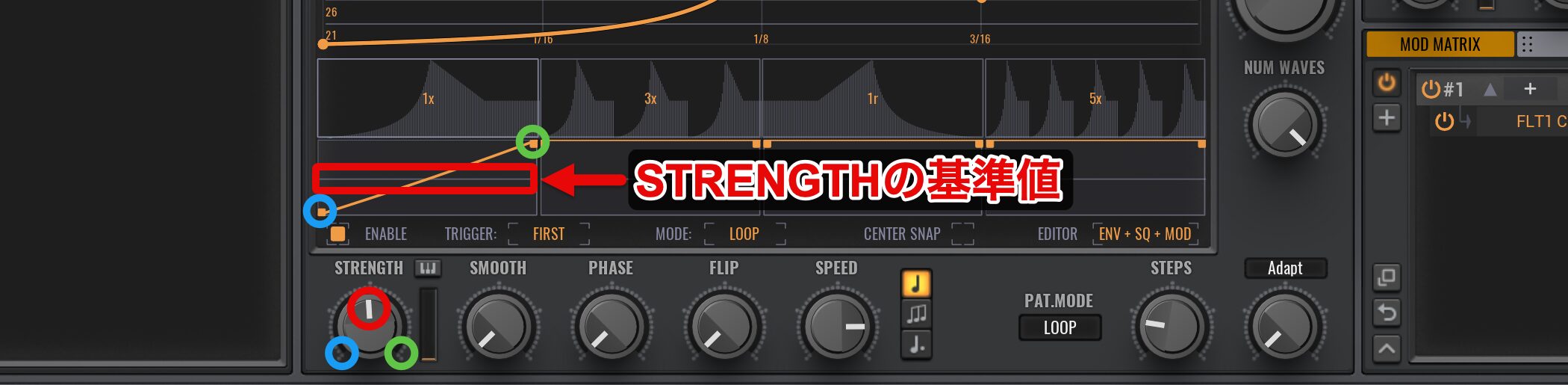
Also, when you turn the STRENGTH knob, a gray line appears; this shows the STRENGTH reference value.
In the image above, the modulation points are placed above and below this reference line, so the movement swings to either side of the reference line.
You can create more complex movement.
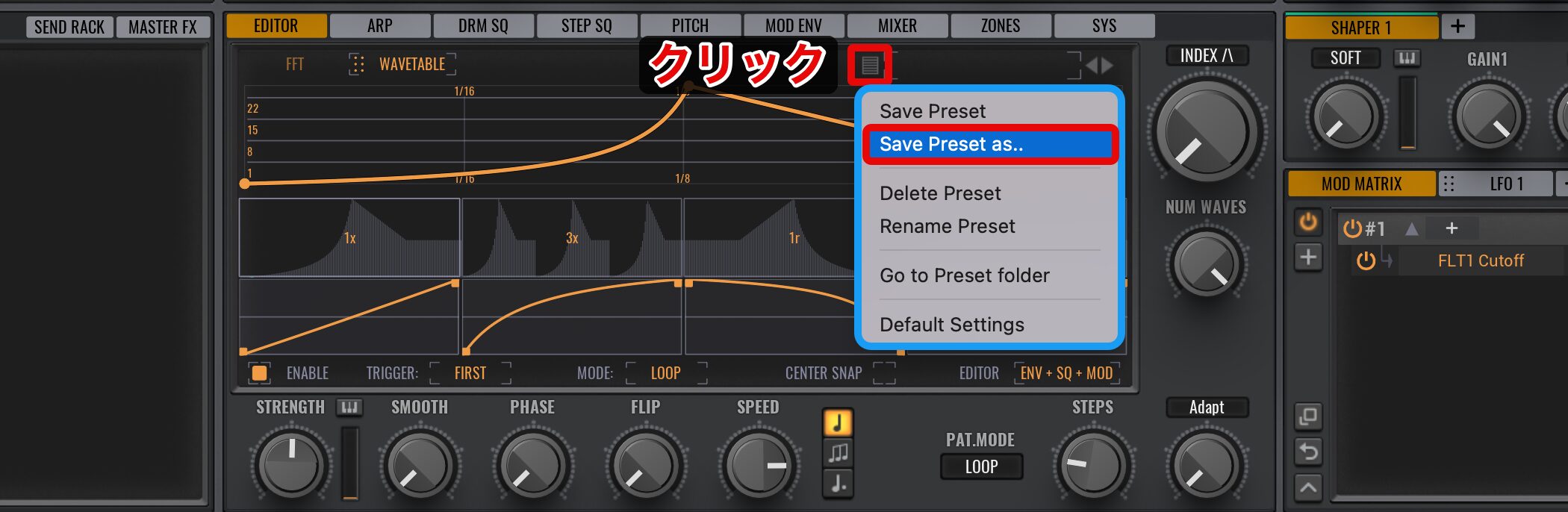
You can also save the sound you created as a preset.
Click the square area and select "Save Preset as..".
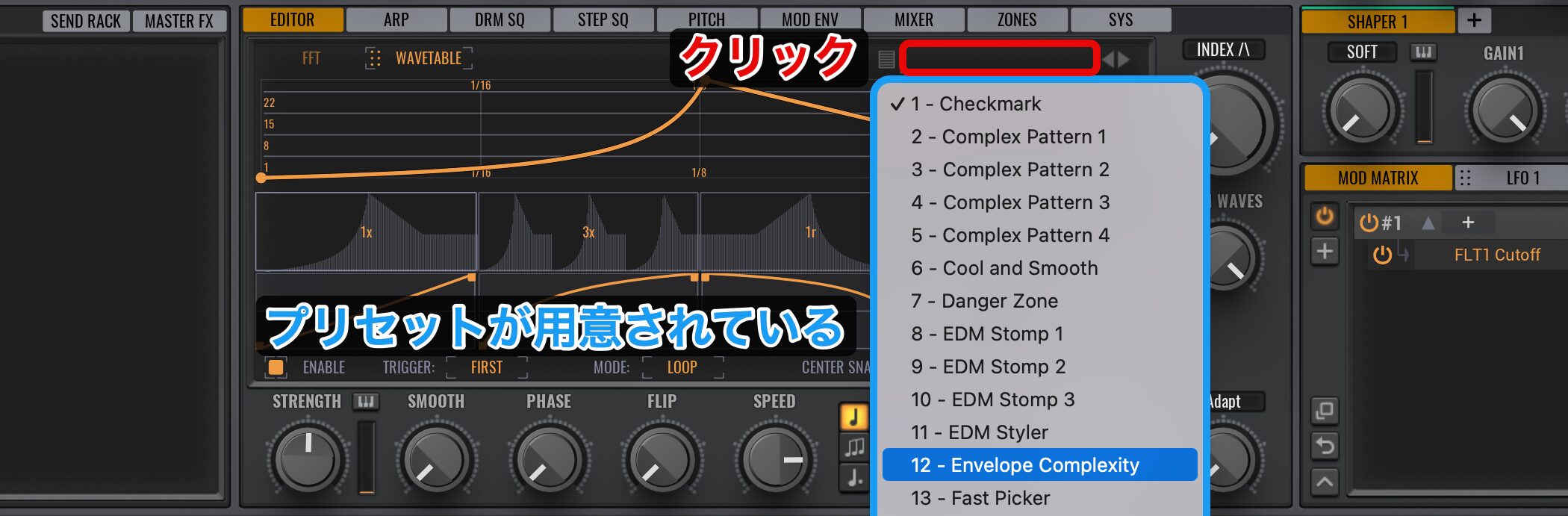
Clicking next to it lets you load EDITOR presets.
Using the Wavetable Editor, you can give the sound complex tonal changes.
It is a unique feature of Avenger, so try out various settings.
Sound design using LFOs
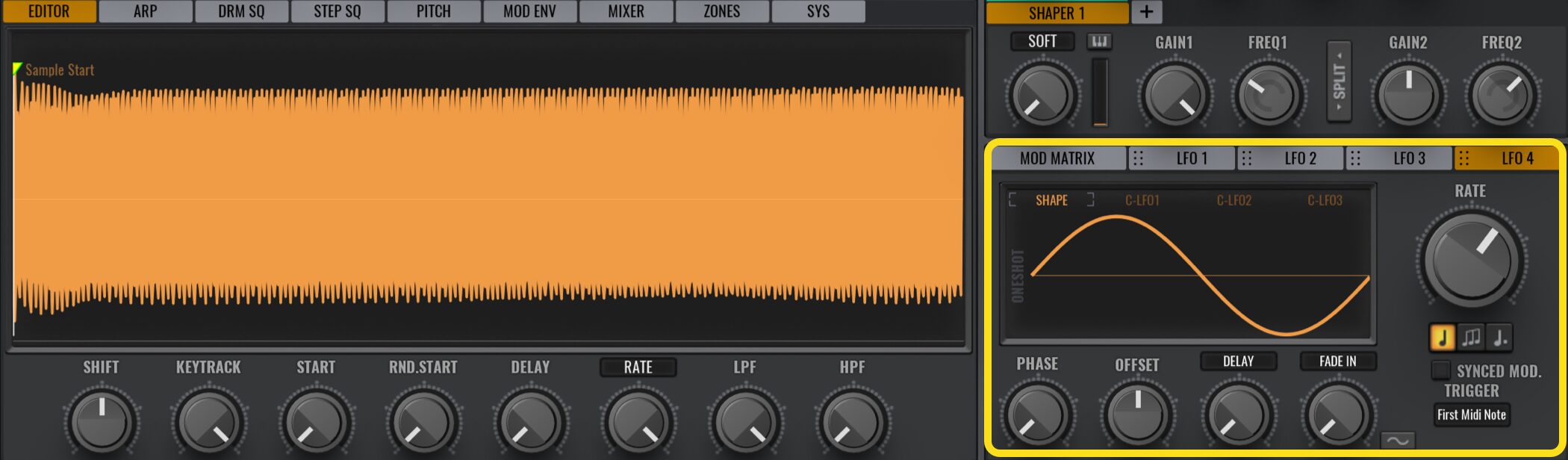
Next, while explaining Avenger's LFO features, we will create a lead sound of the kind often used in EDM.
"LFO" is always included in synthesizers.
Using these LFO parameters, you can add movement and accents to the sound.
Many of the items can also be applied to products other than Avenger, so be sure to learn them.
Avenger video: The LFO section
How to use the LFO section
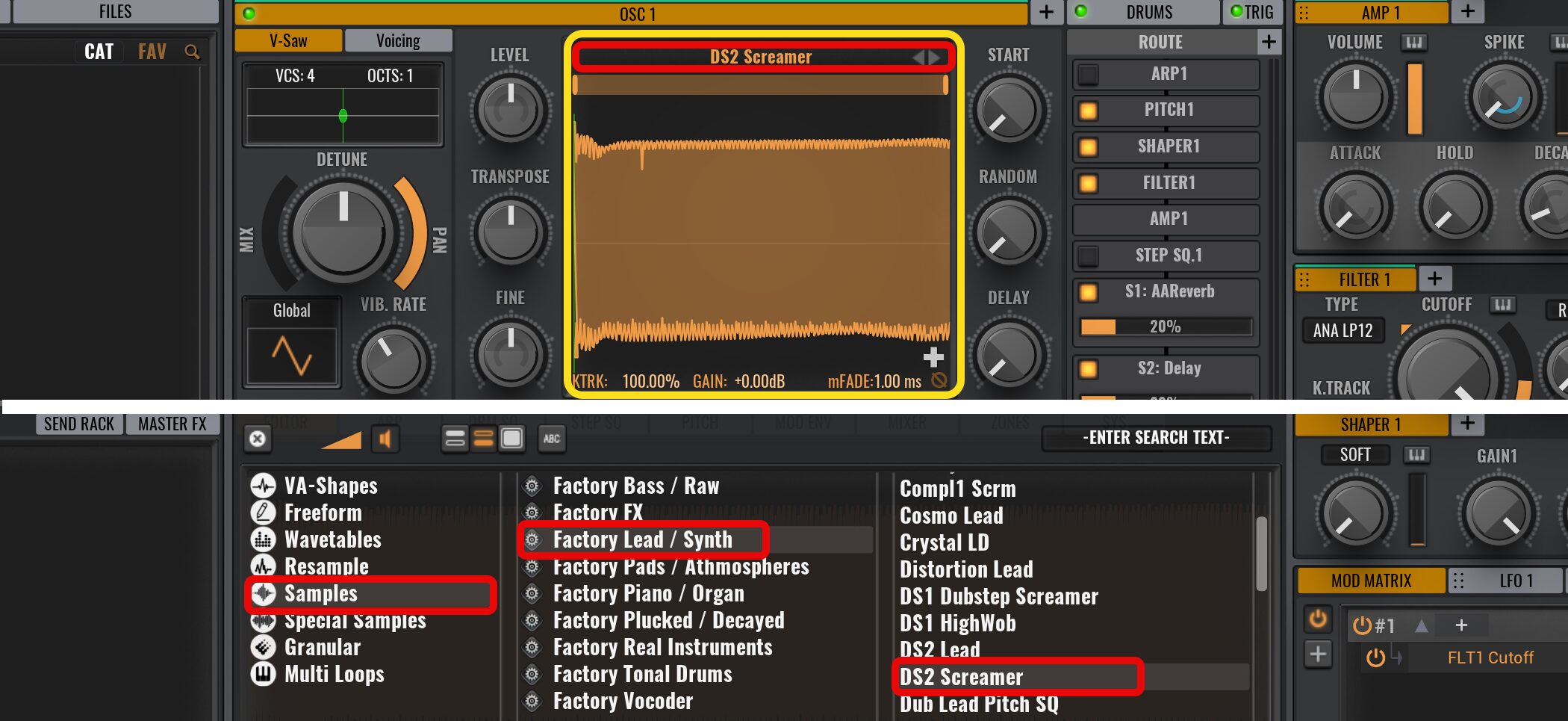
This time we use a multisample waveform.
From OSC 1's presets, select "Samples" → "Factory Lead / Synth" → "DS2 Screamer".
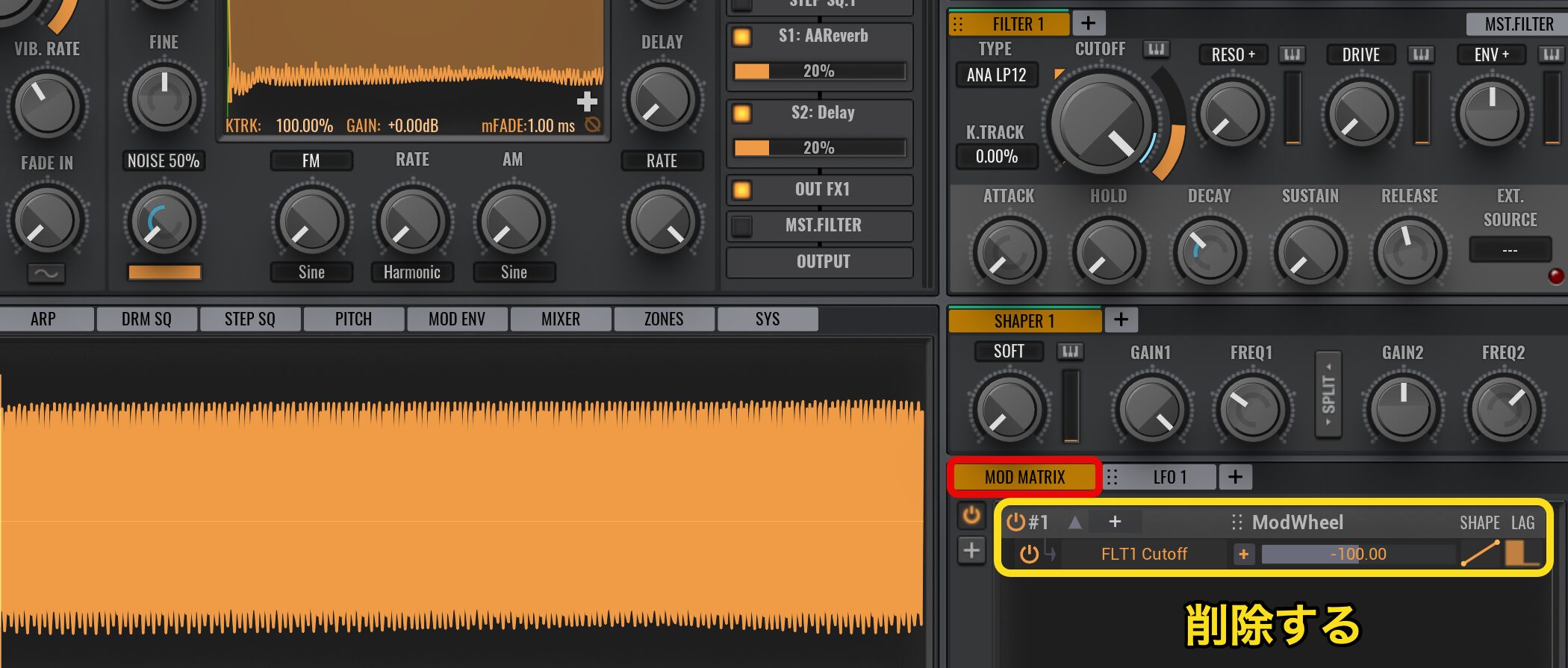
Before the LFO, let's check the "MOD MATRIX".
By default, "Filter 1" "Cutoff" is assigned to "ModWheel".
Let's delete this assignment.
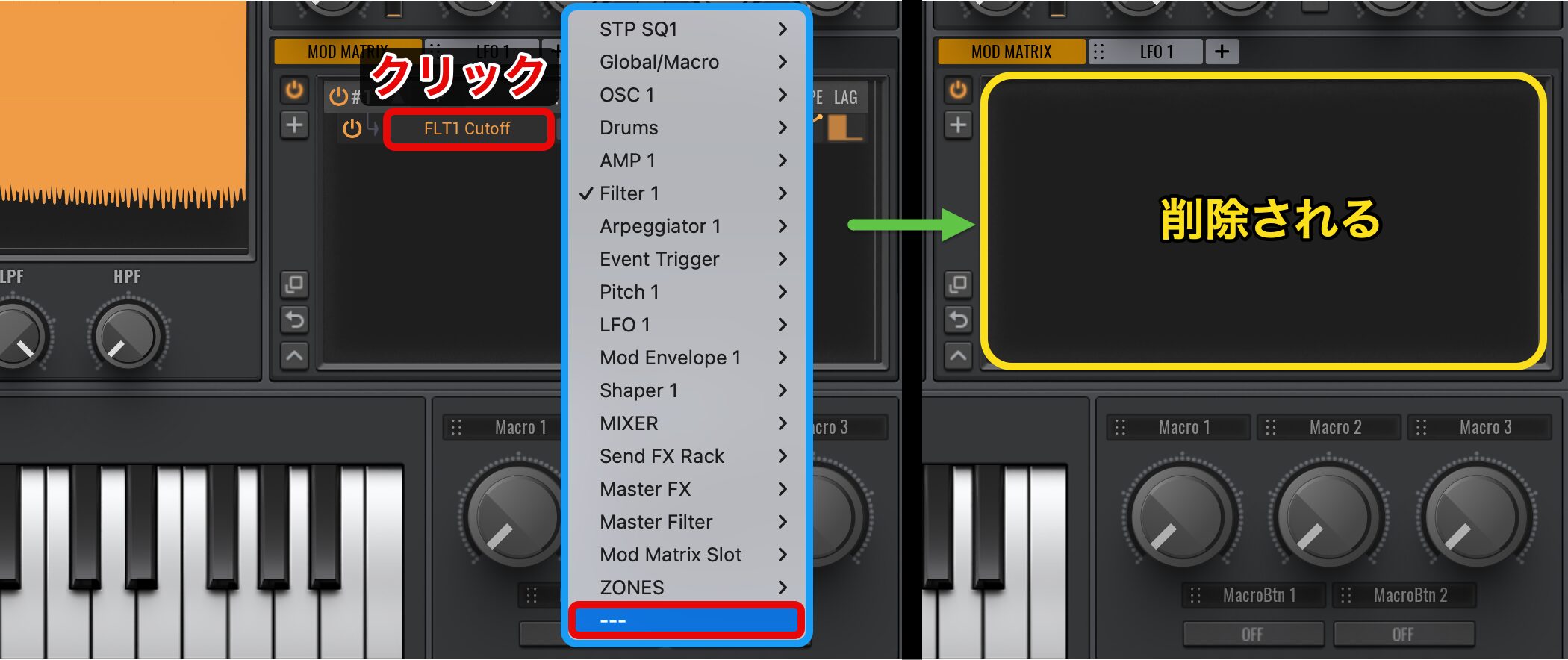
Click "FLT1 Cutoff" and select "—" at the bottom to delete it.
Basic LFO operation and how to assign it
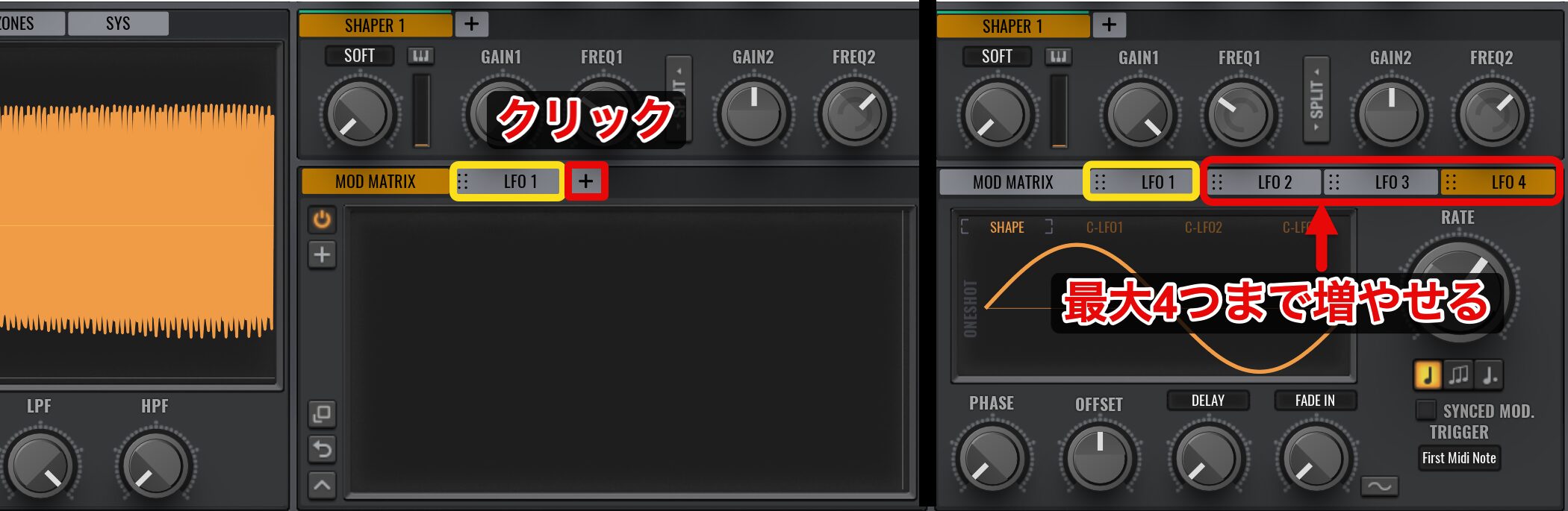
The LFO is next to the MOD MATRIX.
By clicking "+", you can add up to four LFOs.
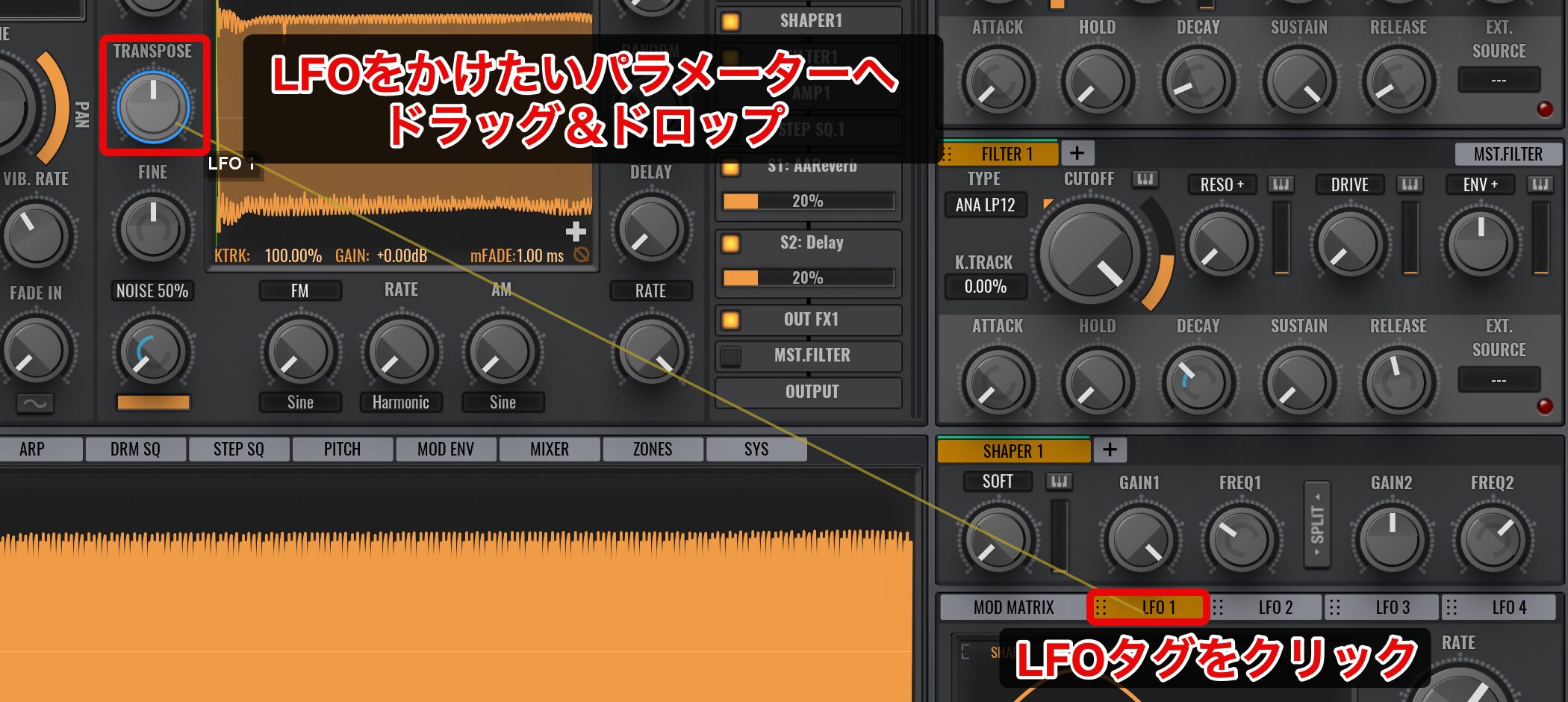
To assign an LFO to a parameter, click the LFO tag you want to use (LFO 1 here) and drag and drop it onto the parameter you want to assign.
A yellow line appears during this operation, so it is easy to see the destination.
This time, let's apply it to TRANSPOSE (pitch), where the effect is easy to hear.
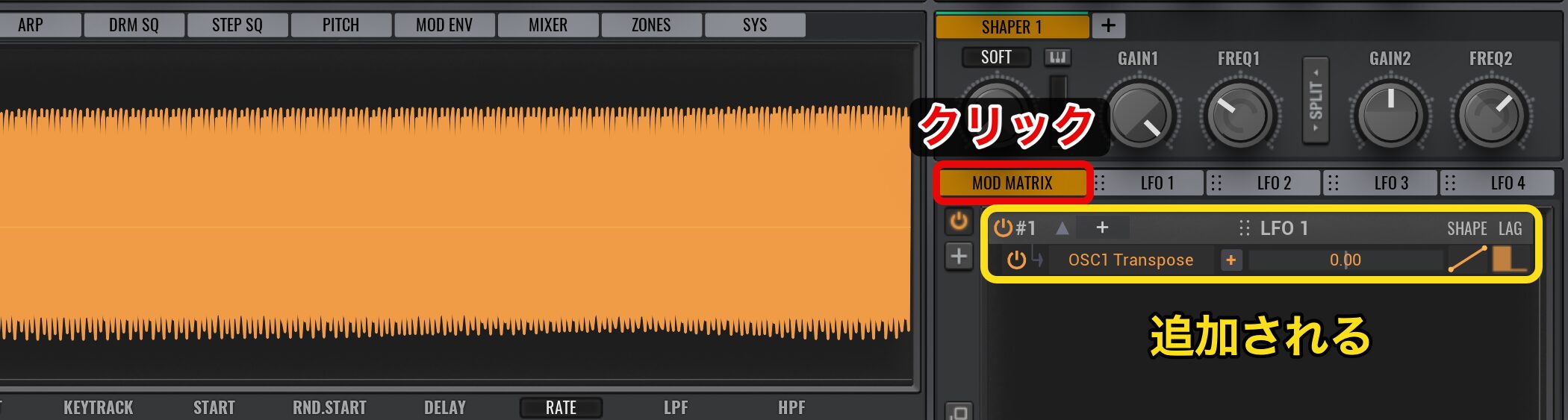
If you open the MOD MATRIX from earlier, you can see that TRANSPOSE is assigned to LFO 1.
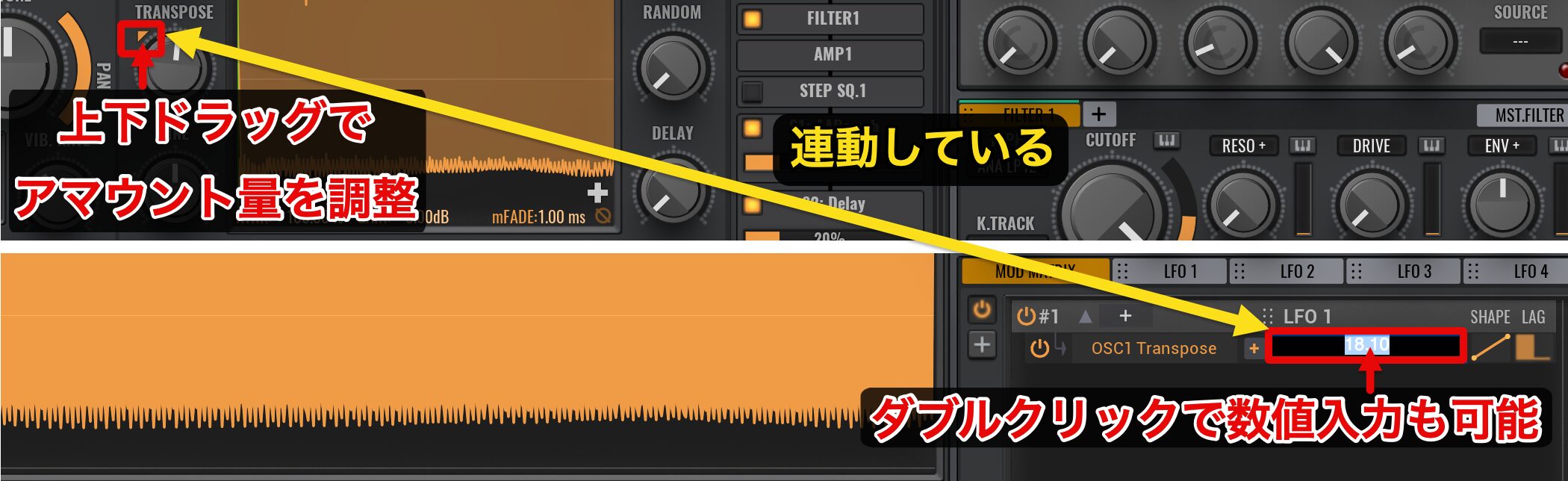
Parameters assigned to an LFO show an orange ▲ mark at the top left.
It is easy to see at a glance.
By dragging this ▲ mark up and down, you can adjust the amount, meaning how much the LFO is applied.
This adjustment is linked to the parameter in the MOD MATRIX, and you can also set it by entering a value directly.
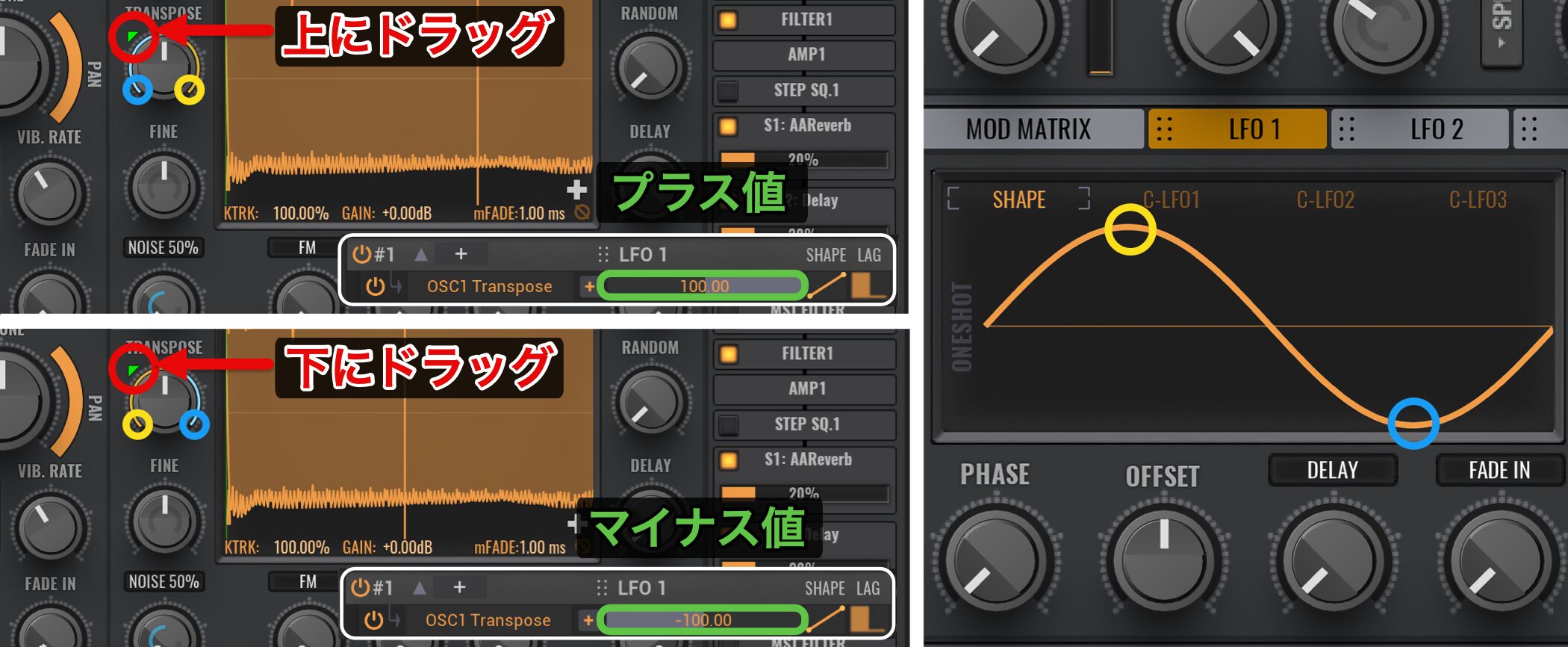
The range of the LFO changes depending on which direction you drag the ▲ mark.
- Drag up: the value becomes positive, with the LFO's maximum at the right end of the TRANSPOSE knob and its minimum at the left end.
- Drag down: the value becomes negative, with the LFO's maximum at the left end of the TRANSPOSE knob and its minimum at the right end.
In other words, depending on the drag direction, the LFO's effect is reversed.
Detailed LFO parameter settings
Now let's look inside the LFO.
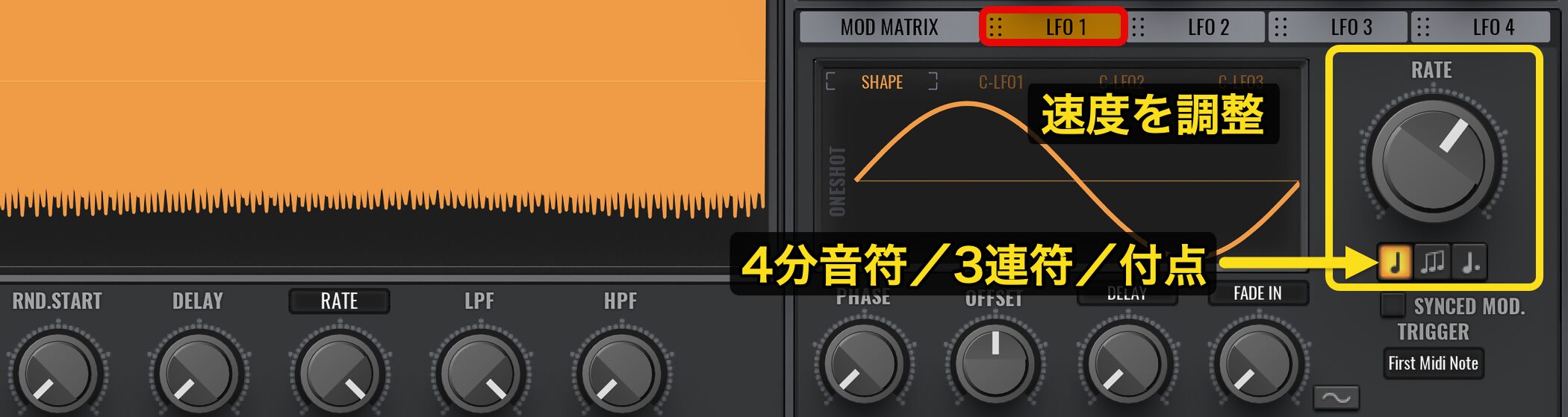
"RATE" lets you adjust the LFO's speed.
Turning it to the right makes the LFO cycle faster.
The Sync button below it is enabled by default and automatically syncs to the DAW's tempo.
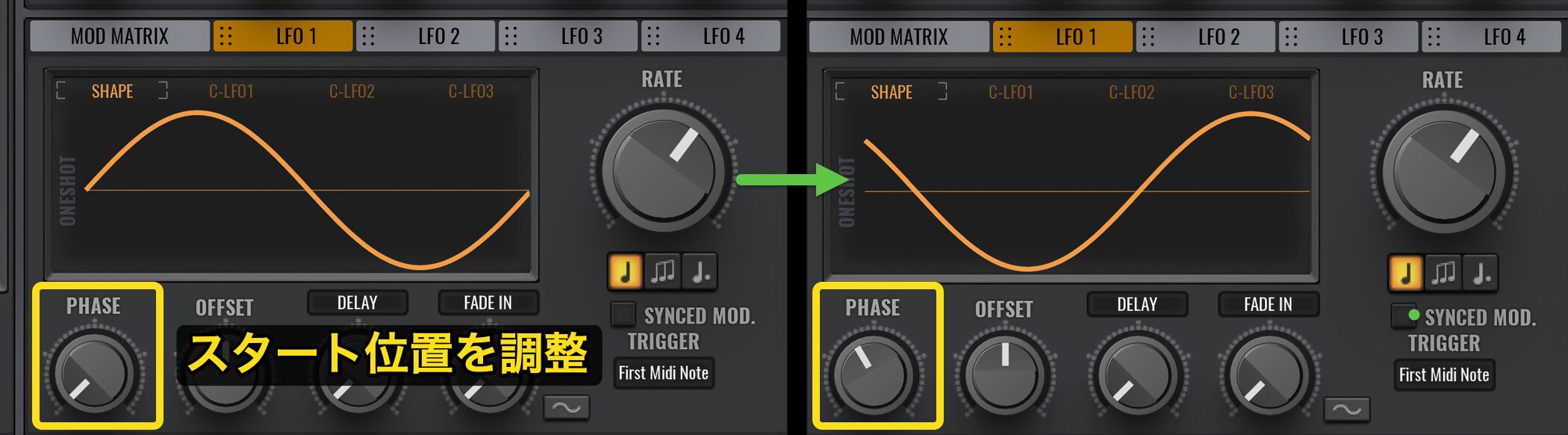
"PHASE" below lets you adjust the LFO's starting position.
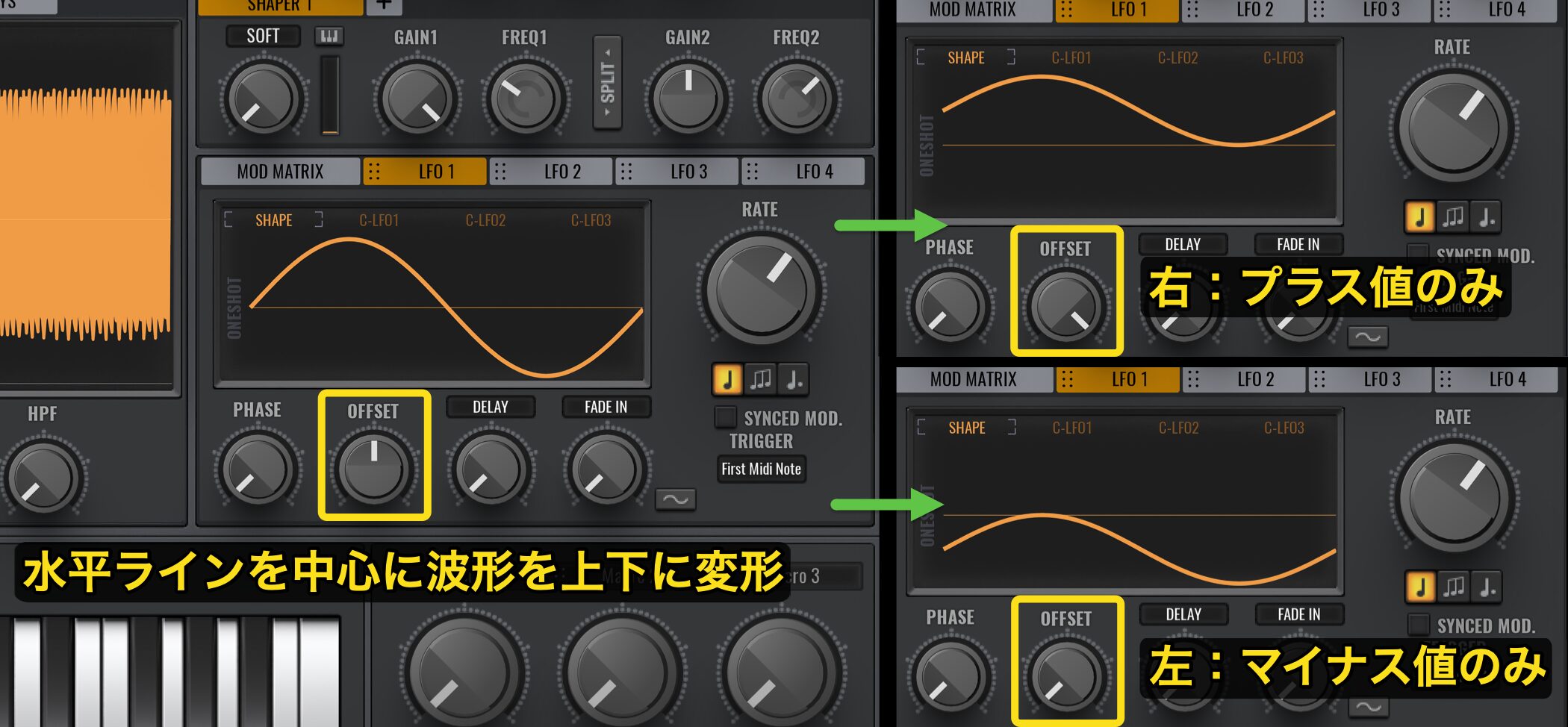
"OFFSET" shifts the waveform up and down around the horizontal line, adding variation to the LFO.
Turning the OFFSET knob fully right outputs only positive values, and turning it fully left outputs only negative values.
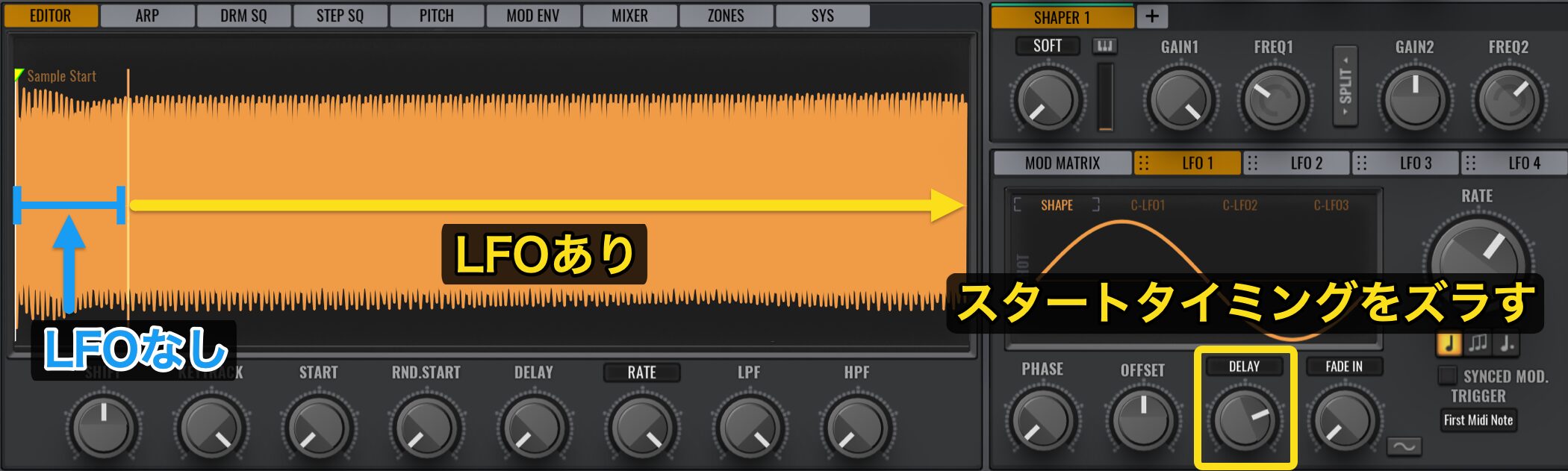
"DELAY" lets you delay when the LFO starts.
This is also handy when you want to apply the LFO only to long notes and not to short phrases.
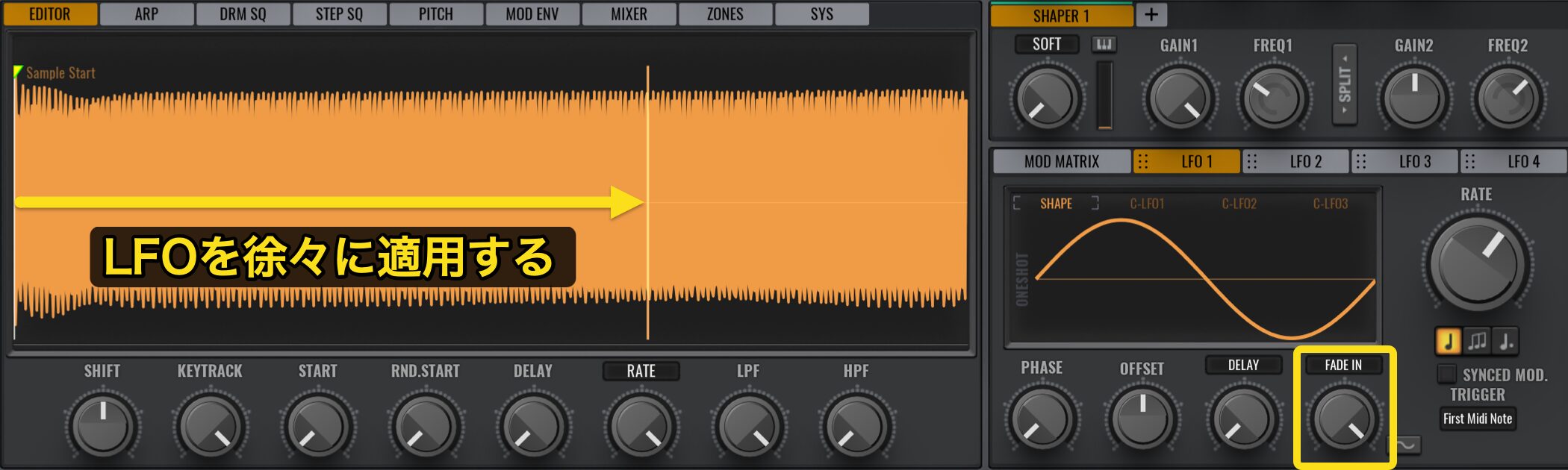
"FADE IN", as the name suggests, lets you apply the LFO effect gradually.
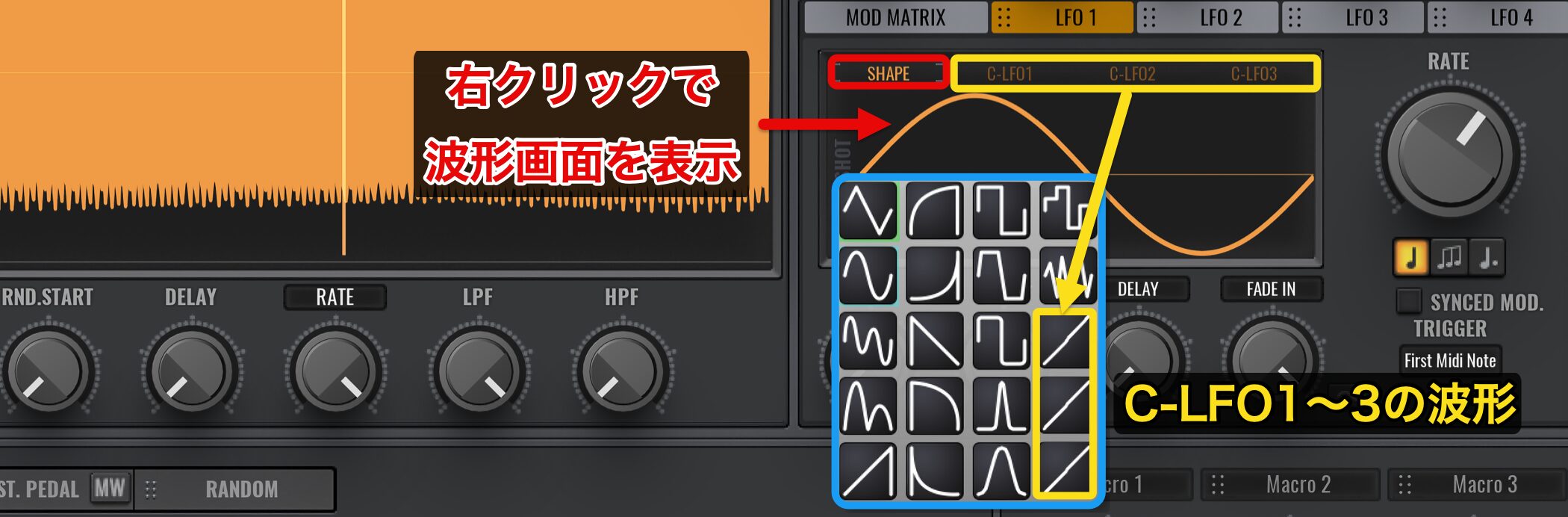
Avenger also provides a wide range of LFO waveforms.
With SHAPE selected, click anywhere in the waveform display to show the list of available waveforms.
If you look closely, the three at the bottom right are the same waveform; these are the waveforms of "C-LFO 1–3" next to SHAPE.
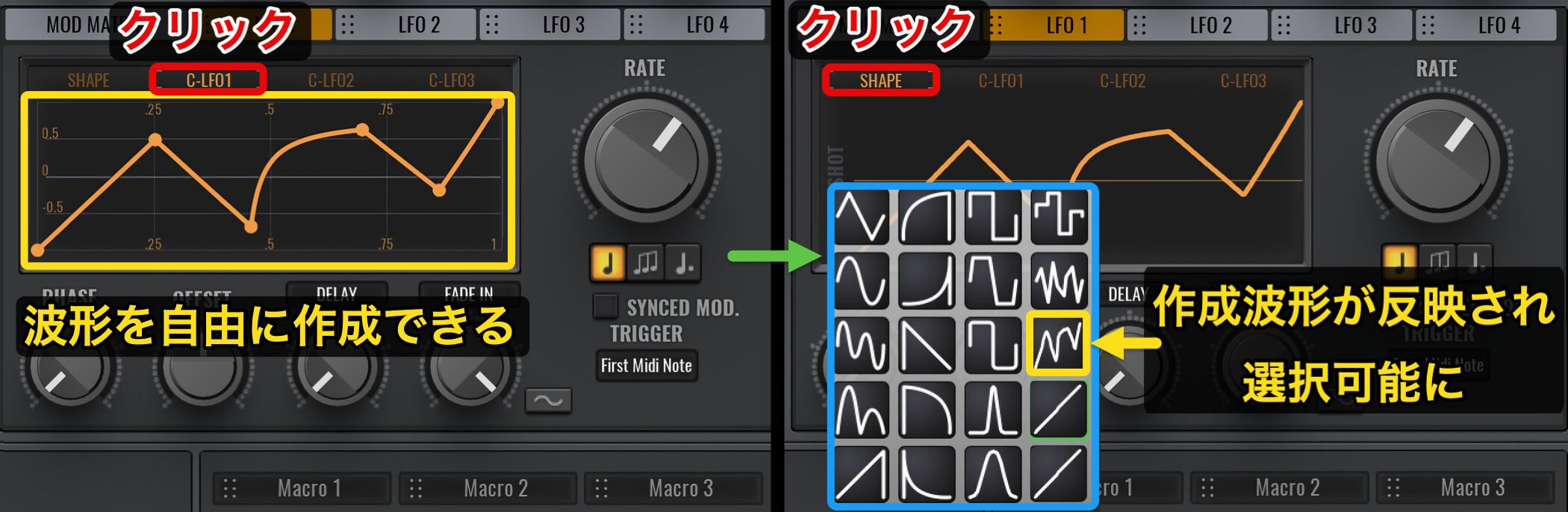
The feature of C-LFO is that you can create your own waveforms.
Double-click to add points, drag them up, down, left and right, and right-click unwanted points and select "Delete Point" to delete them.
The waveforms you create appear in SHAPE's waveform list and can be selected.
It offers a lot of freedom.
Creating a synth lead with LFOs
Now that we understand how to use the LFOs, let's apply this to create a synth lead.
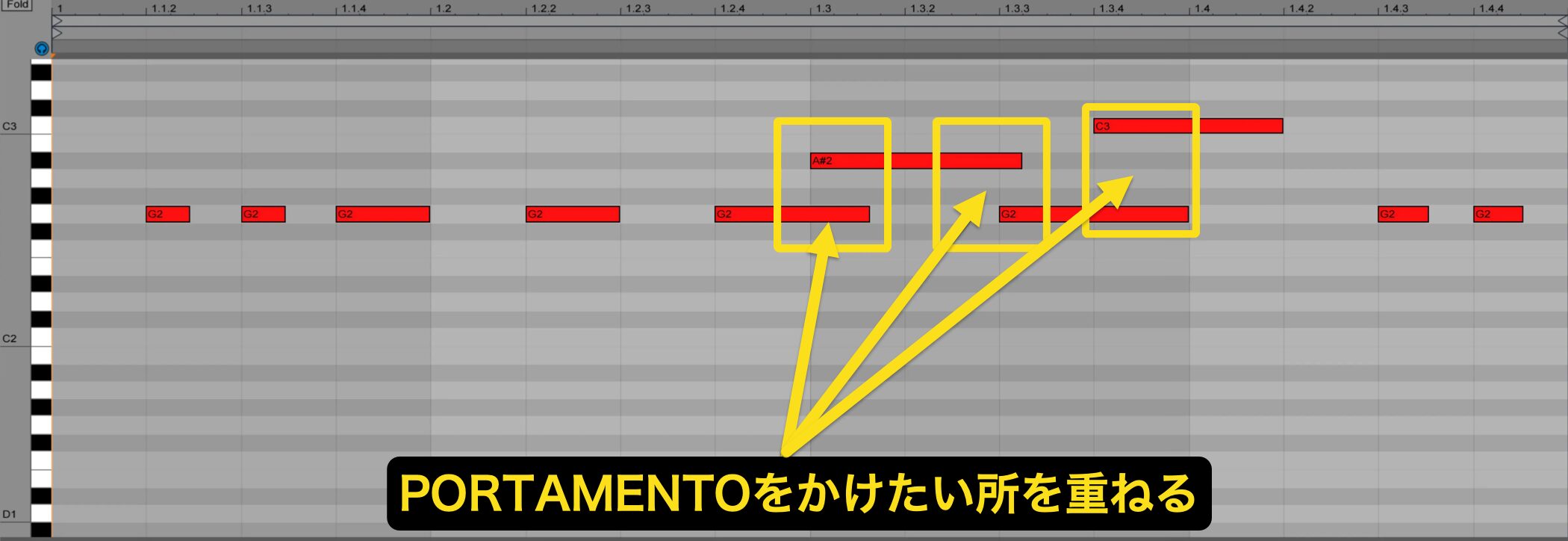
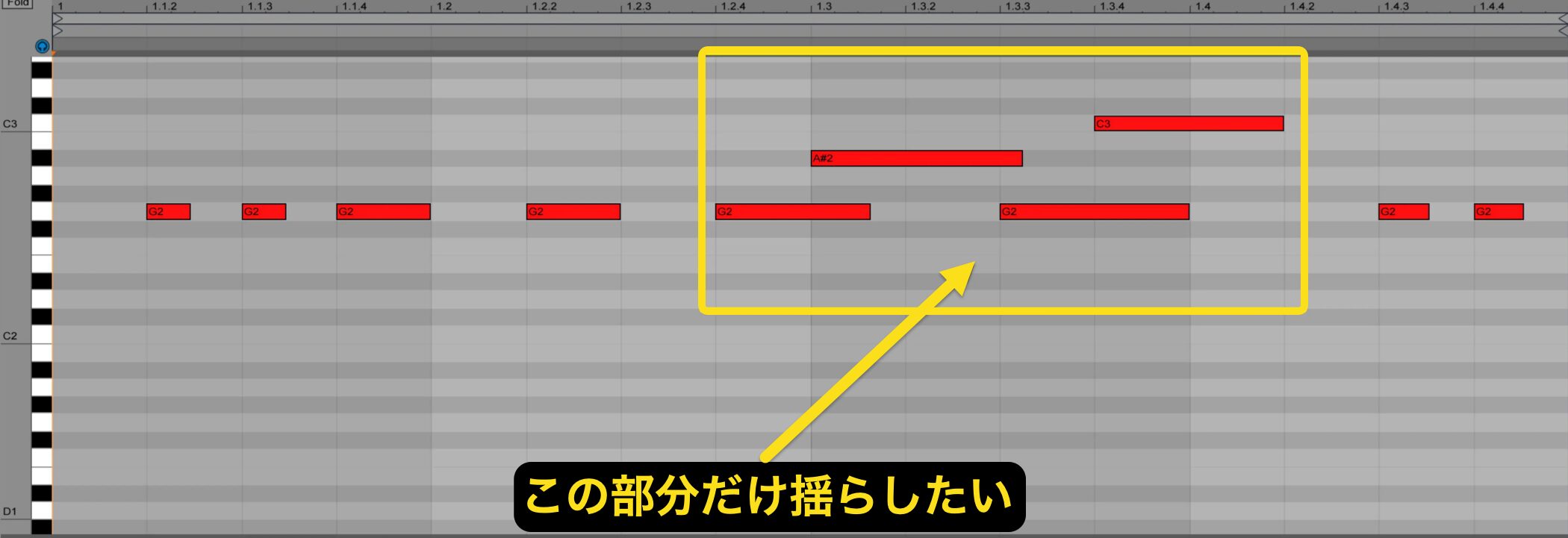
We have programmed MIDI like this.
Notes we want to connect smoothly are programmed so that their timing overlaps.
First, set PORTAMENTO so that the pitch moves smoothly where the notes overlap.
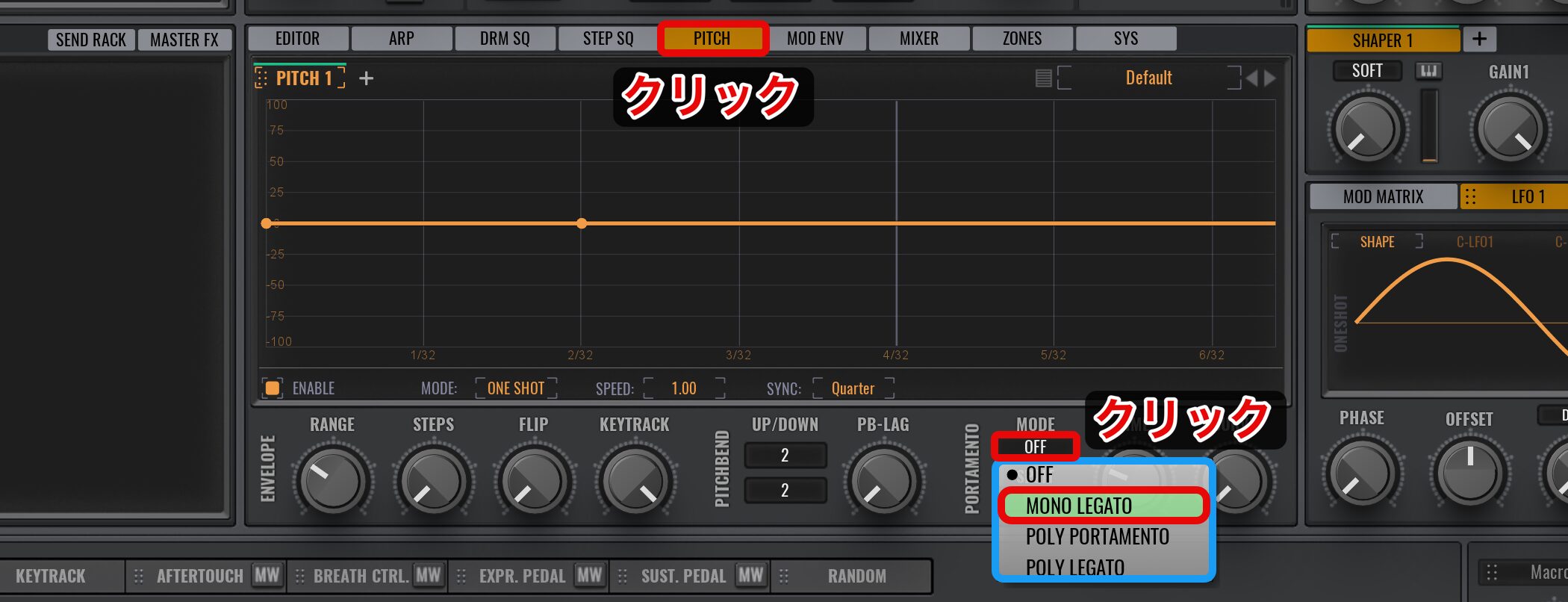
Open "PITCH" and select "MONO LEGATO" in PORTAMENTO's MODE.
We want the LFO effect to appear where the notes are connected.
That means we can use DELAY or FADE IN, explained above.
Let's use FADE IN.
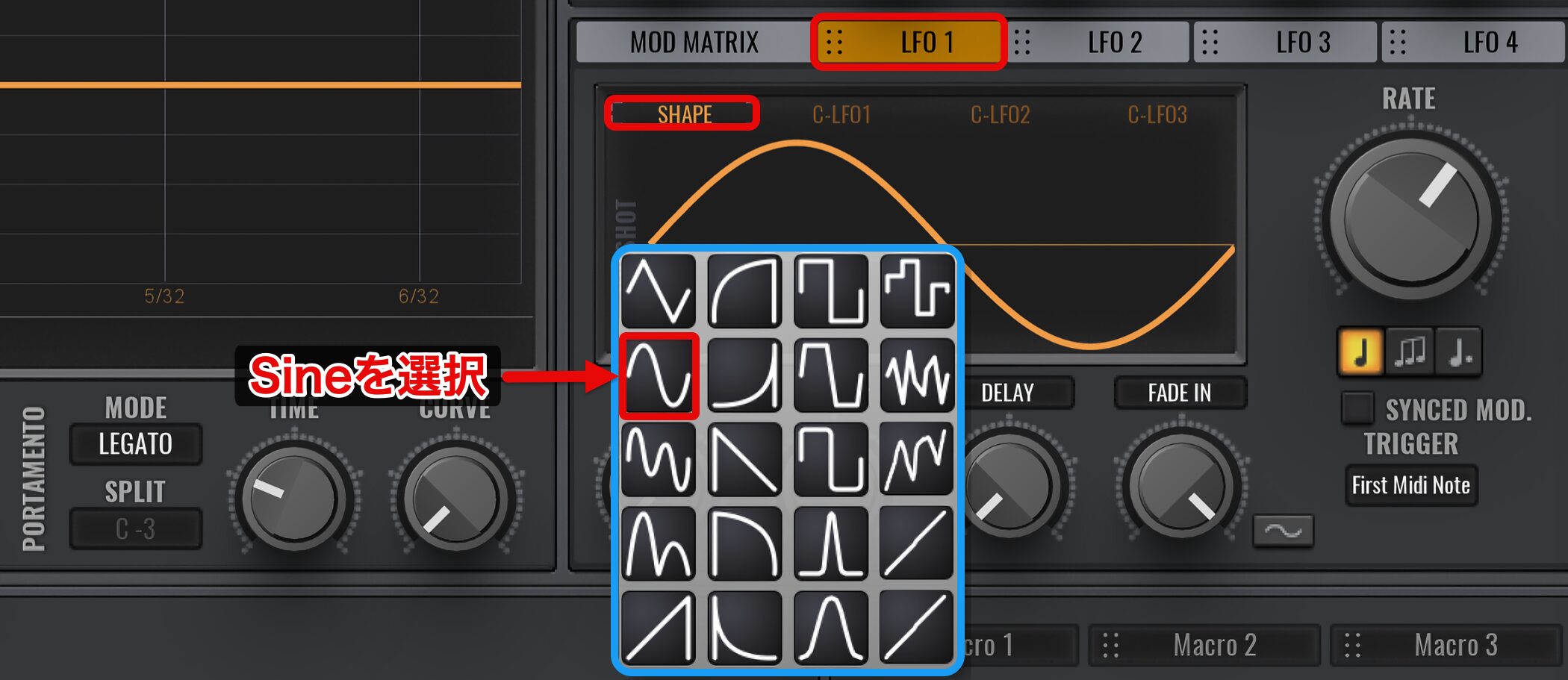
First, set LFO 1's SHAPE to "Sine".
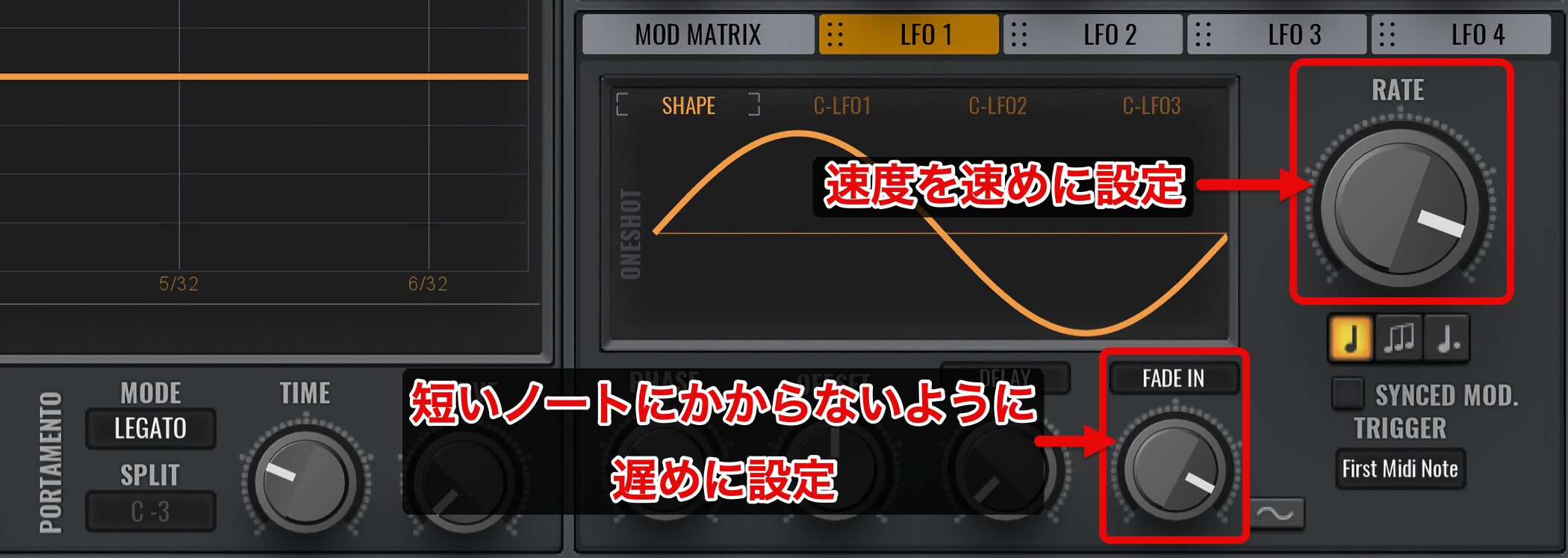
Setting FADE IN fairly slow means the LFO is not applied to short notes.
Also, speed up the wobble with RATE.
Where should we apply this LFO 1 to make the sound waver?
We could apply it to TRANSPOSE for a vibrato-like sound, but this time we apply it to "FILTER".
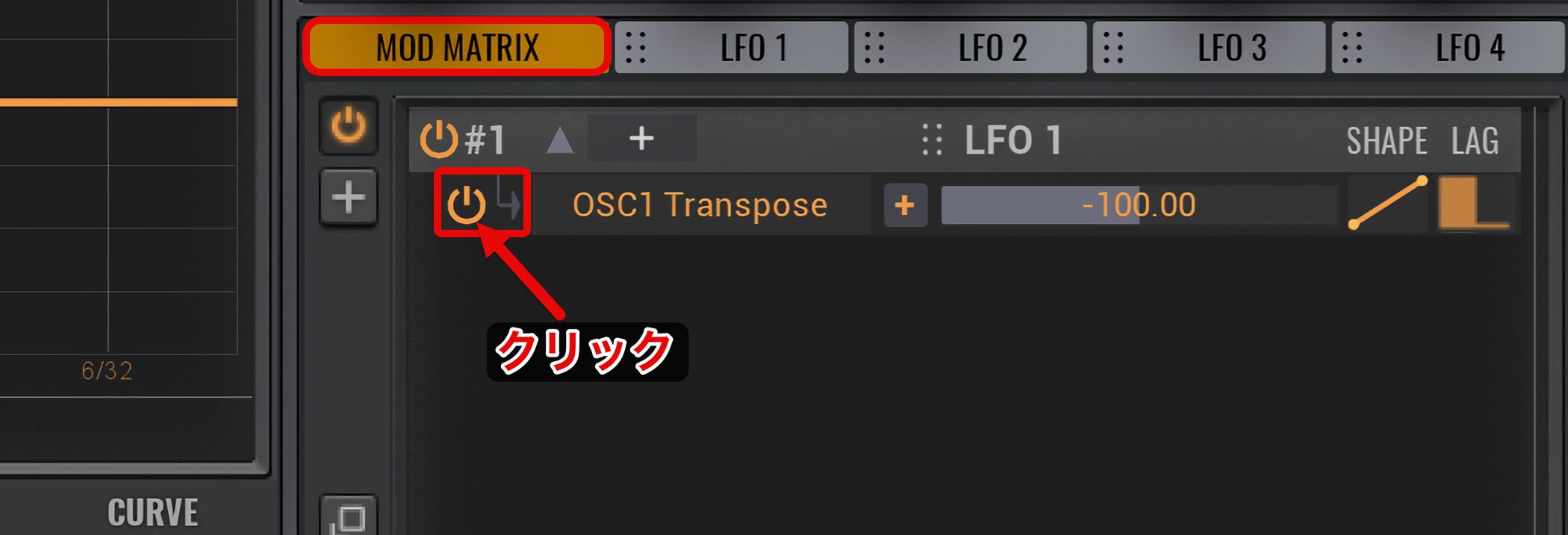
We won't use the LFO currently assigned to TRANSPOSE, so let's turn it off.
Just click the power button of "OSC 1 Transpose" in the MOD MATRIX (turn it off).
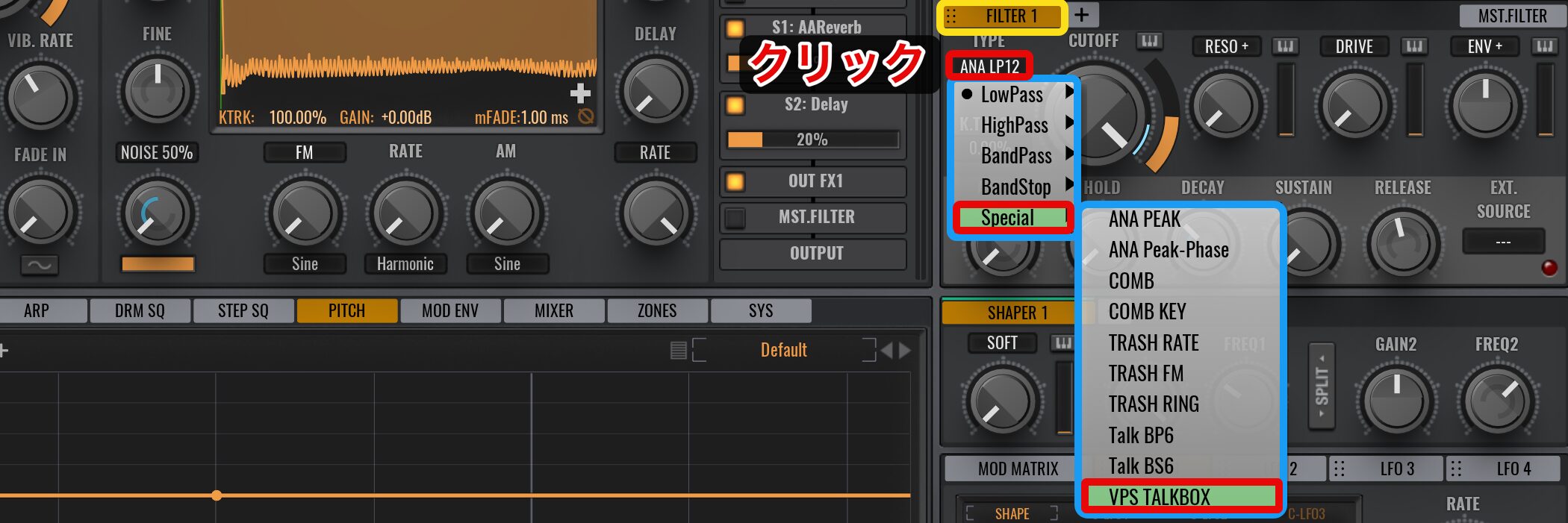
From FILTER 1's TYPE, you can choose the type of filter.
This time we choose "VPS TALKBOX" from "Special".
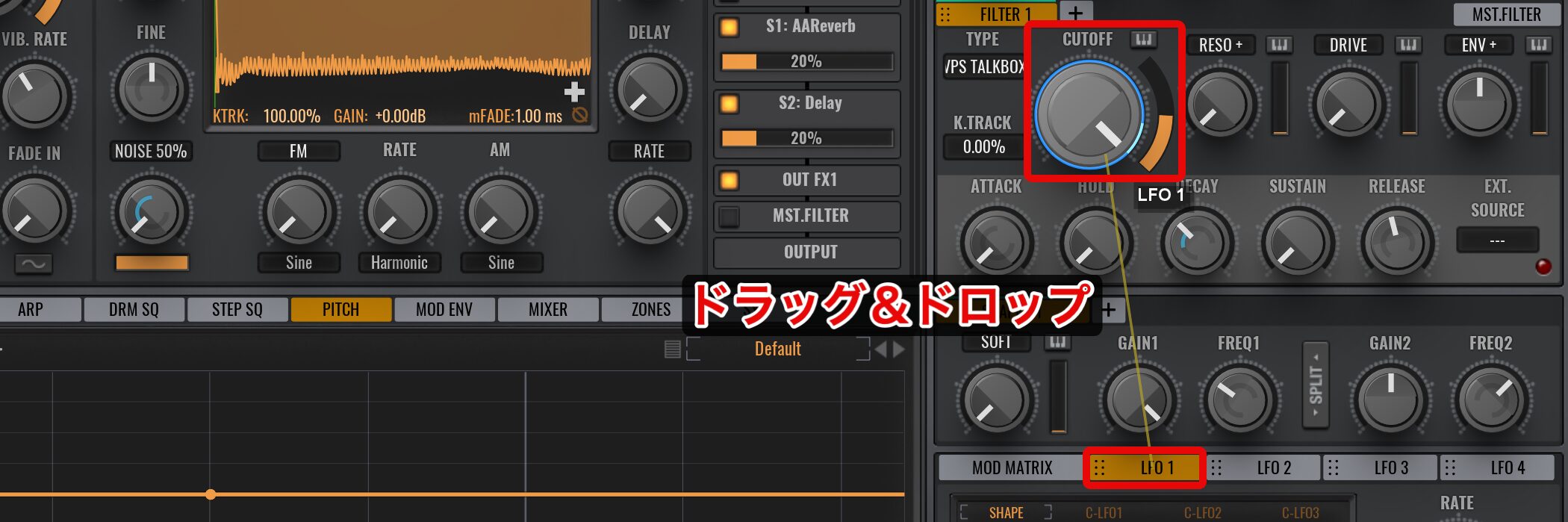
By moving the CUTOFF quickly, you can easily create a wavering nuance in the sound.
Click and drag LFO 1 to assign it to CUTOFF.
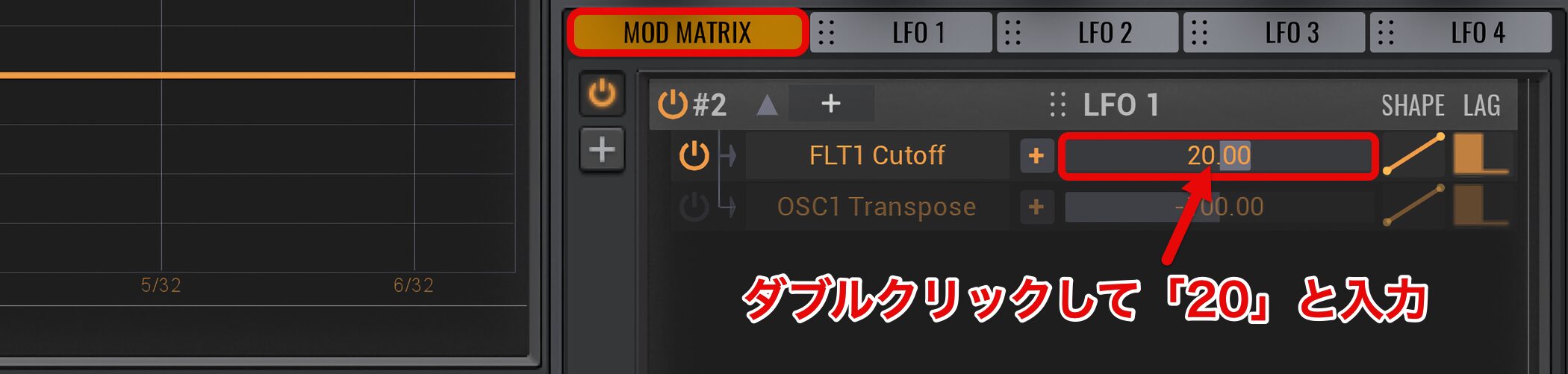
Open the MOD MATRIX and set the depth to a positive value of "20.00".
A large value makes the movement too wide and unpleasant.
Something subtle gives just the right nuance.
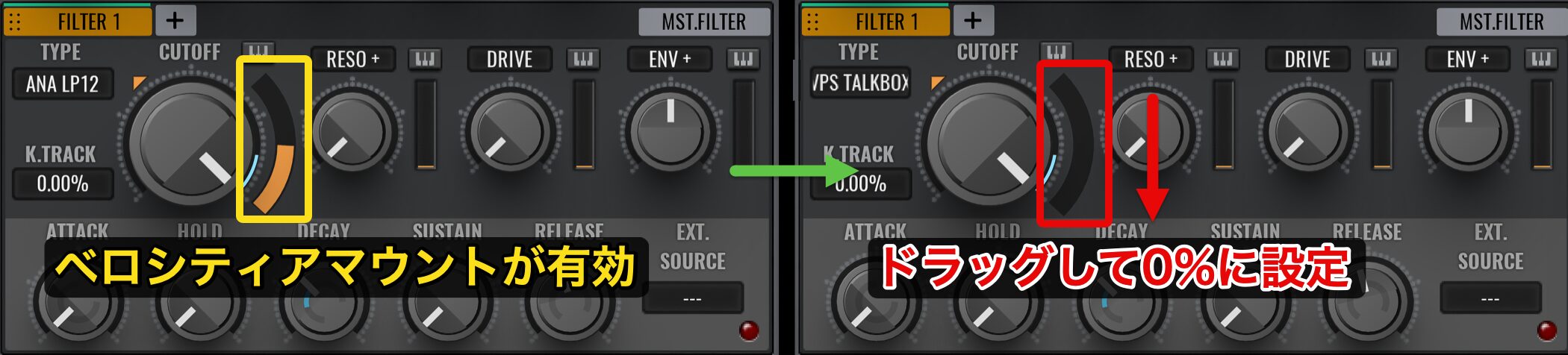
However, as it is, the CUTOFF only moves to the left.
By default, velocity amount is enabled for CUTOFF, so the LFO's movement is controlled by velocity.
This time that prevents the LFO from moving as intended, so drag the value down to 0% to disable it.
Now you get a constant amount of LFO effect regardless of velocity.
Next, let's also set it up so that the tone changes subtly with each note.
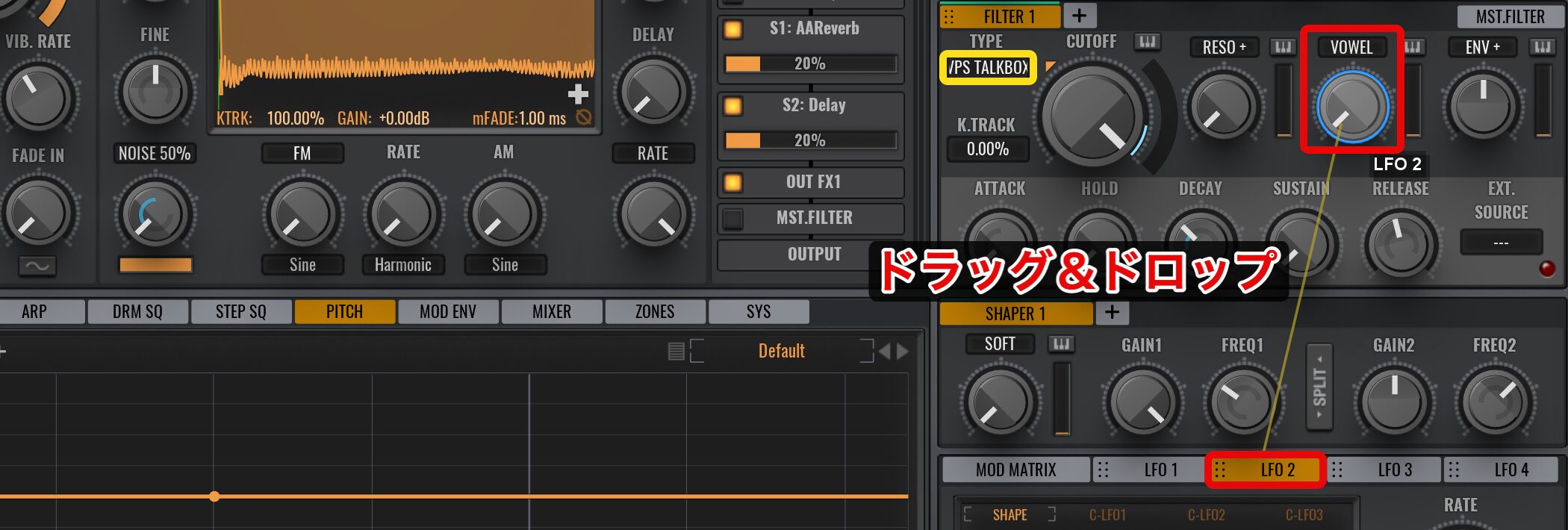
With VPS TALKBOX selected as the FILTER TYPE, "VOWEL" appears next to "RESO+".
Moving this VOWEL changes the vowel sound, and you can easily add nuance to the sound, which is handy.
We apply an LFO here. Click and drag LFO 2 to assign it to VOWEL.
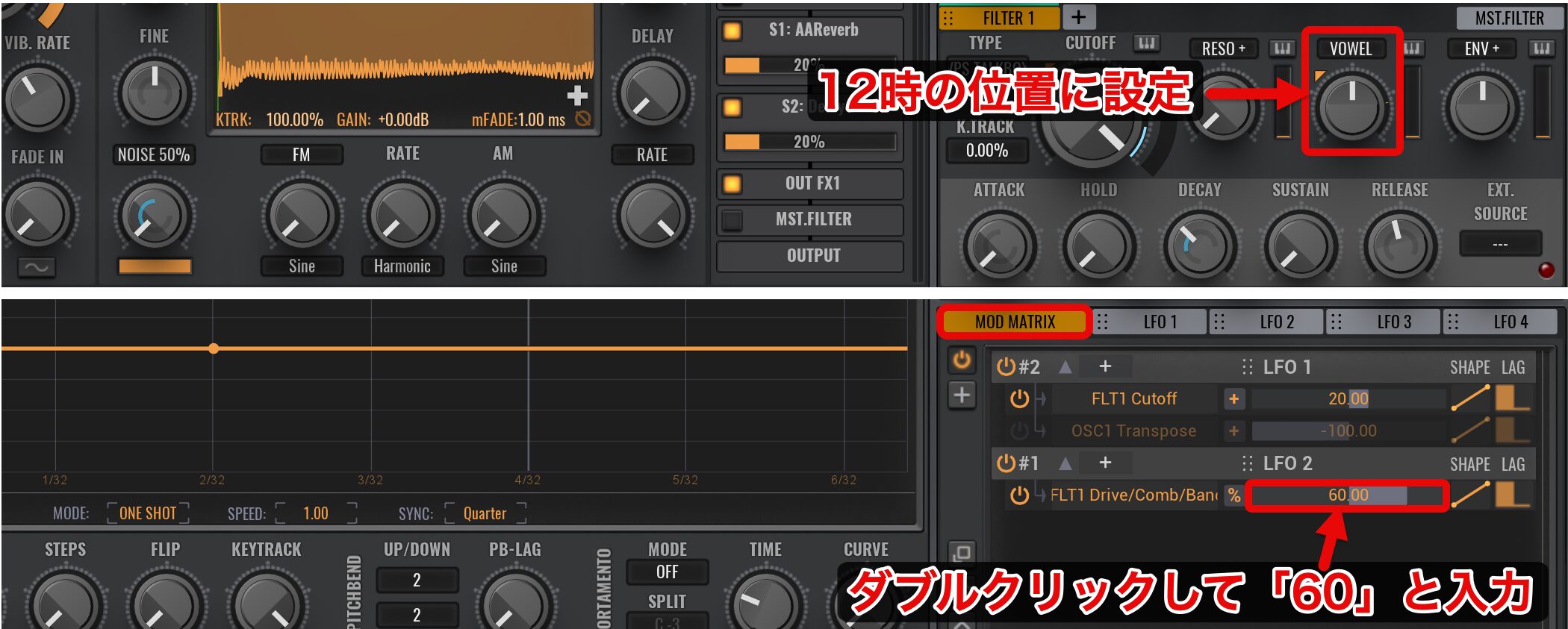
Set VOWEL to the 12 o'clock position so it moves left and right from there.
Open the MOD MATRIX; we set the depth to "60.00", but adjust it to taste.
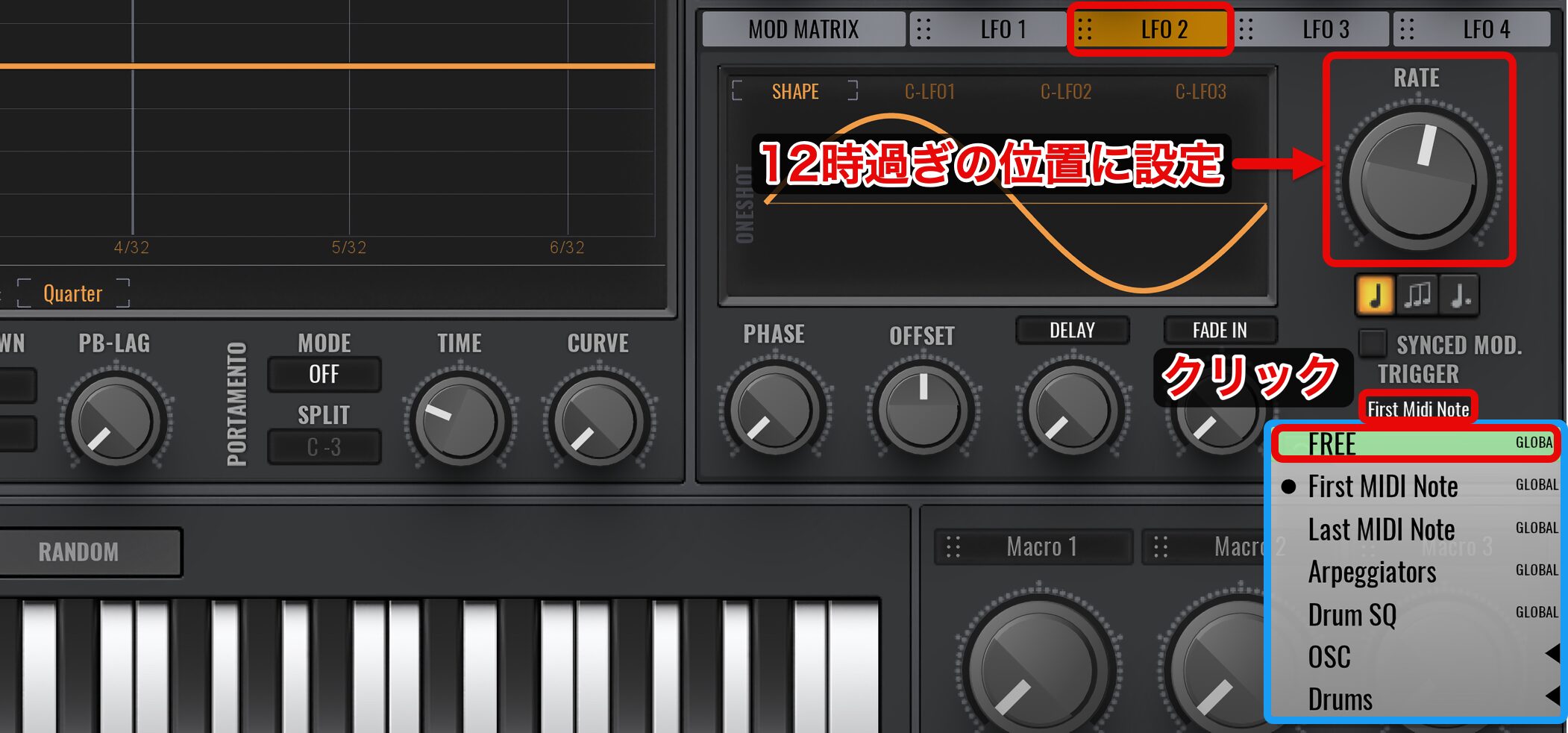
Finally, set up LFO 2.
Set RATE a little slower, just past 12 o'clock.
Also, so that the LFO does not return to the start with every note, change TRIGGER to "FREE".
That completes it.
This time we applied the LFOs to the FILTER, but depending on your ideas you can do all kinds of sound design.
Please try out various things.
A flexible arpeggiator that creates a wide variety of phrases

The arpeggiator is essential in electronic music.
It is a function that plays chords broken up, and everyone has surely heard it at least once.
Arpeggiators are built into many synthesizers, and of course Avenger also has a powerful arpeggiator.
Also, combining it with the Macro function lets you add lots of variation to arpeggiator phrases.
Avenger video: Arpeggiator and macros
How to use and edit the arpeggiator
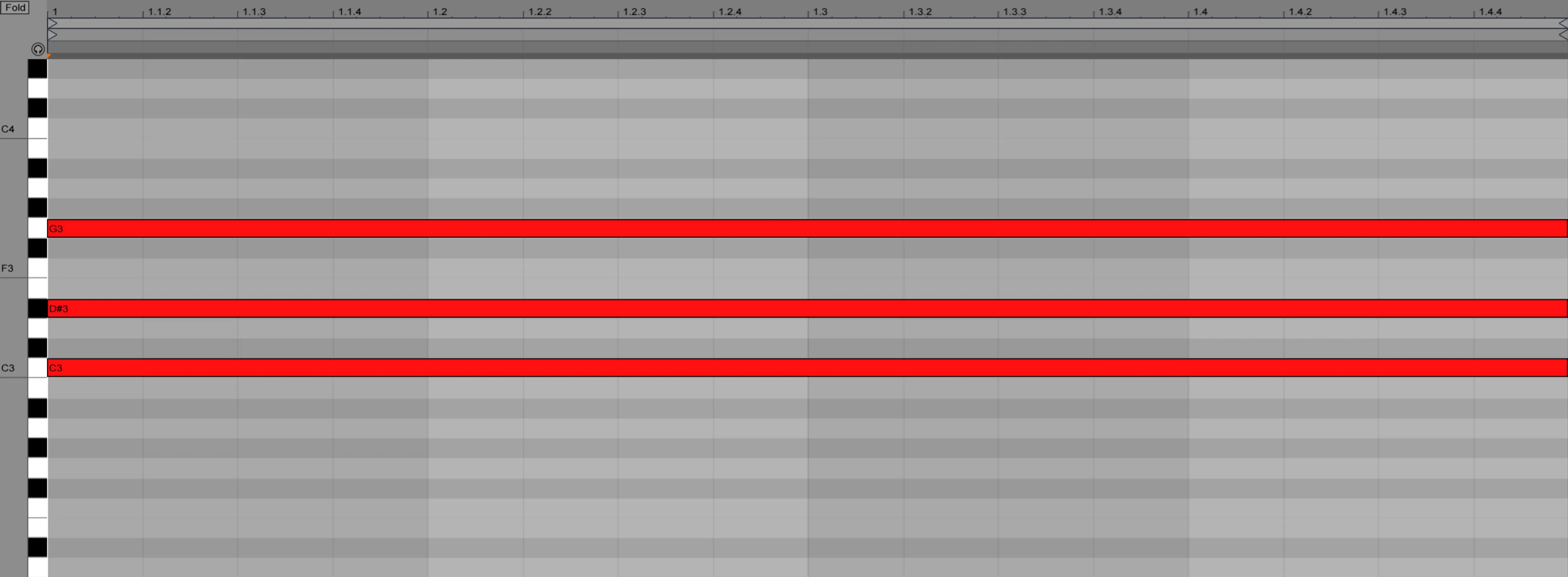
We have programmed chords for the arpeggiator to play.
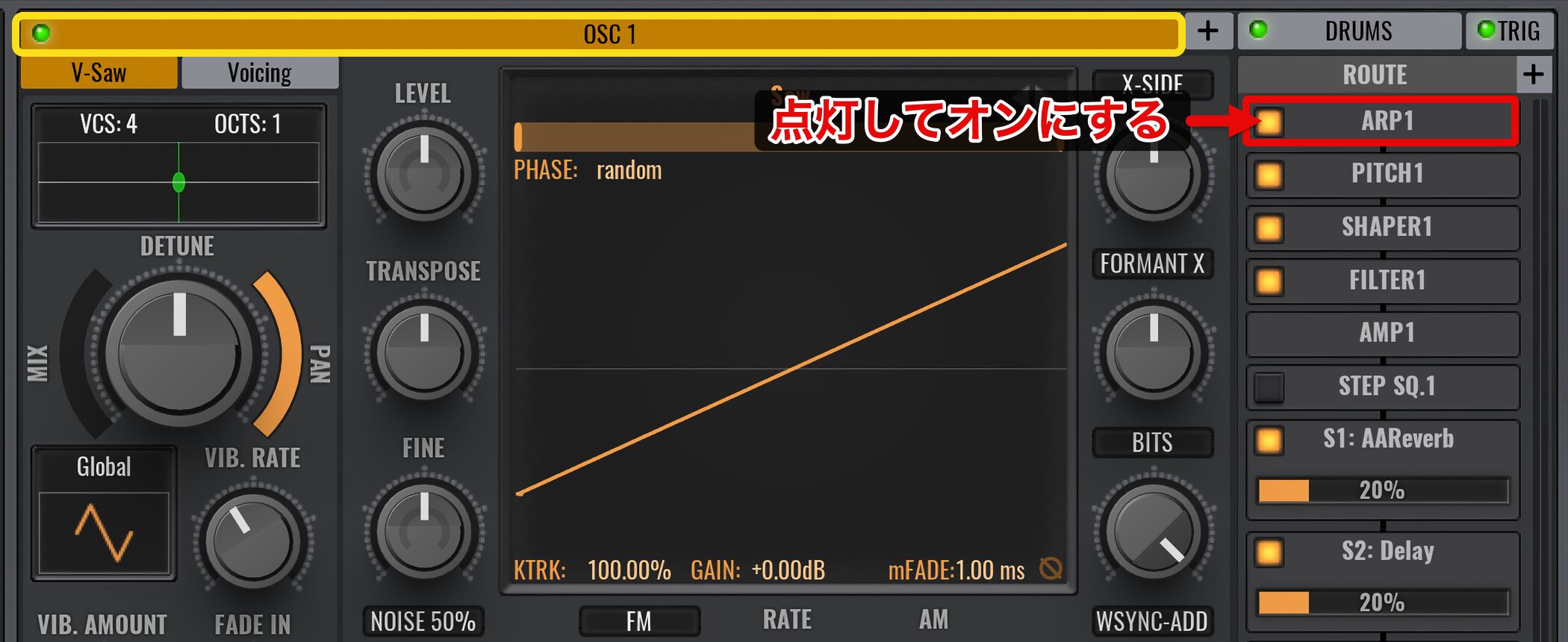
To use the arpeggiator, turn on "ARP 1" in the ROUTE of the oscillator you want to use (OSC 1 this time).

Setting MODE and PAT.SPEED
Set up the arpeggiator from the "ARP" tab below.
Let's look at the details.
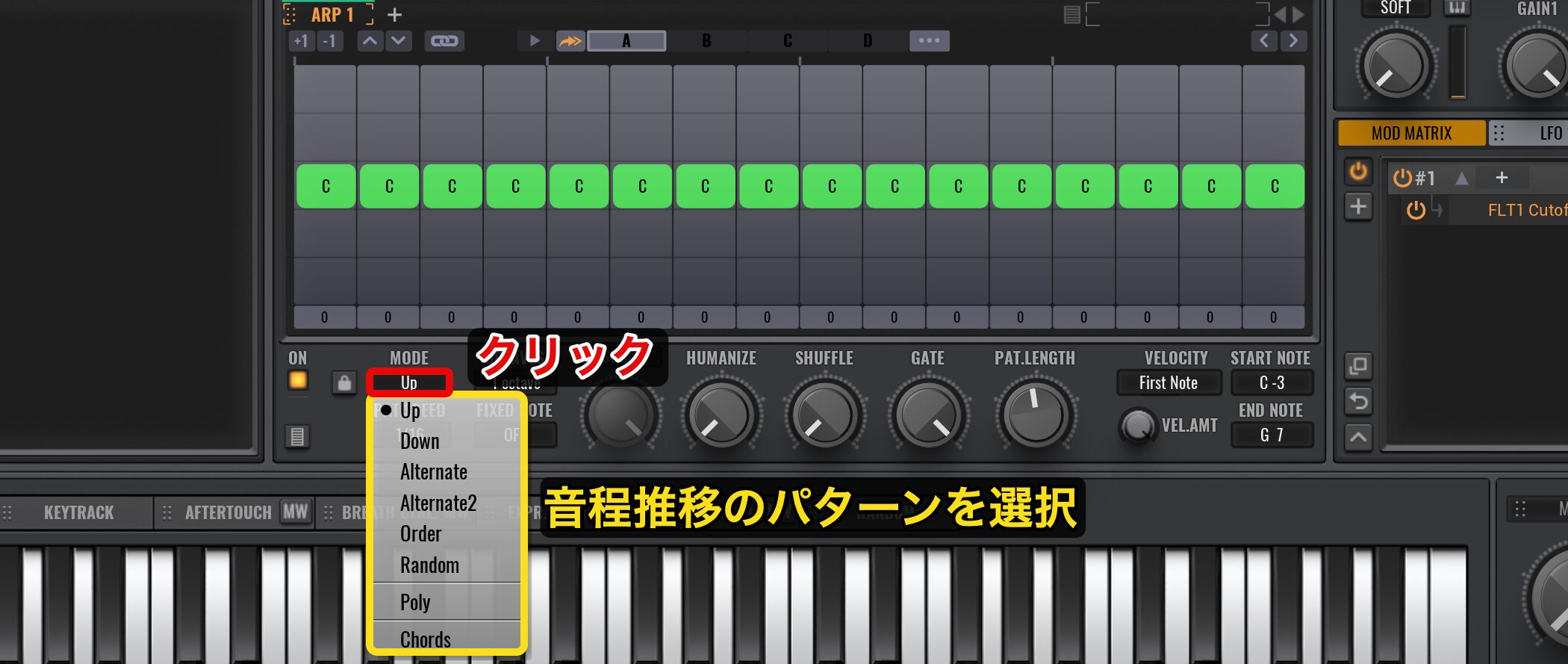
"MODE" lets you choose the pattern in which the arpeggio's pitch moves.
Various movements are provided, such as Up, Down, Alternate and Random.
Look for one that fits your song.
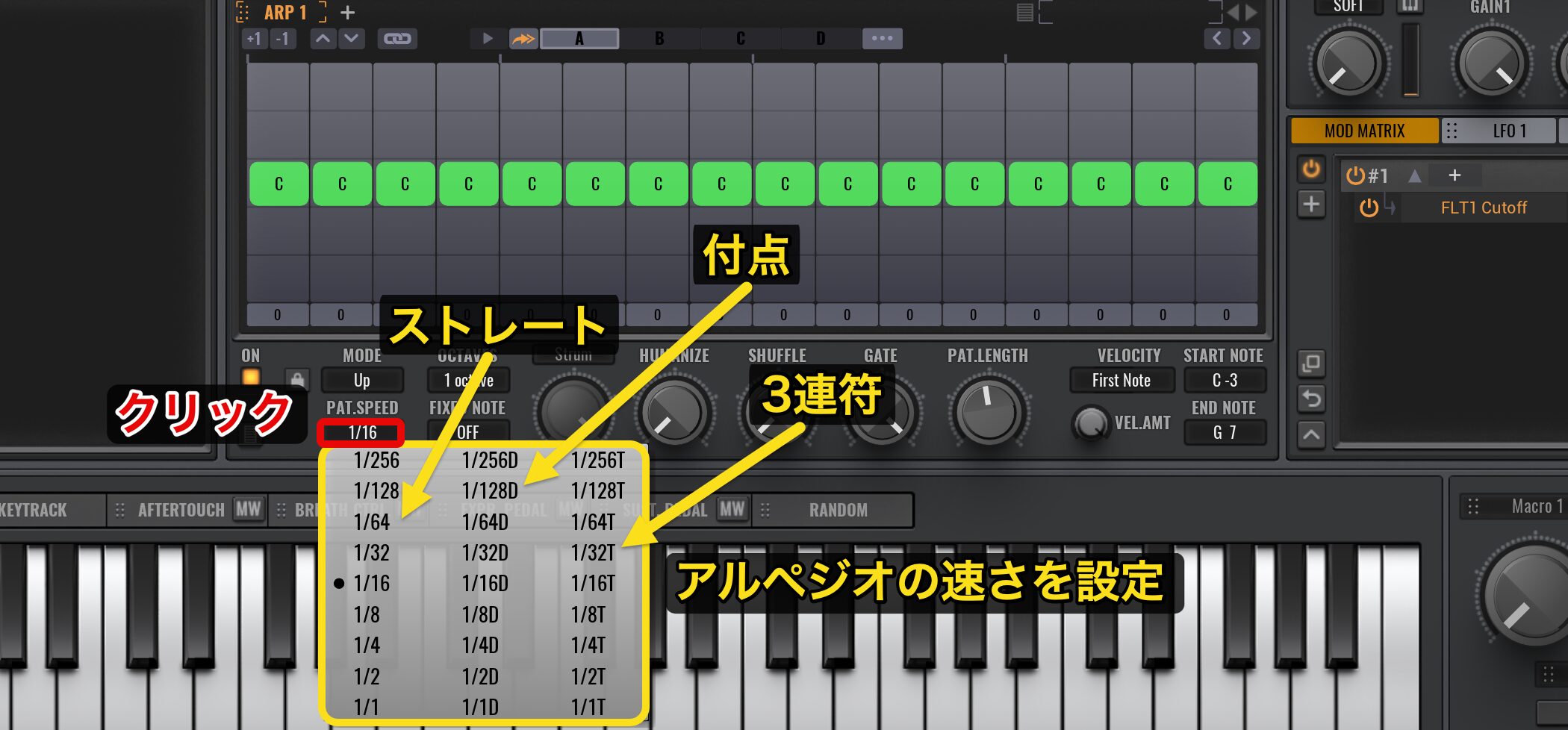
PAT.SPEED below it sets the arpeggio's speed as a note value based on the song's tempo.
The left is straight, the center is dotted and the right is triplets.
Octave settings and note editing
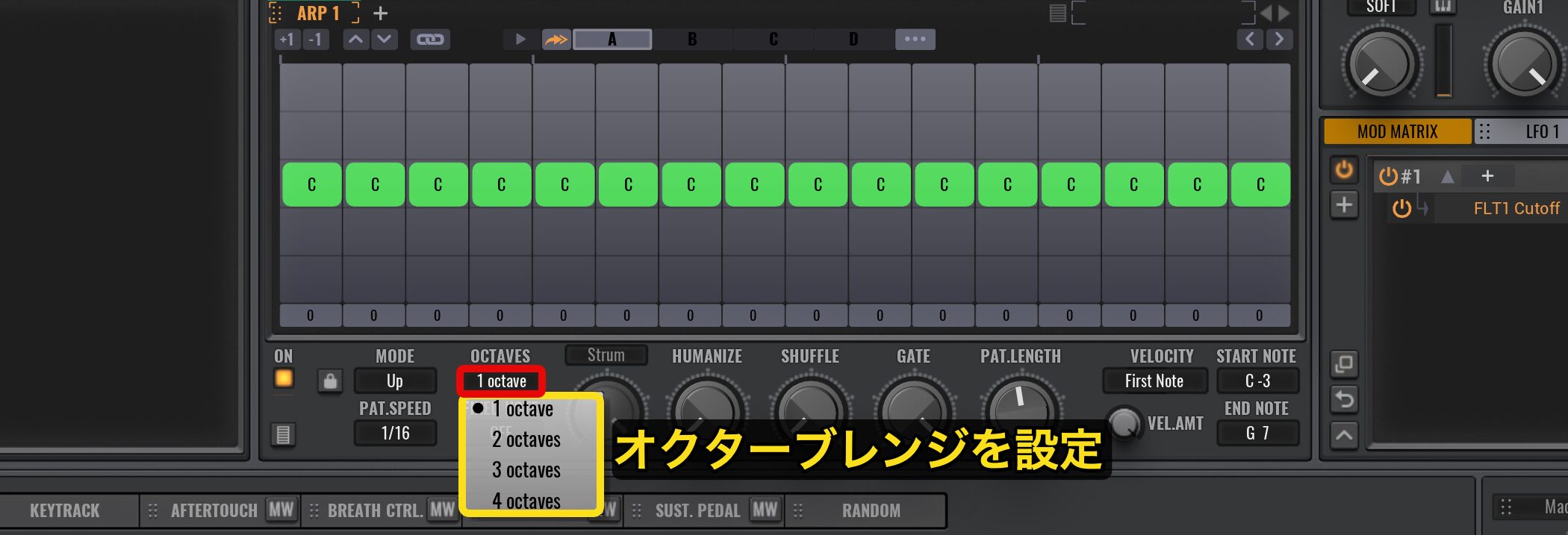
"OCTAVES" sets the octave range, meaning how many octaves up the pitch moves.
For example, setting it to 4 octaves makes the arpeggio phrase play up to four octaves higher, making it a very flashy arpeggio.
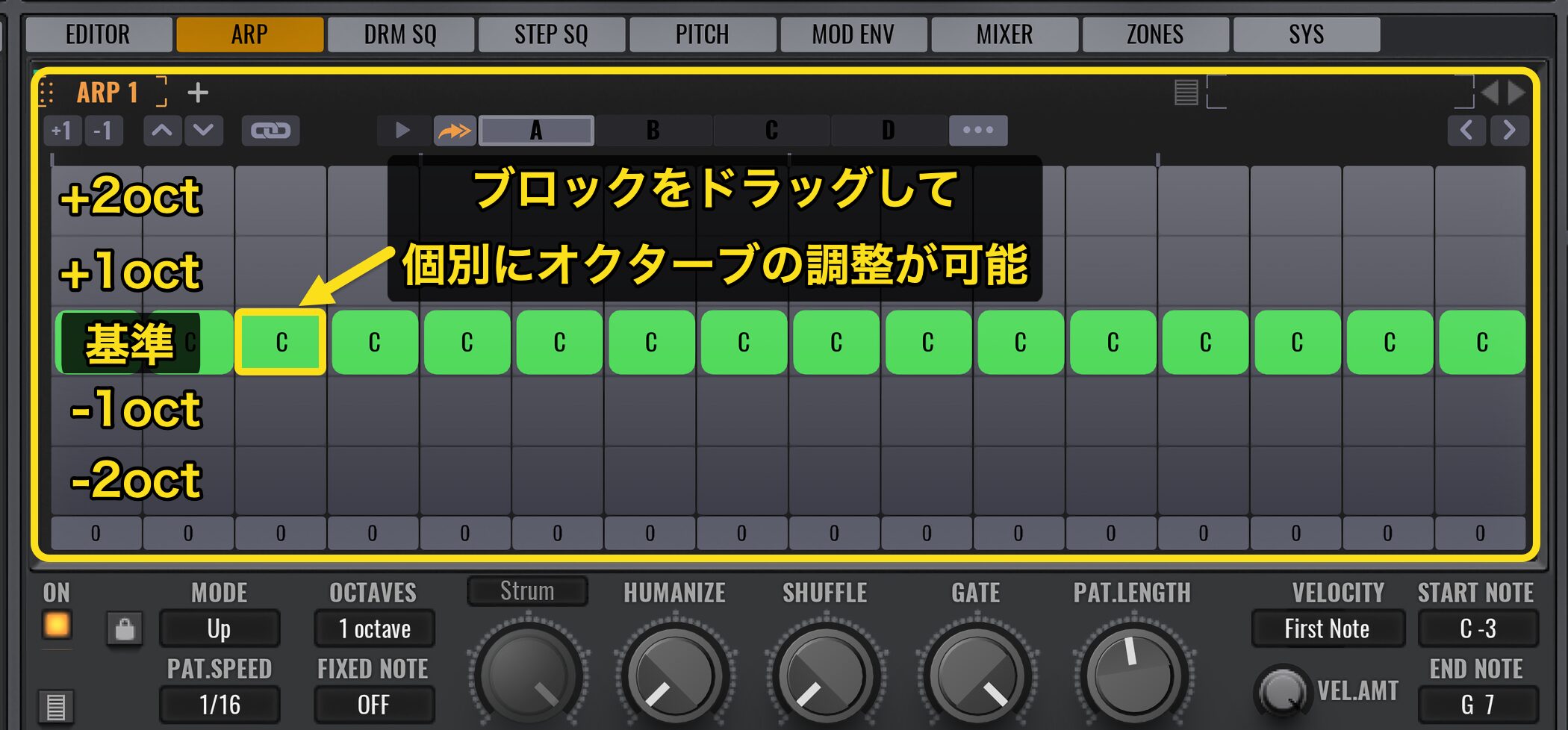
You can also adjust things other than OCTAVES: by dragging the green block of each note up and down, you can change the octave individually.
The center position is the reference octave; moving up raises it by +1, +2 octaves, and moving down lowers it.
Combining these increases your freedom.
Editing the arpeggio in even more detail
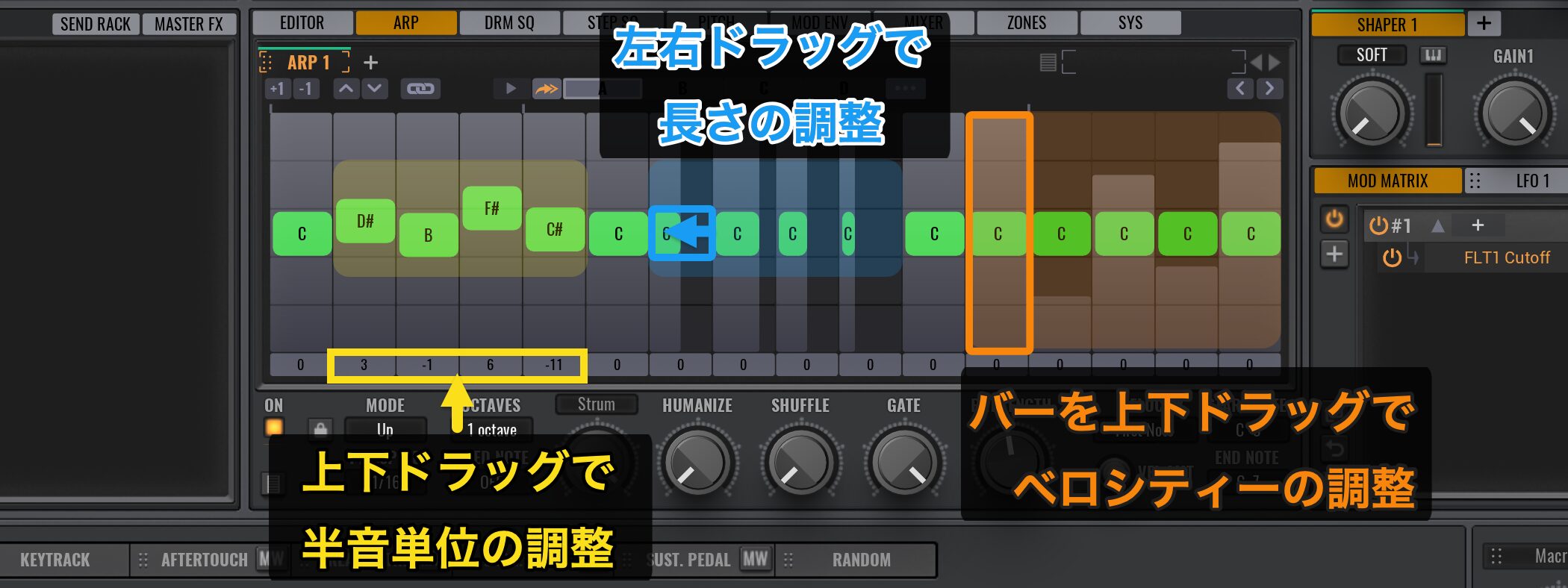
Notes can also be adjusted as follows.
- Semitone adjustment: drag the numbers at the bottom of the editor up and down to change it.
- Note length adjustment: drag the green block left and right to set it.
- Velocity adjustment: drag the gray bar behind each note up and down to adjust it.
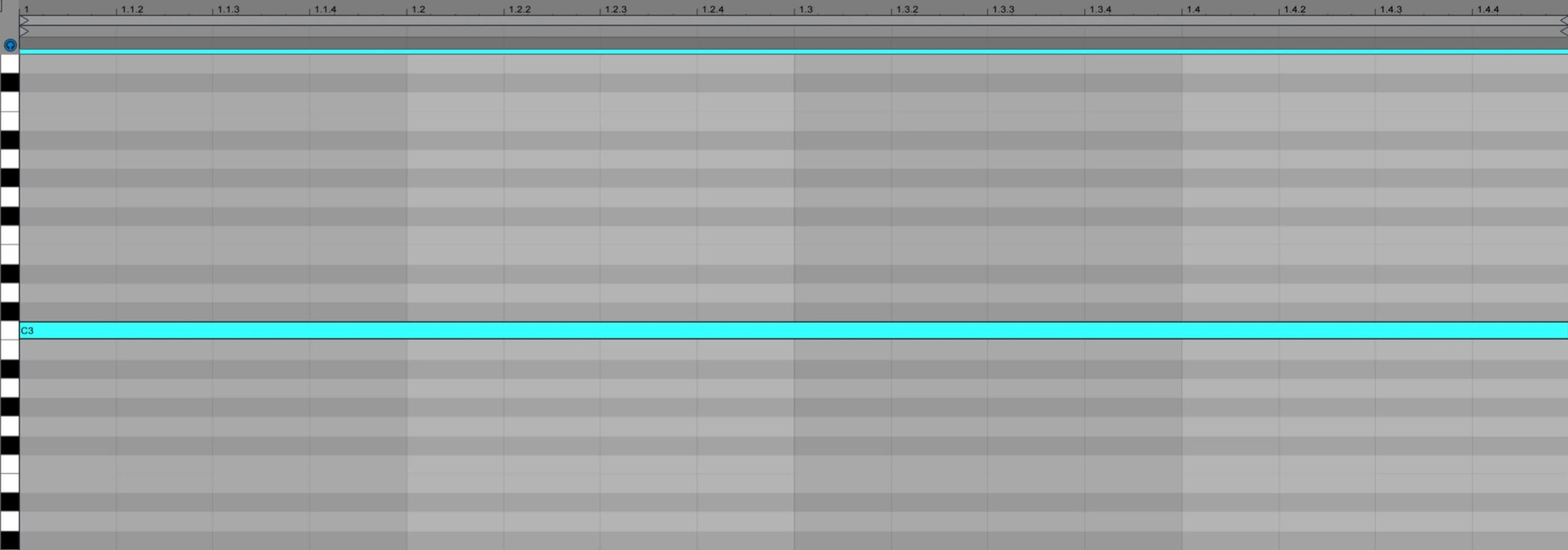
If you can adjust in semitones, then even from a single note rather than a chord, you can create bass or lead phrases.
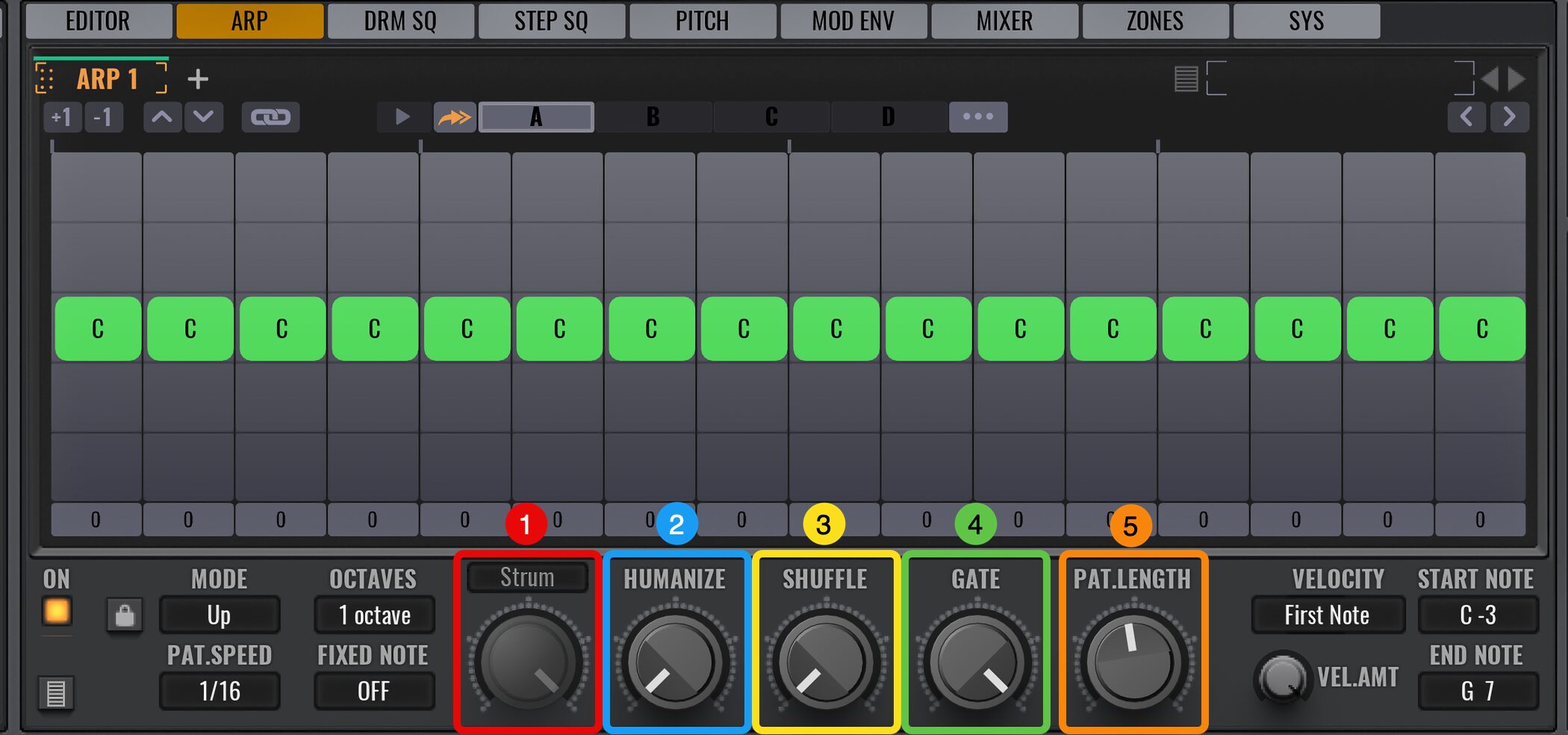
The main parameters are as follows.
① (red) Strum: adjusts the interval at which notes are played in order.
② (blue) Humanize: shifts timing and pitch slightly to add natural, human fluctuation.
③ (yellow) Shuffle: adds swing (a bouncing rhythm) to give the rhythm a groove.
④ (green) Gate: shortens the notes to create a staccato-like effect.
⑤ (orange) Pattern Length: sets the length (number of steps) of the repeating arpeggio pattern.
Creating arpeggio patterns
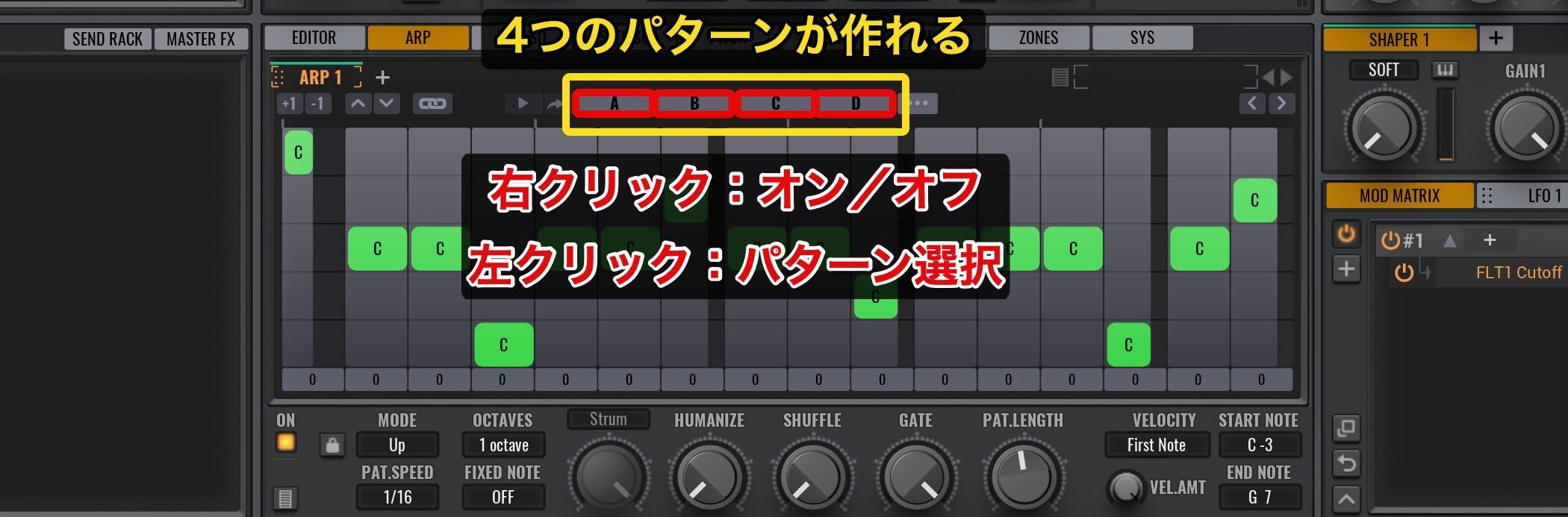
With Avenger's arpeggiator, you can create different patterns in the four slots A to D at the top and switch between them instantly.
Right-click a letter to turn it on or off, and left-click to select the pattern you want to play.
This is handy.
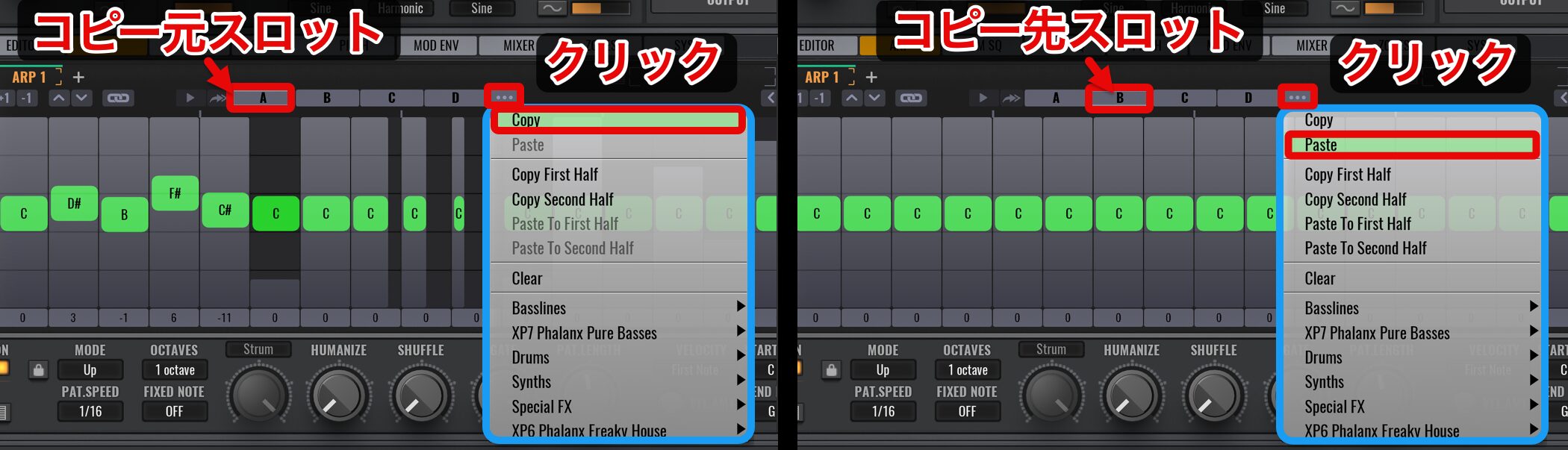
You can also duplicate patterns.
Select the source slot (A this time), click "···" at the right end and select "Copy" from the menu.
Next, select the destination slot (B this time) and select "Paste" from "···" in the same way, and pattern A is copied to B.
Very easy.
Duplicating patterns to prepare slightly different versions and switching between them to suit each section is also quite practical.
Controlling the arpeggiator with macros
After setting up several arpeggios, it's time for the Macro function.
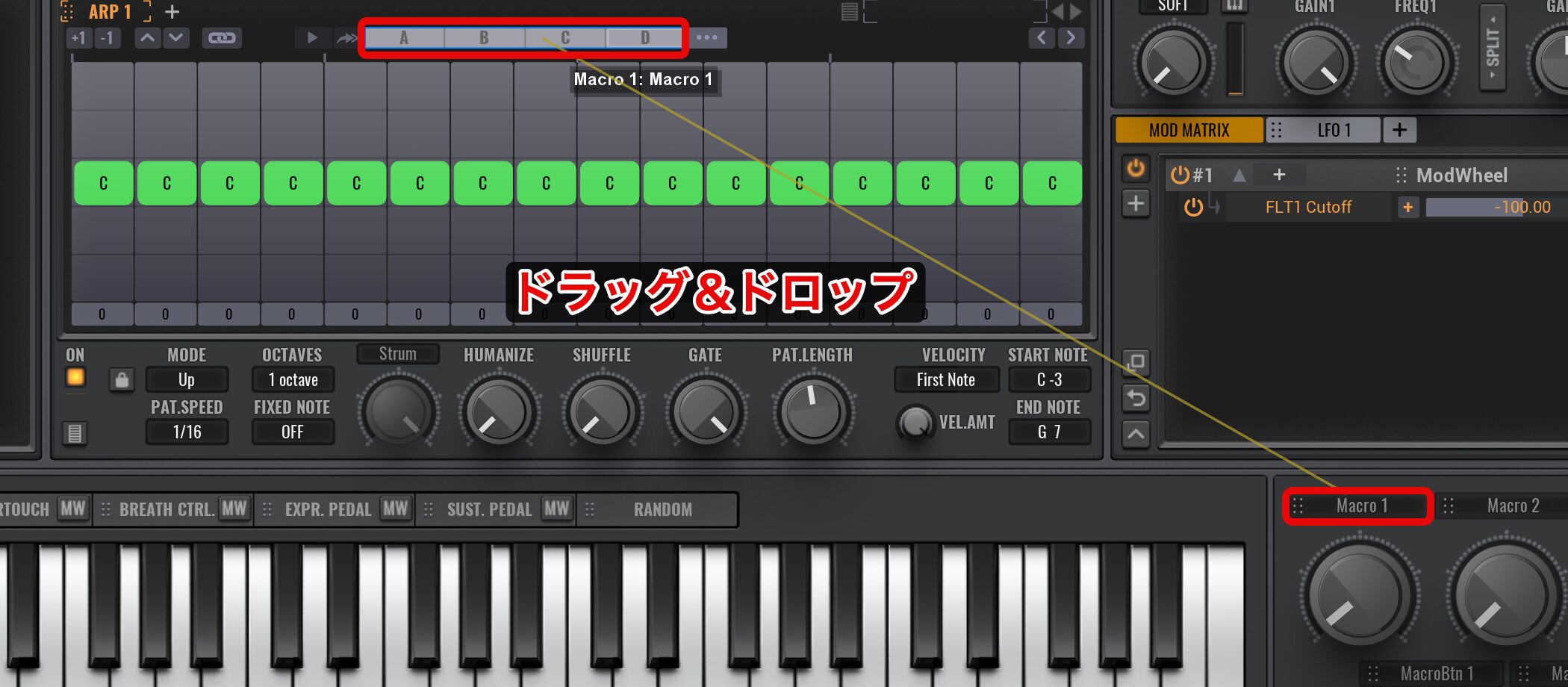
"Macro 1" at the bottom right can be assigned simply by dragging it onto the knob or parameter you want.
Here we assigned the arpeggiator's "A–D" slots.
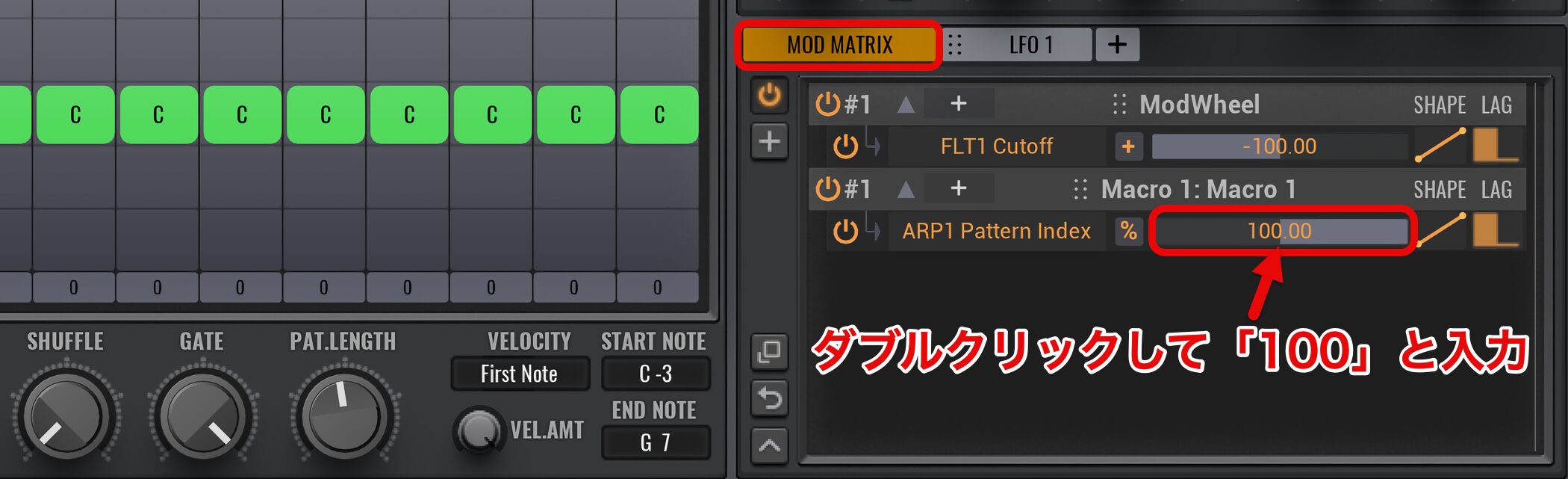
Open the MOD MATRIX and set the value of "ARP1 Pattern Index" to "100.00".
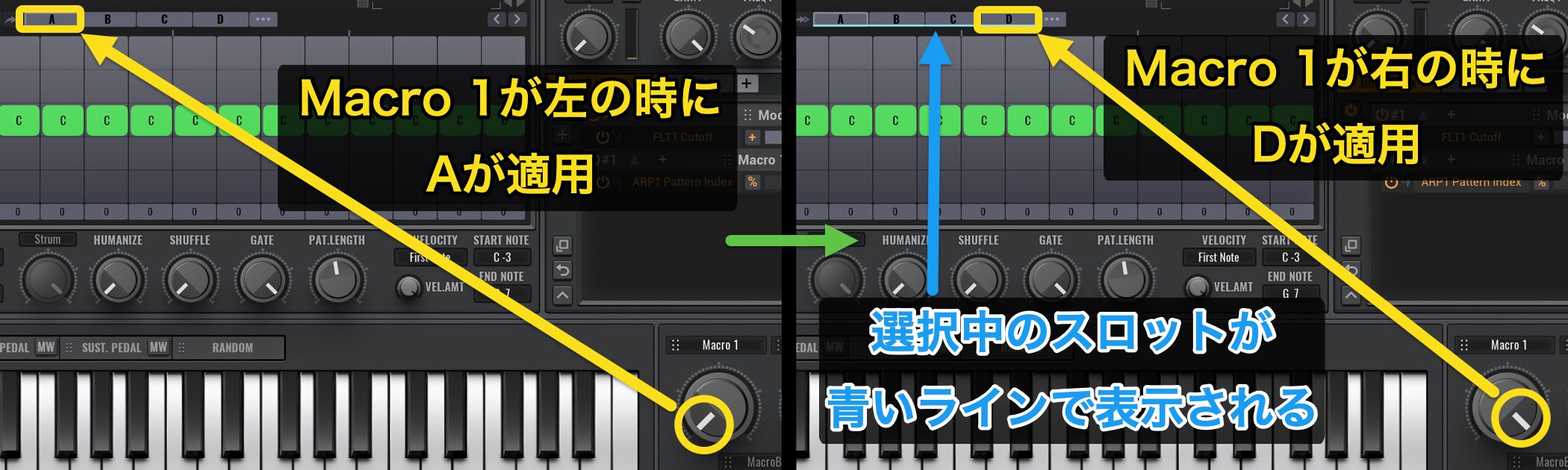
Turning the Macro 1 knob to the left applies slot A, and turning it to the right applies slot D.
Turning the knob moves through "A→B→C→D" in order, and a blue line is displayed as it moves, so you can easily see the current selection.
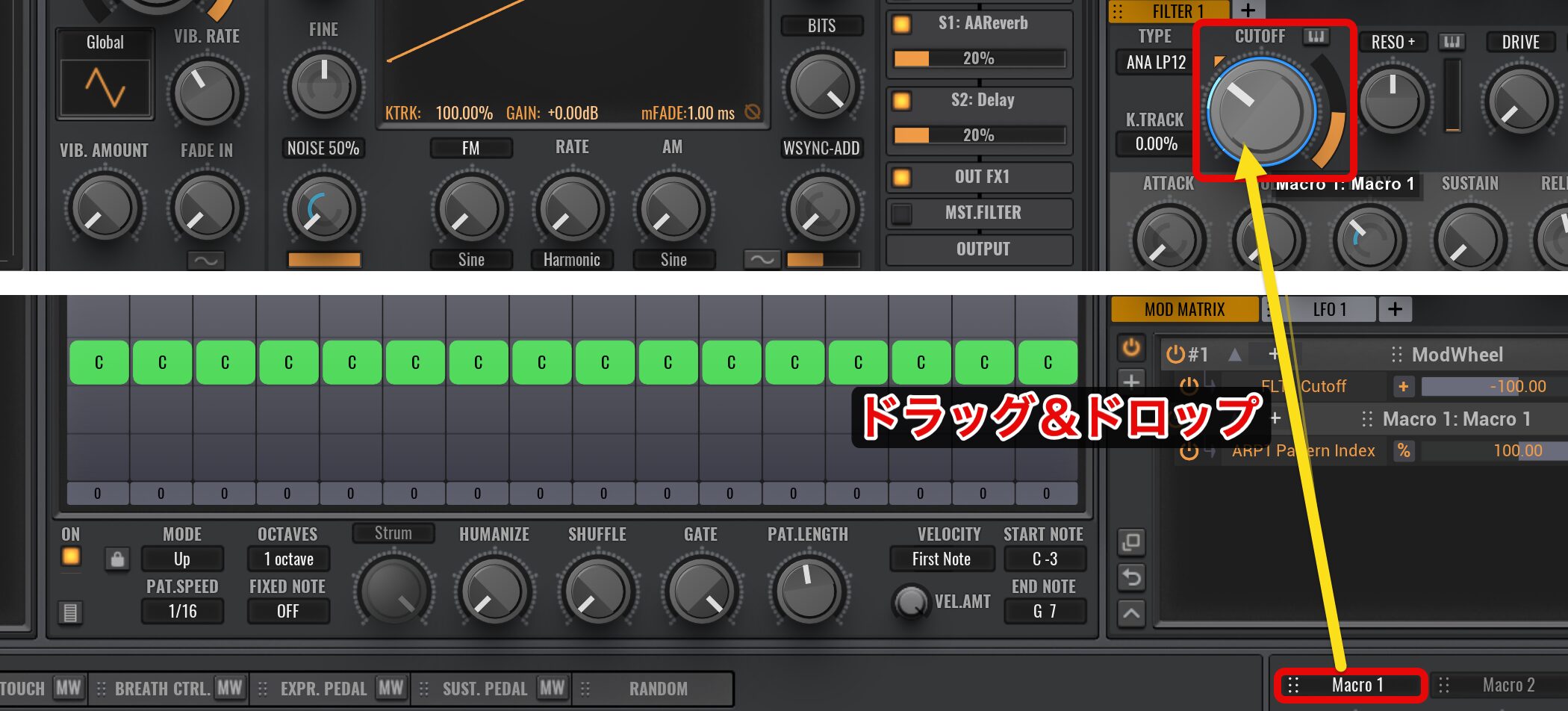
Let's also set it so that as the arpeggio pattern changes from A to D, the FILTER's CUTOFF opens.
Drag the same Macro 1 and assign it to the FILTER's CUTOFF.
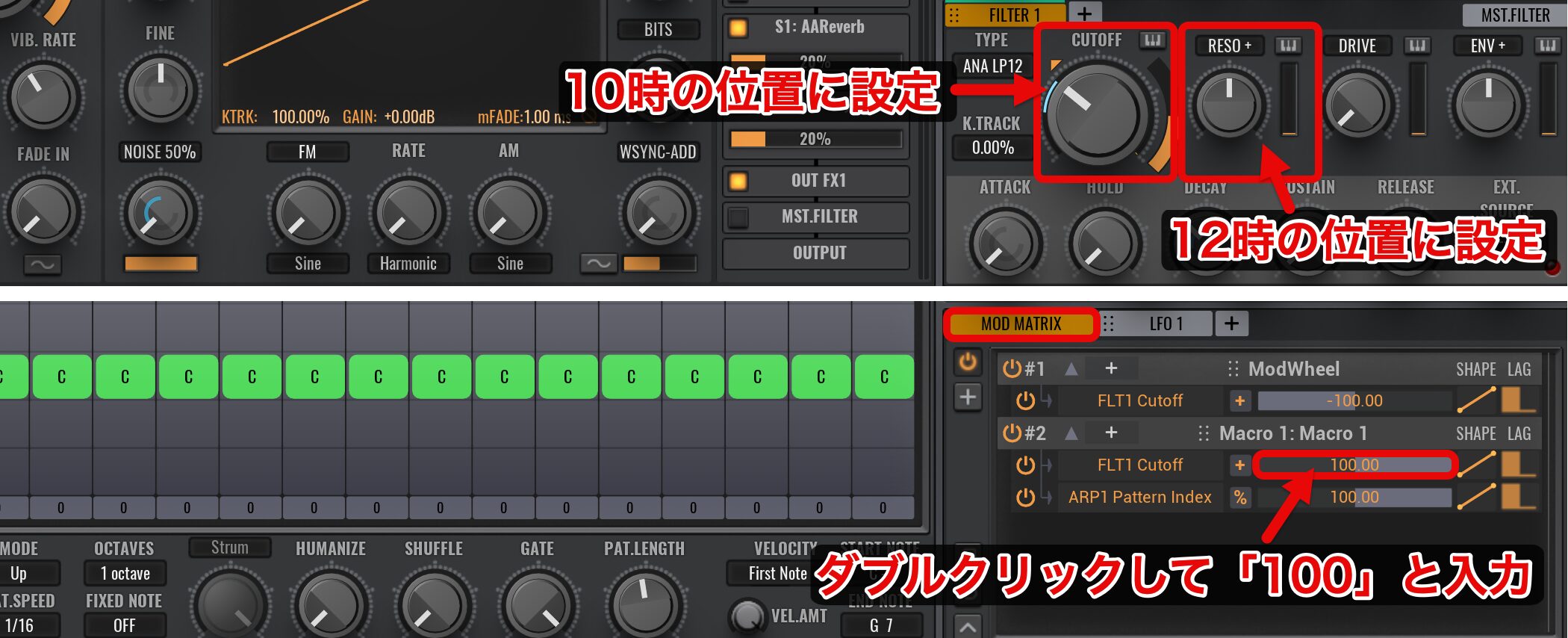
Open the MOD MATRIX and set Macro 1's "FLT1 Cutoff" to a positive value of "100.00".
Set the CUTOFF's starting position to about 10 o'clock and RESO to around 12 o'clock to give the sound some character.
Now the filter also moves along with the arpeggiator changes, giving a very interesting effect.
Avenger's arpeggiator offers a lot of freedom and is intuitive to operate, so editing is a lot of fun.
And by making full use of Macros, you can move several parameters at once and easily create sounds with movement.
Please make use of it in all kinds of sound design.
Reducing CPU load with multiple outputs
Avenger has high-quality sound, but on the other hand its CPU usage is fairly high.
One way to address this is to use OSC multiple outputs, which let a single Avenger send each OSC to a different output.
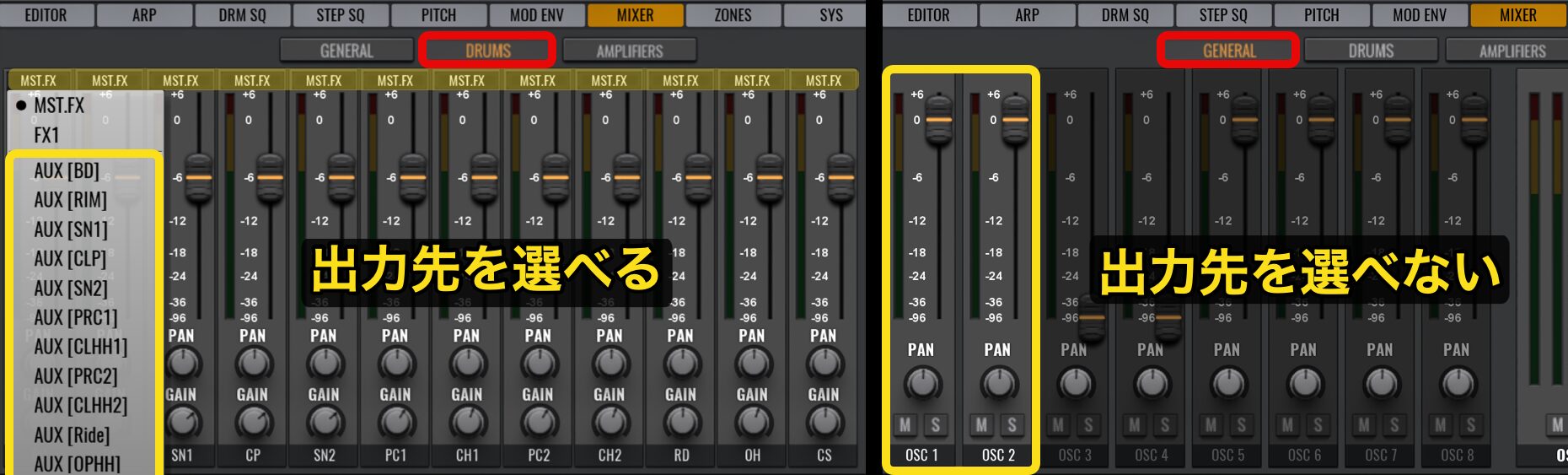
We explained multiple outputs for each kit piece in the drum section, but multiple outputs for OSCs work a little differently.
For DRUMS, you could choose the output from "MIXER" → "DRUMS", but looking at the whole thing in GENERAL, for both OSC 1 and 2 you cannot choose an output destination.
Currently, OSC 2's output is set to "OUT FX1" in ROUTE, and FX1's output flows through "MASTER FX" → "AMP 1" → "MASTER".
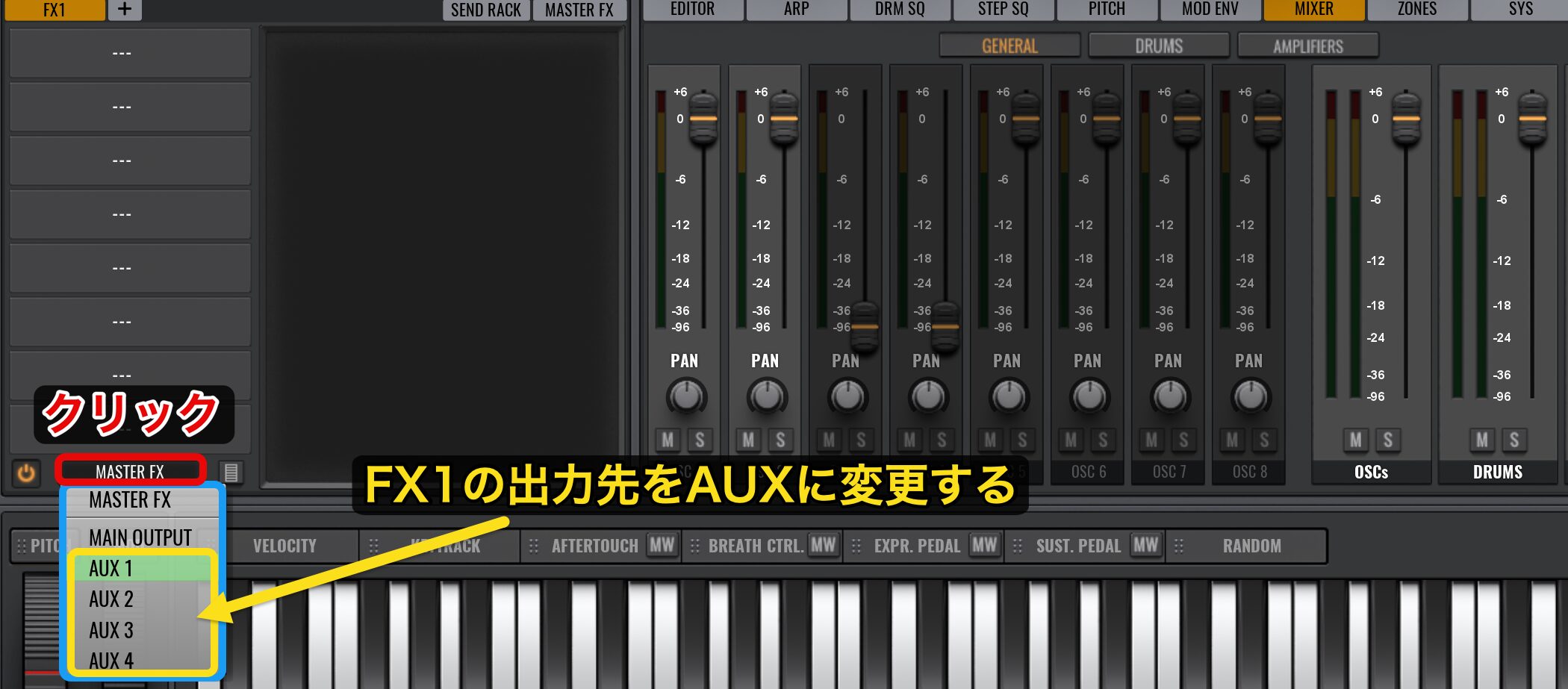
If you change this FX output to an AUX, multiple outputs become possible.
For Ableton Live
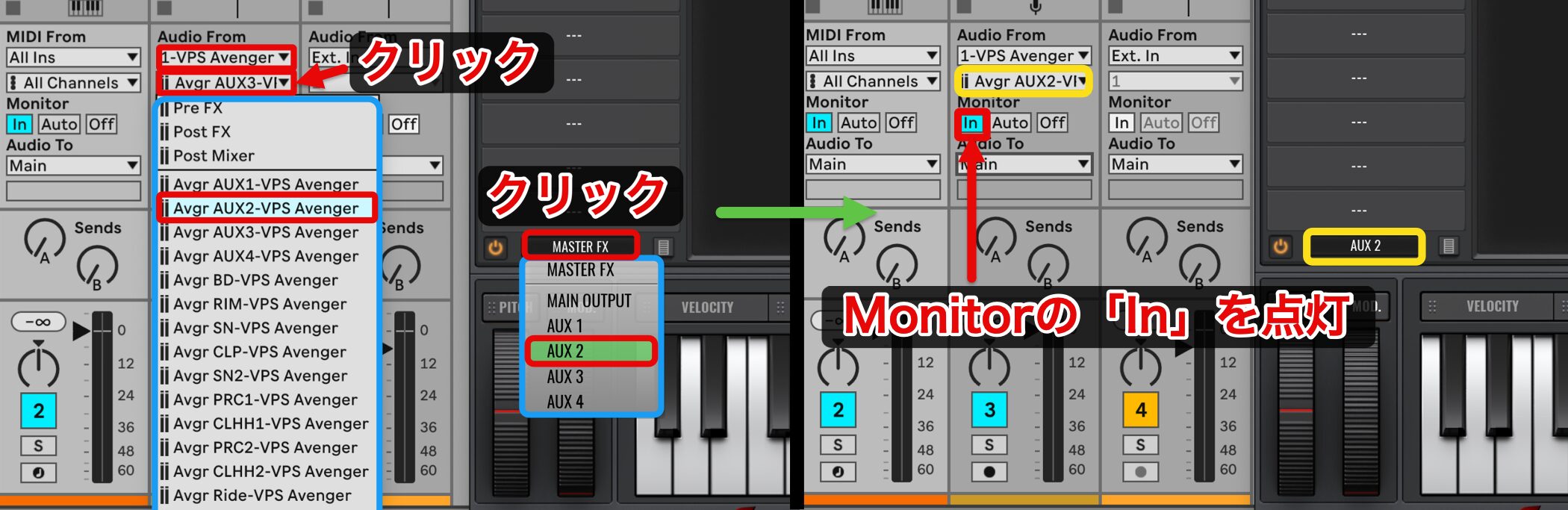
In the Audio Track's "Audio From", select "VPS Avenger".
Next, click the menu below, and VPS Avenger's "AUX 1–4" are shown.
This time we are setting OSC 2's output, so select "AUX 2" on both the Live side and the Avenger side.
Finally, so you can monitor it, enable "In".
Multiple outputs are now set up.
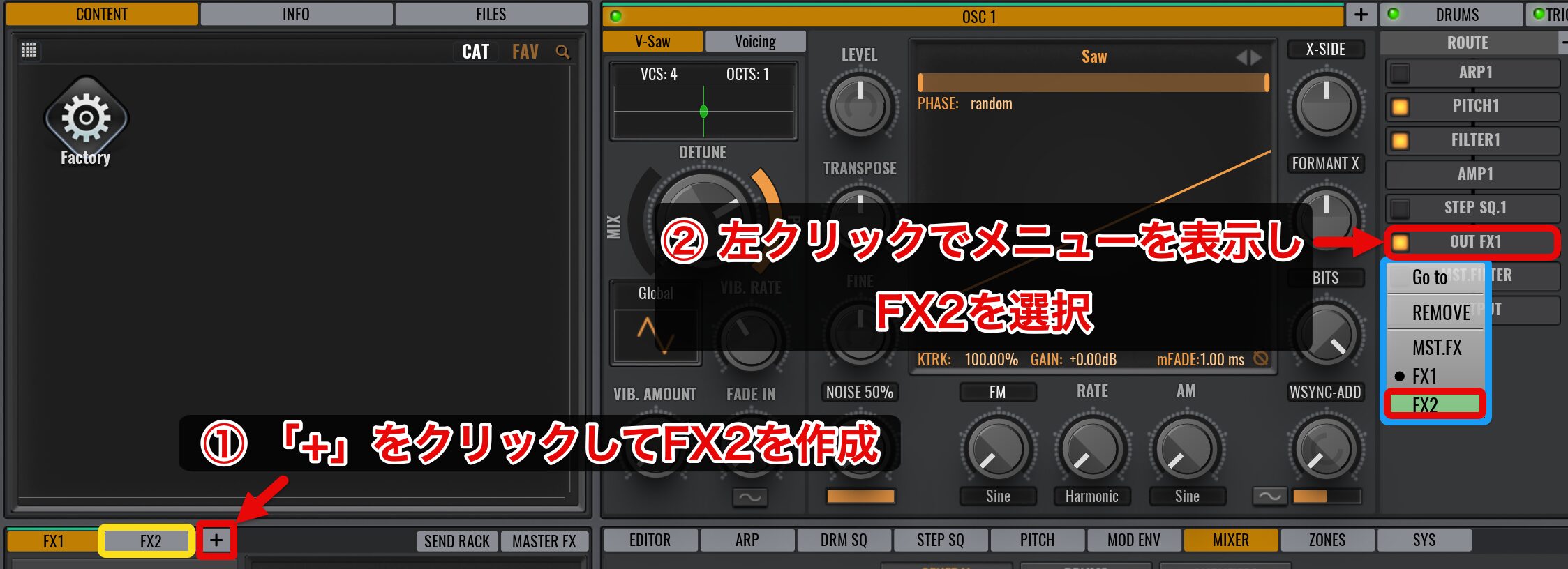
Let's set the output for OSC 1 too.
OSC 2 used FX 1, so click the "+" icon next to FX 1 to create FX 2.
Left-click OUT FX 1 in ROUTE and select FX 2 from the menu that appears.
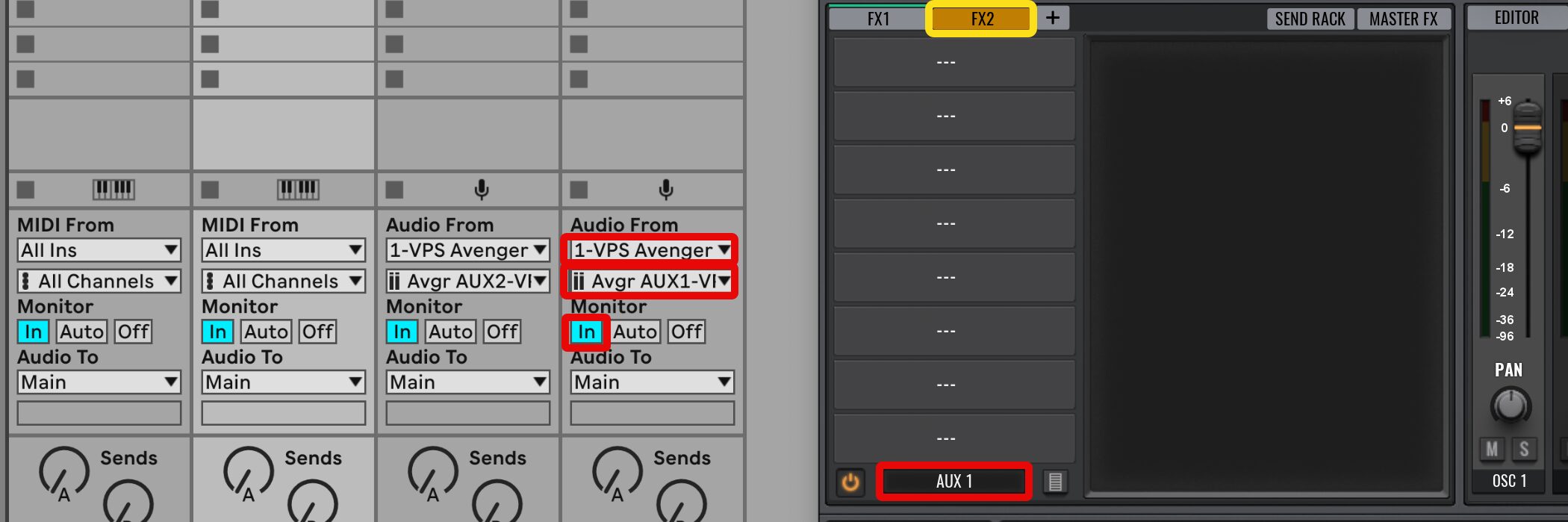
The rest is the same procedure as before.
In Live's Audio Track, set "Audio From" to "VPS Avenger" and select "AUX 1" as the output.
Finally, enable "In" for monitoring and you're done.
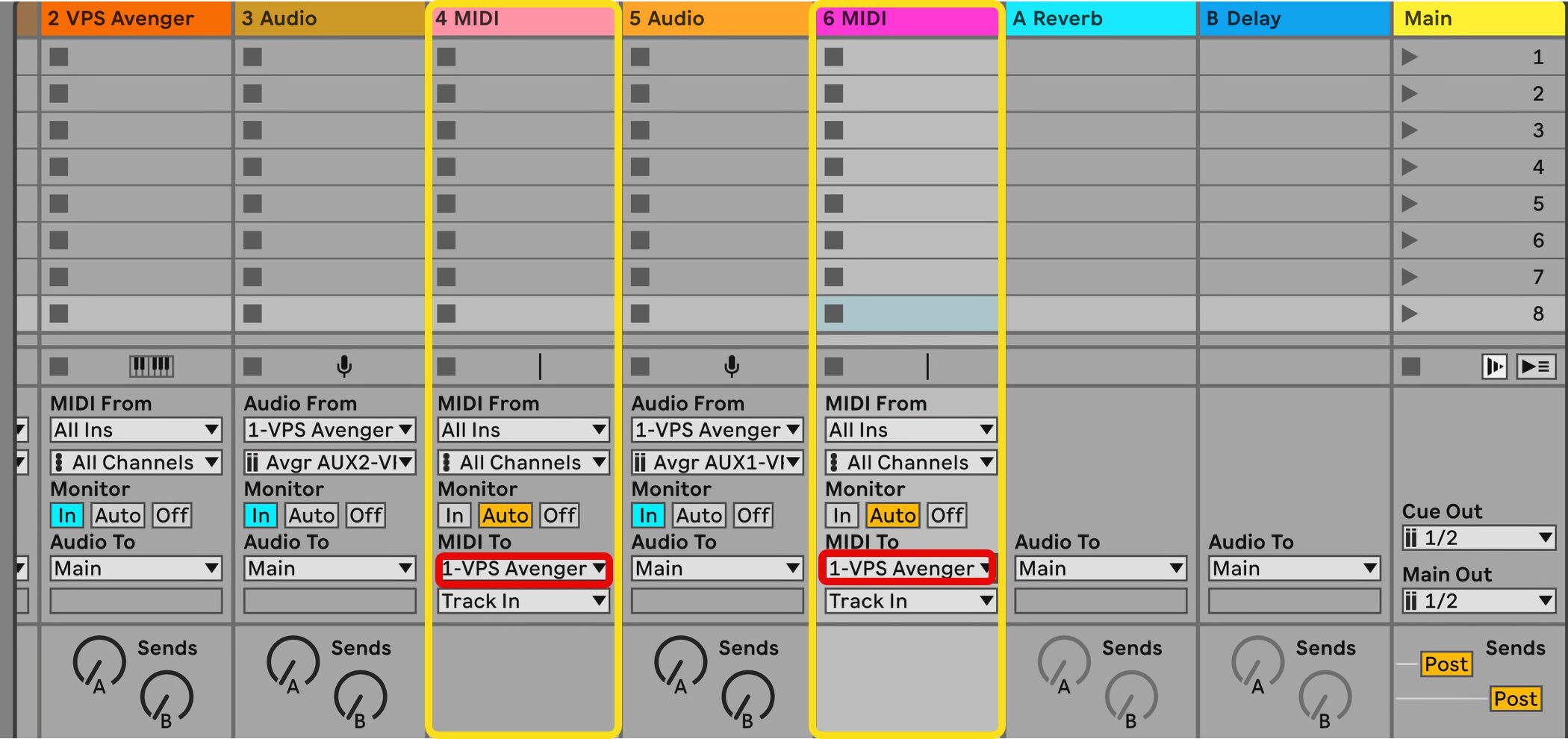
However, as it is, playing Avenger's MIDI track sounds both OSC 1 and OSC 2.
That's fine if they play the same phrase, but if you want them to have different roles, create two MIDI tracks.
After creating them, set "MIDI To" to "VPS Avenger".
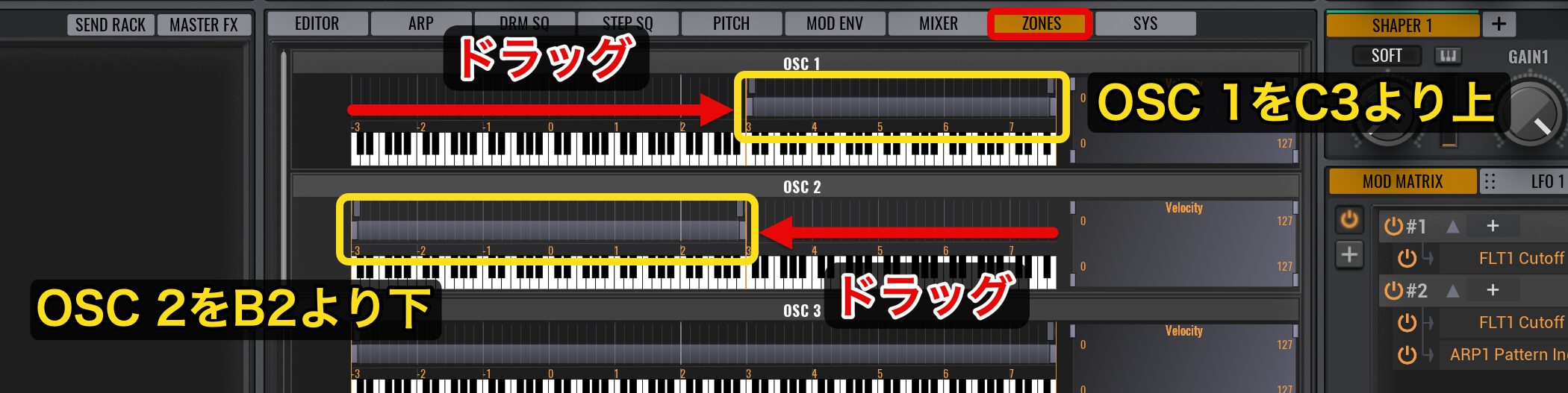
Next, the Avenger side: Avenger cannot set the MIDI input per OSC, so we specify it with ZONES.
Open the "ZONES" tab and set OSC 1 above C3 and OSC 2 below B2.
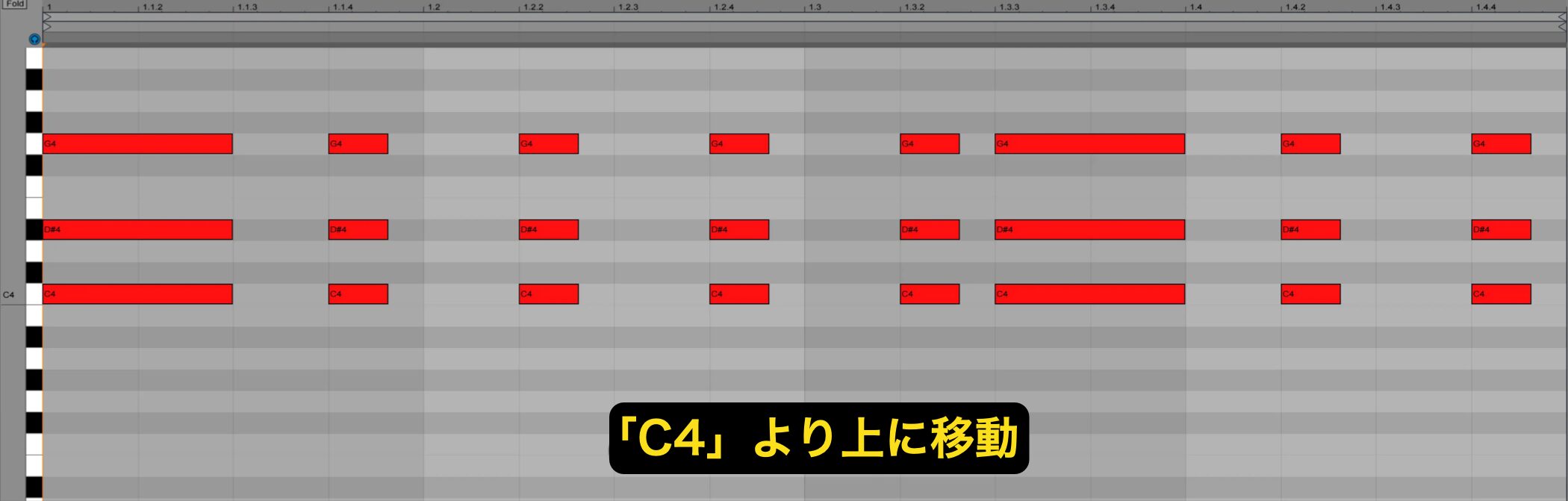
In Ableton Live, the zones are shifted by one octave, so move the notes you want OSC 1 to play above "C4".
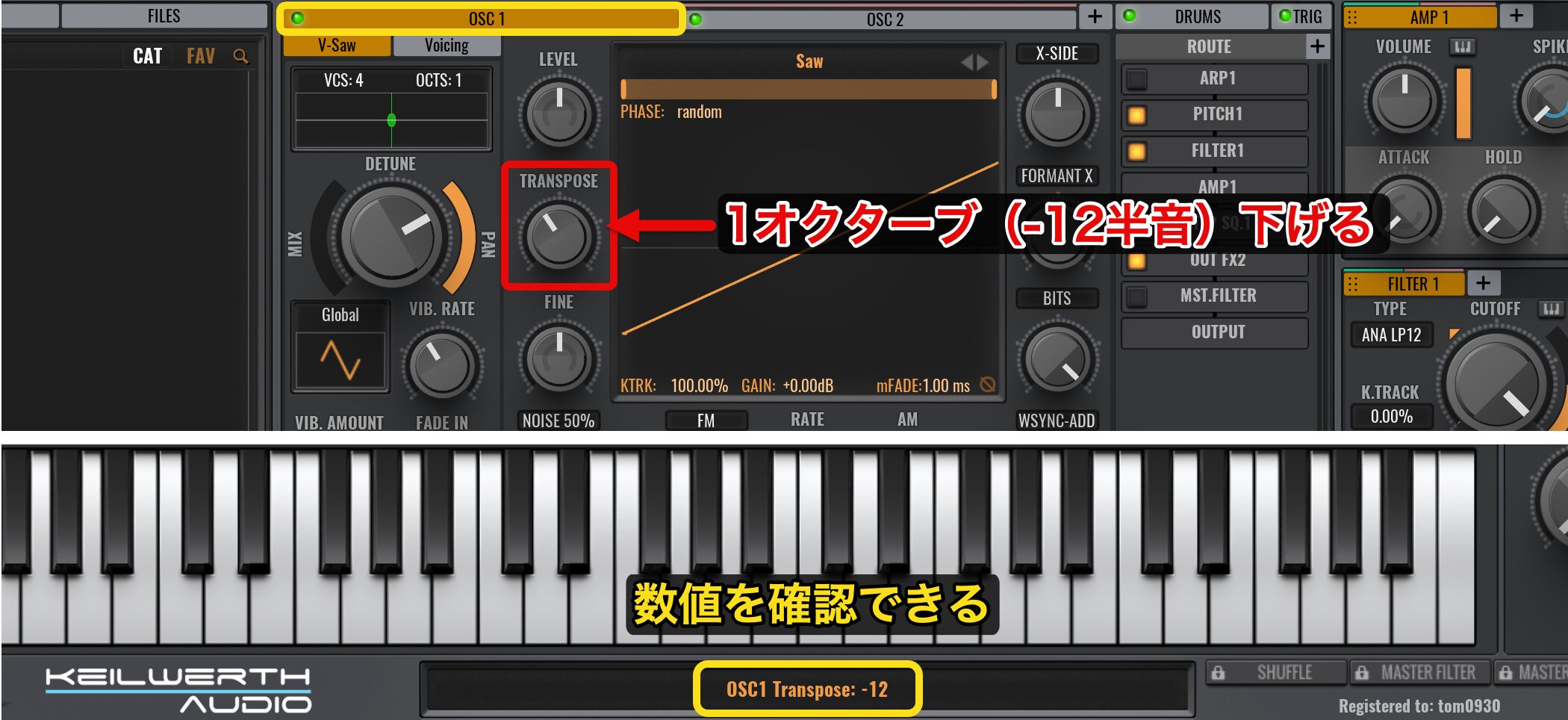
Because we raised them by an octave, lower OSC 1's pitch by one octave (-12 semitones).
TRANSPOSE allows adjustment in semitones.
Check the value at the bottom of the screen and set it to "-12".
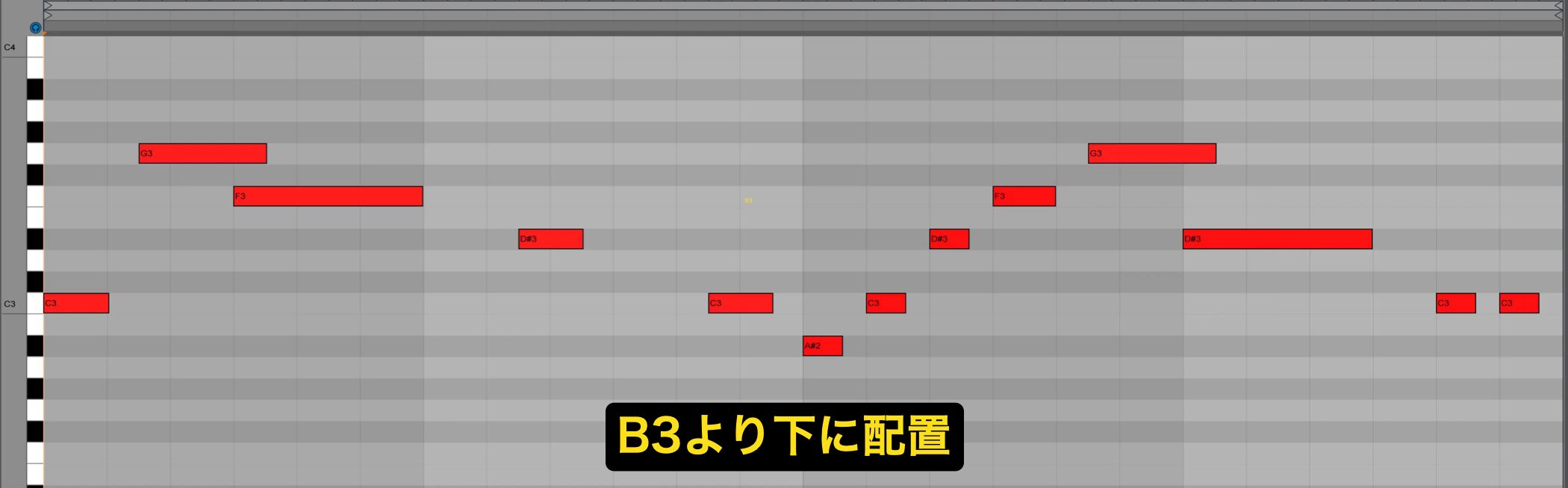
OSC 2 covers B2 and below, which here means B3 and below.
The notes we want OSC 2 to play are exactly B3 and below, so this is fine as it is.
For Logic Pro
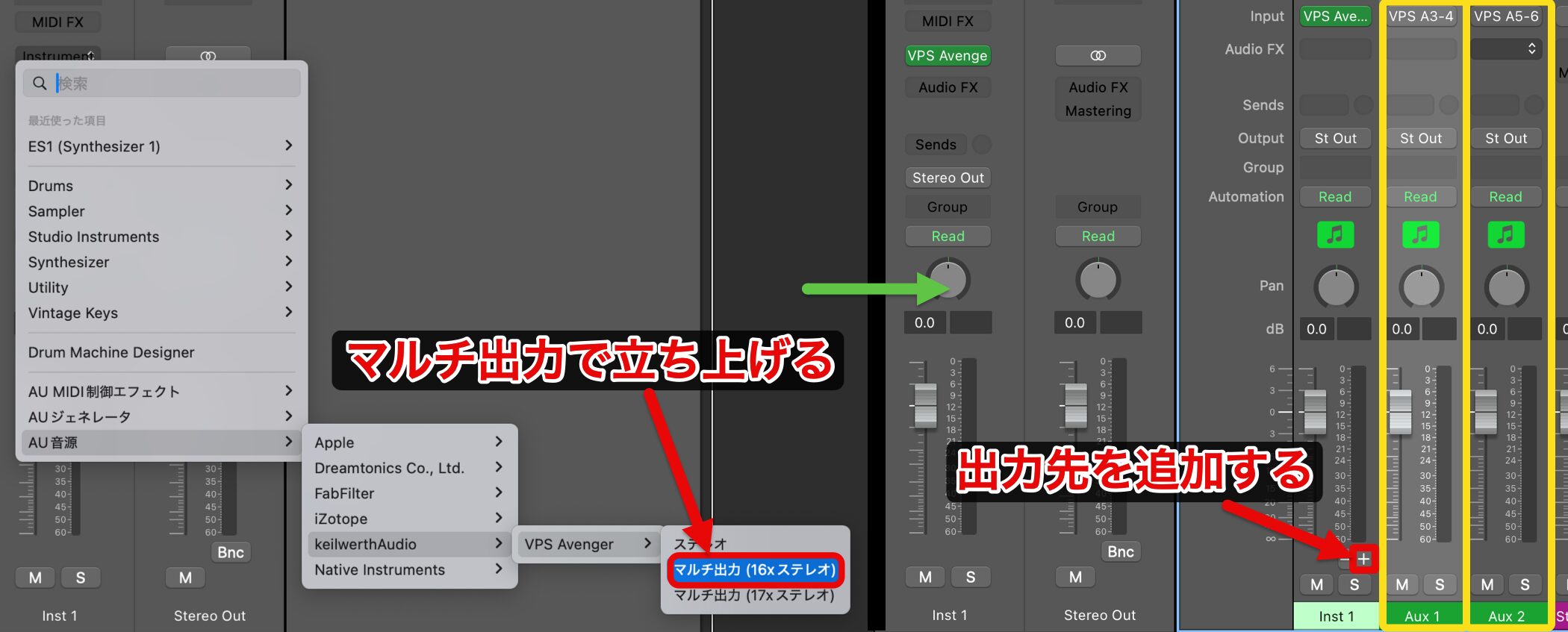
Load Avenger as a multi-output instrument and add outputs with the "+" icon.
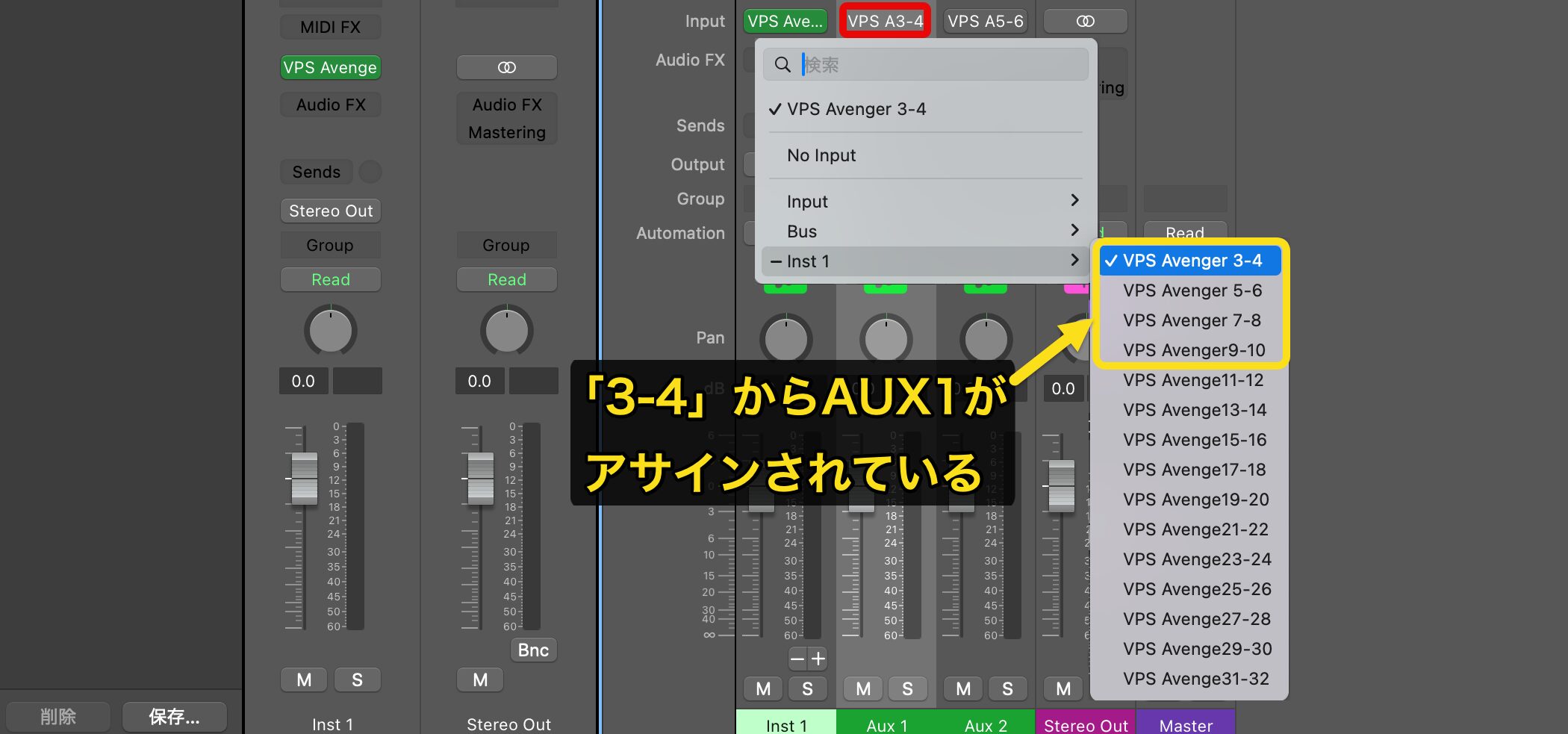
AUX 1 is assigned from "VPS A3-4".
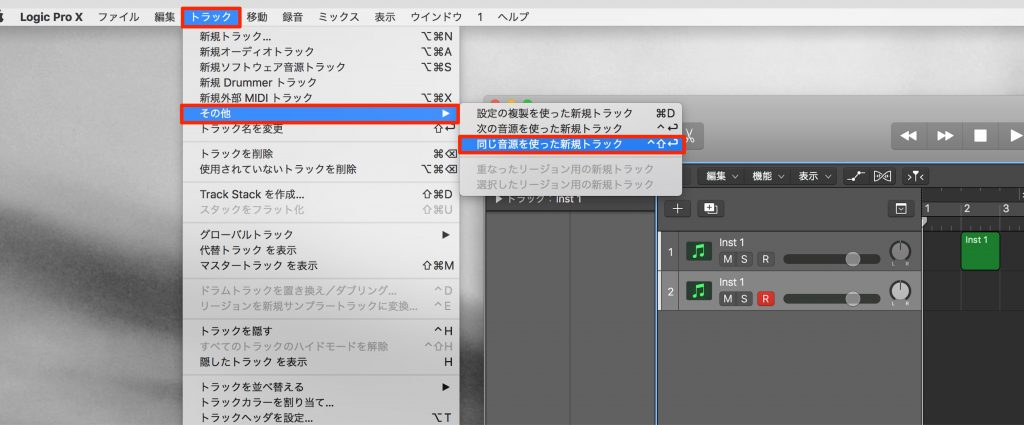
To create a MIDI track, open "Other" from the "Track" menu in Logic and select "New Track With Same Instrument".
For Cubase
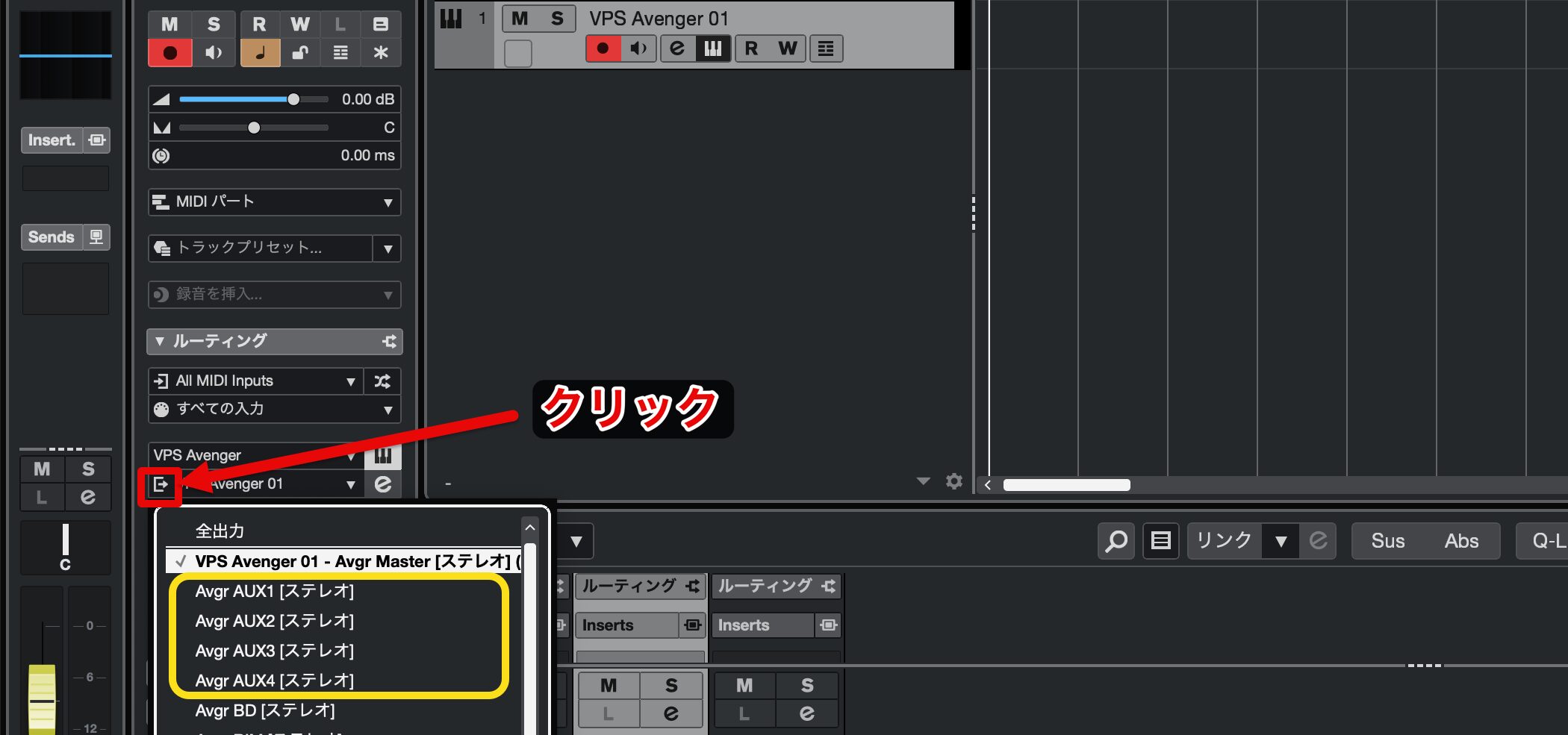
Click the button for selecting the "track output", and the output channels are displayed.
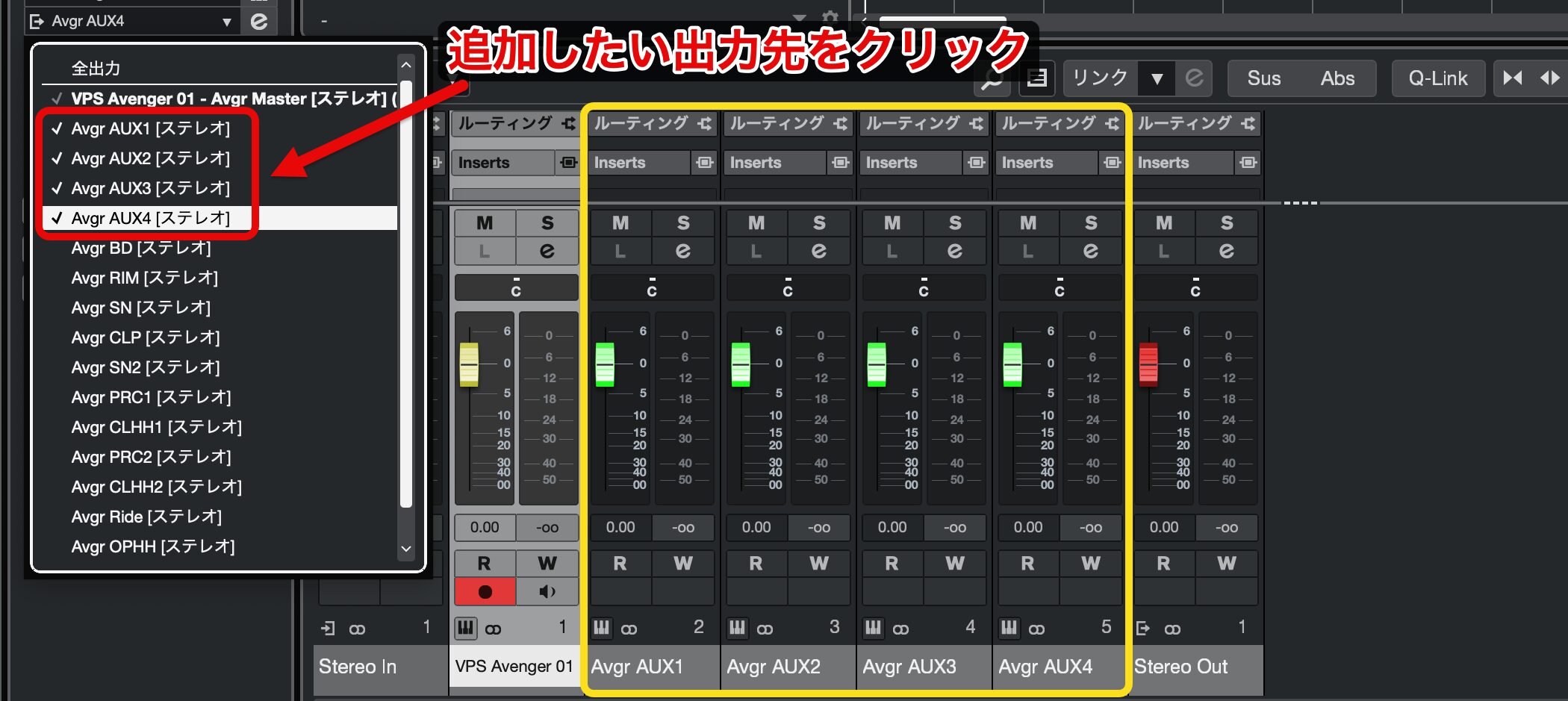
Click the output you want to add, and a channel is created.
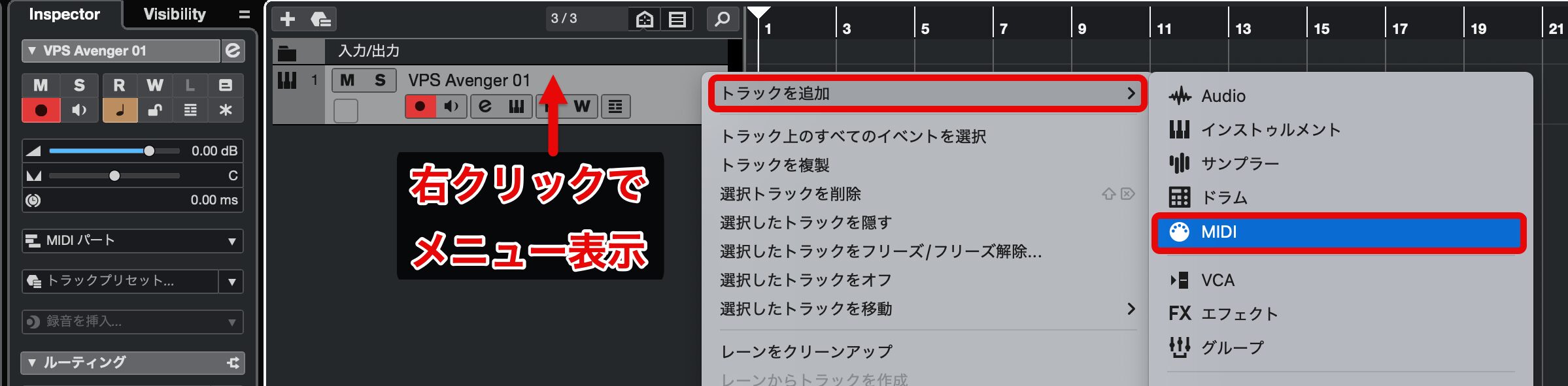
To create a MIDI track, right-click the track Avenger is loaded on and select "MIDI" from "Add Track".
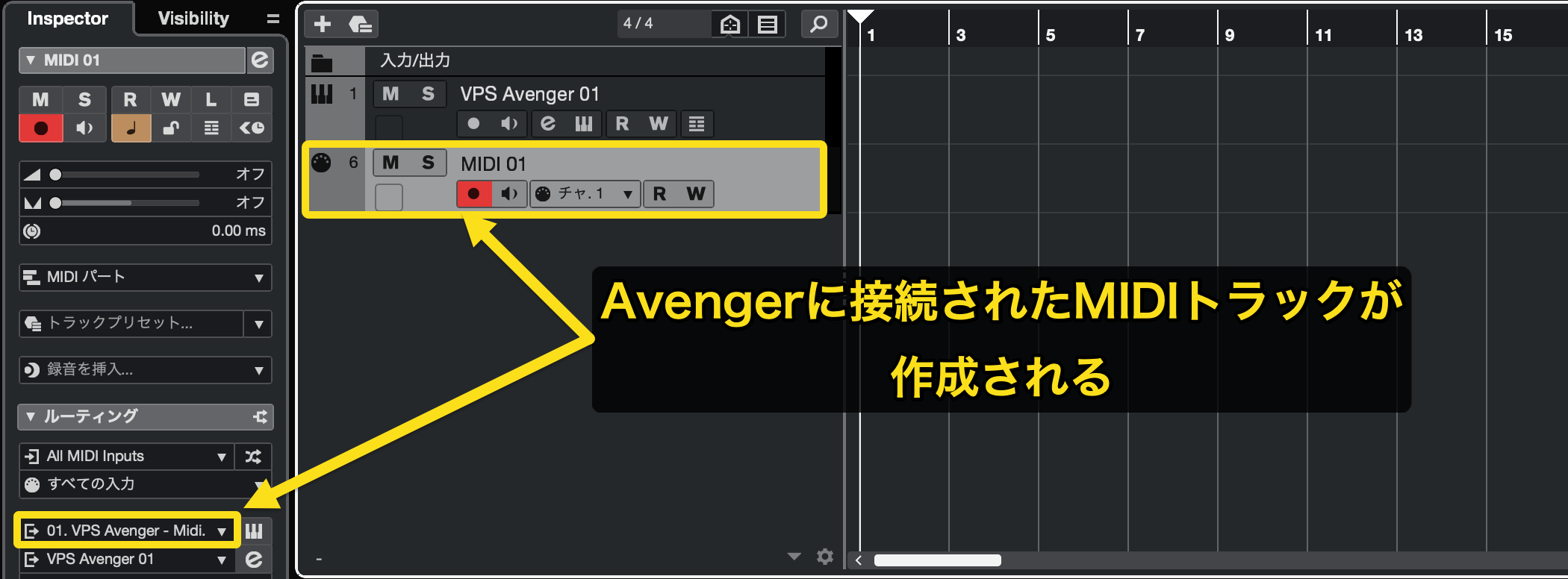
This creates a MIDI track connected to Avenger.
How was that?
Multiple outputs are a bit of a hassle, but once set up you can work comfortably.
Please give it a try.


Frequently Asked Questions
Q1. How many presets does Avenger have?
Avenger comes with more than 900 presets. They are divided into several categories such as Factory, Bass, Drums and Sequence, and you can find presets more efficiently with the tag cloud search function.
Q2. What exactly are the Macro parameters used for?
The Macro parameters are controls that give suitable tonal changes for each preset. For example, Sidechain, Drive and DJ Sweep are assigned, and you can easily fine-tune the sound just by turning a knob, so you can shape the sound without complicated settings.
Q3. How do I save my own presets?
Create a new content folder with "Create new Customer Expansion", edit your original sound, then save it inside "My Preset.avxp" from "Save as". Saved presets can be recalled quickly from your custom folder.
NEW ARTICLES
Latest English Articles