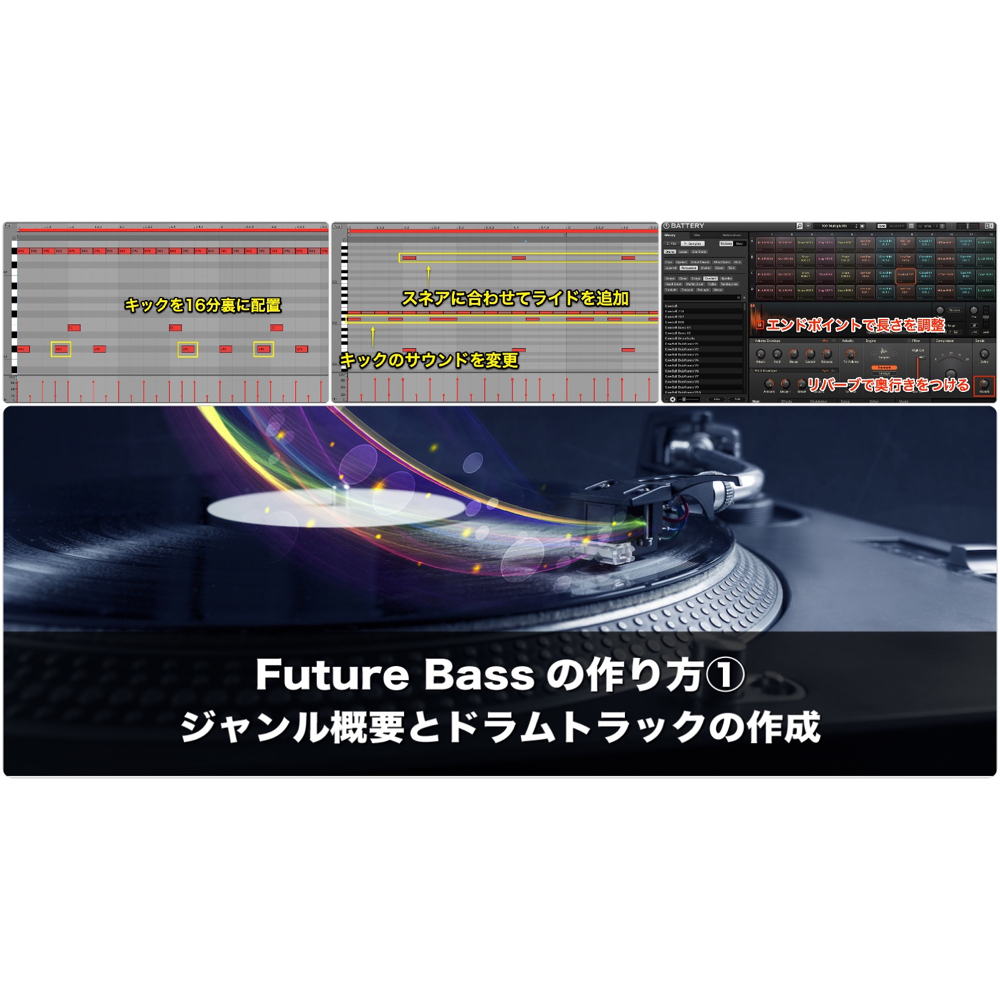
Future Bass is a type of EDM that's popular worldwide, characterized by slow tempos of BPM 70-90 and complex kick placement. This article explains the musical characteristics of Future Bass and then introduces practical drum production using Ableton Live and Native Instruments Battery 4. It covers basic sound design techniques beginners should master, such as programming the transition from the verse to the chorus, choosing simple TR-909-style drum sounds, and deliberately placing notes on 16th-note offbeats, so you can learn a production mindset you can apply in other DAWs too.
What is the Future Bass genre?
Nice to meet you. I'm Kadode, and I make music mainly in the Kansai region.
I'll be writing articles on how to make Future Bass, sound design and more.
It's my first time, so I'm a little nervous, but I look forward to it!
EDM has become popular worldwide in recent years and is frequently played in clubs in Japan too, and one of the genres that appeared after it and is drawing particular attention now is "Future Bass".
In this series, we'll introduce the musical characteristics of Future Bass and then, while keeping its key points in mind, introduce an example of track-making.
In terms of musical characteristics, a great deal of Future Bass draws on EDM and dubstep, and the following points can be noted.
- 1_BPM is generally around 70 to under 90
- 2_The snare is a simple pattern almost always on beats 2 and 4, and fills often use arrangements seen in EDM.
The kick placement is like a more complex version of dubstep, making heavy use of offbeats. - 3_Songs broadly repeat a two-part structure.
If we call them the "verse" and "chorus" as in other genres, the bass and backing synths are used very distinctively in the "chorus" (the part that defines Future Bass; a key point). - 4_Both the bass and the backing/lead synths often use "flashy sounds with complex harmonic content," often found in plug-in synths.
- 5_In the arrangement, pitch-controlled vocal chops and the like are also often used.
As in EDM and dubstep, sidechaining from the kick is also used frequently.
About the production software
The production software we'll use in this series is as follows.
Even if your DAW is different, the approach to production is the same.
- DAW: Ableton LIVE
- DRUM: Native Instruments BATTERY 4
- BASS/LEAD/BACKING: Native Instruments Razor (we'll explain it as the series goes on)
Programming and sound design for the drums
Now let's actually get to work!
This time we'll make a total of 8 bars, going from 4 bars of "verse" to 4 bars of "chorus," corresponding to point 3 above.
Following point 1, I set the BPM to "80."
I'll make the drum pattern in three parts: "Verse (1)" for 2 bars, "Verse (2)" for 2 bars, and "Chorus" for 4 bars (2 bars repeated twice).
First, I programmed the "Verse (1)" pattern as in the image below.
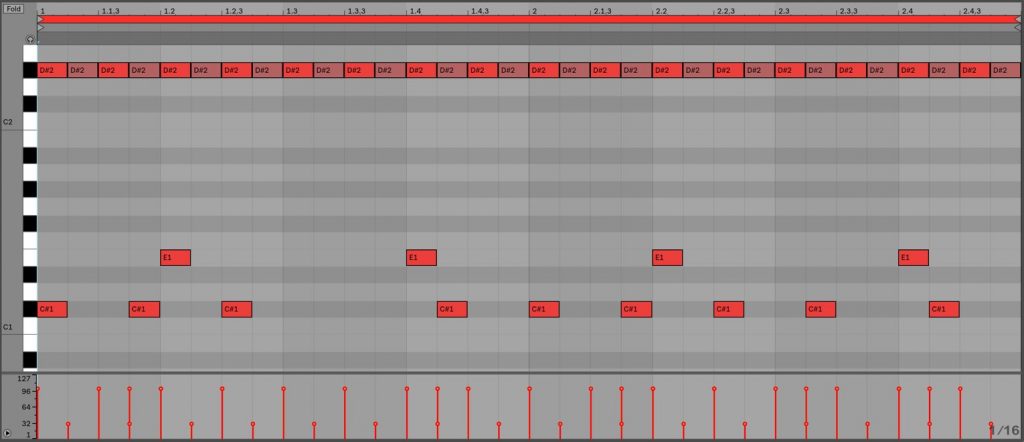
- C♯1: Kick
- E1: Snare
- D♯2: Clap (used here in the role of a hi-hat)
Assign Battery 4 sounds to these.
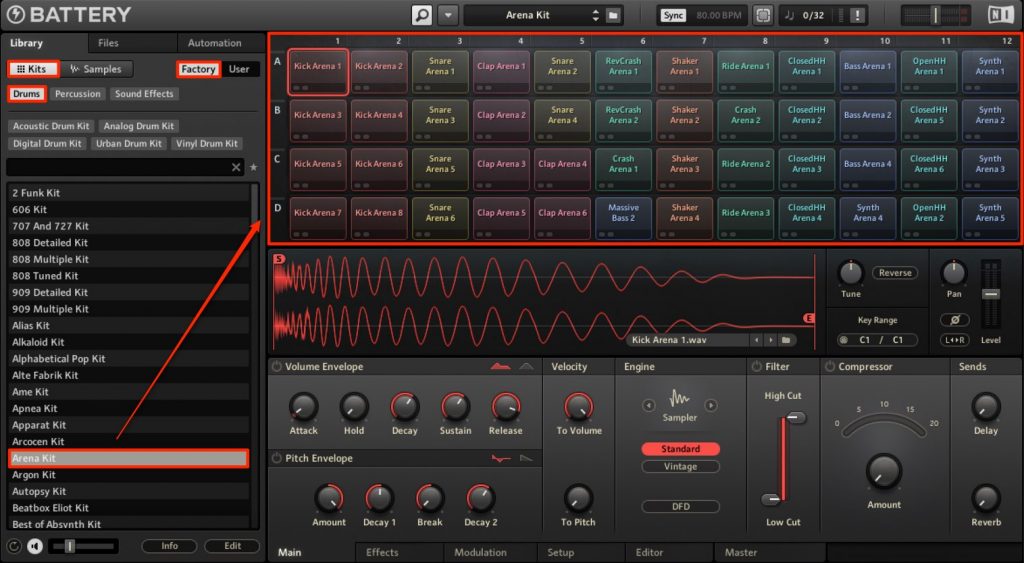
For the BATTERY 4 sounds, we'll use preset sounds.
From the "Library" tab at the top left, select "Factory" → "Kits" → "Drums" in order, then select (click) "Arena Kit" from the list below.
Let's check the characteristics of each part of the kit.
First, the kick.
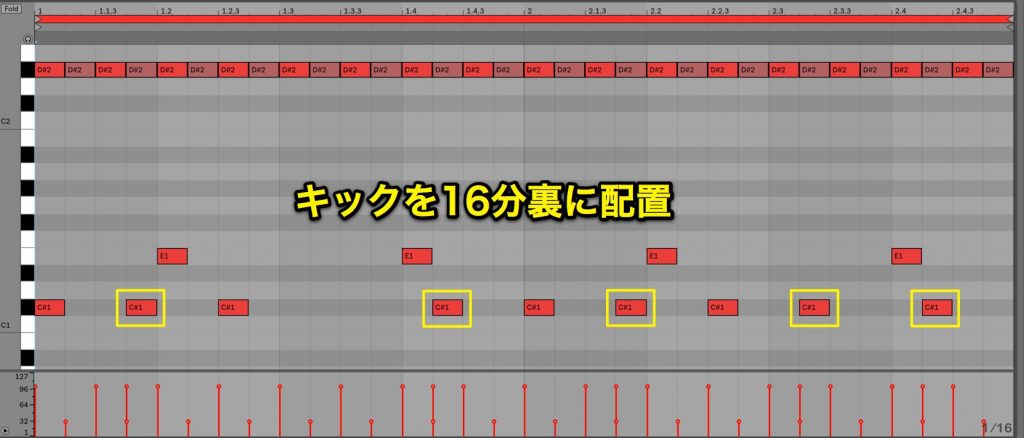
Following point 2, I deliberately placed notes on 16th-note offbeats.
This brings out fine 16th-note nuance.
Next, the snare.
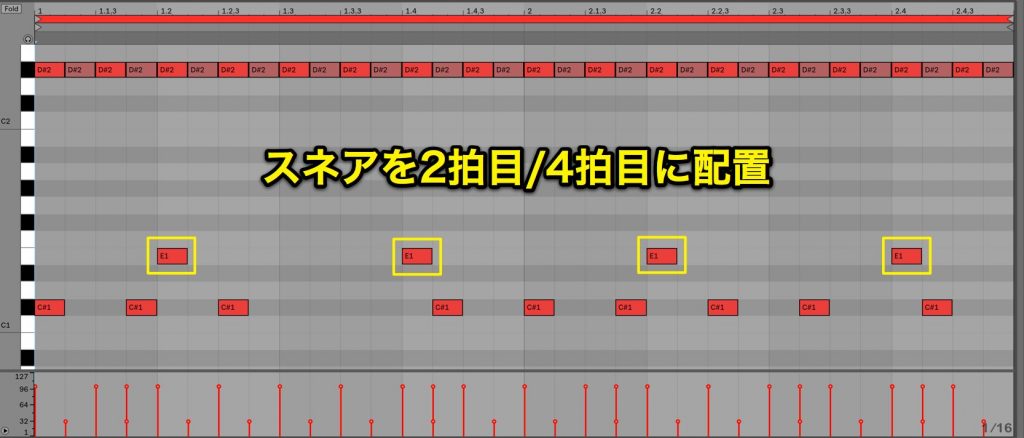
Also following point 2, I placed it on the orthodox beats 2 and 4.
Finally, the clap.
Here it's used in the role of a hi-hat.
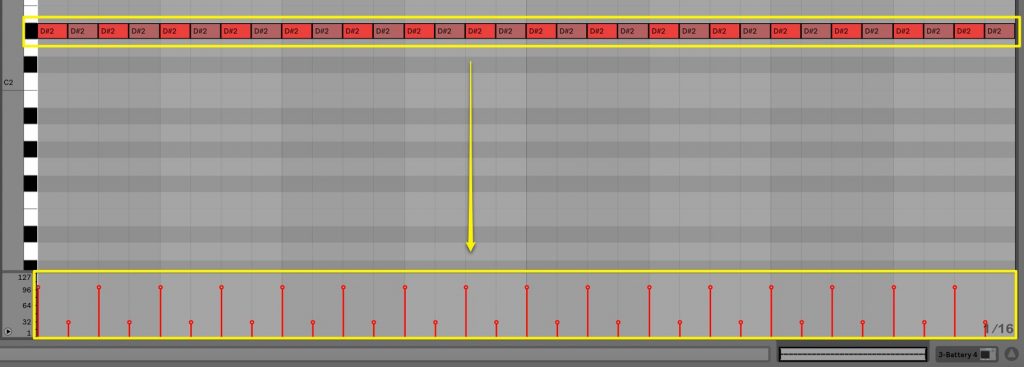
I programmed it in 16th notes like this, and so it doesn't get noisy, I lowered the velocity of the 16th-note offbeats to keep them as a subtle accent.
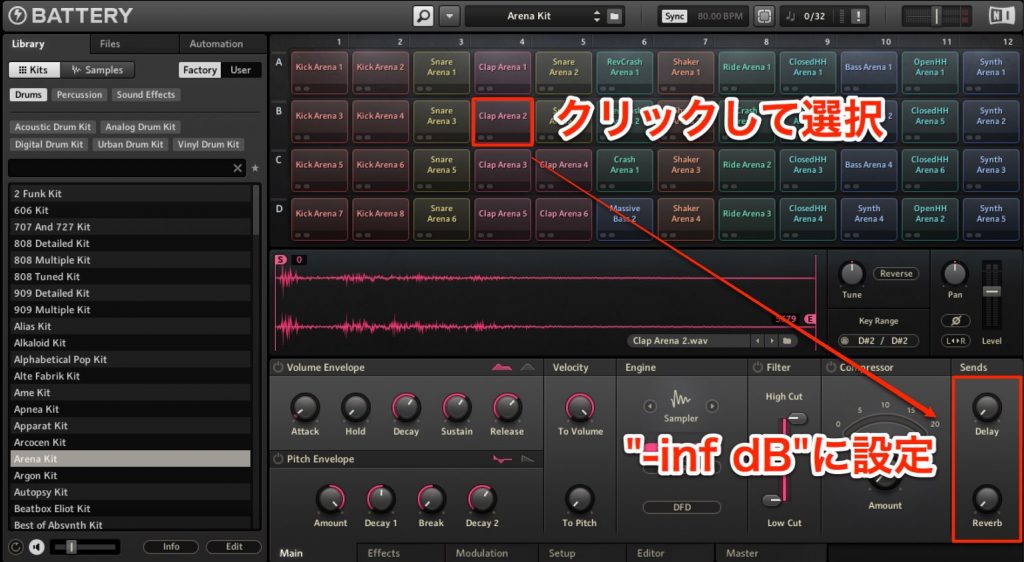
Also, the "Arena Kit" preset has delay and reverb applied.
To give the sounds more bite, let's set both parameters to zero.
That completes the 2 bars of "Verse (1)."
Let's check the sound.
Next, program the 2 bars of "Verse (2)."
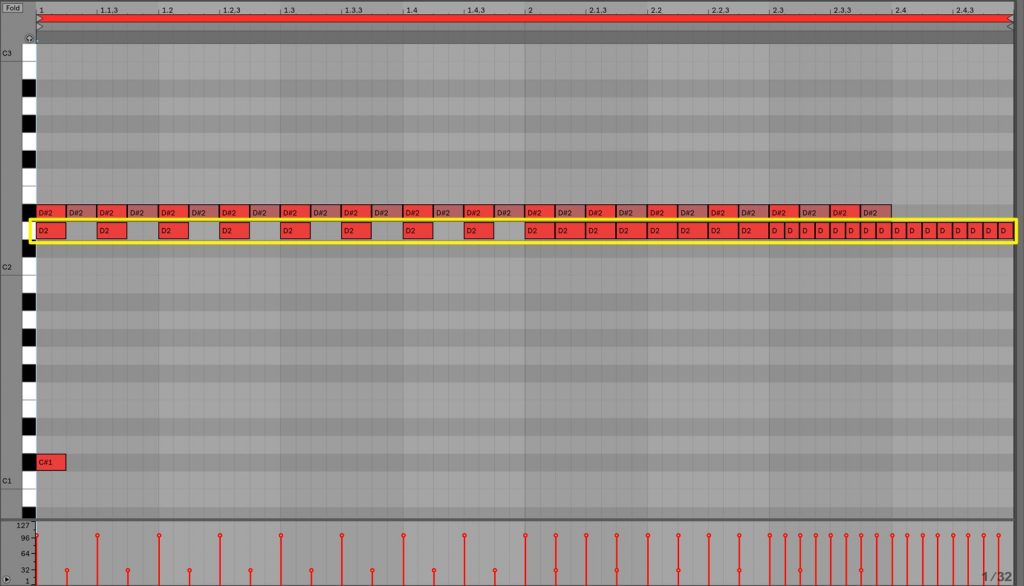
This is the fill just before the "chorus," so I chose a higher-pitched snare in the kit, "D2 (Snare Arena 3)." In the second half I programmed a roll of 32nd notes.
Finally, the 4 bars of the "chorus" (2 bars repeated twice).
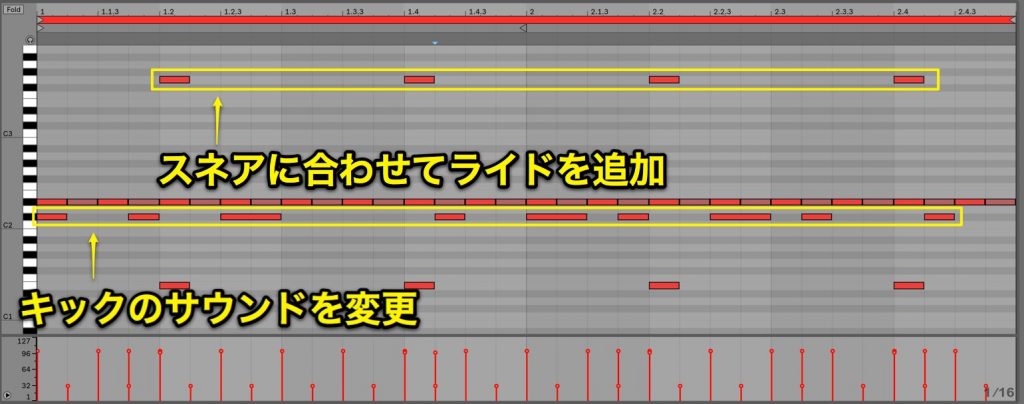
The key point is using a lower-pitched kick than in the first half, "C#2 (Kick Arena 4)," to give it a heavy, "this is Future Bass!" feel.
I also added a ride, "G3 (Ride Arena 2)," at the same timing as the snare.
This isn't a fixed arrangement, so you might try various things.
As with the clap "D#2 (Clap Arena 2)," the delay and reverb parameters are set to "-Inf dB."
The image shows two bars.
That covers points 1 to 3, describing the BPM, song structure and drum characteristics.
Tips for choosing drum sounds
This time I used "Arena Kit" from BATTERY.
For the drum sounds, rather than flashy ones, I think simple ones that let the synths and bass stand out to some degree are good.
But if they're too simple they won't stand out, so it's good to choose ones with a range from low to high to some extent.
In terms of drum machines, sounds close to the TR-909 are often used.
Also, you often hear sound design that blends a cowbell-like sound into the snare or adds reverb.
You could also try using a 707-style cowbell with a 909-style drum kit.
Here's an example using 909-style drums and a cowbell.
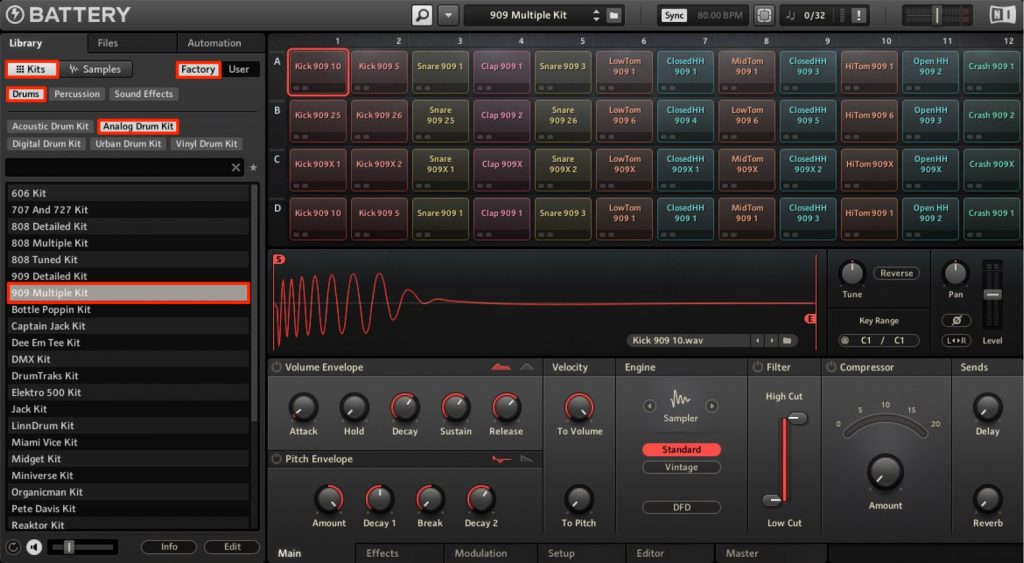
Load a 909 kit preset in the same way as above.
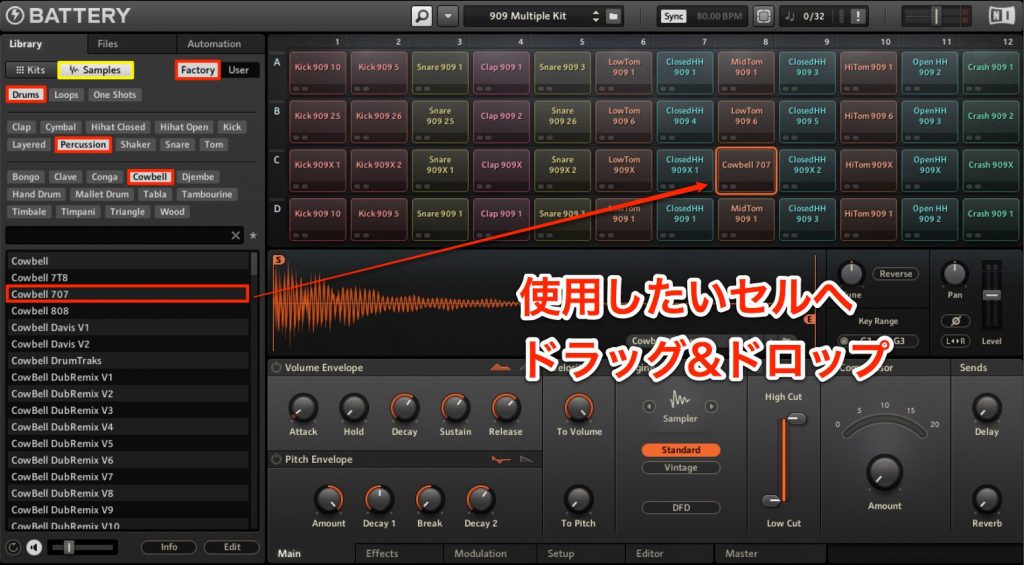
Battery 4 lets you choose individual sounds you want to use from "Samples."
To load a sound, just drag and drop it onto the cell you want.
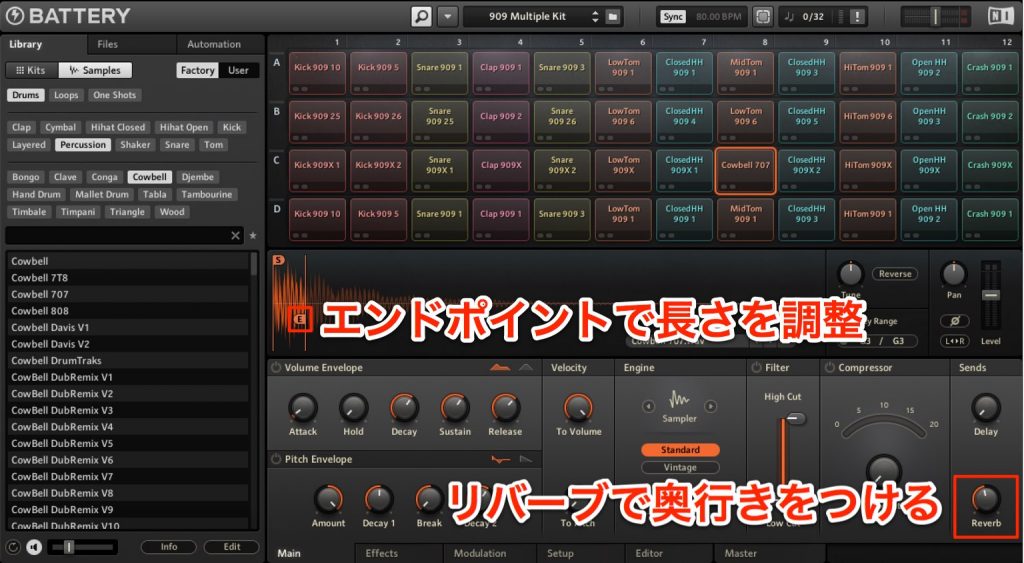
Adjusting the length of the sound gives it a tight groove.
Let's apply reverb to add depth.
After adjusting the volume of each part a little, I made it with a sound like this.
This time I explained an overview of the Future Bass genre, programming the drums, and tips for choosing their sounds.
I used BATTERY 4 as the drum instrument.
But as I explained earlier, if you have 909-style/707-style drum samples, sound design suited to this genre should be relatively easy, so be sure to try it.
Next time I'll explain sound design for the bass part.
Thank you for reading.
About the author
Takumi Kadode
A track maker, VJ and audiovisual artist from Osaka.
Got into music after making noise/tape collage pieces with cassette tapes and MiniDiscs in high school.
While later majoring in architectural acoustics in graduate school, began making dance music influenced by acid house, ambient, breakcore and more.
Live performances center on "audiovisual" expression, with the linking and fusion of sound and visuals as a motif.
Uses self-programmed software in REAKTOR, Pure Data, TouchDesigner and more.
Administrator of the REAKTOR fan site "Native Instruments REAKTOR Users Japan" (www.niru.jp).
Website: http://stereotypeone.com/
Frequently asked questions
Q1. How is the tempo (BPM) of Future Bass different from other EDM?
Future Bass is usually around 70 to under 90 BPM, much slower than typical EDM (around 120 BPM). This slow tempo creates a heavy, weighty feel, and a sound where the bass and synths stand out is a major characteristic of Future Bass.
Q2. What's the most important point when choosing a drum kit?
It's important to choose a kit that's simple, such as TR-909 style, with a range from low to high. If it's too flashy, the bass and synths won't stand out, and if it's too simple, it gets buried in the song, so striking a balance is key.
Q3. Are there beginner-friendly presets in Battery 4?
Battery 4 comes with many practical presets such as "Arena Kit." Selecting Factory → Kits → Drums in order gives you access to professional drum kits you can use right away, so even beginners can start producing with high-quality sounds.
Q4. What processing makes a snare sound more like Future Bass?
Blending in a cowbell-like sound or adding reverb is common sound design. It's also effective to vary the fills by changing pitch and to add depth and space by adjusting the delay and reverb parameters.
Q5. Why is note placement on 16th-note offbeats important in Future Bass?
Deliberately placing notes on 16th-note offbeats creates fine 16th-note nuance and a complex sense of rhythm. By keeping the velocity low as a subtle accent, you can achieve the kick placement characteristic of Future Bass, like a more complex dubstep, adding energy to the song.
NEW ARTICLES
Latest English Articles