An interview with anime song hitmaker Sho Watanabe

For the 4th installment of Pathways into the Music Industry, we talked with Sho Watanabe, a lyricist and composer leading Japan's anime song scene.
Watanabe has written many classics every anime song fan knows, such as LiSA's "Datte Atashi no Hero.," "oath sign" and "crossing field," and ClariS's "Connect" and "Colorful."
We heard plenty about what kind of person Watanabe is, active on the front lines of ever-evolving anime music, so please give it a read!
When did you start music?
Sho Watanabe (Watanabe: below) I started playing an instrument around when I entered vocational school, so at about 19. I think that's pretty late. Back then I was at the level of not knowing where do-re-mi was on the keyboard. I did own a guitar, but I could barely play chords.
What led you to enter a music vocational school?
Watanabe: I was originally aiming to be a producer in the sense of marketing and how music is sold. So I enrolled in a department called the "Producer Course." But that course was more of a production-oriented producer course, like Tetsuya Komuro. And as I took composition classes, I got completely hooked.
Classes must have been really hard with almost no production knowledge.
Watanabe: It was hard at first, really. (laughs)
The first class was about "building rhythms," but I was at the stage of "What's a drum kit, anyway?"
While everyone around me was building 8-beats and sambas, I ended up with GM sounds placed at random and got the comment "That's novel," which was pretty embarrassing.
Didn't that make you give up?
Watanabe: I was at a level where I didn't even know how bad I was or how big the gap with the others was. In later classes too, I struggled in all sorts of ways, like being told "That's in F" when I thought I'd written a song in C.
Still, by the end of the first year I was somehow able to write songs. Very simple ones, though.
What did you do after graduating from vocational school?
Watanabe: Through the school's connections I joined a music agency, but back then I wasn't even putting scratch vocals on my demos, so I wasn't getting picked in competitions at all. So I thought this wouldn't do, and what I found was the "avex artist academy." They had a system where tuition was free if you passed an audition, so I sent in a demo tape, somehow passed and was able to attend for a year for free.
Getting that far within two or three years of starting to compose seems quite fast.
Watanabe: I've always loved listening to music, so I think that's part of it.
What kind of music did you listen to as a student?
Watanabe: I really loved visual kei, and listened widely, from "GLAY" to "DIR EN GREY." Then I came to like "175R" and "SHAKALABBITS," and through that I came to love J-rock in general. I still like listening to rock.
So back then you listened only to rock?
Watanabe: No, I liked J-pop too and listened to it a lot. Every week I checked the Oricon chart, rented every song up to about the top 20 and listened to them constantly. I kept that up every week from my second year of junior high until I graduated from high school.
That's an incredible amount of listening.
Watanabe: I think I'm a "super listener." I loved music that much, and that's exactly why I decided to go down this path.
Is there anything different about "how you listen to music" now compared with before?
Watanabe: Back then I couldn't play an instrument, so I focused on listening to melodies. I mostly followed the title tracks.
But visual kei bands were different: I made a point of listening to every single released by major bands. Then I reached out to indie bands too and collected their recordings... I just listened like crazy.
There can't be many listeners that thorough.
Watanabe: Maybe so. Recently I listen more on Apple Music and YouTube. Watching with the visuals makes it easier to take in intuitively. I follow related videos and try to listen to songs in all kinds of genres.
By the way, do you listen to the songs other people submitted in competitions you took part in?
Watanabe: In the past, I made a point of checking and analyzing them.
You write a wide range of songs. Is that also largely due to having listened so much?
Watanabe: I think that's part of it, and being able to study music theory thoroughly at avex artist academy was also a big factor.
Musicians often debate "whether music theory is necessary." What do you think?
Watanabe: I think it depends on the person.
It's easy to understand if you compare it to language: Japanese people can naturally speak Japanese from the start without learning grammar, right?
Music is the same: people who've been doing it since childhood have naturally developed the feel, so I don't think they need much theory.
In contrast to Japanese, English that you start in junior high can't be done "by feel," right? So if you're writing songs from junior high or high school, I think you need to properly learn "what's going on."
Is there a standard for how far you should learn?
Watanabe: It depends on the genre you want to do and so on, but I recommend going as far as you can.
To use math as an example this time, people who can only add and subtract sometimes make calculation mistakes. But someone who's learned factoring, say, almost never makes mistakes adding and subtracting. In the same way, being able to write songs with more advanced theory gives your songs room to breathe. When writing difficult songs, if you're straining on tiptoe you'll get a cramp and make mistakes somewhere for sure. But if you have the ability to write more advanced songs, you just have to step down the stairs.
That's how I see it, so I think you should learn theory as far as you can.
I see, that's a very easy-to-understand analogy. Besides music theory, what kinds of classes did avex artist academy have?
Watanabe: Every weekend they invited professional composers active at the top of the field for special lessons. We could listen to demos of songs they'd actually written for artists, which was very stimulating. Everyone around me was really skilled too.
That does sound like a stimulating and educational environment. What path did you take after graduating?
Watanabe: In January of my graduation year, I sent demo tapes to several companies and joined "Smile Company," where I still am today.
So that's when you started entering competitions in earnest. When was your first song selected?
Watanabe: When I was 22. It was around March, so about three months after joining Smile Company.
That's very fast.
Watanabe: Yes. I remember being really happy.
About how many songs a year were you writing back then?
Watanabe: Partly from a kind of anxiety, "Now that I'm with a major agency, I have to work hard," I wrote about 100 songs a year. Also to build up a toolbox across genres, I entered every competition I could.
So it's better to write as much as possible?
Watanabe: Production speed varies by person, so I can't say for sure, but I think you should write at least one song a week.
How far do you take your demos in terms of quality?
Watanabe: At minimum, until the arrangement direction is visible, and I try to take them as far as I can.
At first you must have struggled producing while working part-time. When did you become able to live on music alone?
Watanabe: From around 26 or 27, I'd say. I had a fair amount of income from music before that, but I didn't quit my part-time jobs until I was completely in a situation where "I can live on this alone."
By the way, what part-time jobs did you have?
Watanabe: Night shifts at a convenience store and working at a game arcade. I'd hear my own songs on the store's USEN music service. That was a little bittersweet. (laughs)
You're now on the front lines of the anime song world and get many requests by name. Was there a turning point?
Watanabe: After ClariS's "Connect," the theme song for Puella Magi Madoka Magica, was released in 2011.
I gradually started getting requests by name. I made works people liked each time and connected that to the next.
So results brought requests, and you delivered results again... producing hit after hit in a chain. What steps do you follow when composing?
Watanabe: It's not a method I'd recommend, but I often start from the chords. I program chords in the piano roll and think up melodies while looping them.
Which part do you start with?
Watanabe: The intro, or the A melody (verse).
The chorus is the most exciting part, so I think of it as building the flow leading to it.
Many composers start from the chorus for the same reason.
Watanabe: Of course everyone's different. In my case, I produce with the image of building steps toward the chorus, the most exciting part. I think how the B melody ends changes the chorus a lot, so I value the flow into those exciting parts.
How do you work in key changes and the like?
Watanabe: In my case, I'm conscious of modulation and non-diatonic chords from the start. I never modulate for reasons like adjusting the melody's range. Of course, I do reharmonize and so on while making the melody.
There must be times when no melody comes to you.
Watanabe: Sometimes I refresh by listening to other songs, but basically I keep thinking while looping the chords until something comes. If it still doesn't, I change the chords or rhythm, or change the backing pattern...
Do you play the chord loop with a piano sound?
Watanabe: It depends on the song. For a guitar rock song, for example, I'll loop guitar chords. That makes it easier to come up with melodies that fit the mood.
What guitar instrument do you use?
Watanabe: I use "Electri6ity."
What other gear do you use?
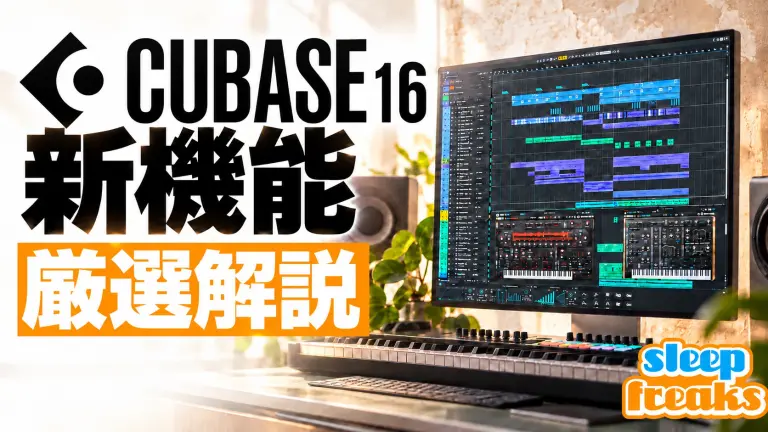
Watanabe: For my DAW, I've always used "Cubase." For software instruments, I often use "Omnisphere 2." I've used both since very early on, so it's just continued that way. I also recently bought Vengeance Sound's "Avenger," which I use a lot too. It makes it easy to get EDM-style sounds, so it's great for adding accents to songs. I think it's handy to have.
Is there anything you always keep in mind when making music?
Watanabe: Making something "I think is good" is a basic premise. Also, it's important to listen to lots of songs in that genre and get completely immersed in it once. It's for flipping the switch in my head, and I think it's also necessary for coming to love that genre.
You write not only music but also lyrics. Did you study that somewhere?
Watanabe: I did learn the basics in vocational school, but I started contributing lyrics through competitions. A few times the lyrics were chosen together with the song, and from there I increasingly handled lyrics too.
It's precisely because you delivered results at key moments under great pressure that you've been able to produce so many hits as both lyricist and composer.
Watanabe: I often overthink until my brain overheats, or my head goes foggy, though. I may not be good at switching off. (laughs)
While battling all kinds of things, have you ever thought about "quitting music"?
Watanabe: Yes. When I was just starting out, I set goals every year and thought I'd quit if I didn't achieve them.
How did you set your goals?
Watanabe: First "join a music agency," then the next year "get selected in a competition," then "get a title track," then "get selected in a tough competition"... I set goals step by step like that. I somehow achieved them, and that's how I've kept going without quitting.
Many people work toward goals. How do you set yours?
Watanabe: It's important to properly set "goals within reach." And ones that still give you a real sense of moving forward. Stagnation really is frightening.
In the coming era, what qualities do you think will be required of people aiming to become songwriters?
Watanabe: I think "branding yourself" is important. Of course there's also the path of winning competitions and becoming active from there, but there are more places to express yourself than before, and I think you need to work while thinking about your own value and how to market yourself.
Songwriters who started as Vocaloid producers are a good example.
Watanabe: Yes. Of course you need to balance it well with your own style of working.
Finally, a word for those aiming for work in anime songs like you.
Watanabe: I think it's important to dig into what you love. If there's a song you love, listen widely in that genre or trace its roots. Anime songs aren't a "genre," so I recommend listening to all kinds of songs that branch out from there and trying to make them.
Thank you very much.
What did you think? I felt there was a lot to reflect on anew, such as the importance of "listening to lots of music," ways of thinking about music theory, and how to approach production. I hope this interview helps you in your activities. Watanabe's future activities are also well worth watching!
We also explain music theory in detail in our articles, so please use them for reference.
Stay tuned for the next installment!

Software recommended by Sho Watanabe
About the author

Interview and text: momo (Mamoru Tanoue)
Born in 1995. A Digital Performer user. After graduating from music school, moved from Fukuoka to Tokyo as a composer.
Made a debut as a writer in August 2017, composing and arranging for Tsukicro's "STARDUST".
With the motto "songs that touch the heart", a multi-player who handles everything from lyrics and composition to arrangement and recording.
Also active as the composer and arranger for the art unit "Shiro".
Twitter ID: @momo_tanoue
"Shiro" website: https://www.shiro.space/
"Shiro" Twitter ID: @shiro_unit
NEW ARTICLES
Latest English Articles