A ring modulator is an effect that makes two oscillators (OSC1 and OSC2) interact to generate complex harmonics, such as unusual metallic tones and sound effects. It works by outputting the sum and difference of the two frequencies, and by deliberately detuning the oscillators from each other you get intense, wobbling changes in tone. Combined with the volume balance and pitch modulation from an LFO, it opens up endless sound design possibilities for genres from pop to experimental music.
Creating Unusual and Metallic Sounds
By combining OSC1 and OSC2,
you can create complex harmonic content (tones).
You can create unusual sound effects and metallic-sounding tones.
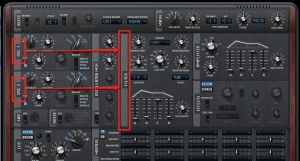
↑ Until now, OSC1 and OSC2 were sent to the Filter separately.
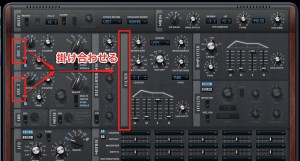
↑ With a ring modulator, the two oscillators influence each other.
Think of it like that.
How to Apply Ring Modulation
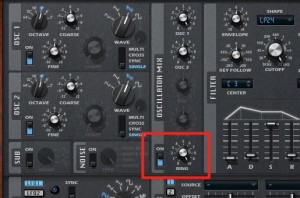
↑ Turn "RING" on, then use the knob to set the depth of the tonal change.
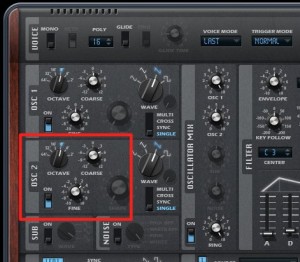
↑ Be sure to turn OSC2 on.
This is because ring modulation works through the interaction of OSC1 and OSC2.
How Ring Modulation Works
The principle of ring modulation is
to output the sum and difference of OSC1's frequency and OSC2's frequency.
For example,
if OSC1 plays 440 Hz
and OSC2 plays 220 Hz,
Sum: 440 Hz + 220 Hz = 660 Hz
Difference: 440 Hz - 220 Hz = 220 Hz
these two tones are output.
For sound, frequency = pitch.
That means if OSC1 and OSC2 are at the same pitch,
the difference becomes 0 Hz and the sum is simply one octave higher, so the effect is subtle.
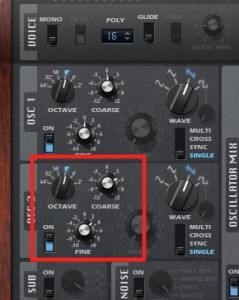
↑ To get dramatic tonal changes,
deliberately detune one of the oscillators.
Even a small change gives you plenty of wobble and tonal change.
But let me say just one thing:
it's unpredictable (lol).
Tuning one oscillator to a consonant interval (a third, fifth, octave, etc.) gives you a natural result
with little wobble,
while clashing intervals such as a semitone make the wobble intense.
However, it also depends on the waveforms you choose,
so the standard approach is to keep tweaking one side until you get the sound you like.
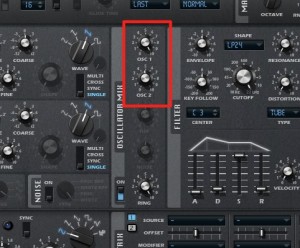
↑ You can also fine-tune the tone with the volume balance of OSC1 and OSC2.
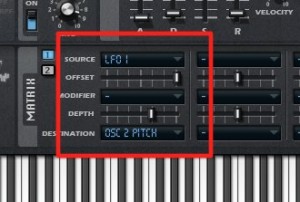
↑ Changing the pitch over time with an LFO or similar also gives interesting effects.
Start by trying various intervals
to get a feel for how the tone changes.
Frequently asked questions
Q1. What kinds of sounds can a ring modulator create?
It can generate complex, distinctive tones that ordinary synth patches cannot, such as unusual sound effects, metallic sounds, and shimmering bell tones. Its defining feature is the rich harmonic content created as the frequencies of the two oscillators interact.
Q2. What settings are needed to use ring modulation?
OSC2 must be turned on, because ring modulation works through the interaction of OSC1 and OSC2. Then turn RING on and adjust the depth of the tonal change with the knob.
Q3. What happens if OSC1 and OSC2 are set to the same pitch?
When both oscillators are at the same frequency, the difference becomes 0 Hz and the sum is just one octave above, so the ring modulation effect is weak. To get dramatic tonal changes, it is effective to deliberately detune one of them.
Q4. What is the trick for a natural sound with little wobble?
Tuning one oscillator to a consonant interval such as a third, fifth, or octave gives you a natural result with little wobble. It is important to experiment until you find the sound you like.
NEW ARTICLES
Latest English Articles