The noise oscillator is a synthesizer feature that takes advantage of noise's lack of pitch, since its frequencies have no regular pattern, and it has a wide range of uses in music production. You can choose from several types, such as white noise and pink noise, and mix it into normal phrases to add energy and accents, or combine it with a filter to create dramatic sound effects. It is a practical technique in genres from pop to electronic music, especially when you want more punch or want to reinforce a sound by mixing in a small amount.
From Reinforcing Sounds to Sound Effects
Noise has no regular pattern in its frequencies, so it has no concept of pitch.
The word "noise" is rarely used in a positive sense, as in "guitar noise" or "ambient noise,"
but noise can also be put to good use.
Most synthesizers have a noise oscillator.
Here, we will explain the noise oscillator.
Turning On the Noise Oscillator
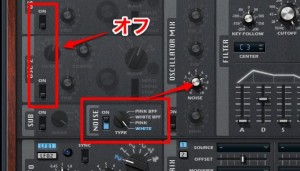
↑ In most cases, it is simply labeled "Noise."
Turn it "ON" and adjust its volume.
If you want to use only the noise,
turn the main oscillator "OFF."
Types of Noise
There are several types of noise,
and you can switch between their characters.

↑ White noise is probably the best-known sound,
but it is a good idea to try switching between types to find one that suits your song.
White noise
Pink noise
Once you have set the noise, how should you use it on a sound?
Let's explain.
Mixing It into a Phrase
Noise is sometimes mixed into a normal phrase.
This can add energy and accents to the sound.
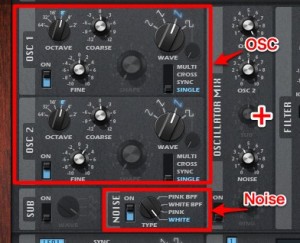
It can also be used to dirty up a sound
that is too clean to blend into the song.
Oscillator only
Oscillator + noise
Using It as a Sound Effect
Noise contains all frequencies,
so filters work very well on it.
By moving the filter applied to the noise,
you can create very dramatic sound effects.
We explain the filter envelope in detail in this article.
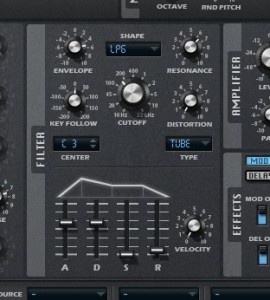
Select a low-pass filter
and raise the attack to get a slow change in sound.
The resonance is set fairly high to emphasize the moving frequency range.
After the attack reaches its peak,
the decay sets how long it takes to return to the original tone.
This produces a sound effect like this.
Adding reverb and delay to it
noise-fx-reverb
makes it sound pretty good.
In particular, the technique above of mixing just a little noise into the oscillator
is very useful, so be sure to try it when you want more punch.
Frequently asked questions
Q1. What is the main role of the noise oscillator?
Taking advantage of noise's irregular frequencies, the noise oscillator is used to add energy and accents to the normal oscillator sound, create sound effects, and reinforce sounds. It is especially effective when combined with a filter.
Q2. What is the difference between white noise and pink noise?
White noise has equal energy at every frequency and sounds bright and hissy, while pink noise has less energy in the high frequencies and sounds softer and fuller. Switching between them to suit the song lets you choose the best sound.
Q3. What is the trick to using noise as a sound effect?
Apply a low-pass filter to the noise and adjust the envelope's attack and decay to create dramatic sound effects. Adding reverb and delay makes it even more polished.
Q4. Is there any benefit to mixing a small amount of noise into the main oscillator?
Yes. Mixing a little noise into the main oscillator adds punch and helps the sound blend into the song. It is especially effective when you want to rough up a sound that is too clean.
NEW ARTICLES
Latest English Articles