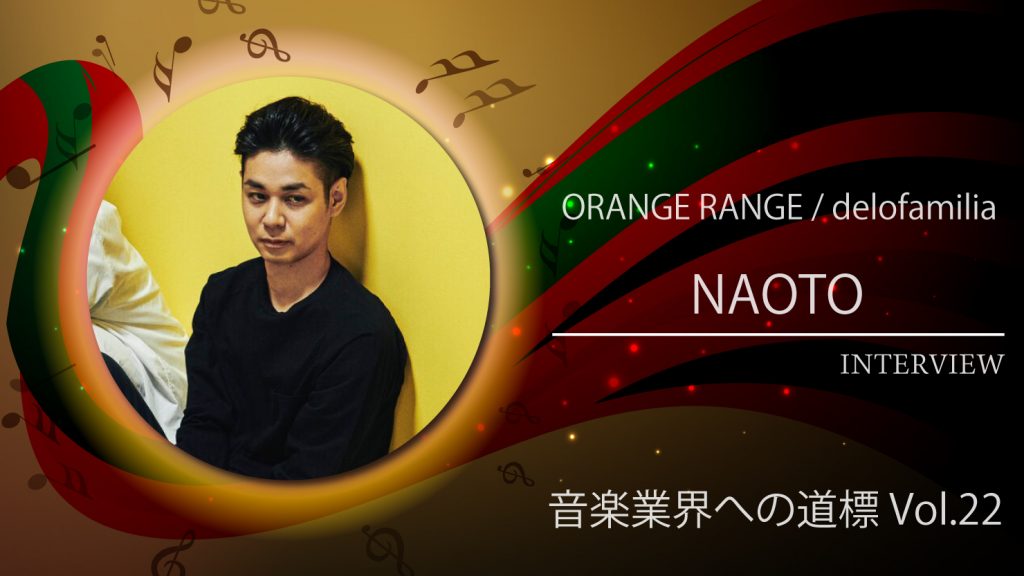
An interview with NAOTO of ORANGE RANGE
For the 22nd installment of Pathways into the Music Industry, we talked with NAOTO, well known as the guitarist of ORANGE RANGE!
ORANGE RANGE has stayed energetically active from its formation in 2001 to today. We dug deep into what has driven NAOTO, the band's guitarist and main composer, so please give it a read.
NAOTO's approach to songwriting
Thank you for taking the time to talk with us despite your busy schedule. First, please tell us about your current activities.
I mainly work as the guitarist and composer for ORANGE RANGE and delofamilia.
How are songs made in ORANGE RANGE?
Basically I write the music, and I leave the lyrics to our three vocalists. On some songs, our bassist YOH writes the music too.
How finished are the demos you bring to the other members?
I build them up to something close to the final form, with the arrangement almost complete, before bringing them to the members. Sometimes there are minor changes after the lyrics go in, but basically I fully program the drums and bass too and then ask them to play it.
How do you go about composing?
I record melodies that come to me on my iPhone, and if I listen back later and like them, I put them into Pro Tools and build them up.
I used to use it alongside Logic, but from about three years ago the MIDI editing in Pro Tools evolved a lot, and I thought, "This alone is enough!" so I stopped using Logic.
What other gear do you use?
For guitar, I've always mainly used a Fender Strat. It's what I'm most used to and easiest to play, and even if it breaks, I can get the same thing right away. I still own several of the same model.
For sound sources, I don't use software much. I prefer hardware like the Nord Lead and Moog. Partly it's because I've used them for a long time, and even if I buy new gear, I end up going back to what I've always used or to the classic machines.
About how many songs have you written so far?
I think I've written about three times as many as have been released.
I think I'm the type who works by "enough shots and one will hit," producing good things out of lots of misses.
When I make songs, rather than "spending ages on them," I throw them away right away if I can't get into them at the arrangement stage, and even if the vocals have been recorded, I'll leave a song as it is if my passion for it has cooled.
ORANGE RANGE – SUSHI Tabetai feat. Soy Sauce
From forming the band to debut
When did you originally start making music?
Partly because my older brother is a musician, from around junior high I was making tracks with an AKAI sampler and a Roland MC-303 groovebox.
But back then it was more like playing around, so I really started making music seriously after I got to high school and formed ORANGE RANGE.
How often were you active in high school?
In my third year of high school, I played about 70 shows a year alongside my studies.
That said, there weren't many places where you could properly perform, so everyone played on the street and such.
Then as now, I think the hardest thing for most bands is drawing an audience. Did you do anything special about that?
Making music in Okinawa is pretty unusual: the audience is attached to "the place." So no matter who played when, people would naturally gather.
We also borrowed the plaza at the local AEON mall and played there.
It was the same for me, but AEON is the holy land for people from the countryside. (laughs)
Exactly. On weekends, classmates and grandparents all gather there, so people come whether you like it or not. (laughs)
In that respect, I think it was a very fortunate environment.
This is a bit of a tangent, but what was the Okinawa music scene like back then?
Musical styles were pretty divided by area. Naha had a strong melodic hardcore and hardcore culture, while in Koza, where we're from, dance music like hip-hop and techno was popular, partly due to the influence of the US military base.
Back then the music was completely different depending on the area.
What kind of music did you originally like to listen to?
For me it was techno, hip-hop and reggae.
Then, after entering high school, making more friends and starting a band, the genres I liked increased all at once.
ORANGE RANGE formed when you were in high school. How did you get to your debut?
As we kept playing live, people in the music business reached out to us, and we released a nationally distributed CD called "Orange Ball." We had lots of songs, but that was the first time we recorded and made a CD.
After that, a label reached out to us, and our major debut was set for 2003. That was right around when I turned 20.
So it was very quick from formation to debut.
It was my first band, and we debuted in a short time, so honestly I didn't really know how to feel. I was pretty easygoing about it. Of course, I think that's partly my personality.
Even after your debut, when reactions started coming in from all over the country, it still didn't really feel real?
That's right. The music industry itself was booming back then, so lots of artists were debuting, and I felt like, "Everyone's probably doing this kind of thing."
Only after a few years, when things calmed down, could I finally think, "That was something amazing," but I felt I hadn't really savored it. (laughs)
ORANGE RANGE × MONGOL800 – Ishin Denshin
The world of the majors
ORANGE RANGE released songs at a very fast pace, didn't it?
Partly we kept recording songs we already had, but above all, our drive to be active was incredible.
Even when our director at the time was troubled, saying things like "Releasing too much isn't good" or "Maybe you should take a break for a bit?", we were like, "No, no, let's release it right away!"
Is the style basically that you, as the leader, pull the band along?
I come up with most of the ideas for our activities, but all the members do them with enthusiasm. I can't even remember anyone saying, "I don't want to do this."
If I were in their position, I'd definitely complain (laughs), but I think everyone knows how to enjoy it.
I also think it actually helped that the members all had different musical tastes. It could have been a cause of clashes.
According to Wikipedia, you came up with the idea of "taking ORANGE RANGE in an idol direction." What was the intention behind that?
I wanted to create a gap. Being marketed like idols, but when you look inside, they're doing something weird.
When we released the album "musiQ," I think it was a hit partly because it was "easy to understand." At that point I thought, "Everyone's paying attention now," and in a short span of ten months we released an extremely niche album called "ИATURAL."
I wanted to overturn the image everyone had of us.
Answer only as far as you can, but during your career, did you ever have the kind of "clash with the record company" that you often hear about in the major-label world...?
I get asked that a lot, but we had none at all. Not outside of production either.
Our director and producer were on the same wavelength as us, and they kept giving the go-ahead even for things that would normally be stopped.
We went a bit too far in places (laughs), but I think we were truly blessed with good people, including the members.
From major to independent
In 2010, ORANGE RANGE launched its own label, SUPER ((ECHO)) LABEL, and went independent. How did that come about?
Around 2009 and 2010, the way information was put out was starting to change with the arrival of social media and YouTube, but they weren't as common as they are now, so we couldn't use those tools freely.
I liked those new trends and wanted to do things like "release a song tomorrow that I made today," but we couldn't really do that kind of thing. Our director at the time did try hard, though.
But I thought that rather than jumping on after everyone else had started using them, doing it now would definitely let us try more interesting strategies and experiments. Timing-wise, it was also right after we released a best-of album, so it was a good moment.
When we told the label people that we were going independent, they sent us off happily, saying, "If that's what you think, go for it." I really felt we'd been blessed with good people.
After that, we launched SUPER ((ECHO)) LABEL within the label, and from around 2011 we've been independent, self-managed and running as our own label.
What was the hardest thing after you started doing everything yourselves?
Everything. Even making a single music video, we had no idea how things worked, and we had to contact the director's manager and everyone else ourselves.
We knew nothing about the money side either, and I was surprised to learn how much it costs just to rent a studio.
Up to then, all we'd done was make music, so it was tough having so much to think about besides music.
What's next for ORANGE RANGE and NAOTO
How did the way you work change?
By working in ways that close the distance with our audience, I think the bond has become stronger.
For example, when we go to regional areas on recent tours, we collaborate every time with local dancers or school brass bands.
On our 15th-anniversary tour of all 47 prefectures, we also collaborated with local people in each place.
As we built connections with all kinds of people like that, our audience naturally grew and became more diverse.
ORANGE RANGE LIVE TOUR 016-017 ~Thanks to you, our 15th anniversary! Carnival in All 47 Prefectures~ at Nippon Budokan
That's a wonderful way of working, possible precisely because you're independent.
Also, when we play in regional areas, we sometimes deliberately avoid the prefectural capitals.
I'm simply drawn to doing what nobody else does. I also live away from Naha myself, so I understand: by playing in a different place each time, even in the same prefecture, we can meet new audiences, and we get to enjoy it like a trip, so it's win-win.
Whether in songwriting or the way you work, you always seem to keep moving forward. What drives you?
I think it's because I'm interested in all sorts of things.
Even when we were on a major label, there were just too many things I wanted to do, and I made each idea happen by sheer force.
Like the "enough shots and one will hit" story earlier, I think success comes out of trying lots of things and failing.
Even now, lots of things I want to do keep coming up, and I never get tired of making music or of music itself.
Please tell us your goals going forward.
Right now our cycle is releasing an album every two years and doing tours and festivals every year, and I hope we can keep that up.
We usually play hall-sized venues each year, and I think that suits our capacity since we can set up all kinds of tricks.
I'd like to keep doing what we're doing now without ups and downs.
Thank you. Finally, for readers of this article, please tell us what you think is "the most important thing in doing music."
People often say "music is free," and I really think that's true.
I'm the type who acts first rather than thinking and judges by the results, so of course I fail a lot.
But by trying first and then judging, I've been able to keep going for over ten years, so I don't think I was wrong.
Music is free, after all, so I recommend not dismissing things before trying them, and giving anything a go first, no matter how silly it seems.
Thank you very much.
Reader giveaway
Thanks to NAOTO's kindness, we've prepared a reader giveaway!
On Twitter, follow the official Sleepfreaks account and tweet with this series' hashtag (its Japanese title), and one winner chosen by lottery will receive a poster autographed by NAOTO!
The entry period is Fri, Aug 17 to Fri, Aug 24, and the winner will be contacted by DM.
This giveaway has ended.
Thank you very much for all your entries.
New release information
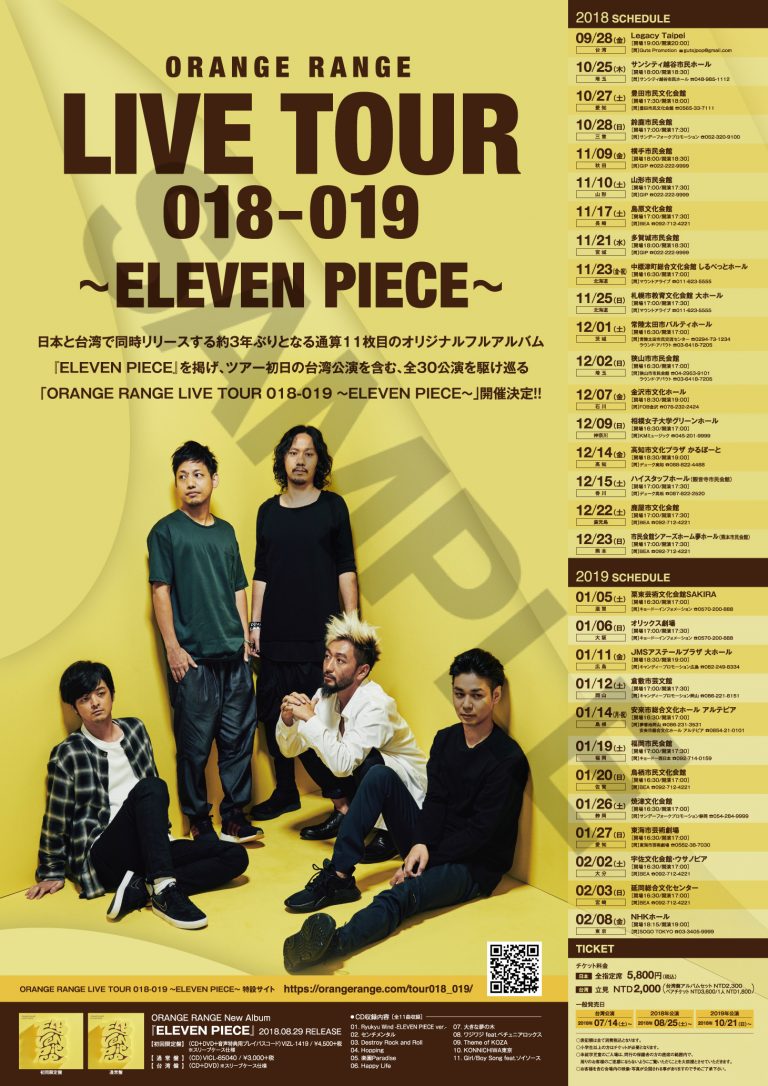
ORANGE RANGE is scheduled to release the new album "ELEVEN PIECE" on August 29. Be sure to check it out!
ORANGE RANGE – Hopping
https://www.youtube.com/watch?v=3aDra51RXjQ
ORANGE RANGE – Ryukyu Wind
Interview and text: momo (Mamoru Tanoue)
Profile: Born in 1995. A Digital Performer and Ableton Live user. After graduating from music school, moved from Fukuoka to Tokyo as a composer.
Made a debut as a writer in August 2017, composing and arranging for Tsukicro's "STARDUST".
With the motto "songs that touch the heart", a multi-player who handles everything from lyrics and composition to arrangement and recording.
Also active as the composer and arranger for the art unit "Shiro".
Website: Music Designer momo
Twitter ID: @momo_tanoue
NEW ARTICLES
Latest English Articles