An interview with bamboo of milktub
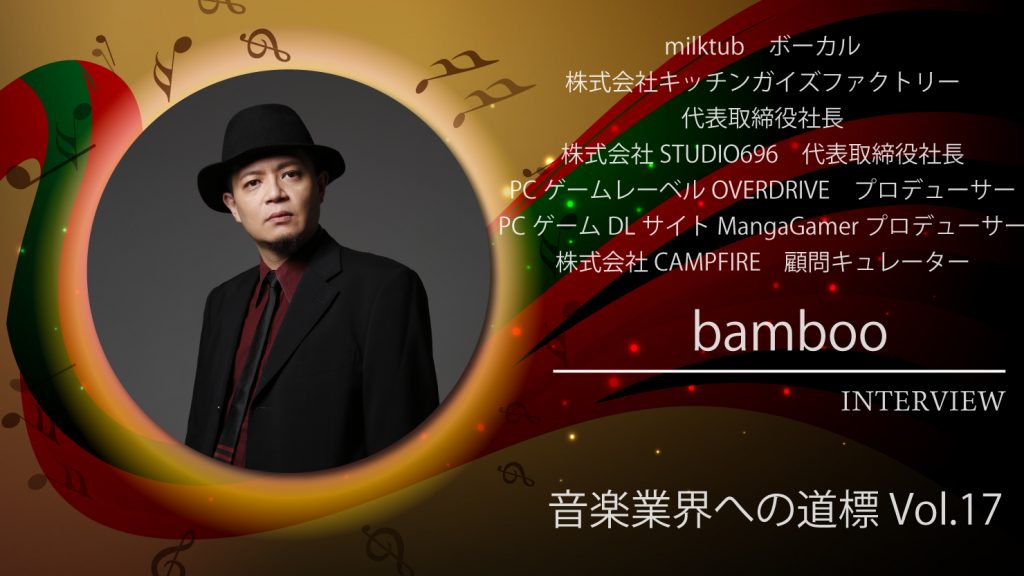
For the 17th installment of Pathways into the Music Industry, we talked with bamboo, well known from milktub. bamboo is known for a wide range of activities including games, crowdfunding and apparel, but what drives it all? We heard lots of bold, rock-and-roll stories! A must-read.
Thank you for taking the time to talk with us despite your busy schedule. You're active as the vocalist of the band milktub while involved in many projects. What are you doing these days?
OVERDRIVE is a brand where I develop games with bands as a motif, and at STUDIO696 I mainly run a recording studio and do merchandise and production.
I also run a company called MangaGamer that translates Japanese bishojo games for overseas, ports them and sells them. I started it ten years ago, and now we've grown to 150,000 members with sales of about 300 million yen.
And for about two years I've also been an adviser to the crowdfunding platform CAMPFIRE.
Why are you involved in so many things?
It's all because I want to make music. I wanted to keep the band going, and doing all sorts of things for that led to this.
For me, milktub is the top priority. I'm turning 45 this year. When I was young I dreamed of "debuting with a band, joining an agency and getting a record label behind us," but that didn't come true. So I thought: "Then I'll create my own tie-ins." That was the idea.
For example, rather than playing 100 shows a year, writing the theme song for my own game would reach a bigger audience. With that in mind, I entered the bishojo game industry around 2000. Holding a game event at a live house, and with a band at that, was something I think I was the first to do back then.
What milktub means
How did you originally get started in music?
I wanted to be popular with girls. That's the reason. I've still hardly ever been popular, so in my next life I'll try hard to be like A9 (Alice Nine) or GRANRODEO. (laughs)
Anyway, for that reason, my childhood friend Ichibanboshi☆Hikaru, a year younger, a few others and I decided to form a band, and that was the start of milktub.
When we formed I was the drummer, and in university I met Matsuyama, who played support drums for early Kuroyume, and learned all sorts of things from that mentor. I also worked part-time on concert production and security.
So from back then you were working on events alongside the band.
Yes. Live houses are fairly expensive to rent, so we'd all pitch in to put on private-booking events, and I did work like a concert organizer. I think that experience still helps me now.
While keeping that up, at around 22 I created a label called BAMBOO RECORD.
What! At 22?
I worked loads of part-time jobs to pay my mentor a salary, and I produced an album for a senior band and released the CD.
But back then I had no idea how to sell anything, and that's when I first learned about distribution and wholesalers. In the end we got it stocked at instrument stores, and I remember being shocked: "They take this much (margin)!?"
We made the CDs entirely ourselves, from assembling them in vinyl gloves to shrink-wrapping, loaded them into a HiAce van, toured all of Japan from north to south and sold about 4,000.
Assembling thousands by hand and selling them sounds like an enormous amount of work...
On top of that, being a total idiot, I spent all 3 million yen of the money I'd saved and borrowed from the bank to make that CD on recording costs. (laughs)
Back then there was nothing like Pro Tools yet, so we recorded on DAT (tape). We rented a studio for nearly a month to make the CD. That's where my original experience of music lies.
It took about a year, but we managed to sell all the CDs, and I really learned "the importance of selling things."
So you experienced both "making" and "selling."
Even so, being in a band is still hard now. In fact, until about four or five years ago, milktub lost money every time we played live. So I thought about how to fill that deficit and got really particular about merchandise, including how we sell it. And that went over pretty well.
Even entering the game world was, basically, for a really simple reason: "If we make music with a game maker's money, we don't have to pay out of our own pockets!" (laughs)
The bishojo game industry is run by relatively few people, so you can become a director or producer pretty quickly. But that comes with responsibility and lots of things you have to do. That's where I got honed like crazy. From budget management to promotion, you just have to sell. That's how it developed into crowdfunding and overseas business.
In the end, it all connects back to "I want to do milktub, I want to keep it going."
So everything comes together in milktub.
Anime groups and units have "acting" as a place to return to. But all we have is music, and this is the result of searching for ways to fight and ideas to keep it going. When I was young, being signed to a record label and playing big venues didn't come true, but now it has. After all, the president of an adult game company is appearing at Anisama and singing at Saitama Super Arena.
The importance of keeping going
What is the driving force that pushes you this far?
I want to play a show at Budokan.
For band people of my generation, Budokan really is a special place. Thanks to Lantis I've done anime music and gotten to sing at all kinds of big venues, but I still want to do Budokan ourselves.
Most of my other dreams have come true, but I want to play that special place, Budokan, before I finish, and that's why I work hard on games and everything else.
Listening to you, I'm reminded again of the importance of keeping going.
Well, it's infuriating, isn't it? Not being able to do what I once dreamed of feels like losing to myself, and I hate that.
The bands around me that have kept going without breaking up are ones like New Rote'ka, A9 and Nagareda Project, and I have huge respect for people like that and want to help them if anything comes up.
Over such a long career, I imagine there were times you felt anxious.
I think it was just before I turned 30. I went to see New Rote'ka's 23rd-anniversary solo show, and when I saw their vocalist Accchan say, "Our 23 years weren't a mistake," I cried so much. I wondered if I could ever say that... no, I hadn't worked that hard yet. I went straight to Lantis and said, "I want to make an album under the milktub name. I'll do anything to sell it."
Then Shigeru Saito, the producer at the time, said, "Let's do it!"
Our major debut started with a two-disc best-of album, and luckily it sold, so they said, "Then let's work with you as an artist," and that's how we got where we are. So we go back a long way with Lantis too.
I see. By the way, what was the hardest period so far?
It's always hard. There's never any money. (laughs)
There were quite a few missions like "raise 10 million yen within a month." But I'm doing what I want to do, so I accept that, and it's not something that makes you explosively rich.
But our audience includes people who really connect with what I make, and they support us, which is why we're here now. So I'm really grateful to the fans, and I always want to never lie to them.
The Eccentric Family 2 OP "Naru ga Mama Sawagu Mama"
milktub's approach to songwriting
How do you usually compose?
I rarely compose myself. My partner Ichibanboshi handles composing. I only learned guitar after I turned 40, and the guys in the band scolded me: "You should've learned it ten years ago!" (laughs)
For The Eccentric Family, Lantis called me in on a Thursday and said, "We'd like two demos, including scratch vocals, by Monday." They said, "You can do it, right, bamboo?" which ticked me off, so Ichibanboshi, the composer Kyoichi Miyazaki and I holed up in a studio and made three songs. One of them was "Uchoten Jinsei."
When a work is based on an original story, we have to speak for the work. It's the theme song, after all.
I read the original thoroughly, putting sticky notes in as I go, and pick out points like "Maybe this is what it wants to say" or "Maybe this is what it wants to convey."
That's how the phrase "If the world isn't interesting, just make it interesting" came out.
*The lyrics of The Eccentric Family OP "Uchoten Jinsei" are here*
"Uchoten Jinsei" was the first anime theme song under the milktub name, wasn't it?
I'm not a full-time singer or a voice actor, just some weird guy who also makes adult games, so I'm amazed Lantis gave me a tie-in. (laughs)
But I had my pride: over these ten years I'd burned through hundreds of millions of yen creating my own tie-ins, and games I made had been turned into anime.
I've created my own tie-ins and kept writing songs for them, so I think I have more know-how than others when it comes to writing songs for a work.
Game production and crowdfunding
You put as much effort into game production as into your work as a musician. I've played "Kira☆Kira" and "DEARDROPS" before, and I remember them piercing my heart and moving me deeply.
I have an intense admiration for bands and band people, and "Kira☆Kira" is what I made when I thought of combining bands with games.
It drew a lot of attention, packed with "band life" moments everyone in a band can relate to, and real struggles and worries.
For "Kira☆Kira" and "DEARDROPS," we ran a crowdfunding campaign on CAMPFIRE last year and were able to port them to Android and iOS as all-ages versions.
"Kira☆Kira" Android version / iOS version
"DEARDROPS" Android version / iOS version
What originally led you to start crowdfunding?
Funding for adult games usually comes from distributors, but packages sell less and less, so the amounts invested are gradually dropping. There are also problems like illegal uploads and downloads, and the bill for the industry's "hopeless stuff" coming due.
So what do we do? That's when I thought, "Wouldn't it be good for us to deliver what we make directly to end users ourselves?" That was the trigger.
You're now an adviser to CAMPFIRE. How did you study how to make projects succeed?
Before launching my own project, I first backed lots of projects. I studied very closely how they interacted with backers and so on.
I also keep gathering information now while curating all kinds of projects. Of course, when I become a curator, I put my name on it properly, stake my credibility and work desperately, all in it together.
You've worked on a really wide variety of projects on CAMPFIRE.
Yes. I'm confident I use crowdfunding more than any other musician in Japan.
They vary, like our own live DVD and projects for Megumi Ogata and clammbon, but the total raised through crowdfunding so far is about 350 million yen. I'm working to spread "the right way to use crowdfunding, a way that looks cool," for so-called successful bands as well as artists who haven't made it yet.
I think many people are afraid of failing at crowdfunding, or uneasy that the numbers are visible, for better or worse.
That's just a lack of study. You're supposed to research more before doing it, but "making a page and starting to take pledges" becomes the goal, and it ends there.
Another factor is not making crowdfunding into entertainment. There are all kinds of elements, like mood and romance, for getting people to "enjoy spending money," but if you don't do that properly, it just becomes collecting money, and it looks uncool.
If you want to ask about this in detail, please consult CAMPFIRE.
For those aiming to enter the music industry
You take on so many things. Do you sometimes fail?
Lots of times. I think 95% of things fail.
95%!? It doesn't look that way at all...
Making it look like things are going well is part of the business. (laughs)
Raising money to do something doesn't mean you're making a profit.
So how you look and how you present yourself is very important. After all, we're frontmen, people of entertainment.
I imagine there are times you nearly give up.
Of course there are, but I switch gears immediately. Like, this life is hopeless, so maybe I'll get a shot in the next one.
So it's the next life again. (laughs)
Sometimes failures drag on, but there's no point dwelling on them. Like, no matter how many women you hit on and fail with, it's no use; it just wasn't meant to be.
Even so, I don't quit, and I don't give up.
Please share any advice for those aiming to enter the music industry.
For kids in the regions especially, I think it's better to build up "value that can be seen in numbers" to some extent before coming to Tokyo.
These days, wherever you live, there are ways to create value for yourself and paths to take on challenges from the regions. Even if you suddenly come to Tokyo, there's no work waiting for you, and you'll be consumed by just getting by.
But with the development of the internet, more and more "ways to give yourself value" have appeared. Play counts on YouTube and niconico are one of them.
It's true, the fields where you can be active keep growing.
People stuck in the regions saying, "I want to be a musician, but..." are just making excuses to themselves.
Humans are so good at making "excuses for not doing things." There are endless fields to release your work in, so I think the most important thing is to use them to properly hone your ability to produce yourself.
I deal with lots of young people, actors and vocalists, and I often hear the young pros all say, "My agency doesn't do anything for me." When something goes wrong, it's easy to blame others, but first, do you have enough value to move the people around you?
I think you can build something inside yourself that makes people around you think "I want to do something for this person," whether you're in the regions or anywhere else.
It's true that with all the tools out there now, anyone can put out anything.
Speaking of band people, I think there are still many who think "playing live is everything," hoping someone will pick them up someday. Of course live shows are really important too.
But for example, even if you grow delicious fruit, it's meaningless unless people know about it, right? There's lots of "delicious fruit" in this world, and unless you create a reason for people to eat yours, nobody will eat it.
That's why there are selling points like "the trending ..." or "with a sugar content of X%."
So you have to present the "reason" from your side.
For instance, if you have numbers like "raised several million yen through crowdfunding," people may see value in that and reach out to you.
Of course there are things that aren't about numbers, but as an easy-to-understand indicator, they really are important.
I've seen tons of people vaguely saying, "I want to become...", but they all do nothing. In short, they only talk about their dreams without realizing that they themselves are the product, so of course they can't make it.
I think you should study more about how to use tools to sell yourself and your work.
Harsh words, but absolutely true. Finally, please tell us about your activities going forward.
Right now I'm making "MUSICA!," a story themed on bands that OVERDRIVE will release next year, and I plan to focus on that. I'm making it to depict even the gritty parts of "bands," so I'd really like people in music to play it.
I'm also always thinking about what entertainment means to me. Everything's better when it's fun, right?
Even if nobody does anything for you, you can make an uninteresting world interesting yourself.
I think I'll retire when I can no longer make exciting things, but until then I'll keep working hard.
Thank you very much.
What did you think? OVERDRIVE is currently distributing a trial version of the new game "MUSICA!" Please check it out too.
Reader giveaway
Thanks to bamboo's kindness, we've prepared a reader giveaway!
On Twitter, follow the official Sleepfreaks account and tweet with this series' hashtag (its Japanese title), and five winners chosen by lottery will receive a pick autographed by bamboo!
The entry period is Tue, Jul 10 to Mon, Jul 16, and winners will be contacted by DM.
This campaign has ended.
Thank you very much for all your entries!
Interview and text: momo (Mamoru Tanoue)

Profile: Born in 1995. A Digital Performer and Ableton Live user. After graduating from music school, moved from Fukuoka to Tokyo as a composer.
Made a debut as a writer in August 2017, composing and arranging for Tsukicro's "STARDUST".
With the motto "songs that touch the heart", a multi-player who handles everything from lyrics and composition to arrangement and recording.
Also active as the composer and arranger for the art unit "Shiro".
Website: Music Designer momo
Twitter ID: @momo_tanoue
NEW ARTICLES
Latest English Articles