UAD's "Helios Type 69 Preamp & EQ Collection" is a plug-in that faithfully recreates a legendary vintage console that symbolizes the golden age of rock. It models the preamp and EQ of the Helios Type 69, used by great artists such as The Rolling Stones and Led Zeppelin, and features bold, fat sound shaping through saturation. It can be applied to a wide range of tracks such as drums, bass and vocals, delivering natural tonal changes without falling apart, as only a passive EQ can. Not limited to particular rock genres, it is an essential tool for polishing sounds in all kinds of music production.
Bold and Musical Sound Shaping
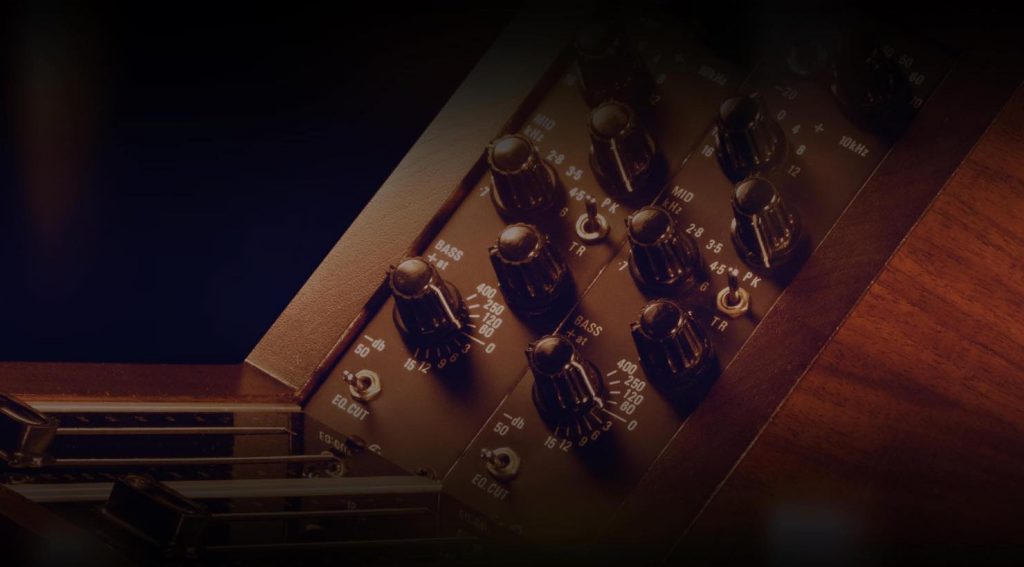
In the third installment of our series introducing outstanding UAD plug-ins, we cover the "Helios Type 69 Preamp & EQ Collection."
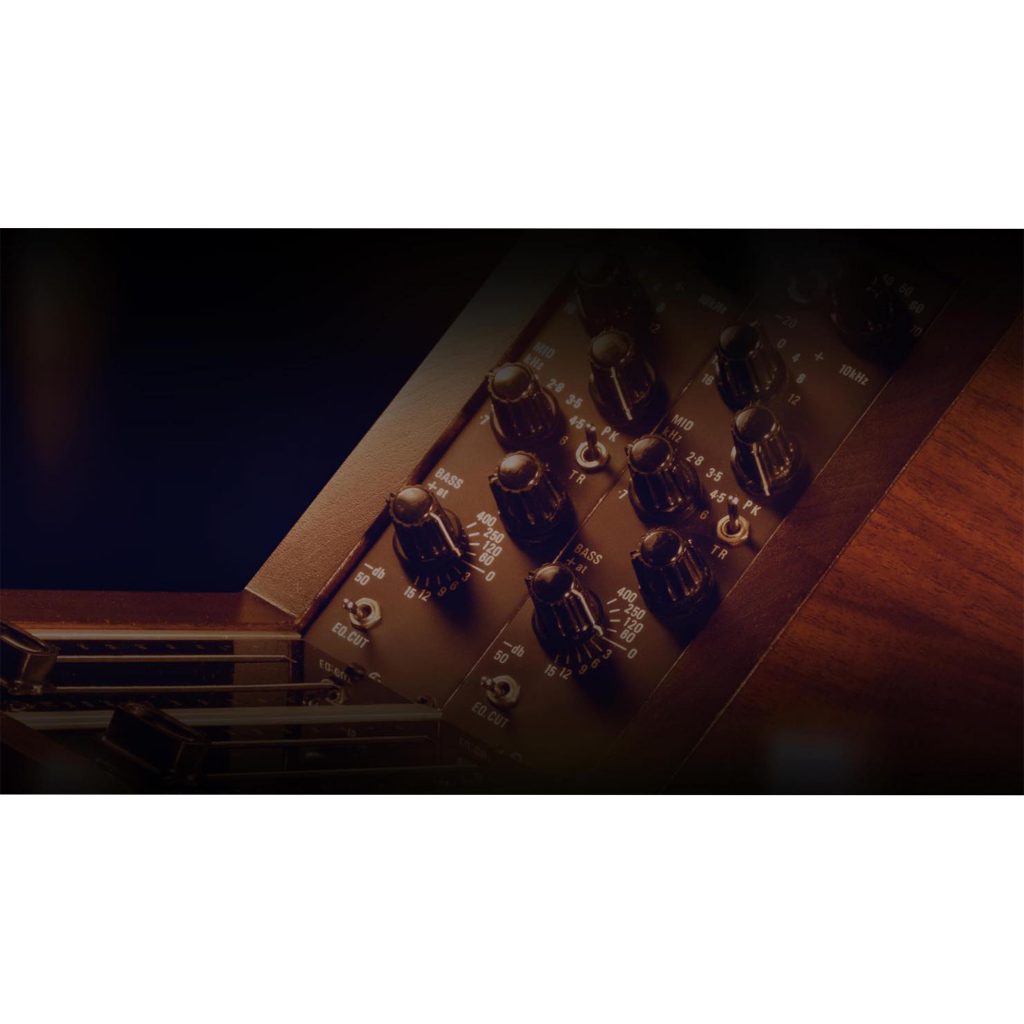
As its name and look suggest, this plug-in emulates the preamp and EQ of a legendary vintage console. Among plug-ins of this kind the NEVE 1073 is popular, but the Helios Type 69 has a flavor only it can deliver, and it is especially useful when you want a fat, rock sound. In fact, it has historically been used extensively in such genres.
However, after using it, I also got the impression that it could be used widely beyond specific genres by making use of its sweet spots.
We will review it along with sound examples, so please read to the end.
Product link: Helios Type 69 Preamp & EQ Collection
Note that UAD plug-ins run on dedicated DSP accelerators (or Apollo series audio interfaces). For details, see this article.

About the Helios Type 69 Console
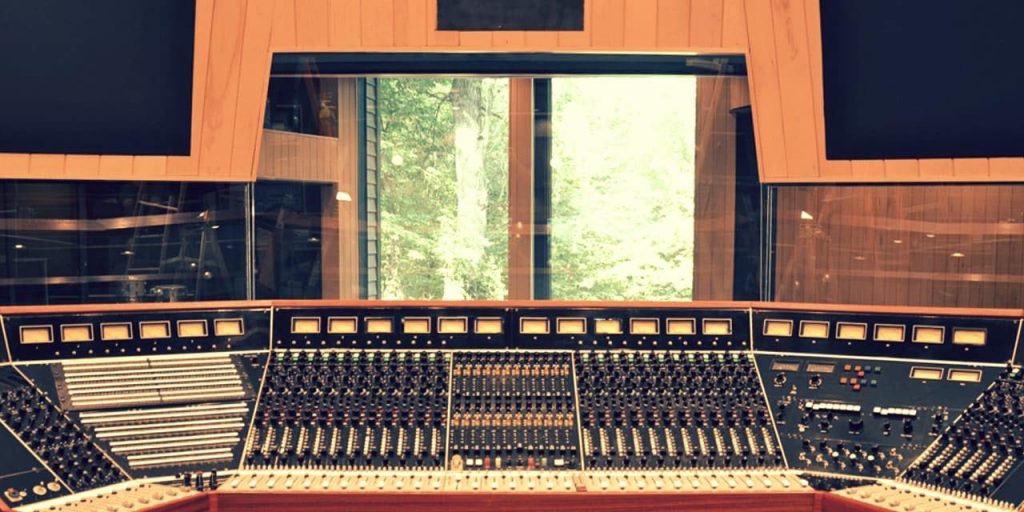
First, a brief word about the Helios Type 69 console, the original that this plug-in is based on.
Installed at places such as Olympic Studios in London, Musicland Studios in Munich and the famous Rolling Stones Mobile Studio, the Helios Type 69 can truly be called a symbol of the sound of rock's "golden age."
The artists who used it are a stellar lineup, from Led Zeppelin, The Beatles, Jimi Hendrix and Pink Floyd to Bob Marley & The Wailers, David Bowie, Black Sabbath and AC/DC.
UAD's Helios Type 69 Preamp & EQ Collection faithfully models every corner of the circuits of that legendary console's preamp and EQ. It is described as "the only 'triple-amp' preamp on the UAD platform," which shows how much effort went into it.
Parameters of the Helios Type 69 Preamp & EQ Collection
It has a simple configuration of a preamp and three-band EQ, but some operations are a little unusual, so let's look at an overview.
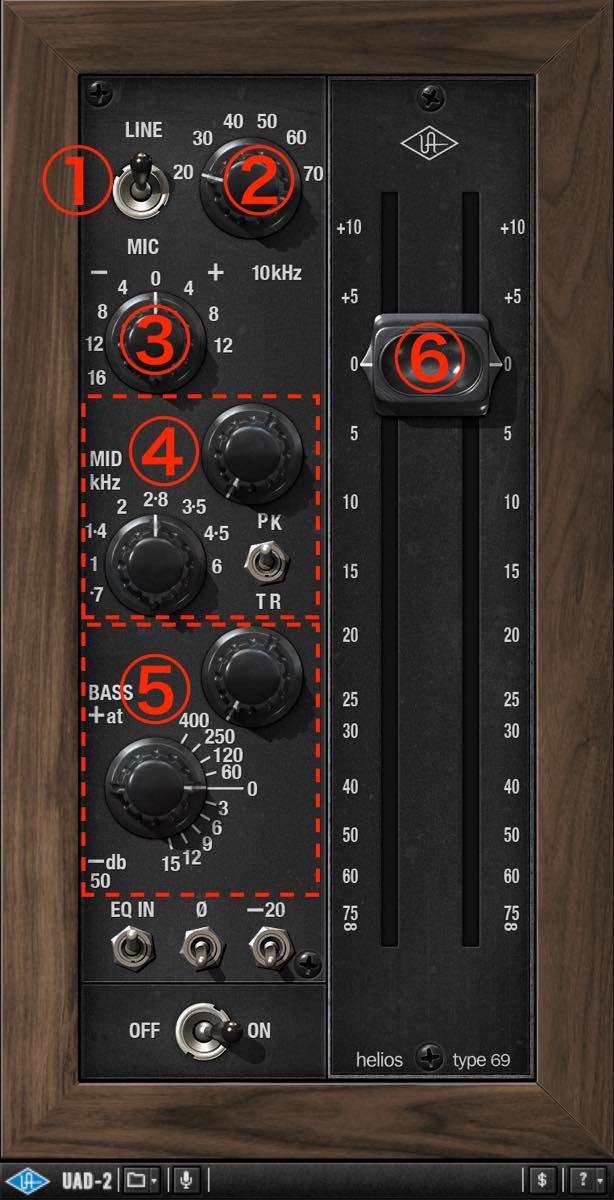
- (1) Input Select
Switches between MIC and LINE input. MIC not only gives a higher output level but also makes the saturation from the gain more pronounced. - (2) Gain
Amplifies the input level and adds coloration through saturation. - (3) High Shelf Gain
A shelving EQ fixed at 10 kHz, controlled from -16 to +12 in 4 dB steps. - (4) Mid EQ
Set the frequency with the lower-left knob and the boost/cut amount with the upper-right knob. Use the PK/TR type switch to switch between boost and cut. The smaller the gain setting, the wider the Q; the larger, the narrower the Q. - (5) Bass EQ
Note that its role changes depending on the position of the lower-left knob. Set to the frequency zone above 0, it becomes a peaking EQ, and you can set the boost amount for that frequency with the upper-right knob. Set below 0, it becomes a shelving EQ fixed at 50 Hz, and you set the cut amount from -3 to -15 dB in 3 dB steps. - (6) Output Fader
Adjusts the final output volume after shaping the sound with the preamp and EQ.
Use Case 1: Applying It to Drum Ambience Mics
From here, we will review it while checking the sound with actual demo tracks.
First, drums.
If you want a full-on rock sound, you can apply it to each mic, such as kick and snare, to shape the sound, but if you just want to add some rock flavor easily, applying it first to the drum ambience mics makes the effect easy to hear.
Since they capture the sound of the whole kit, you can control them to build a sense of presence and the backbone of the sound.
This is just one example, but listen to the sound.
For reference, here is the sound of the whole drum bus.
It has changed into a rough, bold sound where you can almost feel the drum kit vibrating.
The settings look like this.
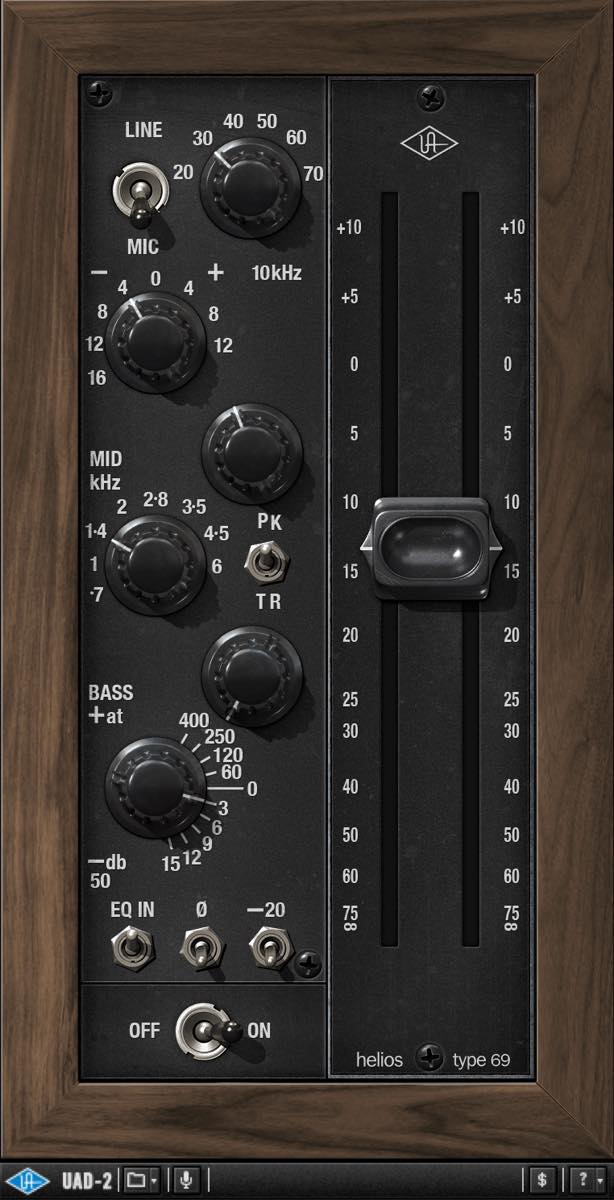
Input Select is set to MIC, and gain is set to 30 to add saturation. Up to 30 counts as saturation; at 40 or higher it becomes quite heavy distortion.
The high shelf gain at -4 dB takes the edge off the highs slightly. The mid EQ boosts 1.4 kHz by about 7 dB to add thickness to the metallic ring of the snare and hi-hat. The bass EQ uses a -3 dB shelving cut to keep the kick from spreading too much.
As a result, the flavoring effect of the saturation is enormous, turning it into a rock vibe all at once. Simply fattening the midrange with EQ would not do this. The EQ is a passive EQ, as expected: you can boost heavily for extreme sound shaping, but it never falls apart, and you can enjoy the changes comfortably.
Use Case 2: Applying It to Bass
Next, bass.
Helios is said to have "a distinctive midrange," but don't underestimate its lows; it transforms the sound more than you would imagine.
It gave us an ideal bass sound that is solid yet has a moderate presence of harmonics.
The settings look like this.
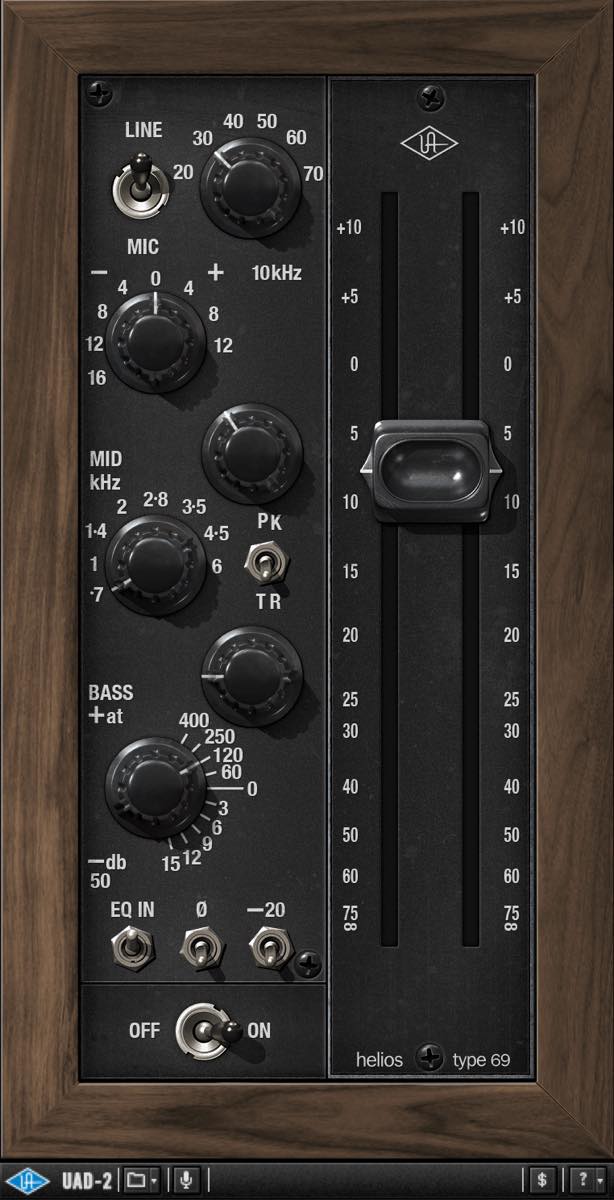
Input Select is set to LINE to avoid too much distortion, and gain to 30, and already at this point the image of the sound changes completely. Yet its character is not too strong; it is a sound that seems to fit many genres. Honestly, I did not expect it to suit bass this well.
The EQ is used only for fine adjustment. The mid EQ cuts 700 Hz slightly for a somewhat tighter impression. The preamp alone brought out the lows nicely, but 120 Hz is boosted slightly to match the song.
It sounds good soloed, and it also sits beautifully and settles into the whole mix. I felt the depth of this plug-in, which depending on the settings can not only create a distinctive rock sound but also polish sounds for all purposes.
Use Case 3: Applying It to Vocals
Next, we applied it to vocals. First, compare before and after.
The highs extend beautifully, and like the bass, don't you think it is a sound without strong quirks?
The settings look like this.
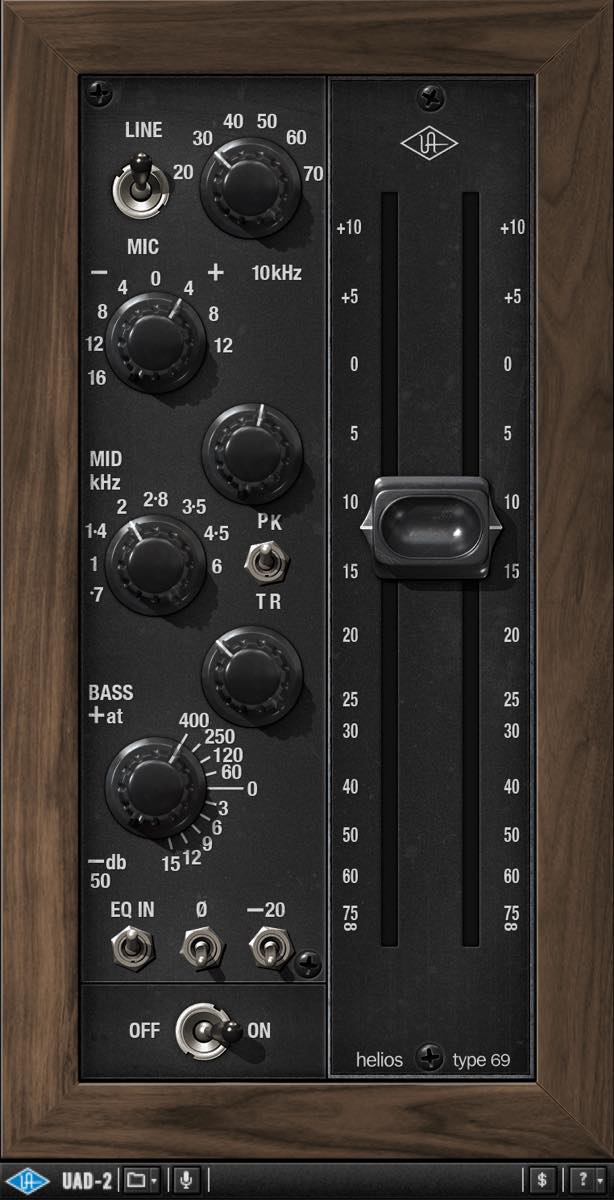
With Input Select set to LINE and gain at 30, pleasant analog-like harmonics are added first, forming the foundation of the sound.
We adjust with EQ from here, and the high boost after the preamp is wonderfully vivid and fresh. It cuts through clearly without sounding harsh and adds conviction to the vocal. Ideally it could be set more finely than in 4 dB steps, but it still has an appeal that makes you want to run all kinds of vocals through it. You might also position it as a high-quality exciter and combine it with other EQs.
The mid EQ, said to be the essence of Helios, is also good. Here, 2 kHz is boosted by about 8 dB; that is a large number, but it acts musically, so it is best to operate it as if searching for the sweet spot.
If you feel the sound has thinned a little, you can reinforce the lows with the bass EQ. Here, boosting 400 Hz by about 5 dB gave just the right result.
Finally, for reference, compare the whole mix before and after applying it to the three tracks above.
That concludes our introduction to the Helios Type 69 Preamp & EQ Collection.
Because of its look and history, it tends to be seen as a somewhat quirky novelty, but in use it has the potential to shine not only in rock but in many genres and sources. Just adding it to a pinpoint spot in your usual mix might completely change the impression of the whole song.
It is a gem I would like anyone interested to try.
Product link: Helios Type 69 Preamp & EQ Collection
Frequently Asked Questions
Q1. What environment does the Helios Type 69 Preamp & EQ Collection run in?
It requires a dedicated UAD DSP accelerator or an Apollo series audio interface. It runs only on the UAD platform and is not a standalone plug-in.
Q2. How does it differ from the NEVE 1073?
Both are classic console emulations, but the Helios Type 69 excels especially at fat, rock sounds and has historically been used extensively in rock genres. Their midrange characteristics differ, so you can choose according to your purpose.
Q3. Can beginners master it?
With a simple configuration of a preamp and three-band EQ, the basics are easy to learn. However, there are unusual operations, such as the bass EQ switching function depending on the frequency setting, so checking the manual is helpful.
Q4. Can it be used on tracks other than vocals?
Yes. It can be applied to drum ambience mics, bass and instruments in general, and the preamp's saturation gives a distinctive coloration to all kinds of tracks.
NEW ARTICLES
Latest English Articles