LALAL.AI is an AI service that separates a song's 2-mix into vocals and accompaniment, or into individual instruments such as drums and bass. The new engine greatly improves vocal separation accuracy, and comparative tests against the old version and iZotope RX 10 confirmed its excellent performance, especially in vocal extraction. For bass and drum separation, each tool takes a different approach, and the best tool may vary depending on the song's characteristics. Because it enables professional audio separation at an affordable price starting at 1,900 yen per month, it is a practical option for creators doing DTM production and remixing.
This time, we revisit LALAL.AI, which we introduced before, a service that separates 2-mix audio into vocals and backing track, or into instrument stems such as drums and bass.
The reason is that its internal engine has been powered up, enabling even more accurate separation, so the aim this time is to test it by comparing it with the old version and with Music Rebalance in iZotope "RX 10," which has the same function.
We also received comments on the previous video eagerly asking for a comparison, so we planned this in response.
The results turned out to be interesting, so please read to the end.
High-Precision 2-Mix Part Separation Service "LALAL.AI" Video
A Recap of the Features and Plans
First, let's briefly recap LALAL.AI's features and how to use it. It has hardly changed from the old version, so please see the previous introduction video for details.
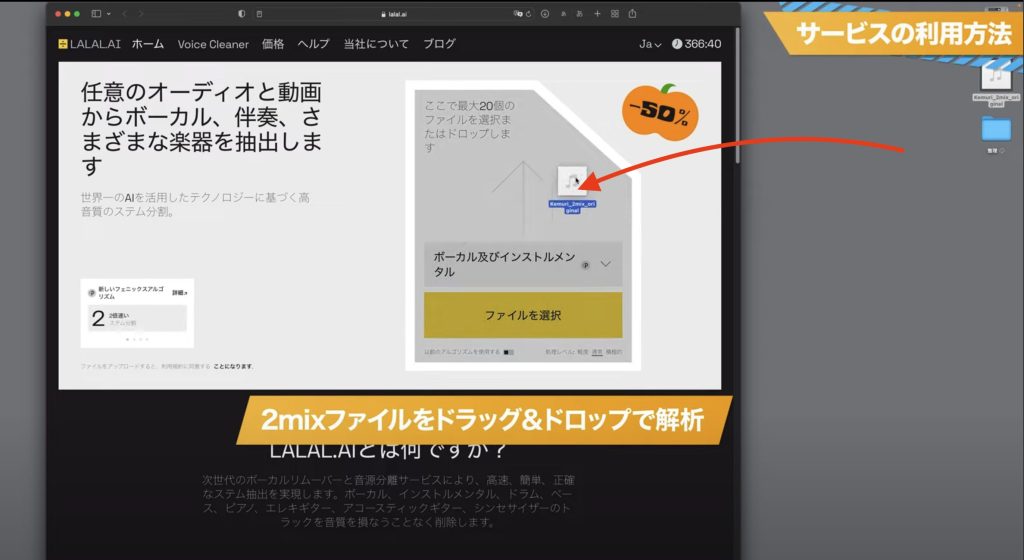
LALAL.AI is a web service that separates 2-mix audio by part; drag and drop the 2-mix file you want to separate onto this screen, and analysis starts right away.
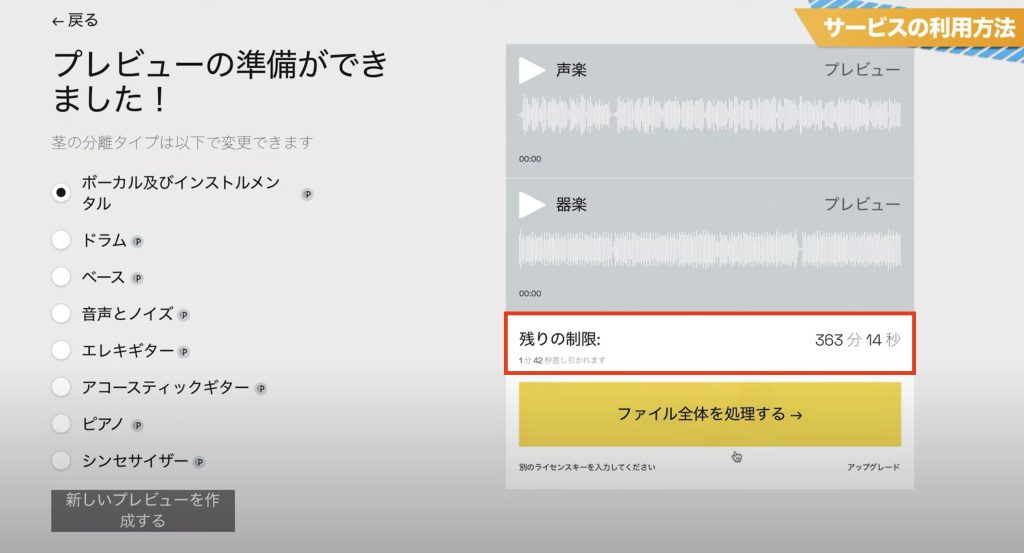
When the analysis finishes, you can listen to a preview.
It is currently set to vocals and backing track, but you can switch to other ways of splitting.
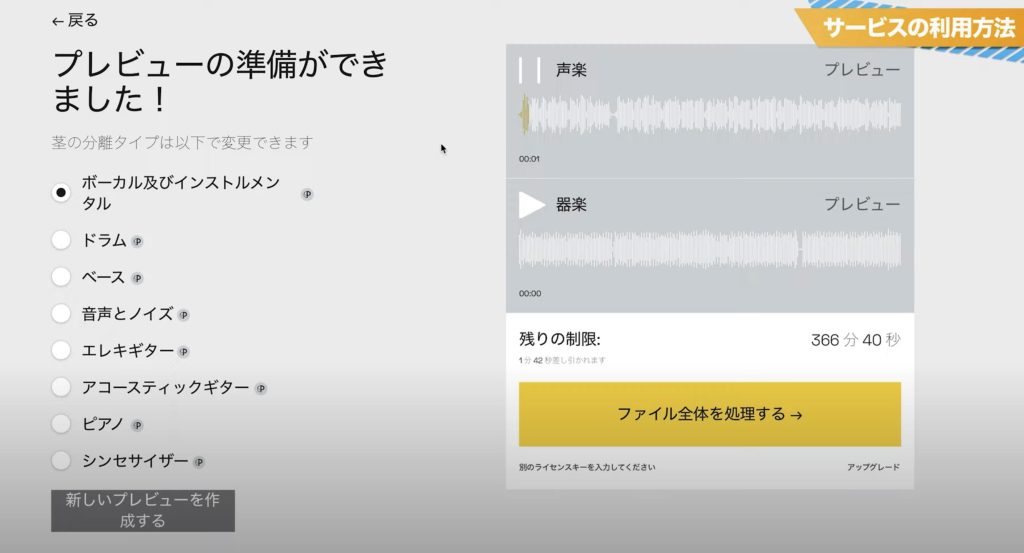
If you are happy with the preview, you download it; this screen is currently in a state registered for paid use.
A free trial is of course also possible, so please see the previous video for details.
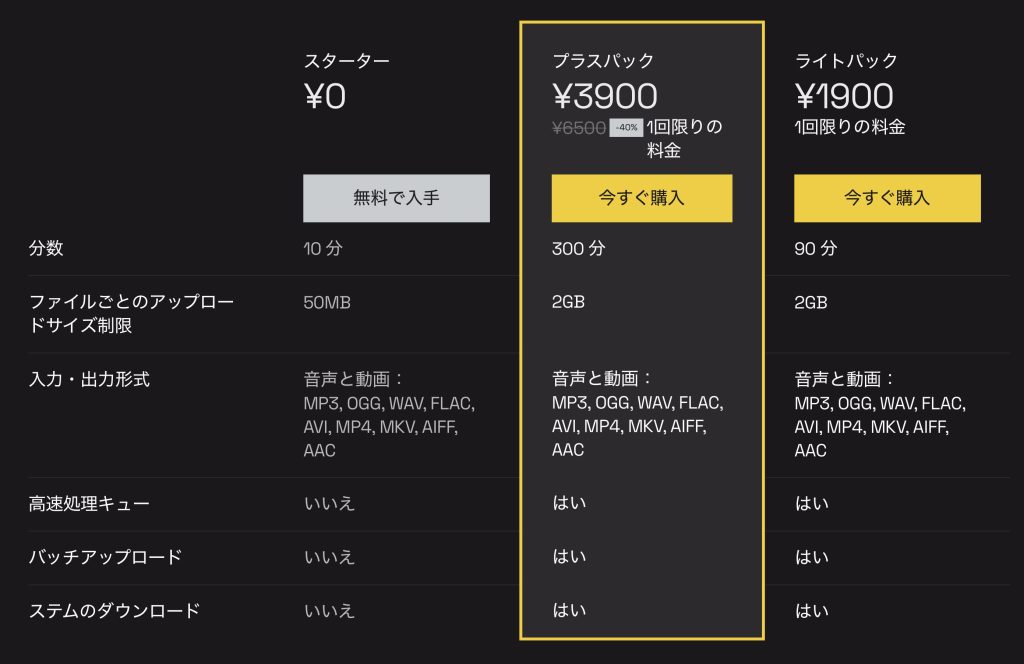
The free tier allows 10 minutes of downloads, and if you use that up and want to continue, you buy a paid pack.
The current lineup is as shown: the Lite pack, which processes 90 minutes, is 1,900 yen, and the Plus pack, which processes 300 minutes, is 3,200 yen.
Comparison with the Old Version and iZotope RX 10
Now, let's test what the new LALAL.AI can do.
We will use the same song we used with the old LALAL.AI, so first let's check the 2-mix.
We separate the parts of this with the new and old LALAL.AI and iZotope RX 10 and compare them.
Separating the Vocals
First, separating the vocals and backing track. Let's start with the old LALAL.AI.
Next, the new LALAL.AI.
Finally, iZotope RX 10.
How did they sound?
The separation accuracy was already high, but the progress from old to new is considerable. The clarity of the vocals is completely different, so it may also be easier to transplant them onto a relatively quiet backing track.
In the new backing track, the vocals disappear with considerable accuracy even in quiet parts such as the verse, to the point that you might hardly notice if you mixed in a new vocal.
RX, on the other hand, is one function among many, so it is undeniable that it loses somewhat to LALAL.AI, which was developed specifically for this. However, its purpose is to change the balance, so they cannot be compared simply.
Separating the Bass
Next, we tried separating the bass.
Both seem to separate it with relatively good accuracy, but their tendencies differ a little.
LALAL.AI feels like it focuses firmly on the low end and extracts it narrowed to the center.
RX, on the other hand, sounds like some higher-frequency content is mixed into the bass and the stereo position is wider.
I felt that we would not know which is better without trying a wider variety of songs.
This is because it is not clear by what criteria each AI technology judges "this phrase is bass" and extracts it.
The low-frequency part of the bass is in a narrow frequency range and can be said to be easy to extract, but depending on the sound, some basses have a lot of harmonic content. For those, RX may extract them better.
Similarly for position: an electric bass is basically centered, but some synth basses have width.
Whether they separate while properly judging these factors cannot be determined from this alone, I think.
Separating the Drums
Next, the drums.
The drums gave interesting results.
A feature of this song's drums is the hi-hat playing constant 16ths, and RX seems to try hard to pick it up, but other instruments' sounds come along with it.
LALAL.AI, on the other hand, picks up the main accents but seems to discard quite a lot. It may prioritize the clarity of the kick and snare over the hi-hat.
That concludes our introduction to the new LALAL.AI and our test comparing what it can do.
As a result, I felt its vocal separation is at a very high level among services of this type. Its other separations also have distinctive tendencies compared with others, but I think it has reached the cutting edge of current technology.
It is also nice that it is inexpensive and easy to use.
If you are interested, please give it a try.
[2-mix separation] LALAL AI vs iZotope RX 10: comparing and testing how well they extract vocals and instruments from songs
We planned this in response to comments eagerly asking for a comparison. The results turned out to be interesting, so please read to the end.
Video: https://t.co/kRiym5iylCArticle: https://t.co/uBlDIp45xR#DTM pic.twitter.com/eJa0i51nR8
— SLEEP FREAKS (@SLEEPFREAKS_DTM) November 13, 2022
Frequently Asked Questions
Q1. Which is better, LALAL.AI or iZotope RX 10?
LALAL.AI is more accurate at vocal separation, but RX 10's function is aimed at adjusting balance, so a simple comparison is difficult. For separating individual instruments, which is better tended to vary with the song's characteristics.
Q2. Can LALAL.AI be used for free?
The free trial allows 10 minutes of downloads. Continued use requires buying a paid plan (Lite 1,900 yen for 90 minutes of processing, Plus 3,200 yen for 300 minutes).
Q3. Is the vocal separation accuracy good enough for real use?
The tests report that the new LALAL.AI produces very clear vocals, at a level where you can mix a new vocal onto a quiet backing track with almost no sense of unnaturalness.
Q4. Which instrument is separated most accurately?
In the tests, vocal separation was rated the most accurate. Drum and bass separation tended to depend on the song's arrangement.
NEW ARTICLES
Latest English Articles