Audiostock is one of Japan's largest marketplaces for music assets, a service where songs and sound effects made by creators are sold for business use. Buyers can use commercially licensed audio without limits for 500 to 3,000 yen per track, avoiding the complicated procedures required for JASRAC-registered songs. For creators, it is more than just a source of income: among roughly 6,000 registered creators, many earn over 100,000 yen a month, and it can also help promote their names. Demand is rising with the rapid growth of video advertising, with BGM and Japanese-style music drawing particular attention, and more creators are efficiently earning money by recycling songs they have already made.

Have you heard of a service called "Audiostock"?
It is one of Japan's largest sites for selling the audio you make, and it is a service attracting a lot of attention right now, used by a wide range of musicians, from creators to band members.
This time, we interviewed Shuichiro Nishio of CREOFUGA Inc., the company that runs Audiostock.
If you are seriously thinking about "making a living from music," please give it a read!

Shuichiro Nishio, CEO of CREOFUGA Inc.
--First, please briefly tell us what kind of service Audiostock is.
Audiostock is positioned as a "marketplace for music assets," a site that sells sound licenses.
When people hear "distribution," many imagine consumer services such as iTunes, but the biggest feature of Audiostock is that it is often used for business purposes.
For example, when using music or sound effects for commercial purposes, such as music for a company's commercial or BGM for a game company's new title, you can buy a track for around 500 to 3,000 yen.
Once you buy it, you can use it freely with no limit on the number of uses, so I think it is a very good fit for today's internet content.
--Being able to use content freely is a pretty big advantage for buyers.
For example, using JASRAC-registered songs requires complicated procedures and is quite a burden in terms of cost.
In that respect, many people use Audiostock because you can buy casually, like online shopping, and it is much cheaper.
Also, recently, "video ad" content has been increasing rapidly everywhere, on Twitter, LINE and so on.
Things that used to be still images are steadily turning into videos, and demand for music to play in the background is rising along with that.
--I see. So video production companies and game companies are actively buying content on Audiostock. By the way, what made you want to start this service in the first place?
Our business originally started with holding music contests on the internet. We received a lot of entries, and every now and then companies said, "We'd like to use this song."
But handling music rights is quite difficult. For example, even if a company wanted to use an indie artist's song, there were cases where they gave up in the end because of discussions about fees, contracts and so on.
So we thought that by creating a platform where audio could be bought and sold easily, we could eliminate complicated procedures and hassle. That was what led us to start the service.
--So Audiostock takes care of all that tedious paperwork.
Exactly. As long as you agree to the site's terms of use, we handle everything on your behalf, including the procedures for your earnings.
--Next, I'd like to ask a few questions from the perspective of creators who want to sell their audio. How many artists and creators are currently registered?
As of now, there are about 6,000 registered users, and about 80,000 tracks registered, including sound effects. (As of October 2017)
--That's overwhelming. How many tracks does each person upload, and how much do they actually earn?
Some people upload as many as 1,000 tracks.
As for earnings, creators basically receive 40% of the price they set, and although only a few, some people earn more than 200,000 to 300,000 yen a month.
My impression is that quite a lot of people earn over 100,000 yen.
--That's quite inspiring. Apart from earnings, what are the benefits for creators of using Audiostock?
Audiostock displays the name of the person who made the audio, so I think it also helps promote your own activities.
In fact, some people were later contacted directly by the client and named for a different project.
After all, I think the ultimate goal for creators is to be personally named for projects, so it can also help in the sense of "making a name for yourself."
Well, for us it's a bit of a lonely story. (laughs)
--So it's also a place where you can show what kind of songs you make. It seems many people upload a lot of tracks. What do people who use it well have in common?
Audiostock users range from students to professional creators, so it's hard to generalize, but many people use it to recycle what they've made, for example by uploading stock songs they made long ago or songs that didn't pass competitions.
Others work on their main job during busy periods and make songs for Audiostock in their spare time.
--I see. So not only new songs, but even songs that were "rejected" can be reused and turned into income. By the way, is there a trend in what kind of songs sell well?
BGM has a higher unit price, so it brings in the most profit.
Also, since companies often use the music in commercials, music that is too assertive seems to be avoided at times.
It may be a good idea to make music while keeping in mind that it will play in the background of a commercial.
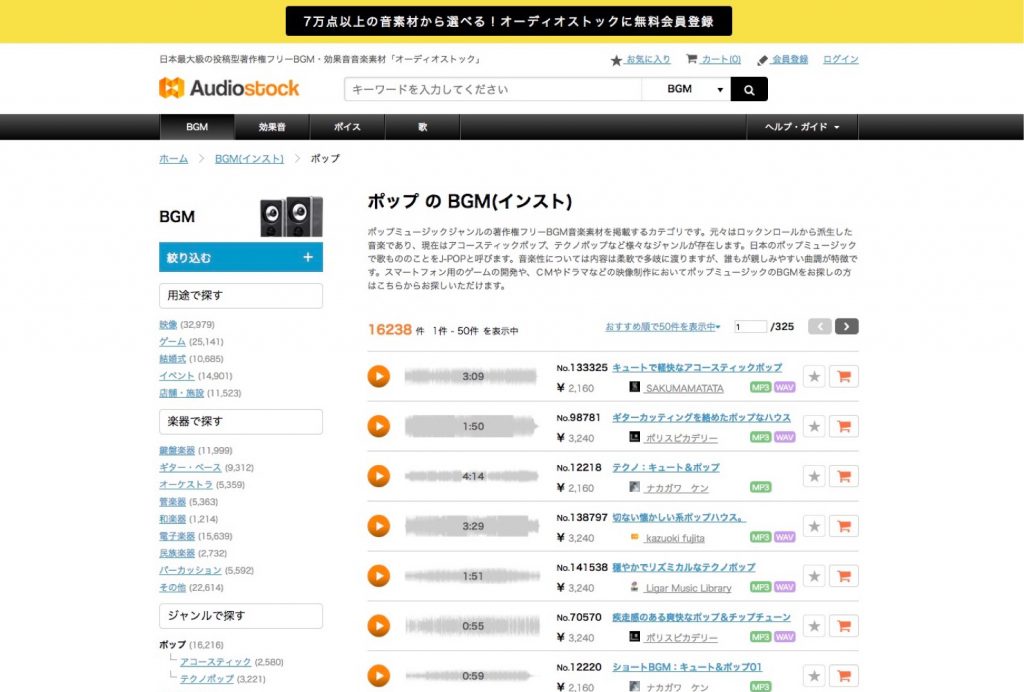
--What track length is preferred?
Around two minutes.
In many cases buyers cut out the part they want to use, so even for commercials, tracks that are too short seem to be hard to use.
--Are there any genres for which demand has been rising recently?
As a trend, there have been many searches for "Japanese-style music" recently.
With the Tokyo Olympics coming up, it seems to be increasingly used in ads promoting Japanese culture and tourist destinations.
Also, many of the tracks currently posted are so-called "programmed" music, but songs performed on live instruments tend to be preferred, so aiming for that may be a good idea.
Also, best-selling tracks often sell many times, so there's a good chance a single track can generate a lot of income.
--I see. Is there anything Audiostock wants to focus on more in the future?
Right now, many of our customers are still in niche areas such as video production and game companies, so going forward we'd like to expand further, for example into music used on TV.
I also think there's still a lot of room to develop songs with vocals.
In the future, I'd like to see major creators and artists emerge from among Audiostock users.
Right now, the highest earnings for registered creators are around 200,000 to 300,000 yen a month, but if someone in the 10-million-yen-a-year class appears, that would make it a really inspiring story.
--That would be a dream world. (laughs) Finally, please say a few words to Sleepfreaks readers.
I hope you'll upload the audio sleeping on your computer and earn money from it on Audiostock.
We look forward to your registration!
--Thank you very much.
So it seems there are many ways to make a living from music besides aiming for the major-label industry.
Registration for Audiostock is of course free, so why not take this opportunity to let your songs take flight?
Thank you for reading to the end.
Sign up for Audiostock here.

About the Author

Interview and text: momo (Mamoru Tanoue)
Born in 1995. Digital Performer user. Moved from Fukuoka to Tokyo as a composer after graduating from music school.
Debuted as a writer in August 2017, composing and arranging for Tsukicula's "STARDUST."
With the motto "songs that pierce the heart," momo is a multi-player who handles everything from lyrics, composition and arrangement to recording.
Also active as the composer and arranger of the art unit "Shiro."
Twitter ID: @momo_tanoue
"Shiro" Website: https://www.shiro.space/
"Shiro" Twitter ID: @shiro_unit
Frequently Asked Questions
Q1. Is it difficult to register to sell audio on Audiostock?
No. You can register just by agreeing to the terms of use, and Audiostock handles the earnings procedures on your behalf. Because you can start as easily as online shopping, a wide range of creators, from students to professionals, use it.
Q2. How much can you actually earn on Audiostock?
You receive 40% of the price you set. Many people earn more than 100,000 yen a month, and some earn 200,000 to 300,000 yen or more a month. Best-selling tracks are purchased many times, so a single track can generate income repeatedly.
Q3. What genres and characteristics of music sell well on Audiostock?
BGM brings the most profit, and because it is often used in company commercials, understated music that is not too assertive is preferred. There is also high demand for Japanese-style music and songs performed on live instruments, such as orchestral music, and a length of around two minutes is ideal.
Q4. Can I sell rejected songs on Audiostock?
Yes. You can recycle and sell stock songs you have already made or songs that were not selected in competitions. Many creators upload such songs alongside their main jobs to earn income.
Q5. Does registering with Audiostock have a promotional effect?
Yes. The creator's name is displayed with the audio, so you can showcase your work. There are cases where a client directly names a creator for a different project, which can lead to personally commissioned work.
NEW ARTICLES
Latest English Articles