In DTM, a trigger is what starts a synthesizer's sound processing. The simple act of pressing a key generates a trigger, which then affects parameters such as envelopes and LFOs so that the tone and volume change over time. Triggers have two modes, "reset" and "retain": in reset mode the envelope restarts with every new key press, while in retain mode it carries over the state of the previous note. Because this setting greatly changes the nuance of the same phrase, it is an extremely important concept in music production.
Triggers: What Sets Each Action in Motion
From the title alone it may look a bit complicated,
but it really isn't.
A trigger is a cue that starts something.
The simplest example is that
when you press C on the keyboard, the synthesizer plays a C.
Pressing the key acts as the trigger (cue), and the sound is produced.
In a synthesizer, these triggers work at various moments to change the sound.
When the sound stops as you release the key,
it stops because there was a trigger: releasing the key.
Controlling How the Envelope Is Applied
Closely related to triggers are
the envelope and the LFO, which we introduced earlier.
Here, we will use the article "6_AMP Envelope" as an example.
It was about controlling changes in volume with ADSR.

Here, the attack is set long, to 5 seconds,
and the sustain is at maximum.
There is no volume decay, so the sound keeps playing as long as you hold the key.
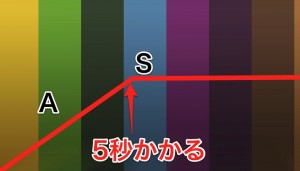
From the moment you press the key (the trigger),
the sound slowly rises to maximum volume over 5 seconds.
Now for the trigger modes.
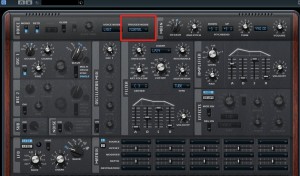
Broadly speaking, there are two modes:
"reset" and "retain".
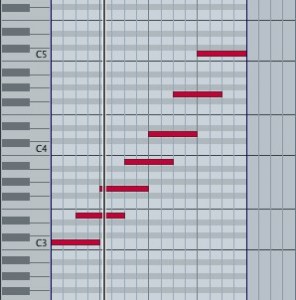
↑ Set Voice to Mono and play a phrase like this.
Reset Mode
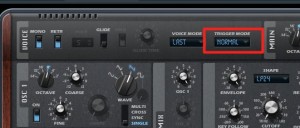
↑ On this synthesizer, the type labeled "Normal" is reset mode.
When the next key is pressed, the envelope starts again from the beginning.
Every note starts from a quiet point.
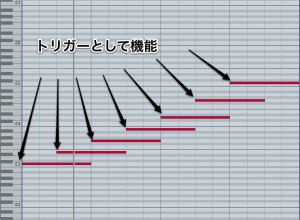
↑ Every note acts as a trigger and affects the envelope.
Retain Mode
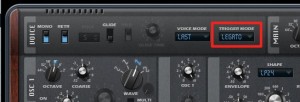
↑ The type labeled "Legato" is retain mode.
When the next key is pressed,
the sound carries over the envelope so far
and keeps getting louder toward the peak at 5 seconds.
The whole phrase is treated as a single note.
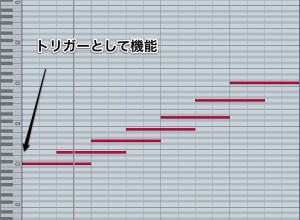
↑ Only the first note
acts as a trigger that affects the envelope.
As you can see,
trigger settings are also very important in terms of
what nuance a phrase is played with.
Next time, we will look not only at the volume envelope
but also at the relationship between triggers and the filter envelope, which affects the tone.
You Can Apply It Like This
Frequently asked questions
Q1. What exactly is a trigger on a synthesizer?
A trigger is what starts sound generation. For example, pressing a key is a trigger that produces a sound, and releasing the key is another trigger that stops it. Multiple triggers like these control how a synthesizer behaves.
Q2. What is the difference between reset and retain trigger modes?
In reset mode, the envelope starts from the beginning each time you press a new key, so every note starts quietly. In retain mode (legato), the state of the previous note carries over and multiple key presses are treated as one note, allowing smoother playing.
Q3. Are trigger settings important in DTM?
Yes, extremely. Trigger settings can greatly change the nuance of the same phrase. They affect the expressiveness of a song and are an essential concept when controlling changes in tone and volume.
NEW ARTICLES
Latest English Articles