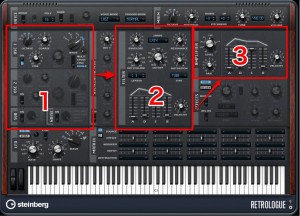
There are many kinds of synthesizers and they may look complicated, but they are actually built on three basic components. The flow of choosing the waveform with the oscillator (OSC), shaping the tone with the filter (VCF), and controlling the volume with the amplifier (VCA) is the foundation of every synthesizer, whether subtractive, additive, or FM. Understanding this basic structure lets you learn to operate any synthesizer efficiently and create the sounds you like.
Synthesizer Basics! A Surprisingly Simple Three-Part Structure
There are many synthesizers on the market,
but their structure is basically the same.
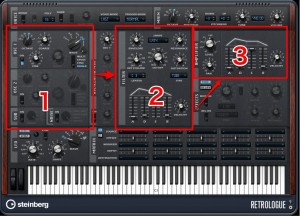
- 1_Choose the waveform_Oscillator (OSC)
- 2_Shape the waveform and create the tone's character_Filter (VCF)
- 3_Set the volume_Amplifier (VCA)
↓
↓
This is the basic structure.
There are different types of synthesizers,
such as subtractive, additive, FM, and granular,
but the basic structure is still the same.
We will start by explaining
the simplest of them, subtractive synthesis.
Next time, let's look at part "1" in the image above,
the oscillator (OSC).
Frequently asked questions
Q1. What are the three basic components of a synthesizer?
The oscillator (OSC) determines the waveform, the filter (VCF) shapes the tone, and the amplifier (VCA) controls the volume. This three-step flow is the foundation common to every synthesizer.
Q2. Do synthesizers other than subtractive ones have the same structure?
Yes. There are many types, such as additive, FM, and granular, but the three basic components are the same. The differences between types lie in the details of how the sound is processed.
Q3. Which kind of synthesizer should beginners start with?
We recommend starting with the simplest, subtractive synthesis. Understanding the basic structure first and then moving on to other types helps the knowledge sink in more efficiently.
NEW ARTICLES
Latest English Articles