In synthesizer sound design, the filter is an important element that cuts specific frequency ranges of a waveform and defines the character of a sound. This article explains in detail how the three basic filters found on every synthesizer, the low-pass, high-pass, and band-pass filters, work and what makes each distinctive. By adjusting which frequencies are removed with the Cutoff parameter and adding character with Resonance, you can achieve the sound design you want. Learning the character of each filter by ear lets you choose the right filter accurately when producing.
Shaping Sounds with a Synthesizer's Filter
After choosing and adjusting the waveform in the OSC section, you shape the character of the tone with the filter.
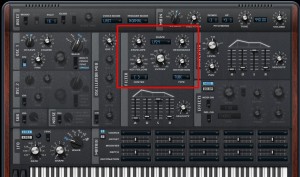
A filter cuts a certain frequency range of the waveform.
Cutting frequency ranges determines the tone and character, so it is a very important part.
*The more harmonics a waveform has, the more a filter changes its tone.
Filters are used very often with the sawtooth wave, which contains many harmonics.
Types of Filters
Synthesizers come with all kinds of filters,
but here, learn the three basic filters.
Every synthesizer has these.
Low-Pass Filter_LPF
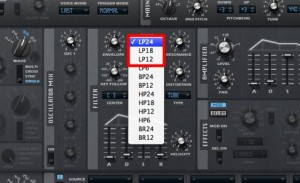
As the name suggests, it "passes the lows" = it "cuts the highs".
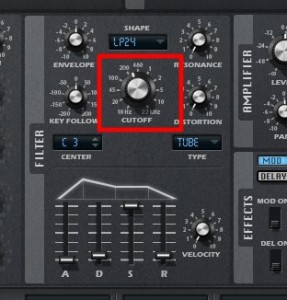
↑ "Cutoff" determines how much of the high end is cut.
Explained with an EQ, it looks like this. ↓
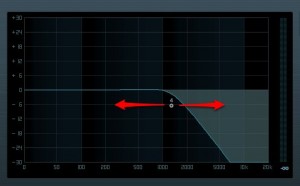
Here is a phrase played while moving the Cutoff. ↓
It's a classic sound you hear often.
This is the most frequently used filter on synthesizers.
One more thing to learn is "Resonance".
This parameter adds character to the sound, making it sound distinctly like a synth.
Explained with an EQ, it looks like this. ↓
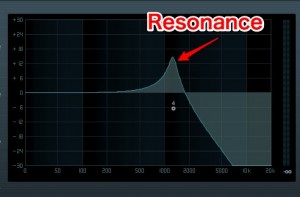
It deliberately boosts and emphasizes the cutoff point.
The knob value sets how much this point is emphasized.
Moving the Cutoff with this setting creates a sound whose movement is emphasized, like this. ↓
Of course, just raising the Resonance also changes the tone dramatically.
High-Pass Filter_HPF
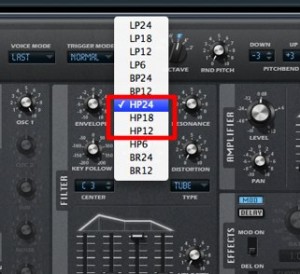
The opposite of the low-pass filter explained above: it "passes the highs" = it "cuts the lows."
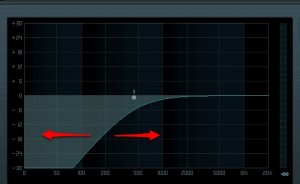
↑ "Cutoff" determines how much of the low end is cut.
Explained with an EQ, it looks like this. ↓
Here is a phrase played while moving the Cutoff. ↓
This is also a sound you hear all the time.
Its characteristic is that the sound becomes thinner.
"Resonance" works the same way. ↓
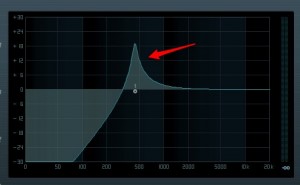
Again, moving the Cutoff creates a sound whose movement is emphasized, like this.
Band-Pass Filter_BPF
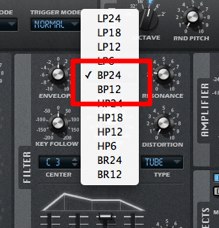
It is a low-pass filter plus a high-pass filter.
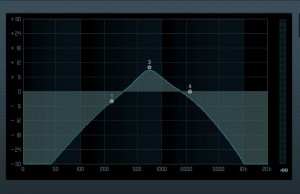
The midrange remains.
↑ "Cutoff" determines how much of the low and high ends are cut.
Explained with an EQ, it looks like this. ↓
Here is a phrase played while moving the Cutoff.
As it looks, it gives a very distinctive sound.
It is often used as an accent sound in songs.
Setting Resonance adds even more character. ↓
Summary
Filters may seem complicated,
but once you understand the principle, they become a powerful ally in sound design.
First, learning the characteristics of these three filters by ear
lets you accurately judge which filter to use when you imagine a sound.
We will also explain the technique of automatically moving the filter's Cutoff, as in the videos above, in a later article.
Frequently asked questions
Q1. What is the difference between a synthesizer's filter and an equalizer?
A filter is a sound-shaping tool that cuts frequency ranges of a waveform to create a tone, and its parameters are often changed in real time to create dynamic changes in sound. An equalizer, on the other hand, is a device or plugin used to adjust the frequency balance of an existing audio signal.
Q2. What are the benefits of using a low-pass filter?
A low-pass filter cuts the high end, making the sound softer and rounder. It is the most frequently used filter on synthesizers, and moving the Cutoff creates complex, expressive changes in sound, making it a basic technique of sound design.
Q3. What changes when I raise the Resonance parameter?
Raising Resonance deliberately emphasizes the filter's cutoff point, making the distinctive synth character more pronounced. The movement of the Cutoff is emphasized, creating dramatic effects and giving your song a unique character.
Q4. When is a band-pass filter used?
Because a band-pass filter leaves only the midrange, it produces a very distinctive sound. It works as an accent sound that stands apart from its surroundings in a song and is effective when you want to emphasize a particular sound.
NEW ARTICLES
Latest English Articles