
In synthesizer sound design, the filter envelope (ADSR) is an important feature for finely adjusting how a tone changes over time. This article explains in detail how fast the cutoff frequency moves during the attack, how decay and sustain control the fall-off, and how release returns the tone after you let go of the key. Understanding the filter ADSR correctly lets you use a low-pass filter to move from open to closed sounds, and create rich tonal changes over the whole life of a sound, from its start to its end, for more advanced sound design.
Controlling the Filter with ADSR
In the previous article, we introduced the settings of the filter itself.
In this article, we use the filter's ADSR to control the filter effect over time.
For more about ADSR, see here.
How to Set It Up
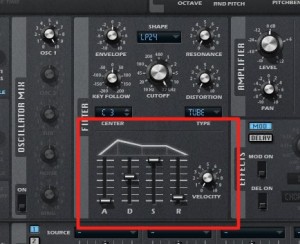
↑ Make the settings in the area outlined in red.
You can think of it as taking the volume ADSR movement we explained earlier
and applying it directly to the filter.
A_Attack
From the position where the cutoff is set,
how fast does it move? That is what attack controls.
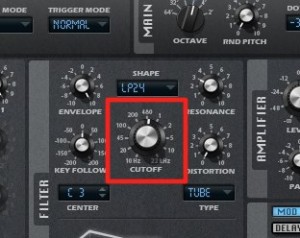
Also pay attention to "Envelope" (the amount) at the upper left.
At 0 in the center, the envelope has no effect.

↑ The further you turn it to the right, the further the cutoff moves to the right.
Because a low-pass filter is currently selected,
the sound opens up.

↑ The further you turn it to the left, the further the cutoff moves to the left.
Because a low-pass filter is currently selected,
the sound closes down.
With a Slow Attack
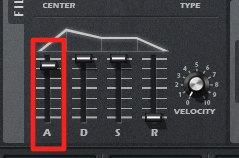
The cutoff moves slowly, giving an effect that opens up gradually.
With a Fast Attack

The filter opens immediately, so the effect appears only at the start of the sound.
D_Decay and S_Sustain

For volume, D and S controlled the fall-off,
and the basic idea is the same here.
Put simply:
S_Sustain:
once the cutoff movement from the attack reaches its maximum,
how far does it return toward its original position?
D_Decay:
how fast it returns toward its original position.
That's what they do.

↑ When S (sustain) is at MAX,
the cutoff does not return from its maximum at all.
So D (decay), the speed of the return, has no effect.
Sound with S at max
↑ The sound fully opened by the attack stays that way.
Sound with S at 0% and D at 2500 ms
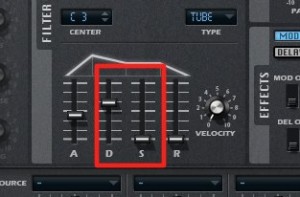
↑ Because S (sustain) is 0,
the cutoff returns to its position at the start of the note.
And with D (decay) at 2500 ms,
it takes 2.5 seconds to return to the original cutoff.
We plan to show detailed sound design using these in future articles.
R_Release
Sets the time it takes to return to the original cutoff value after you release the key.
If the volume is set to disappear immediately after you release the key,
the filter's release has no effect.
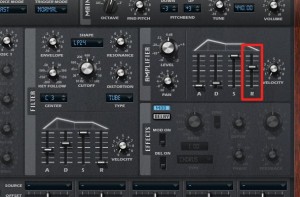
↑ So these examples use a longer volume release.
Sound with R (release) at 0
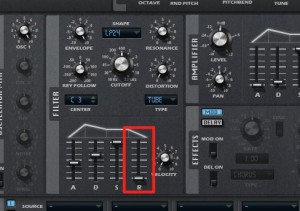
The cutoff returns to its initial value the moment you release the key,
so the sound changes abruptly.
Sound with R (release) at 5000 ms

The release is 5000 ms.
After you release the key, the cutoff takes 5 seconds to return to its initial value.
You can hear a slow change in tone.
As you can see, the filter ADSR alone allows a lot of sound design.
Next time, we will show sound design using these.
First, make sure you fully understand what ADSR means and how it changes the sound.
Frequently asked questions
Q1. What is the difference between the filter envelope and the volume ADSR?
The volume ADSR controls how the volume changes over time, while the filter envelope controls how the cutoff frequency changes over time. The ADSR concept is the same, but the target differs, so combining the two lets you shape tone and volume independently.
Q2. What happens if I set the envelope amount to 0?
When the envelope amount is at 0 in the center, the filter envelope has no effect at all. In other words, even with attack, decay, sustain, and release settings, the cutoff value does not change.
Q3. If I set a long filter release, do I also need a long volume release?
It is not required, but if the volume release is short, the sound disappears even with a long filter release, so the effect is hard to hear. To make the most of the filter release, it is effective to set the volume release long enough too.
NEW ARTICLES
Latest English Articles











