A DAW (digital audio workstation), the software you install on your computer to compose and edit music, is essential to DTM music production. In the 2025 popularity ranking, Cubase took first place with an overwhelming 36.9% share, followed by Studio One and Logic Pro. No DAW limits you to a particular genre. When choosing one, look at criteria such as how much information is available thanks to a large user base, which artists use it, and how it handles. For beginners, the key to success is to master a single program. Each DAW has its own character, so choose one that fits your musical style and goals.
DAW Software for Composing Music
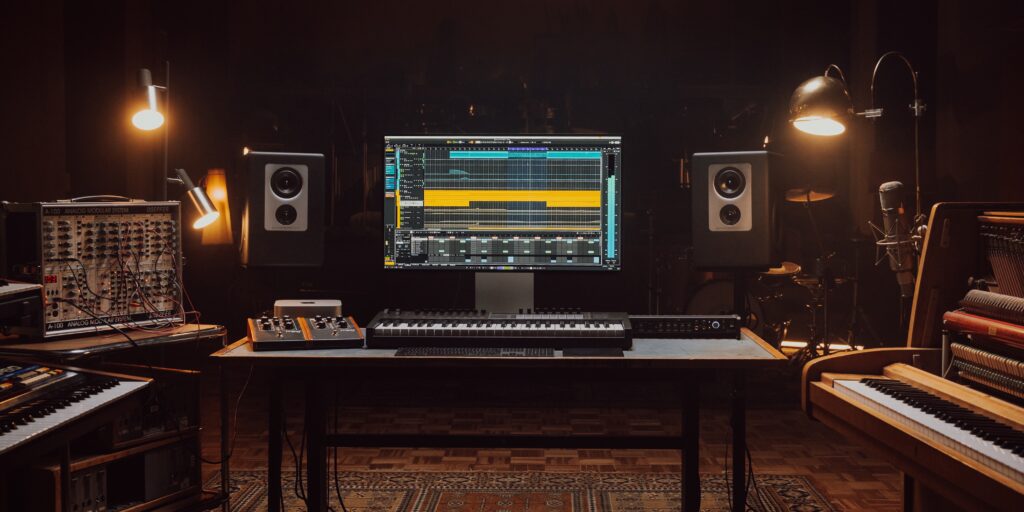
An essential part of DTM is the software you compose with, called a "DAW".
DAW is an acronym of "Digital Audio Workstation" and is pronounced "dow" or "D-A-W."
The two terms DTM and DAW look and sound similar, but
- DTM (desktop music)
Making music with a computer - DAW (digital audio workstation)
Composing software you install on your computer to do DTM
That is the difference.
Many manufacturers sell a wide variety of DAW products.
2025 DAW Popularity Ranking Video
How Should You Choose a DAW?
In our lessons, we are often asked which DAW we recommend.
With this many DAWs available, it is easy to get lost deciding which one to buy.

The first thing to understand is that no DAW will prevent you from producing a particular genre of music.
Choose with a positive mindset, thinking about how each product's characteristics can make your work more convenient.
Choosing the DAW your favorite artist uses is also a perfectly good reason.
Many advanced DTM users switch between several DAWs, but if you are just starting out with DTM, it is important to really master one DAW.
Otherwise, it becomes hard to grasp each program's characteristics, and difficult to judge which DAW suits you.
Popular DAW Software
Each program has its own functions and features that allow more advanced editing and music production.
We hope this helps you find a DAW that suits your genre and musical style.
1st: Cubase | 1,190 users, share: 36.9%
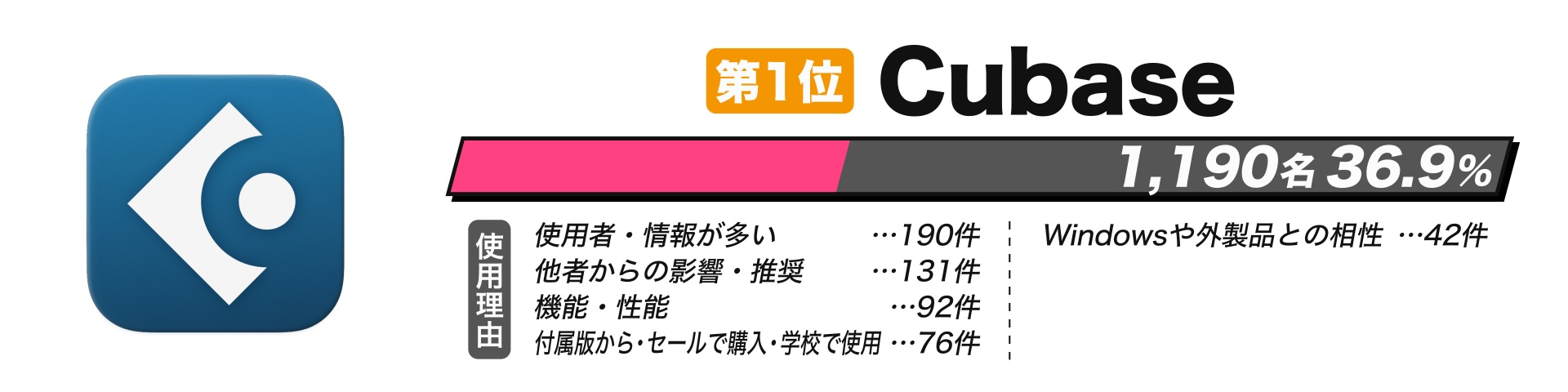
*Respondents could give multiple reasons for use
Cubase proved strong as expected.
It reigns again this year as Japan's No.1 DAW, with as many users as the 2nd and 3rd places combined.
The biggest reason for choosing it was the large number of users and the wealth of information that comes with it.
When you are choosing a DAW without knowing what you need, being able to solve problems easily when you get stuck is certainly an important factor.
Other notable reasons were "my favorite artist uses it" and "I kept using it after starting with the bundled version that came with my gear."
As the reasons for use also show, it is feature-rich, and updates consistently add new functions.
It is truly a DAW that no one will regret buying.
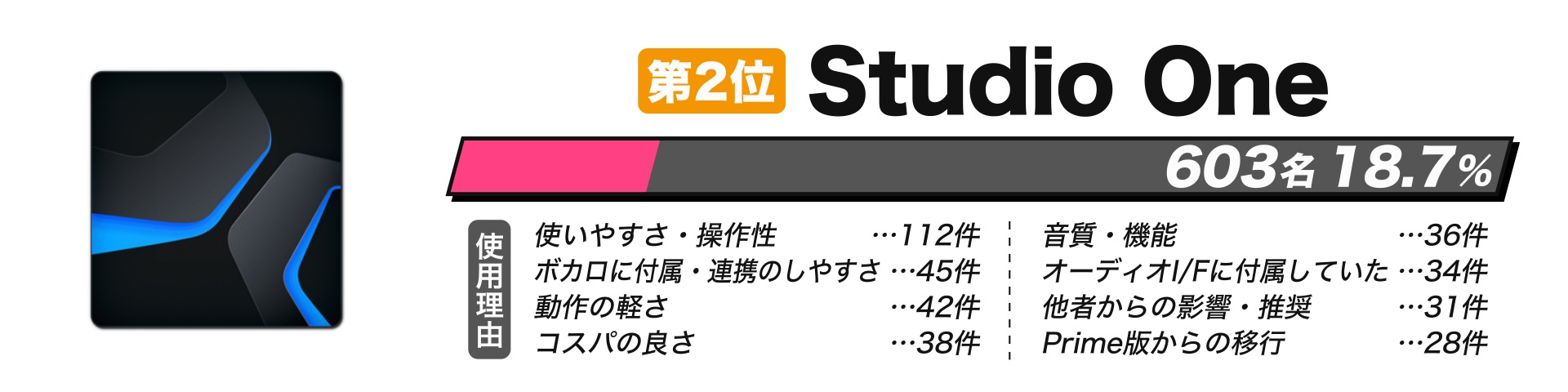
2nd: Studio One | 603 users, share: 18.7%
*Respondents could give multiple reasons for use
Studio One ranked 2nd, narrowly ahead of Logic in 3rd.
Many respondents noted that it is focused on the functions you really need, with refined handling and a relatively light load.
Being easy for DTM beginners to use is a big plus.
Last year's major update drew attention with its "Splice integration," but at the same time the free version was discontinued and the software moved to a subscription model, so it will be interesting to see how its user base changes going forward.
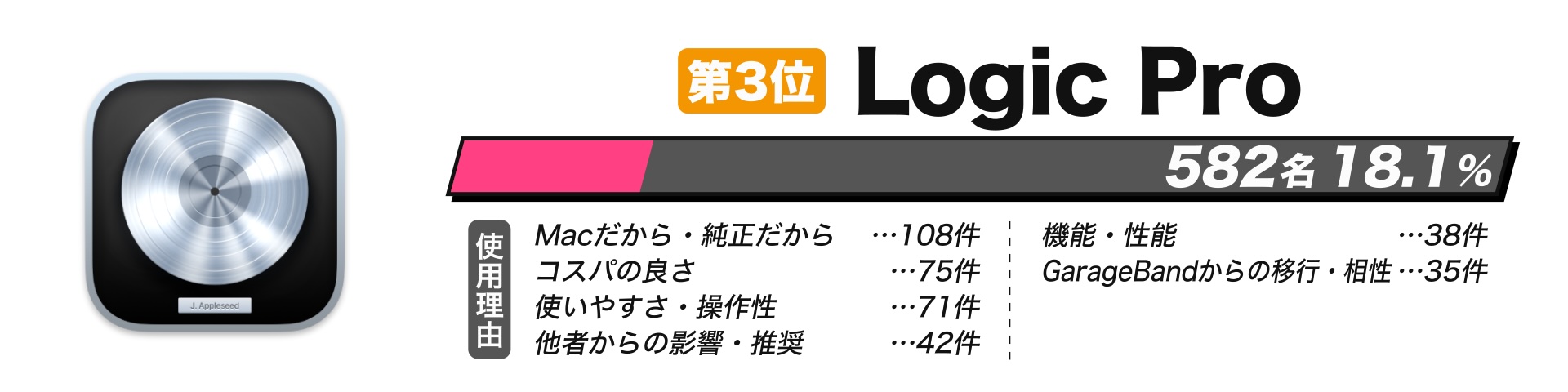
3rd: Logic Pro | 582 users, share: 18.1%
*Respondents could give multiple reasons for use
Compatibility with Macs and other Apple products was the main reason for choosing it.
Being able to use it with confidence and without trouble even on the latest Mac is a convincing reason.
The fact that it ranks 3rd despite not supporting Windows also shows the strength of the Apple brand.
It is also affordably priced, so its excellent value for money should not be overlooked.
Last year's major update brought AI into phrase generation for instrument performances, and its accuracy was stunning.
It is easy for beginners to understand, but it is actually also an expert's DAW packed with hidden tricks.
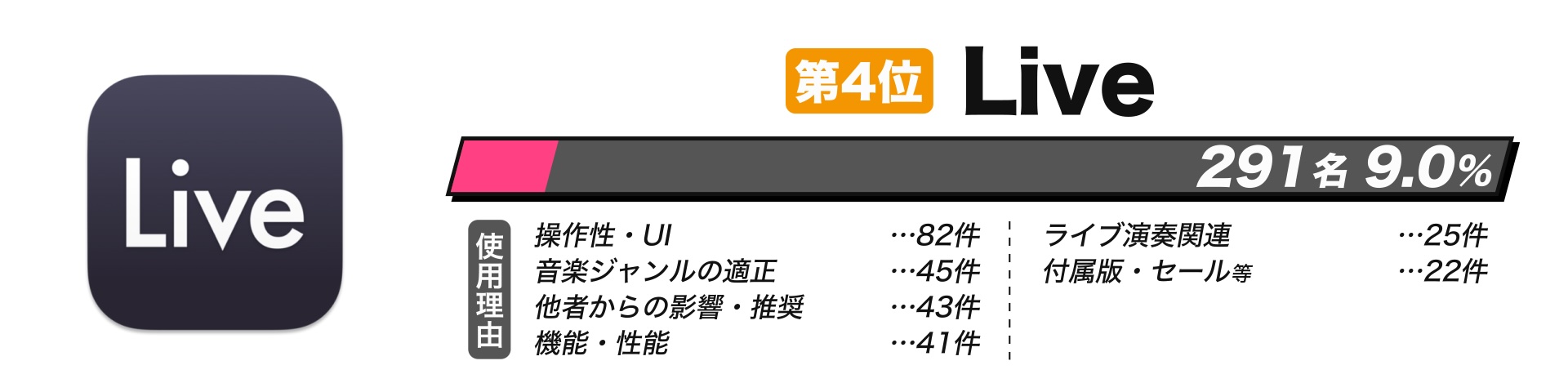
4th: Ableton Live | 291 users, share: 9.0%
*Respondents could give multiple reasons for use
Its handling and design are highly rated, and many respondents also said their favorite artists use it.
Its strong affinity with electronic music and its focus on live performance were cited as reasons for choosing it.
Its handling is also very refined, and calling up the functions you want is intuitive, which is excellent.
Last year's update drew attention with a feature that searches for presets similar to a selected sound, as well as advanced MIDI editing.
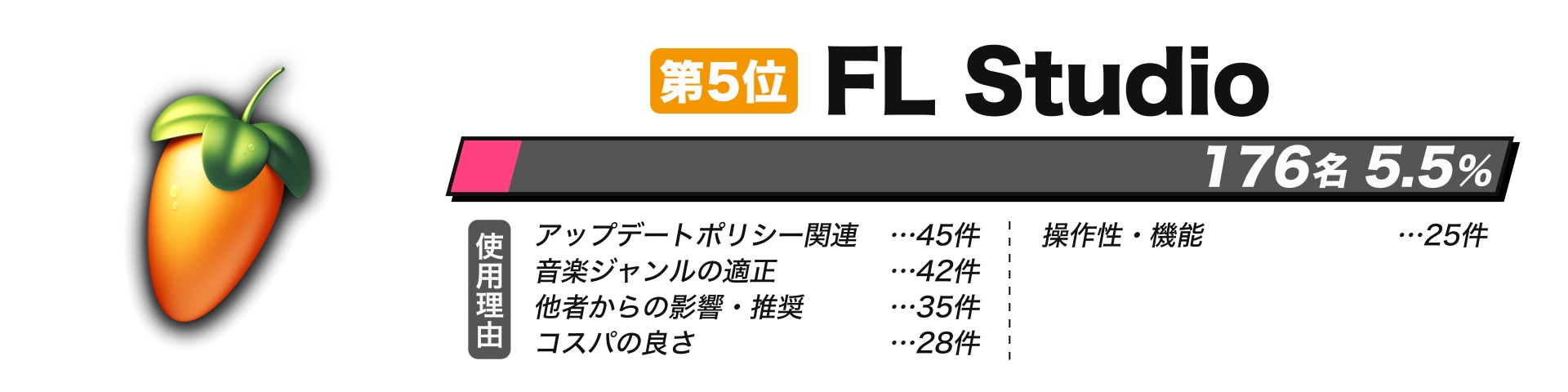
5th: FL Studio | 176 users, share: 5.5%
*Respondents could give multiple reasons for use
The policy of free lifetime updates was the biggest reason for choosing it, and its affinity with EDM and hip-hop was also valued.
Beyond value for money, advanced features that beatmakers need are actively added, positioning it as a DAW that strongly appeals to specific users.
Last year's update finally added Japanese language support. It has the potential to climb the rankings in the future.
About Pro Tools
Pro Tools, in 6th place, is the industry-standard DAW and a must-learn program if you want to become a mixing engineer.

As you can see, it boasts an overwhelming share of professional users.
Let's look at the reasons for choosing it in more detail.

*Respondents could give multiple reasons for use
As shown, use in professional settings and studios is the main reason for choosing it.
Many also said they "rely on its audio editing and recording features," so if you want to work as a studio engineer, it is a DAW you absolutely must know.
What did you think?
Check the popularity ranking and the characteristics of each DAW, and find the one that suits you!
Sleepfreaks-Supervised DTM PC Models Released!
In collaboration with Thirdwave Corporation, we have released Sleepfreaks-supervised models designed specifically for DTM.Configured around the specs recommended for DTM, the lineup includes an entry model for those just starting DTM and a high-end model that maximizes comfort and speed.
Frequently Asked Questions
Q1. What is the difference between DTM and DAW?
DTM (desktop music) refers to music production with a computer as a whole, while a DAW (digital audio workstation) is the composing software that makes it possible. DTM is the broader concept that includes the DAW.
Q2. Which DAW should a beginner choose?
At first, it is important to master one DAW. We recommend Cubase for its wealth of information, Studio One for its refined handling, or Logic Pro if you use a Mac. Choosing the DAW your favorite artist uses is also a valid option.
Q3. Are there any genres a DAW cannot produce?
No, every DAW can produce every genre. Each program has different characteristics, with some suited to electronic music and others excelling at audio editing, but there are no restrictions.
Q4. Can I use multiple DAWs at the same time?
You can, but beginners should avoid it. You will not be able to understand each program's characteristics, and choosing the right DAW becomes difficult. Advanced users sometimes switch between several.
Q5. Who is Pro Tools suited for?
Pro Tools is the industry-standard DAW, used mainly by professional mixing engineers and in studios. It is essential for anyone aiming to become a studio engineer.
NEW ARTICLES
Latest English Articles