In Future Bass production, the chord progressions of backing tracks are characterized by complex harmonies that include tension notes. By combining hybrid chords that omit the 3rd with add-type tension chords, you can create a unique floating feel and sense of coolness. This article introduces three concrete chord patterns using Razor and explains in detail the genre-specific chord-building techniques, such as ambiguous voicings like Ⅰmaj/Ⅳ and avoiding tension with Ⅴ6. Mastering this knowledge lets you produce a professional Future Bass sound.
Creating a chord backing sound with Razor
In the articles up to last time, we introduced programming and sound design for the drum and bass tracks.
This time it's about chord progressions for creating the backing track.
About chords in Future Bass
Before programming a Future Bass backing track, let's check the characteristics of its chord progressions.
One tendency of the chord progressions is chords with relatively complex harmonies that include tension notes.
Those using hybrid chords
- Ⅰmaj/Ⅳ Ⅳmaj/Ⅴ Ⅲm7/Ⅵ Ⅴm7/Ⅰ
Hybrid chords have no 3rd relative to the root.
As a result, their character, bright or dark, becomes ambiguous, giving a unique floating feel.
Not every chord has to use complex harmonies; triad major and minor chords are also used for a poppy, easy-to-understand sound, and you'll also find songs that use both hybrid chords and tension chords.
Let's look at a few examples.
Chord pattern 1
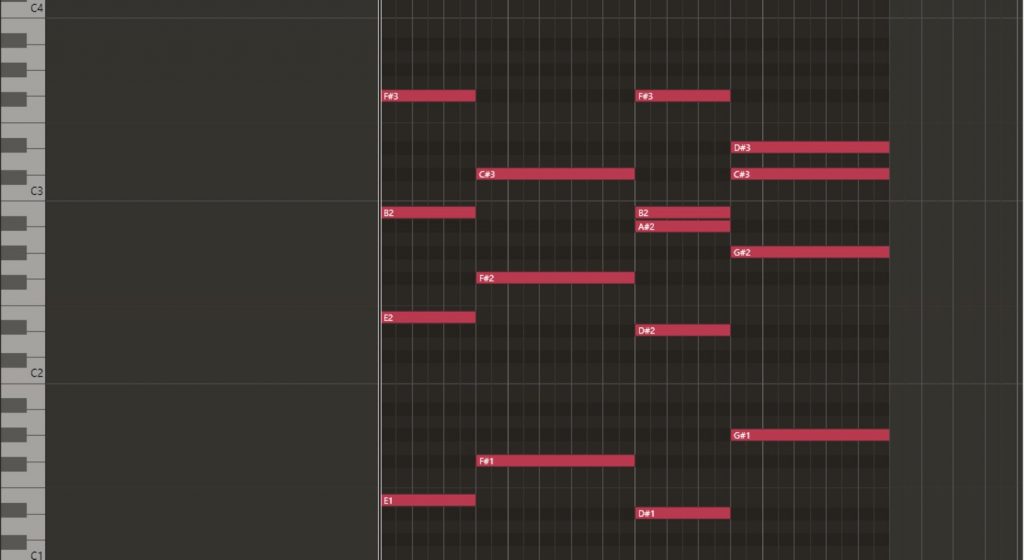
Ⅰmaj/Ⅳ Ⅴomit3 Ⅲmadd13 Ⅵsus4
- Ⅰmaj/Ⅳ
The chord stacks a Ⅰ power chord on top of the root Ⅳ.
It's an ambiguous sound that can be interpreted as an abbreviated Ⅰmaj/Ⅳ or an abbreviated Ⅳadd9.
- Ⅴomit3
It's a power chord with the 3rd omitted.
- Ⅲmadd13
The 13th is an avoid note, so in terms of music theory it's a chord that isn't recommended.
By using chords without the 3rd throughout the song, it creates a unique sense of coolness.
Pattern 2
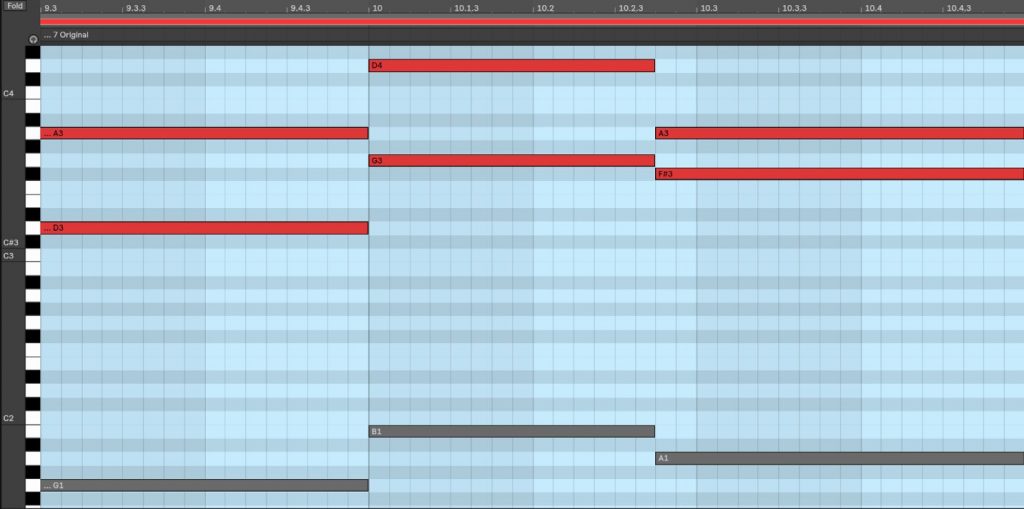
Ⅰomit3/Ⅳ Ⅳ/Ⅵ Ⅴ
- Ⅰomit3/Ⅳ
Like the song above, this can be seen as an abbreviated Ⅰmaj/Ⅳ or an abbreviated Ⅳadd9.
- Ⅳmaj/Ⅵ
It's not the tonic Ⅵm but an inversion of the subdominant Ⅳ.
- Ⅴ
With only two notes it isn't technically a chord, but if you had to interpret it, it's best seen as an abbreviated Ⅴ6.
Pattern 3
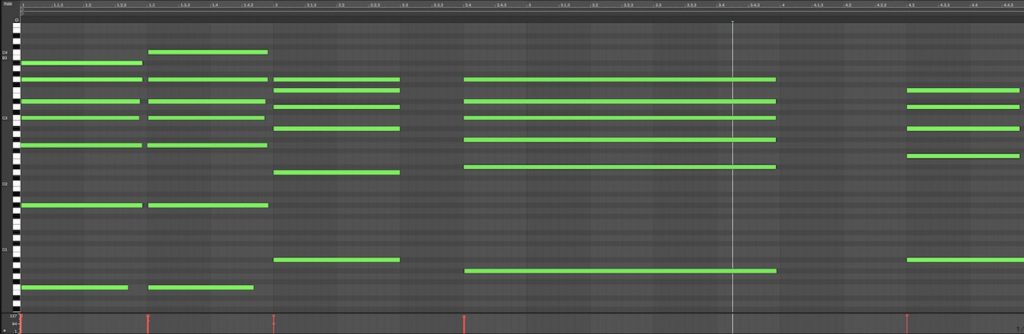
Ⅱm7(9 11) Ⅴ6 Ⅳmaj7 Ⅴmaj
A feature is that the first three chords use G as a pedal tone.
- Ⅱm7(9 11)
- Ⅴ6
In Future Bass, many songs use Ⅴ6 instead of Ⅴ7 to avoid the tension of the dominant 7th.
- Ⅳmaj7
- Ⅴmaj
Be sure to keep points like these in mind when building your chords.
In the next article, we'll create the backing sound for playing these chords.
About the author

Takumi Kadode
A track maker, VJ and audiovisual artist from Osaka.
Got into music after making noise/tape collage pieces with cassette tapes and MiniDiscs in high school.
While later majoring in architectural acoustics in graduate school, began making dance music influenced by acid house, ambient, breakcore and more.
Live performances center on "audiovisual" expression, with the linking and fusion of sound and visuals as a motif.
Uses self-programmed software in REAKTOR, Pure Data, TouchDesigner and more.
Administrator of the REAKTOR fan site "Native Instruments REAKTOR Users Japan" (www.niru.jp).
Website: http://stereotypeone.com/
Frequently asked questions
Q1. What's the most important characteristic of Future Bass chord progressions?
The biggest characteristic is the use of complex harmonies with tension notes and hybrid chords that omit the 3rd. This creates a unique floating feel where brightness and darkness are ambiguous, achieving the signature Future Bass sound.
Q2. How should I interpret the chord Ⅰmaj/Ⅳ?
It's a hybrid chord with the root on Ⅳ and a Ⅰ power chord stacked on top. It can be seen as an abbreviated Ⅰmaj/Ⅳ or an abbreviated Ⅳadd9, and is characterized by an ambiguous, floating sound.
Q3. Why use Ⅴ6 instead of Ⅴ7 in Future Bass?
To avoid the strong tension of the dominant 7th chord. Using Ⅴ6 achieves a softer, more refined sound that suits the elegant atmosphere of Future Bass.
NEW ARTICLES
Latest English Articles