Overview of the sus2 Chord
This time, let's learn a relatively new chord, "sus2."
It apparently wasn't seen in the past, but in recent years it is commonly listed on websites and in books.
You see it in DAWs too.

Knowledge of sus4, 7sus4 and omit is essential to understand this lesson, so if you haven't read about them, please refer to the following.

The Sound of sus2
First, let's check the sound of sus2.
The chord tones are played one by one, followed by the chord.
- Csus2
To tell you up front, sus2, like sus4, is characterized by having no 3rd (m3rd or M3rd).
It can't be classified as bright or dark, and it sounds cool.
Let's compare it by alternating with other triads.
- C → Csus2 → Cm → Csus2
Notation of sus2
There are hardly any variations in how sus2 is written, but a slightly unusual notation does exist.
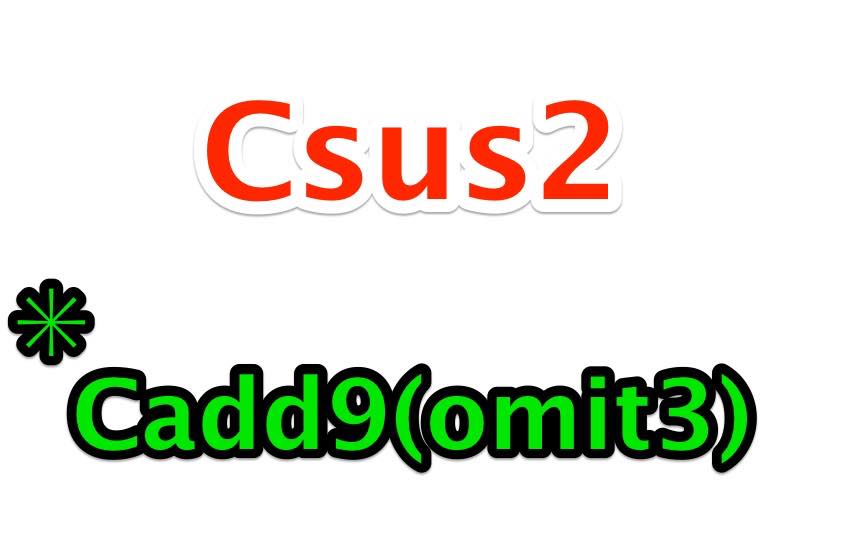
It is generally written as follows.
- C sus two = Csus2
- E sus two = Esus2
*We will explain Cadd9(omit3) later.
How sus2 Is Formed
Another number, "2," has appeared.
Using the C major scale diagram from the add9 lesson, let's focus on the "2" in sus2.
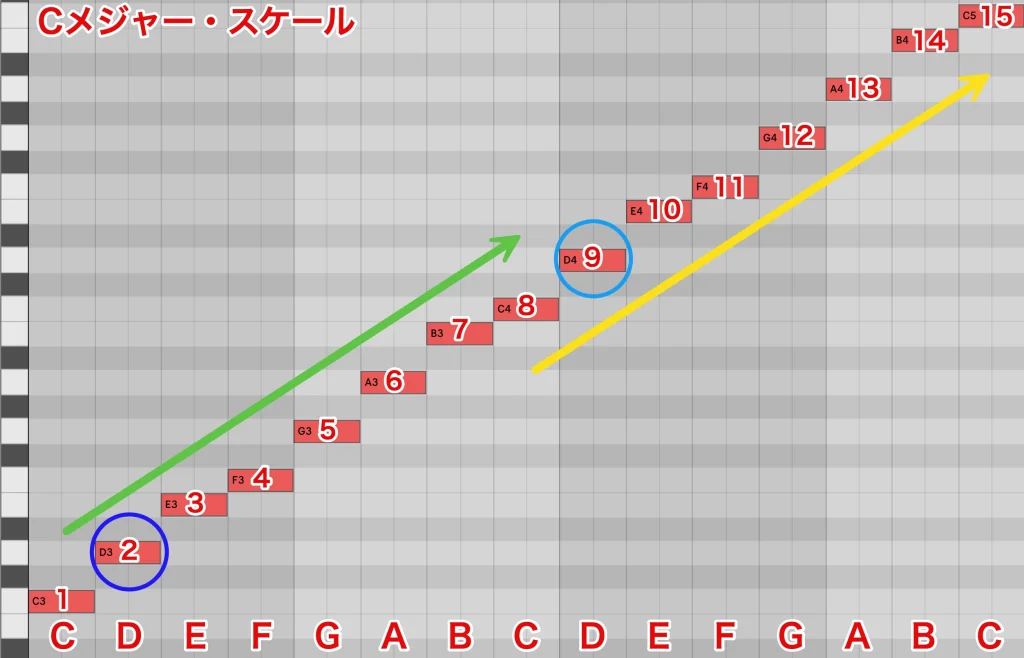
In the C major scale, the 2nd note is "D."
Some of you may have already noticed, but the sus2 chord contains this "2" note.
Let's check it on the score and the piano roll.

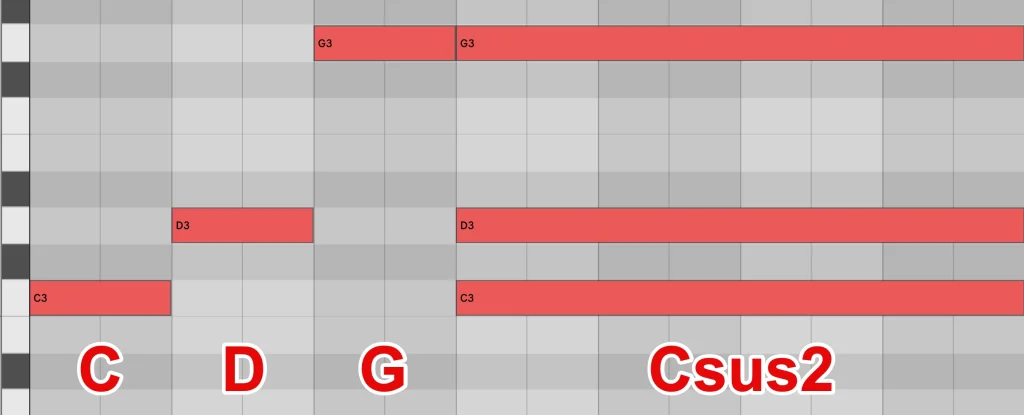
Let's check its structure together with other triads.
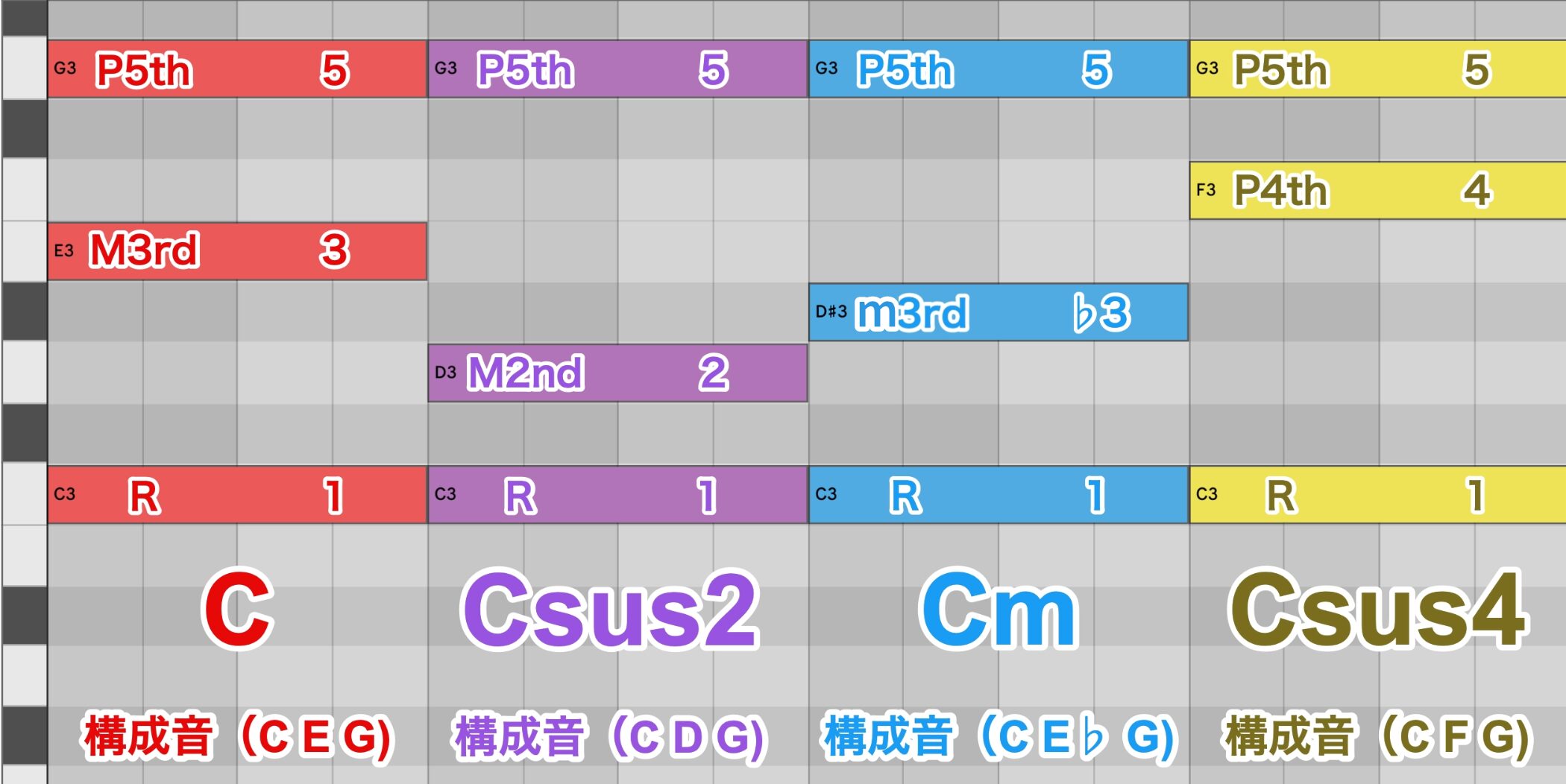
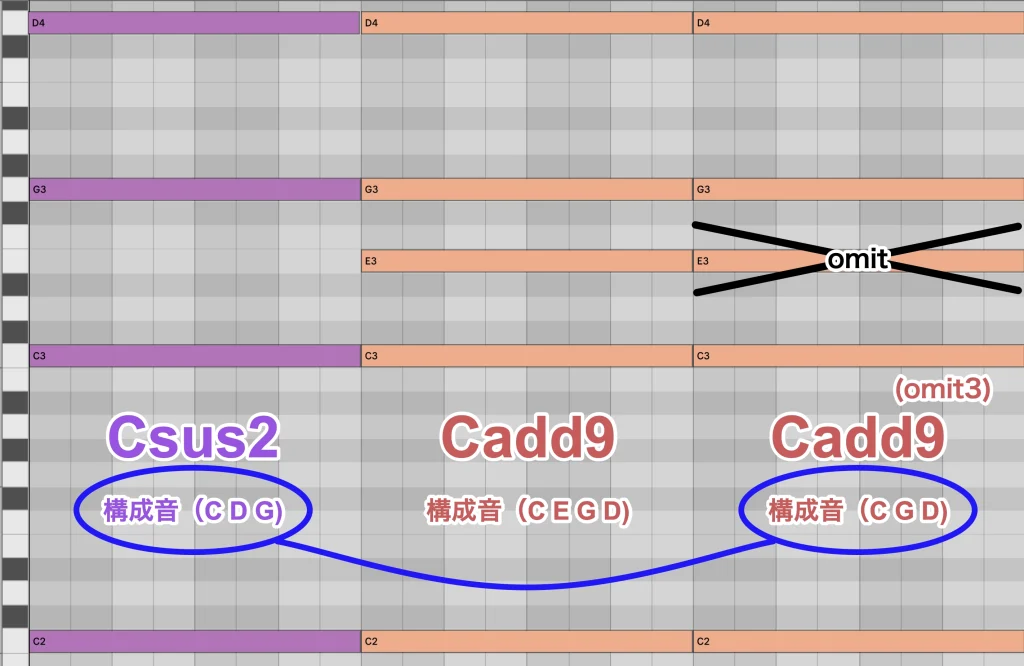
Csus2 can also be seen as Cadd9 with the M3rd omitted.
However, sus2 is shorter to write, which is probably why it came into use.
Using sus2
Let's look at typical ways sus2 is used.
- Fsus2 → F → Csus4 → C
You can feel it settle from an ambiguous feel into major.
- Csus4 → C → Csus2 → C
Techniques like this, creating movement by alternating sus2 and sus4 on the same root, are also common.
Next, let's listen to an example of changing major and minor chords to sus2.
- Before Am → G → F
- After Asus2 → Gsus2 → Fsus2
It now has a cool impression that is neither bright nor dark.
As you can see, there seem to be many ways to use it.
When you find a song that uses it, analyze it including the chords before and after.
Thinking About sus2 Chords on Guitar

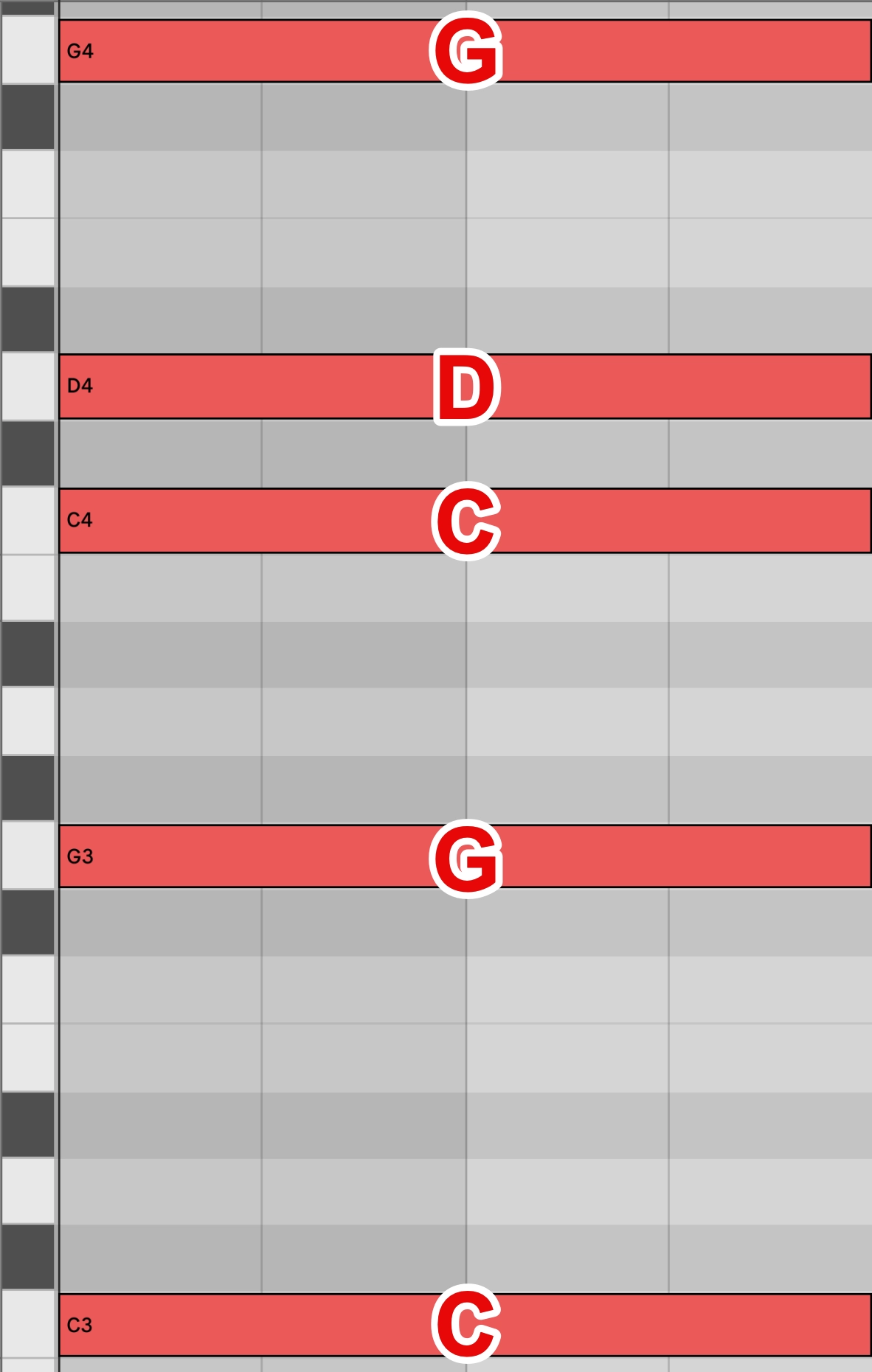
The above is a well-known guitar fingering (voicing) for Cadd9, but people sometimes say, "Isn't this actually Csus2, and isn't the fingering that includes the M3rd the real Cadd9?"
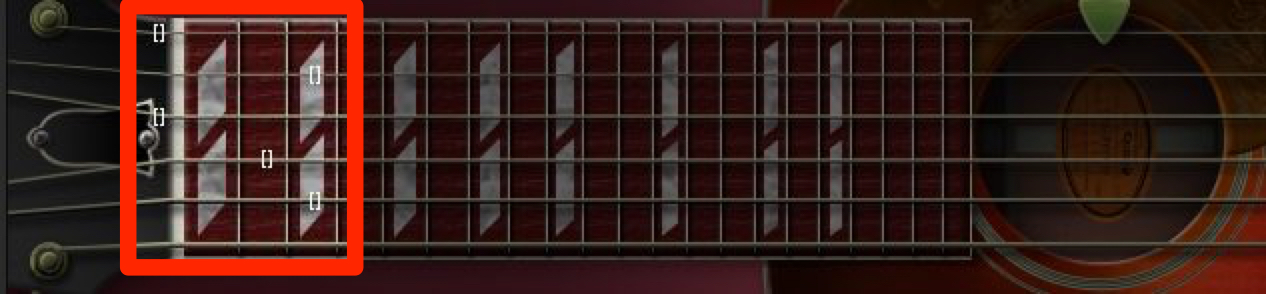
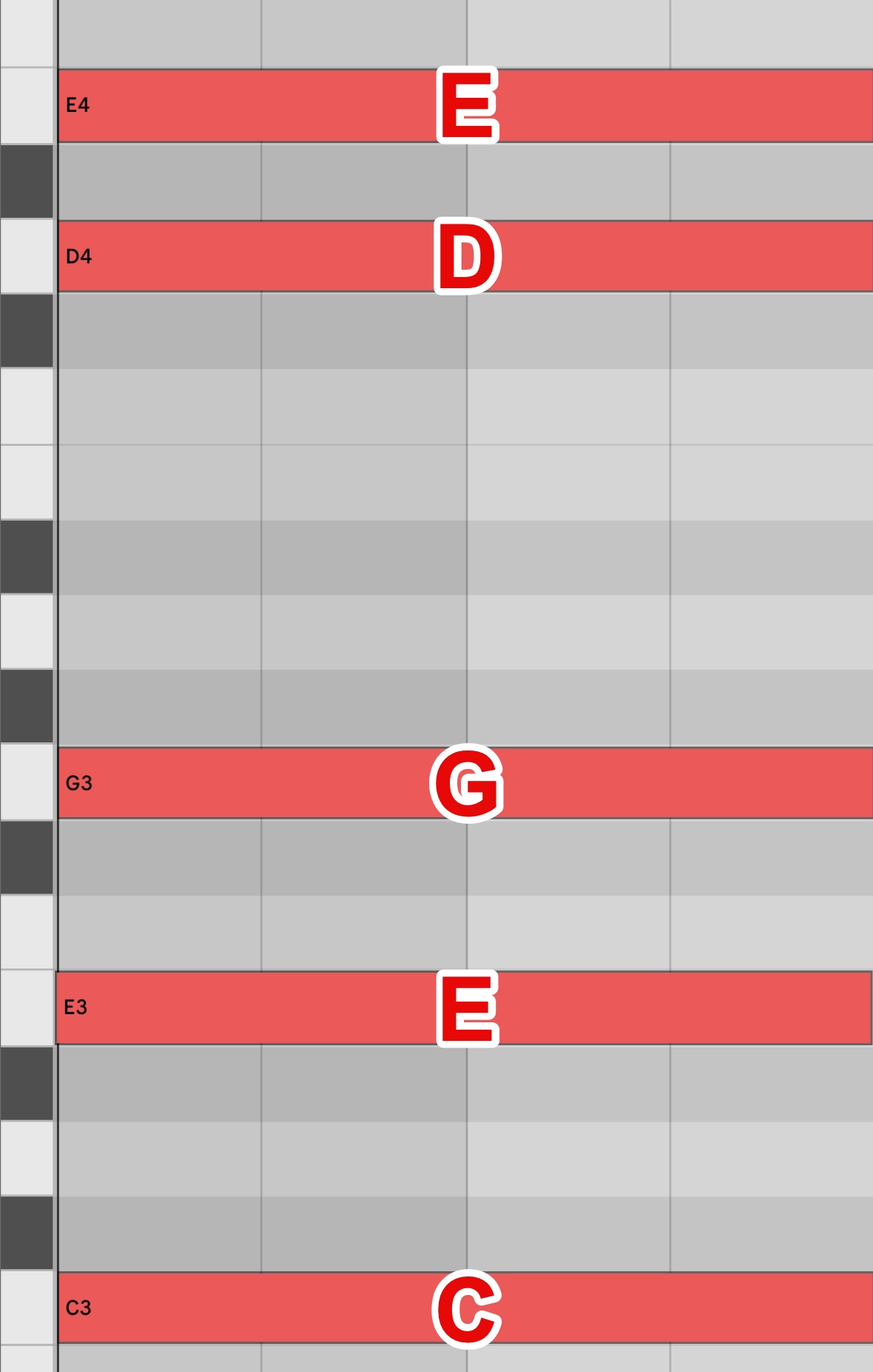
The difference is whether the M3rd is present.
If another instrument plays the M3rd so that add9 is complete, or if it isn't a problem in the arrangement, either is fine, but if you want to emphasize or, conversely, hold back brightness on guitar alone, it's better to choose consciously between them.
About the Dominant Seventh sus2
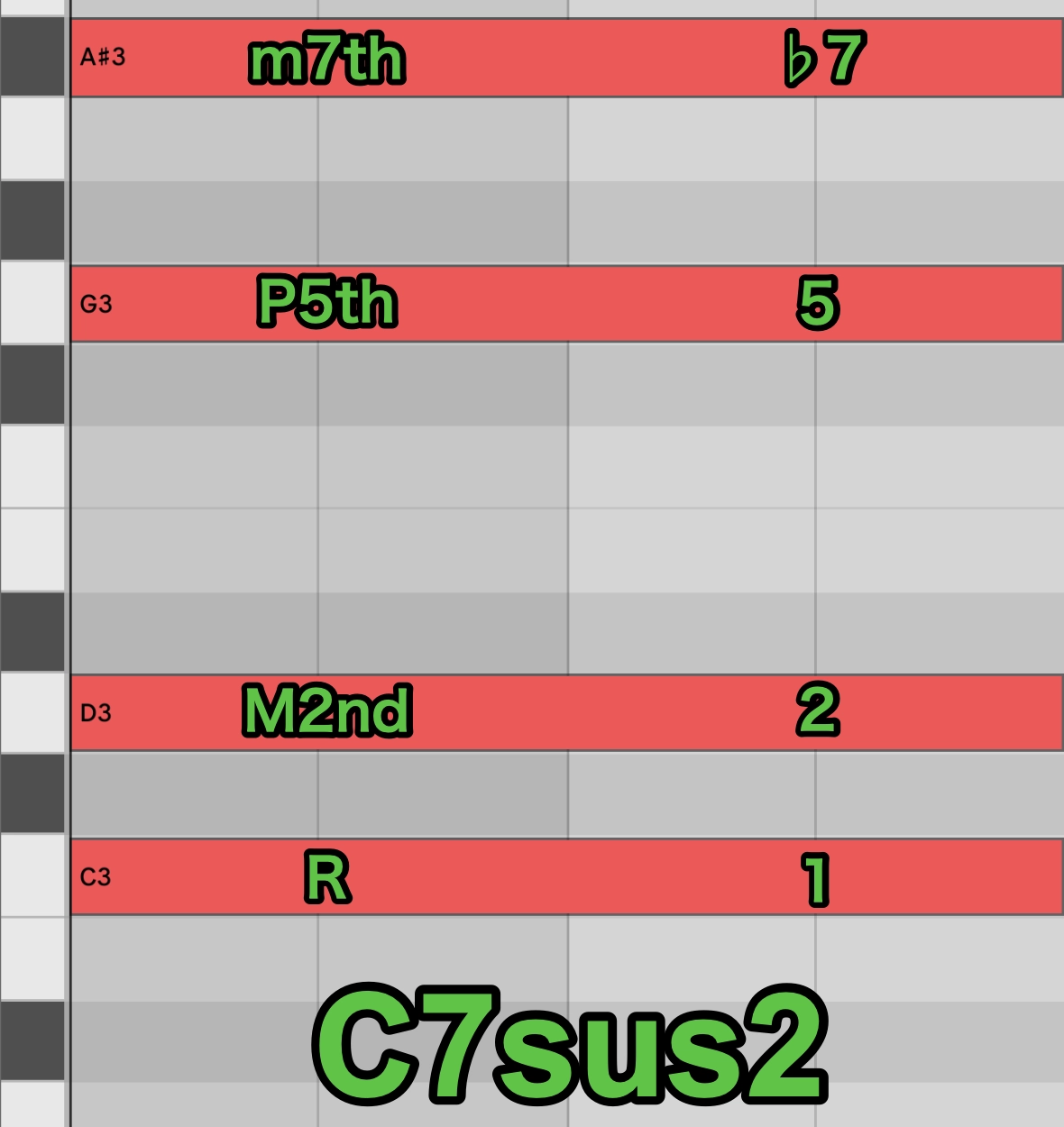
The "dominant seventh sus2 (7sus2)" can be interpreted as another chord, so you rarely see it.
However, it seems the 7sus2 notation is sometimes used to clarify the relationship with the chords before and after.
If you do come across it, it is structured as follows.
Next time, we will learn the add11 chord.
Frequently Asked Questions
Q1. What is the difference between sus2 and sus4?
sus2 is a chord in which the 3rd is replaced with the 2nd, and sus4 is a chord in which the 3rd is replaced with the 4th. Both lack a 3rd and so sound cool, but because the pitches differ, they give subtly different impressions.
Q2. What are the notes of Csus2?
Csus2 consists of the root C, the 2nd D and the 5th G. Unlike a regular C major chord (C, E, G), the 3rd, E, is replaced by D.
Q3. Do I need to distinguish between add9 and sus2 on guitar?
The distinction matters if you want to emphasize the tone on guitar alone. However, if another instrument plays the M3rd, add9 is complete, so either notation is fine if it works in the overall arrangement.
Q4. In what kinds of songs is the sus2 chord used?
sus2 makes use of its ambiguity and cool feel, and is used in a wide range of genres, such as for building tension before resolving to a major chord, and in pop, rock and film music.
Q5. Is 7sus2 (dominant seventh sus2) used often?
7sus2 can be interpreted as other chords, so you rarely see it, but it is sometimes written when you want to clarify the relationship with the chords before and after.
NEW ARTICLES
Latest English Articles