Unstable yet gorgeous: the "minor seventh flat five"

Continuing from the dominant seventh chord in the previous lesson, this time we will learn about the minor seventh flat five.
This chord is also called "half-diminished," "half diminished," "half-diminished seventh," or "half diminished seventh."
*However, please note that it is a different chord from the "diminished seventh".
With such a long name, the minor seventh flat five may seem a little difficult.
However, this chord is exactly what its name says, and it is actually simple.
First, let's listen to the sound of C minor seventh flat five.
The notes of the chord are played one by one, followed by the chord itself.
It sounded mysterious along the way, but when you hear the notes together at the end, it has an unstable yet gorgeous sound.
How the minor seventh flat five is written
The minor seventh flat five is often written as follows.
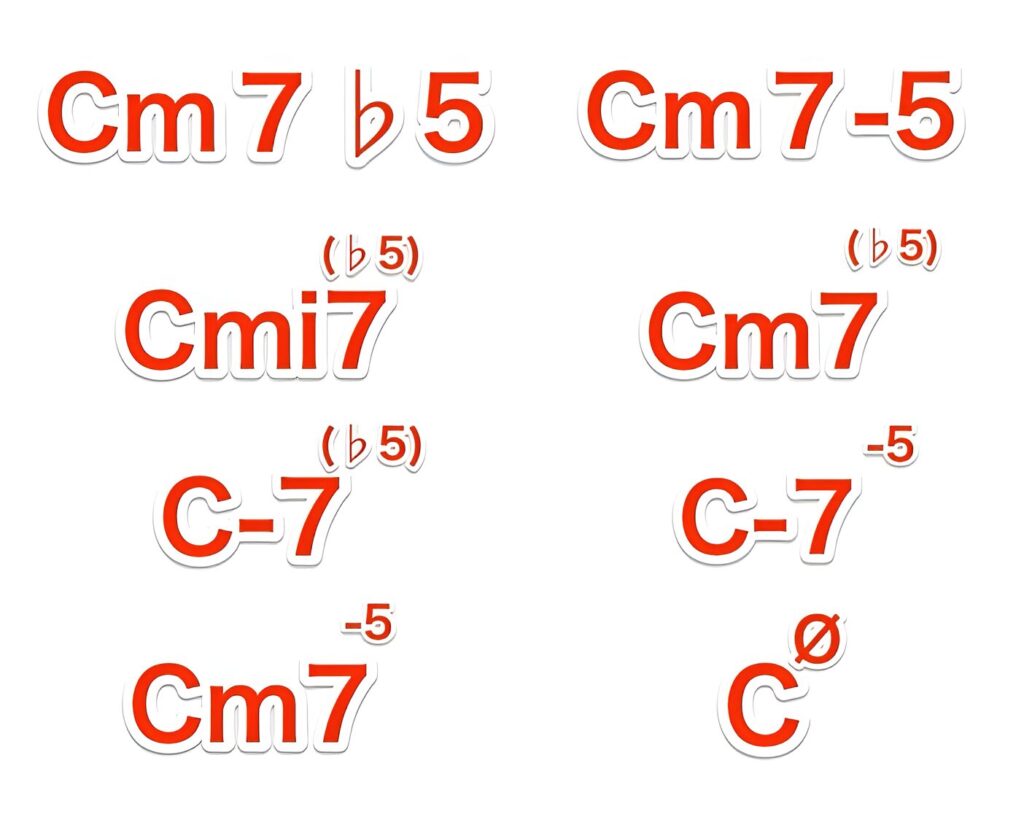
Among these, the most common are
- C minor seventh flat five = Cm7-5
- D minor seventh flat five = Dm7-5
and similar notations.
You will also see notations such as "Cm7♭5" and "Dm7♭5."
The basic form of the minor seventh flat five
Let's look at Cm7-5 in both notation and the piano roll.

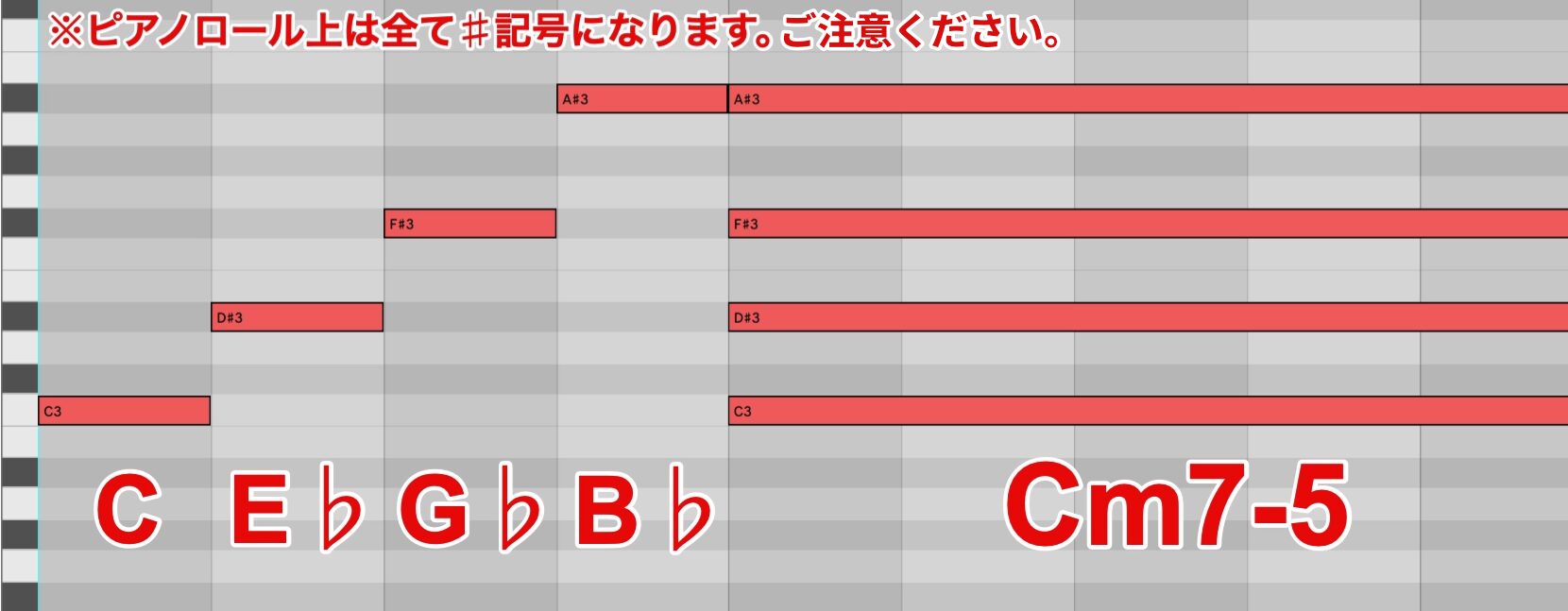
Do you notice anything here?
That's right. Up to a point, it is the same as the diminished (triad).
And it is similar to the minor seventh chord.
Let's take another look at the chord name.
- "Minor seventh" "flat" "five"
The "5" (five) of the minor seventh is "♭" (flattened), as you can read from the chord name.
If you compare Cm7 and Cm7-5, it is obvious at a glance that there is only one difference from the minor seventh chord.

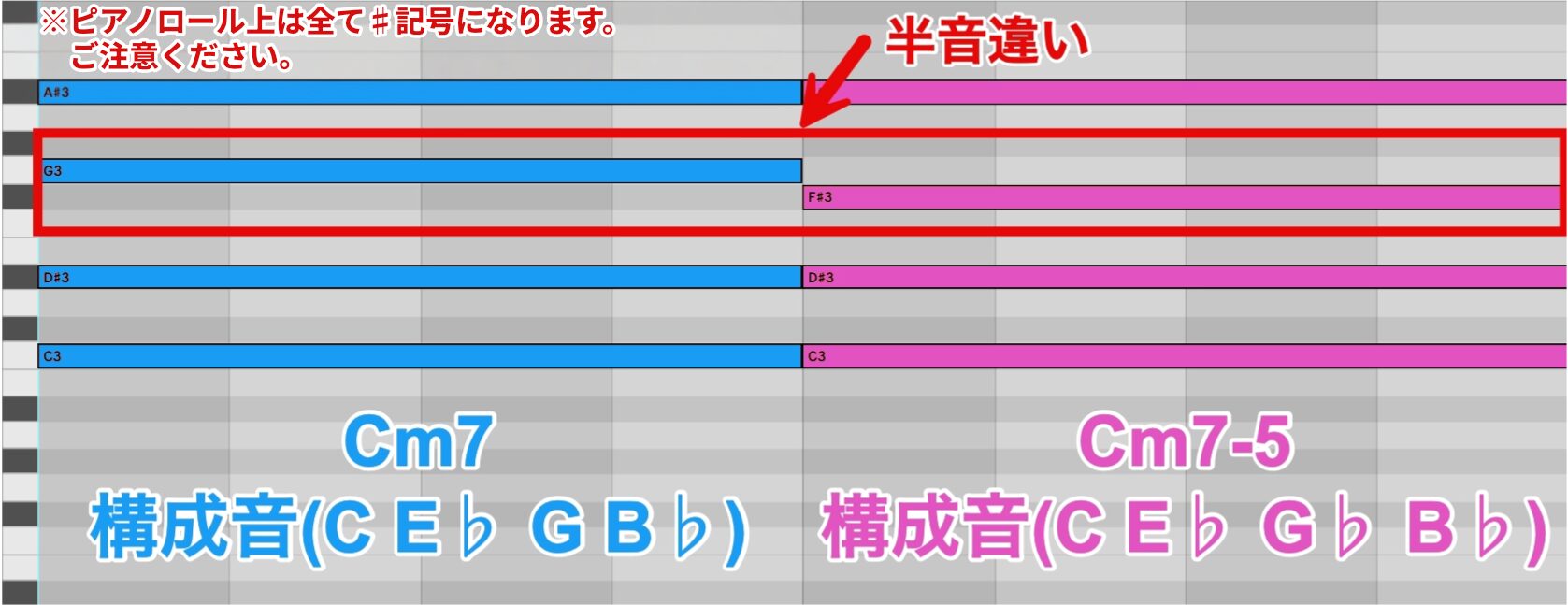
As you can see, by lowering the P5th of the minor seventh chord's basic form by a half step to make it a dim5th, you can change it into the basic form of the minor seventh flat five.
As an easy way to remember it, think of it like this.
- Add an m7th to the diminished (triad)
- Or, as the chord name says, lower the "P5th" of the minor seventh by a half step (make it a "dim5th")
The intervals of the minor seventh flat five are
- If you memorize it by intervals: R m3rd dim5th m7th
- If you memorize it by scale degrees: 1 ♭3 ♭5 ♭7
.
Summary of triads and four-note chords
Now let's review all of the triads and four-note chords that have appeared so far.


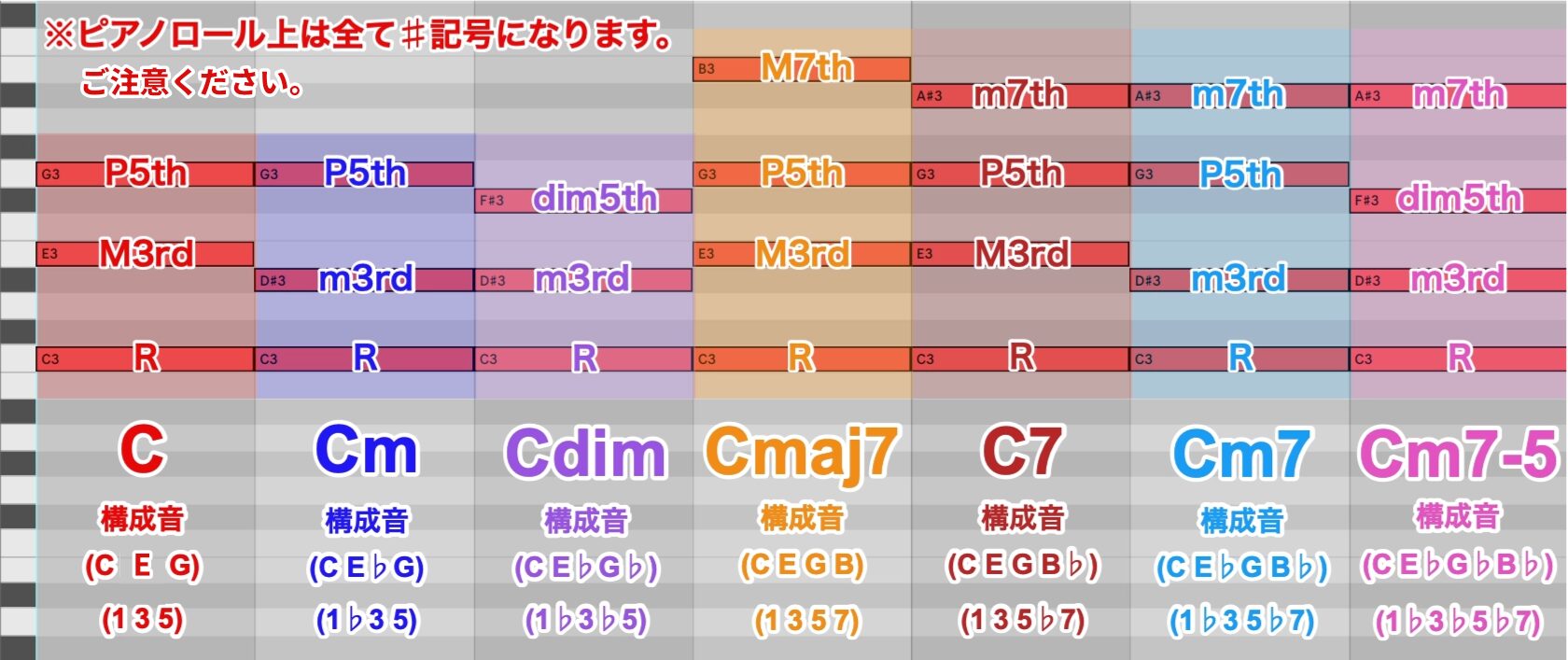
Once again, note that the diminished (triad) contains a tritone.

There are many other chords, but this lesson wraps up how to build chords for now.
From the next lesson onward, we will focus on how to choose the chords used in accompaniment and so on.
In the lessons so far, you should have understood the relationship between a song's key and the scale it uses. Chords relate to that as well, so all of your knowledge will come into play.
Be sure to review everything up to this point as you continue.
Frequently asked questions
Q1. What is the difference between the minor seventh flat five and the diminished seventh?
The minor seventh flat five (Cm7-5) consists of the root, minor third, diminished fifth, and minor seventh. The diminished seventh (Cdim7), on the other hand, has a diminished seventh instead of a minor seventh, so it sounds quite different. Both have an unstable sound, but they are treated as different chords.
Q2. Should I write Cm7-5 or Cm7♭5?
Both indicate the same chord, and notations such as Cm7-5 and Dm7-5 are generally more common. You will also see notations with a flat sign such as Cm7♭5, but this is only a difference in notation, and the sound is identical.
Q3. Is there an easy way to remember the minor seventh flat five?
The easiest way is to "lower the perfect fifth (P5th) of the minor seventh chord by a half step." Remembering it as "adding a minor seventh to a diminished triad" is also effective.
NEW ARTICLES
Latest English Articles