Interview with ZRO, CEO of JENERGY Inc.
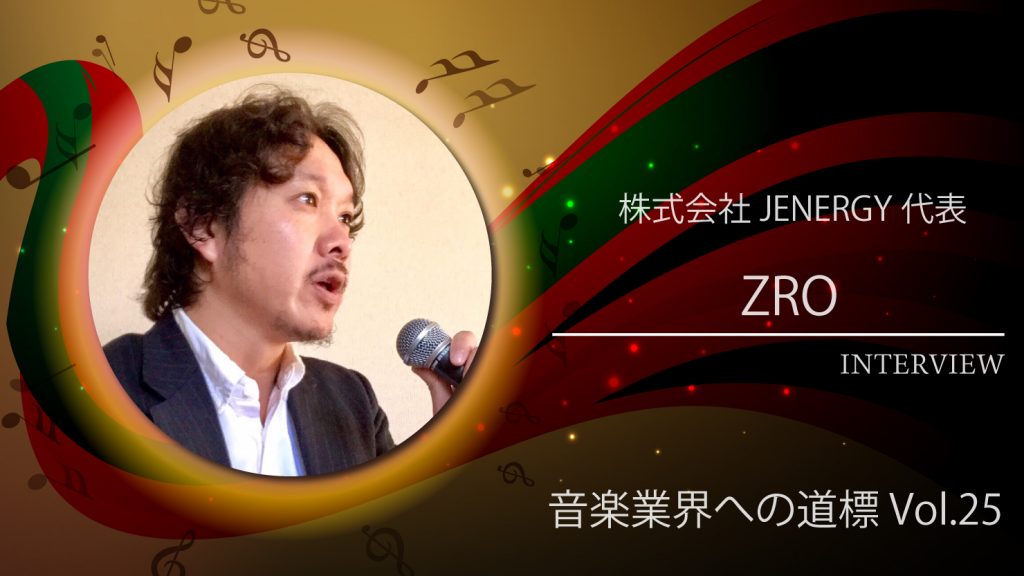
For the 25th installment of Pathways into the Music Industry, we spoke with ZRO, MC of Asia Engineer and now CEO of JENERGY Inc..
From his major-label days to the present, ZRO has faced music with a consistent style. Once again, we heard many useful stories.
How He Came to Launch a Company Song Label
Q: Thank you for letting us interview you. First, please tell us about your current activities.
As CEO of JENERGY Inc., I produce company songs, as well as karaoke distribution, music videos and more.
Q: What led you to start a company that makes company songs?
Even after Asia Engineer went on hiatus, I always had the desire to "energize people through music." I wanted to keep making my own music, but I thought that a career path like a commercial music production company would inevitably mean client-oriented work where it's hard to show individuality.
So I wondered, "Couldn't I open up a path in places where there's no music?" That was the idea.
After Asia Engineer went on hiatus, I joined a company that builds exhibition booths and, as an office worker, saw lots of corporate trade shows. Small and medium-sized companies were announcing new products, but there was no music playing at all. It seemed like such a waste that they'd built a proper space without any music, and at the same time I thought, "It might be interesting to bring music in here." That was what led me to launch my current business.
Q: So rather than an existing music business, you created a new need.
That said, once I got started, I found that many small companies couldn't afford to make music. I considered making it for free, but that felt like selling ourselves short, which seemed wrong.
So, crass as it sounds, I thought about what kind of music wouldn't get discounted, what music would be valuable to a company, and I figured a song about the company's identity would have value. That's how I started the company song business.
Having real professional artists and composers make them adds value, and above all, I thought people would be happy with them.
Q: Many composers work with JENERGY. Weren't there some who were reluctant to "write songs for companies"?
It's true that many people, like in rock or hip-hop, have a strong image of "music = anti-establishment."
But if you really think about it, whether it's J-pop, rock or hip-hop, the people listening are almost all office workers and working people. Making a company song is by no means pandering to the world; it's just that the audience is narrowed to working people.
Everyone buys music with the money they earn by working, so I don't feel anything wrong about writing songs for those people. It's neither dropping out nor selling out; if anything, I think it's giving back to the people who support us.
That's exactly why we don't make them like a part-time job; our policy is to make cheer songs that help listeners work hard.
That hasn't changed at all since my Asia Engineer days.
Three B Co., Ltd. company song MV
ZRO's Path So Far
Q: When did you start music?
Originally I had no interest in rap at all. In high school, I liked listening to UK rock like Oasis, RC Succession and Happy End. I didn't like Japanese rap much because I had the image of junior high and high school kids dressing up like Black artists and goofing around in Roppongi, all flashy. Also, my high school was a boarding school in the mountains, so I think I had a twisted feeling like, "City people are chasing trends, but I listen to music outside the mainstream!" (laughs)
But after graduating, I entered a cram school, and a friend I made there (SHUHEI, who later became a member) was a rapper. He'd won a big audition and had sung at Yokohama Stadium, and he told me, "The music you like isn't popular right now. If you want girls to like you, rap!" I tried writing a rap, and he praised me a lot, saying, "You've got talent." That's when I started listening to rap.
Q: So meeting that friend changed your musical direction.
Then I borrowed RHYMESTER's album "Egotopia," and as I listened to it over and over, I realized, "Maybe this is exactly the slightly twisted underground spirit I've been aiming for." I remember everything suddenly looking fresh from then on.
I'd had an image of hip-hop as flashy guys who looked like bad boys, but I learned that it sampled the rock and folk I loved and had a broad musical range.
Since junior high, I'd been writing down what I felt in a diary every day, and that overlapped a lot with rhyming, putting your feelings into lyrics, so I came to love it more and more.
Q: And from there you went deeper into the world of rap.
In university, we often gathered at a friend's place and wrote raps together. We'd also rap them over karaoke tracks of Diana King and Jamiroquai.
Eventually a girl I knew offered to record us, and we dubbed the recordings onto tapes and had our friends listen to them.
Then two classmates from junior high said, "We want to do it too!" and joined us, and the four of us formed Asia Engineer.
Q: What did you do when you first formed?
At first we rapped about things like social criticism, but it felt forced, coming from university students who hadn't thought that deeply. The turning point for our musical direction came when a member at the time, a younger schoolmate from junior high, became seriously ill and was hospitalized.
When we went to visit him, we said, "We always rap, so let's visit him with a rap," and we all made a get-well song. It was incredibly upbeat and silly, so much so that we thought he might get angry, but he was so happy he cried in his hospital room. That surprised us.
Seeing him cry while reading the lyrics, I sensed the potential of cheer songs.
Q: And from there your style changed.
That's right.
After that, we made providing fun and energizing people the theme of our activities. Taking a step beyond our previous rap style also let us stand out from other groups.
In terms of the times, Ketsumeishi, RIP SLYME and KICK THE CAN CREW became huge first, and a little later HOME MADE Kazoku, BENNIE K, SEAMO, mihimaru GT and FUNKY MONKEY BABYS made major debuts and had hits. The times were flowing that way, so I think we were lucky too.
Then in 2005, we made our major debut on rhythm zone.
Asia Engineer / Orion
Q: What were your major-label activities like?
We debuted with an ending theme for ONE PIECE and "Super Hero," and set out to sing down-to-earth cheer songs, but it was an era when ringtone songs and romantic rap were hugely popular, and we were asked to make those kinds of songs too. We made them, but something felt off.
But if you don't sell, you can't keep making music... Honestly, there was a period when I was torn and really struggled.
Q: How did you break out of that?
One day, my father, who's a doctor, asked me to "cheer up a child who's one of my patients." The child had suddenly lost their sight in elementary school and had stopped going to school.
We happened to be on tour, so we sent a message we all recorded together at the hotel, along with an unreleased song called "Zettai Makenai!" (I'll Never Lose!).
Apparently, after listening to it, the child started going to school again, and my father told me, "With your music, you can heal hearts that even doctors can't." That's when a lot of things fell into place for me.
After we went major, I'd only been paying attention to the Oricon charts, but I realized that for listeners, it's not "I'll listen because it's ranked number X," it's "I'll listen because it's a good song."
Even the love songs I'd felt uneasy about, when I thought that there were people who cherished them, I could affirm what we were doing.
We're on hiatus now, so I no longer make hit songs and step forward as an artist, but the desire to energize people through music still drives me.
Asia Engineer / Zettai Makenai!
The Importance of Keeping Going
Q: Even though what you do has changed, it's impressive that your core hasn't wavered, then or now.
I think making something without feeling is uncool. In my case, I'm not hugely talented, so I've always thought that unless I at least stay true to my own sound, I can't make anything interesting.
Q: Many people struggle to balance "what they want to do" and "what they can do."
Music inevitably tends to be judged by numbers. Even if you patch together all sorts of things and get a hit, it's often quickly forgotten.
That's exactly why I think it's important to make "songs you'll remember for a lifetime."
Of course, you have to make a living, and it's very hard to live only on what you love.
But I think it's a waste to judge a song you worked really hard on only by the Oricon chart.
Music is free, so I think it's also important to step away from "it has to sell" for a moment and think.
Of course, there's no point if that makes it self-indulgent, so in my case, I work with all kinds of writers I respect to keep objectivity and quality while doing what I want to do.
Q: What do you think is most important for making a living doing what you love?
I'd say keeping at it without giving up.
It took Asia Engineer about seven years to debut, and during that time I thought about quitting many times.
After graduating from university, I took a job in extremely tough real estate sales and kept the band going while working. Every week I worked from morning to night Monday through Saturday, then had shows on Sunday. The stress was so intense I broke out in hives, and one day I couldn't take it anymore and told the members I was quitting. Then they told me, "If you quit, we'll look down on you for the rest of your life, and we'll stop being your friends."
I thought that out in the world, I'd never again find friends with that kind of bond, who needed me and would pull me along. So I held on, and six months later we were able to debut.
Q: So you were able to keep going because you had wonderful bandmates.
Even if you don't get results, the fact that you did it remains, right? I think the only way to do what you want to do is to keep doing it.
It's also important how you can create an interesting environment for yourself. In my case, a big part of why I could keep going was having my bandmates.
I think it's precisely because I'm making music with lots of friends now too that I can keep happily doing what I want.
Q: Thank you. Finally, please tell us about your future goals.
Right now I'm making company songs at JENERGY, and I want to make them much more common. Rather than spending 100 million yen on producing a commercial, I'd like to help make making and promoting your own company song a more widespread option.
So far we've produced company songs for about 50 companies, so first 100 songs, and eventually I want to be the person who's made the most company songs in Japan and be called "O-Shaka" (a pun on Buddha and "company song"). (laughs)
Q: Thank you very much.
Creators Wanted
JENERGY is looking for composers and singers of any genre who want to make company songs with us. For details, contact info@jenergy.co.jp.
Free company song samplers are also available!
Interview and text: momo (Mamoru Tanoue)

Profile: Born in 1995. A Digital Performer and Ableton Live user. After graduating from music school, he moved from Fukuoka to Tokyo as a composer.
Made his debut as a writer in August 2017, composing and arranging for Tsukicro's "STARDUST".
With the motto "songs that touch the heart", he is a multi-player who handles everything from lyrics and composition to arrangement and recording.
He is also active as the composer and arranger for the art unit "Shiro".
Website: Music Designer momo
Twitter ID: @momo_tanoue
NEW ARTICLES
Latest English Articles