For the 14th installment of Pathways into the Music Industry, we interviewed Yashikin, a creator who keeps producing great songs, from anime theme songs to soundtracks.
Beyond talent, Yashikin says, "I've been very lucky with people." From composing techniques to tips on relationships, we heard some rich stories, so please give it a read.
Yashikin | Profile
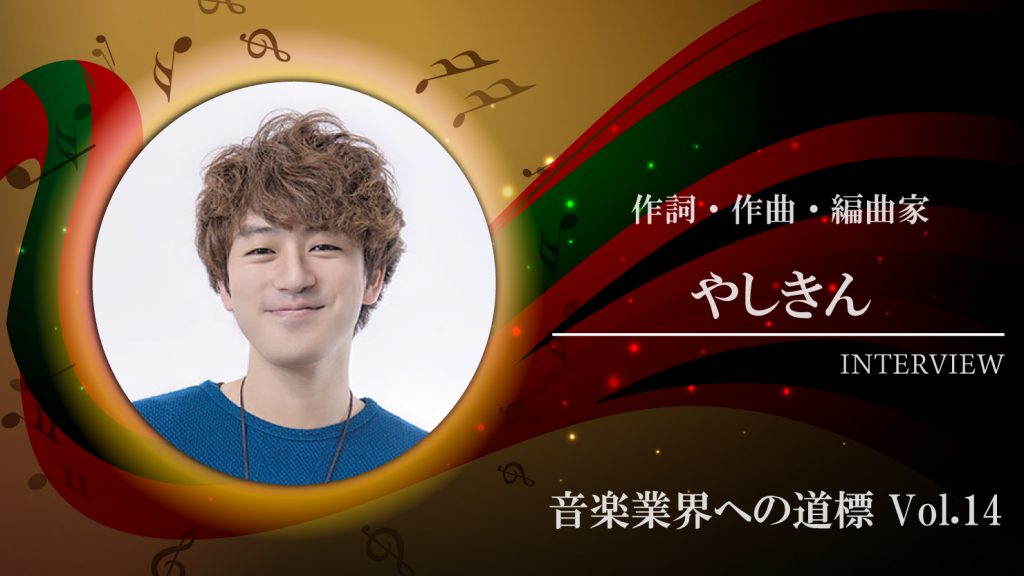
Born May 12, 1988, blood type O. Born in Tokyo, raised in Ikebukuro. Began playing in bands in high school.
Continued with bands after entering university, but the band broke up when job hunting season arrived. Longing for music activities focused on composing, began studying DTM and music theory on their own. Debuted as a writer in summer 2010 after being selected in a song competition for the TV anime "Oreimo (My Little Sister Can't Be This Cute)." Since then, has been working across lyrics, composition and arrangement, mainly in anime music.
About Yashikin
Thank you for taking the time despite your busy schedule. First, could you briefly tell us about your current activities?
I mainly make anime-related music. I compose and arrange, of course, and depending on the project I also write lyrics.
For songs with male vocals, I occasionally sing the scratch vocals myself or join in on backing vocals.
As listed on Wikipedia too, you've worked on a huge number of songs, from theme songs to soundtracks. When did you originally start music?
I started music when my parents bought me an acoustic guitar in junior high. I liked pop bands like Mr.Children and Spitz, so I'd play and sing, and imitate their chord progressions to write my own songs.
Partly because of that, even now the arranging tool I can use most freely is backing guitar.
What gear do you mainly use now?
My DAW is Cubase. That hasn't changed since I started DTM. I often use standard plug-ins, but one I've found interesting recently is RealiTone's RealiBanjo.
I used it when I made a country-ish song, and it just looks great. The animation of a cheerful old man and a dog is really fun, so I recommend it.
I also like ilya efimov's BAYAN because it sounds incredibly good.
Both are pretty niche plug-ins. (laughs)
When it comes to gear, I often buy things people around me recommend. I'm the type who never reads manuals, so I actually don't know that much about gear.
Around my second year of university, right when Vocaloid was booming, I bought Cubase and Vocaloid and started DTM, but I started with no knowledge at all.
Looking at the mixer, I was at the level of "The meters are maxing out and turning red. What is this...?" I didn't even know about limiters, and because I was using cheap headphones, I didn't notice the clipping.
Didn't you look things up?
For some reason that idea never occurred to me. (laughs)
I figured I'd match the volume of existing songs, so I adjusted things by drawing automation by hand on every single track.
That sounds like an enormous amount of work...
Yes. But thanks to all that trial and error and taking the long way around, I picked up all kinds of methods and became better at handling trouble.
Of course there are lots of efficient methods too, and that's fine as well.
TV anime "Toji no Miko" second OP "Shinkakei Colors"
Until aiming to become a composer
You started music in junior high. How did you get from there to where you are now?
From high school, I joined an existing band as guitarist and vocalist.
By the way, I was in the light music club, but when I joined it was in pretty bad shape. We couldn't even use mini amps, and the budget was cut every year, so I also worked on rebuilding the club.
That sounds like an anime.
It really does. (laughs)
The band I formed in high school did a few covers but mostly played original songs.
At first the guitarist wrote the music and the drummer wrote the lyrics, and gradually I started writing songs too.
Playing lots of original songs while still in high school is pretty impressive.
Since we didn't do many covers, we were behind in technique in a lot of ways. We entered all kinds of band contests, and maybe because we were valued for our fresh high school band vibe, we often made it fairly far.
We'd only played live at school festivals, but suddenly we got to stand on the LAKE STAGE in the final selection for ROCK IN JAPAN (TEENS ROCK IN HITACHINAKA). That's a great memory.
So you were very active.
Yes. Around then, Shoichi Taguchi of Kanshou Vector and Yoshikatsu Shuto of KEYTALK were also in the same contests.
Even if I didn't notice at the time, I often hear later, "Oh, we were on the same show back then!?"
People who like entering contests apply to lots of them, so you cross paths in all kinds of places. (laughs)
Didn't that band lead to a debut?
I kept playing in the same band after entering university, and people from labels' talent scouting came to see our shows, but it never got that far.
In the end, we never took off, and the band broke up when job hunting came around.
What made you turn to composing from there?
Even when I was in a band, composing was the most fun part for me. When I realized there were many ways to release music besides a band, Vocaloid happened to be popular. That's when I started DTM.
Borrowing illustrations from Pixiv and having my aunt help with the videos, I tried to upload a song every one or two weeks.
And that led you to aim to become a composer.
One of the composers I respected back then was Satoru Kosaki of MONACA, and when I learned that Kosaki had become an anime song writer after working as a game sound designer, I took all kinds of action aiming in that direction.
In 2010, in the ending theme competition for amateurs for Oreimo (the anime "My Little Sister Can't Be This Cute"), you had two songs selected out of more than 1,000 entries.
That was exactly when I was aiming to be a game sound designer. I'd been reading the original and really loved it, so I entered. It was a competition with lots of very active doujin musicians and freelance composers, so I was nervous, but I remember being so happy when the email saying I'd been selected came. I danced like crazy in my room. (laughs)
Why do you think your songs were selected?
That competition was looking for something like character songs, so I wrote with the aim of making people love the characters even more.
I was a huge fan of the work, and I think that was a big factor too.
Yashikin's approach to communication
You now work on many songs, mainly anime songs. How does work actually come to you?
When I joined my agency, I steadily entered competitions. At first nothing got picked and it was tough. Now I mostly get work by name.
Also, when I was in a band, I often ran into UNISON SQUARE GARDEN at the same studio, and I've known their bassist Tomoya Tabuchi since then. It's a relationship like an older guy you see now and then.
After the Oreimo competition, Tabuchi suddenly contacted me: "I heard there's someone trying to make composing their job. Want to talk sometime?"
That led to Tabuchi giving me arrangement work on a song Tabuchi had composed, and since then I've been involved in all kinds of productions.
UNISON SQUARE GARDEN "Kimi no Hitomi ni Koishitenai" brass arrangement (arrangement assistance)
There are so many curious connections.
Even how I joined my current agency came through an introduction from yamazo, who co-arranged the song of mine selected in the Oreimo competition.
My song had been polished into something really cool by a professional arranger, and I was so moved that I looked up their contact details and sent a thank-you email. That started our relationship, and yamazo gave me all sorts of advice.
I really think I've been far too lucky with people.
Is there anything you keep in mind when dealing with people?
Being honest and not hiding what I like, I suppose.
I don't associate with careless people; I try to only spend time with people I feel "I want to be with."
If I'm going to live anyway, I want to live happily with people I like as much as possible.
Even if you deal with someone you don't like thinking "it might lead to work," it usually doesn't. Of course I'm careful not to be rude.
There's a limit to the number of songs I can write in my life, so I don't want to waste any shots.
I also don't really separate work and private relationships. I often work with drinking buddies, and there was even a case where a friend who worked in apparel became a screenwriter and we ended up working together.
So rather than "let's build a network!", where you are now is the result of associating with people you want to be with.
It's fine to approach people intending to build one, but I think what matters is properly communicating with "that person" right in front of you. It's ultimately a connection between people.
I see, that's a lesson.
That said, of course I make plenty of mistakes too. I get scolded sometimes. (laughs)
But if you properly fix things, people start to see you again, and I think you become a proper person by piling up all kinds of failures like that.
Production techniques and originality
How do you usually compose?
Most often I take one motif that comes to me and keep expanding it. Usually that motif ends up symbolizing the song.
Sometimes I also start from the track or the sound.
I've gone through a lot of trial and error, so I make full use of all kinds of methods depending on the genre.
For you, what's the standard for a "good song"?
The most important thing is whether it fulfills its purpose. On top of that, it's best if some kind of individuality shows.
With one more hook as a plus, I think it becomes an even more attractive song.
Since jumping into the music industry at a young age, what was the hardest period?
My first soundtrack job. I got the offer at about 24, but I had little gear or know-how, so I struggled a lot.
I couldn't make it well, and the deadline was closing in... I got close to a nervous breakdown.
How did you get through that tough situation?
When I thought "This is bad," I consulted the person managing the production.
Then a senior composer helped with several pieces, and I barely made it through. Of course, as a pro I didn't let the final quality drop, but that was really hard.
There are many people who, even when stuck, can't consult anyone because of all kinds of things inside them.
There's vanity and pride, after all. Like, "I might not get the next job..."
But I thought blowing a deadline was bad as a working adult, and more than what happens to me, the work itself would suffer. That's the one thing I wanted to avoid.
Even now, I'm really glad I made that decision.
So you're always thinking about "who the song is for."
I think I have little ego. Sometimes that becomes a complex, but I want to make it my strength that an "ordinary person" can write such interesting songs.
As a professional composer, I can take all kinds of approaches for all kinds of orders, so I think it's my calling.
What do you think your originality is?
I think my lyrics are the most distinctive. The way I fit words and rhyme is kind of English-like, and I'm also good at so-called denpa (wacky, offbeat) lyrics.
Also, I have a producer's perspective, so to speak; even when I'm making something, I often think about "non-musical elements" too, and I think that's probably my individuality.
TV anime "Teekyu" season 7 theme song "Tsuppari-kun vs Sekitori Man"
For those aiming to enter the music industry
Did you have any doubts when you decided to make a living with music?
Back then I didn't have enough information to have doubts, and I thought there was no point in thinking about it.
I figured that even if I got a regular job, I'd keep doing music because I love it, and if so, making music my job would let me immerse myself in it all day, and it wouldn't be slacking off from my main job.
While those around you were getting jobs, didn't your parents object?
Actually, they supported me. I get along really well with my parents, and I kept them updated on what I was thinking, how I saw things and my current situation, so I don't think they ever felt they didn't know what I was up to.
I also made a point of discussing money face to face properly. They helped me in so many ways, and I'm still really grateful. Thankfully, recently I've finally been able to start repaying them.
You embody "living by doing what you love," but many people worry that "if you make what you love your job, you'll come to hate it."
I think that's not true. Even if you love music, there are all kinds of jobs, right? If you choose something "a little off" among them, I think you won't be happy.
For example, in my profession, I don't think it suits someone who says, "I love composing, but I also want to do celebrity-type work."
So it's just that they haven't found where they fit.
Yes. The published data is often different from reality, so it's important to look into as many worlds as possible and talk with people in the world you're aiming for.
That way, any strange idealization goes away, and I think you can think more realistically rather than in terms of a dream.
Thank you. Finally, please tell us your goals going forward.
I want to write a great song that goes down in history. Like, I could die happy once I've written it.
I'd also like to try working as part of a team on something from the early stages of a project!
Thank you very much.
About the author

Interview and text: momo (Mamoru Tanoue)
Born in 1995. A Digital Performer and Ableton Live user. After graduating from music school, moved from Fukuoka to Tokyo as a composer.
Made a debut as a writer in August 2017, composing and arranging for Tsukicro's "STARDUST".
With the motto "songs that touch the heart", a multi-player who handles everything from lyrics and composition to arrangement and recording.
Also active as the composer and arranger for the art unit "Shiro".
Twitter ID: @momo_tanoue
Shiro: YouTube channel
NEW ARTICLES
Latest English Articles