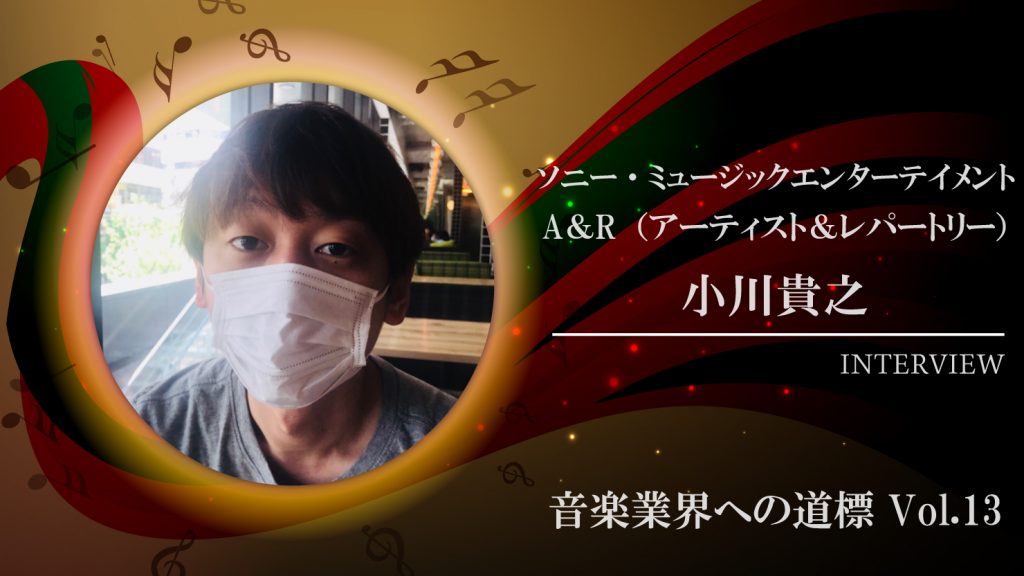
An interview with Takayuki Ogawa, A&R at SACRA MUSIC
For the 13th installment of Pathways into the Music Industry, we talked with Takayuki Ogawa, who works as an A&R at SACRA MUSIC within SME (Sony Music Entertainment)!
Many of you have probably heard the term A&R but "don't know what they actually do," right?
This interview is a must-read for musicians, covering the appeal of working as an A&R and a way of thinking about music from a different perspective than creators. Please give it a read.
What is A&R?
Thank you for agreeing to this interview despite your busy schedule. First, could you tell us about your current work?
I currently handle artists signed to SACRA MUSIC.
What exactly does an A&R do?
It's short for Artists and Repertoire, and the work is wide-ranging: thinking about release schedules and visual image, deciding what strategy to use to market an artist, and so on.
So you're basically not involved in production?
No, in my case I often direct at recording sessions myself, so I'm actively involved in production too.
So the work differs depending on the person?
A&R can be interpreted very broadly. Some people focus entirely on branding, such as promotion and marketing, while others like me attend recordings and direct as well. It really varies from person to person.
You do both. Did you decide that scope of work yourself?
A&R is a very vaguely defined role to begin with, and nobody teaches you the job. There's routine daily work, but there's no right answer for making a hit, like "release at this timing and push on the web..." If there were a way to make things sell like that, I'd want someone to teach me. (laughs)
So pretty much everyone does it their own way.
Artist handled by Ogawa: ASCA "Rin" MUSIC VIDEO
Until becoming an A&R
How did you come to work as an A&R in the first place?
When I first joined Sony, I was editing magazines at Sony Magazines. I interviewed artists like GLAY, ORANGE RANGE and Kaela Kimura.
So you weren't aiming to be an A&R from the start.
At university I was in a department that was more or less specialized in becoming a novelist, and I was already working part-time at a magazine back then, which I found pretty interesting.
I enjoyed getting to talk with writers I liked, and when I thought about a job, I figured, "I'm also really interested in music, and if I interview for a music magazine, I might get to meet artists I like." That was the trigger.
Then after searching around, I found Sony Magazines, got in, and that's how it went.
By the way, didn't you want to be on the artist side?
My father runs a live house, and there I saw musicians far better than me and music school students my age, so I thought, "There's no way." (laughs)
I did play guitar, in a Beatles cover band and so on, but I felt the difference from my own playing.
I see. How did you go from magazine editor to A&R?
I was in editing for about five years, but I felt the distance between me and the artists was really great.
I'd work hard on serialized features hoping they'd sell, and when they actually did, they'd say "thank you," but along with the joy I also felt a bit lonely.
I thought, "I want to stand on the artist's side and celebrate together," and that's what led me to request a transfer.
The work of an A&R
You're now active as an A&R for many top anime song artists. What path did you follow after the transfer?
First, I worked with Porno Graffitti as a kind of apprentice. I got to see all aspects of the work, from TV to everything else, and gained experience there.
By the way, Porno Graffitti had a team of three A&Rs.
So sometimes several people handle one artist.
Yes. That also varies by artist. For Porno Graffitti, the roles were divided into sound specialists, marketing specialists and so on.
After that, in parallel with Porno Graffitti, I came to handle a new artist called Alice.
So that was effectively your first artist.
I remember struggling because I started without understanding any DTM terminology at all.
With Porno Graffitti, production revolved around the great producer Akimitsu Honma, but with Alice it was truly a start from zero, and I felt completely lost.
The person who helped me then was a writer called URU, who taught me all sorts of things about "this is how music gets finished," like how to make demo tapes and how to record.
Also, my younger brother is a songwriter, and talking with various writers through that connection, I learned all kinds of things, like "this is how they usually feel when composing" and how they think about melody.
Moving forward in step with the artist
An important part of an A&R's work is marketing, "how to promote the artist." How do you decide that?
Naturally I don't decide this alone, so I have the artist picture "where they ultimately want to end up," and we decide while discussing it with the artist and staff.
I also look for the "seat that's currently empty" while thinking about how to bring out the artist's most attractive qualities.
With so many songs out there, finding an empty seat seems quite difficult.
SACRA MUSIC, where I work, specializes in anime songs, but it's not all so-called "anime-song-style songs." Everyone really puts in all kinds of effort to differentiate themselves and bring out originality.
For example, I often look at other genres, like "songs that are established in the J-pop scene but don't exist in the anime song world."
So you decide by thinking with a wide perspective, not bound by genre.
Yes. But it's not as if doing the same thing as artists who are selling is enough, so we refine it while taking in the artist's opinions and those of the people around them.
Either way, I think the most important thing is to identify, together with the artist, the goal we're pursuing.
Since there's no right answer, there are endless options, and I imagine that's often hard.
Our president often tells me, "All you can do is put out what you believe in and love without wavering." In the end, the A&R has to take responsibility and steer, so I want to avoid wavering as much as possible.
As an aside, if you were to scout new artists from now on, what would you prioritize most?
What I find most attractive is the "voice."
Songs and lyrics are important elements too, of course, but I think a voice is something no one can replace.
It's an era where you can be active without showing your face, like VTubers, so I think visuals are no longer as important an element as before.
Thoughts on song competitions
Selecting from so-called "competitions," where songs for artists are solicited from songwriter agencies, is also part of an A&R's work. From your perspective, what makes a "good song"?
First, it's important whether I can feel confident it'll reach the finish line.
If the arrangement direction isn't visible to some extent at the competition stage, there's a risk that, at worst, even if we select it, it won't get to the finish.
Also, for anime tie-in songs, the key is how deliciously you can present it within the 89-second limit. For example, starting with the chorus to show up front "this is the kind of song it is"; songs where the finished form is easy to see from the very start tend to stick in the mind.
Depending on the artist, far more than 1,000 songs can come in for a single competition, so I think it's good to create with "how to make an impact" in mind.
That's an incredible number of songs...
Sometimes a week isn't nearly enough time. But writers who keep submitting good songs, even if they aren't selected that time, I do remember their names, and sometimes for a B-side we'll think "Oh, there was that song" and select it.
In my case, I try to create opportunities to commission new writers that way as much as possible.
I'd like to ask a little deeper: what's the difference between people who are often selected in competitions and those who aren't?
I think the difference is whether they've properly captured the artist's color and flavor.
It's often obvious at first listen: "Ah, they made this without listening to the artist's previous songs."
Writers who are often selected are good at fusing the good parts of the reference with the artist's "color."
That said, I think there's also a way to stick to "your own color" even if you're not selected. When something brings you to the surface, it becomes a strength: "That kind of song is that person."
The music industry from an A&R's perspective
This is my personal opinion, but I feel more and more people these days "want to keep making music but don't know what to aim for."
Yes. The line between major and indie has been disappearing for a while. These days the possibility for anyone to become a star has grown, and values are changing day by day.
What are the benefits of being on a major label now?
Spending money to push artists who have something outstanding, or getting them tie-ins. In those respects I think majors are still strong.
But it can also come with more restrictions, so of course it can be a disadvantage too.
It seems the way you work changes depending on where you find value. What's the current state of the music industry as a whole, and where do you think it's heading?
Sales of packaged products like CDs are definitely declining steadily, and while streaming services are gradually catching on, their growth is still slow compared with the decline in CD sales, so my impression is that overall sales are decreasing.
Even among major artists, some offer streaming and some don't.
It hasn't been properly monetized yet; subscriptions alone can't recoup the costs, so the reality is that we have no choice but to rely on the package business. But I think at some point subscriptions (flat-rate services) and packages will trade places.
What do you think will happen when streaming becomes mainstream?
Like niconico video at one time, there'll be a flood of artists, and "curators" who dig out great songs and make playlists will get attention. People in a DJ-like position who select songs, rather than the creators themselves.
There's also a concern that if streaming takes off, creators' and artists' income will drop.
It's true that the income coming in when a new song is released will probably drop. But unlike CDs, I think there's the benefit of "being listened to for a long time."
For example, there are songs that always make it into cherry blossom playlists or Christmas playlists, right?
Unlike CDs, you get paid every time it's played, so once the monetization system is in place, I think it can become a proper source of income.
What's next for Ogawa
Please tell us what you're aiming for from here.
Just as songwriters now have to do not only composing but also arranging and recording, A&Rs have more and more to do too.
I think we won't survive unless we work from a 360-degree perspective, covering CDs, live events, merchandise, management and so on.
Finally, what's your greatest joy in working as an A&R?
Of course it's when the artists I handle become successful, and when we announce something and get a reaction, I'm really happy.
Also, when I see fans getting excited at a live show, or the crowd erupting in cheers when a title is called, I'm deeply moved and feel it was worth doing this.
Thank you very much.
About the author
Interview and text: momo (Mamoru Tanoue)
Born in 1995. A Digital Performer and Ableton Live user. After graduating from music school, moved from Fukuoka to Tokyo as a composer.
Made a debut as a writer in August 2017, composing and arranging for Tsukicro's "STARDUST".
With the motto "songs that touch the heart", a multi-player who handles everything from lyrics and composition to arrangement and recording.
Also active as the composer and arranger for the art unit "Shiro".
Twitter ID: @momo_tanoue
Shiro: YouTube channel
NEW ARTICLES
Latest English Articles