Interview with Guitarist Takanori Goto
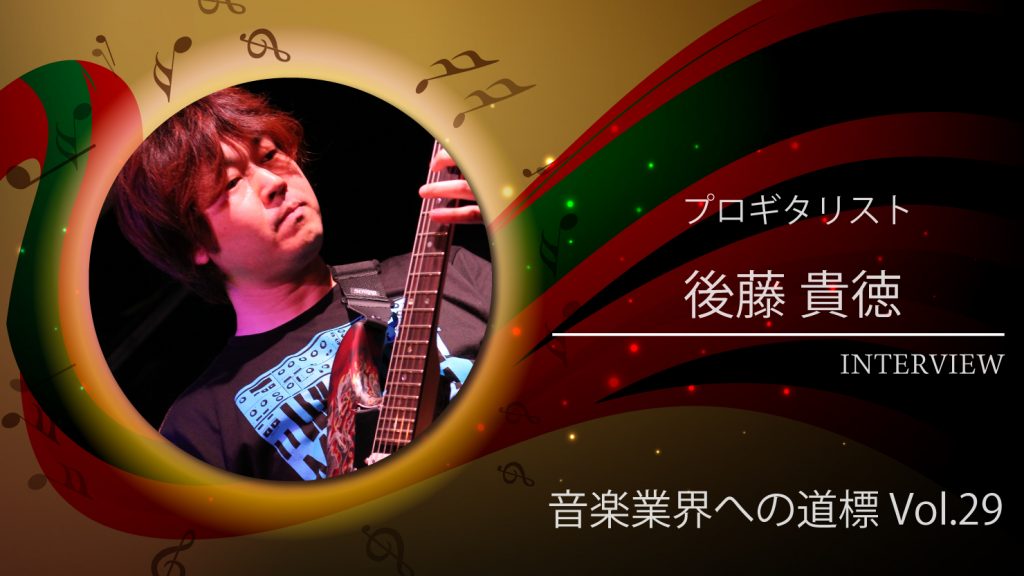
Takanori Goto | Profile
Started playing guitar at 15. Active in a wide range of music scenes, including rock, fusion, jazz, bossa nova and pop.
Has played on many games and anime, including ACE COMBAT, THE IDOLM@STER, NieR, The Melancholy of Haruhi Suzumiya, Lucky Star, Kannagi and Sekirei.
For the 29th installment of Pathways into the Music Industry, we interviewed guitarist Takanori Goto.
Mr. Goto plays on all kinds of songs, centered on anime songs, and this time we heard in depth about his road to becoming a professional guitarist. Please give it a read.
Q: Thank you for letting us interview you. First, please tell us about your current work.
I play guitar on recordings for all kinds of songs, and recently I've also been performing live on stage productions. I also give lessons.
Q: You seem to be very busy.
I'm not sure... But I love games, so I play games in between.
That's why I'm really happy to have played guitar on so many game titles.
The Road So Far
Q: When did you start music?
My family ran a musical instrument store, and with my parents' encouragement, I first started the trumpet in fourth grade.
Q: So you started with the trumpet.
Then, around the second year of junior high, I started guitar alongside the trumpet.
I got completely hooked, and I'd neglect the trumpet and play the guitar that was kept in the wind band club room.
Q: What music did you like back then?
I remember often copying X JAPAN, BOØWY and COMPLEX, because my friends were playing them. I also mainly copied Japanese artists such as Seikima-II and Kome Kome Club.
Guitar credit: "Onegai! Cinderella" / CINDERELLA PROJECT
Q: What path did you take after that?
I actually wanted to go to a guitar school, but back then there were almost no schools where you could get a proper university degree. I could play the trumpet, and I just wanted to pursue music, so I went to a music college, thinking it wasn't completely unrelated. But I quit the trumpet after graduating. (laughs)
Q: Why did you quit?
At the time, I thought that even if I pursued both trumpet and guitar, I couldn't beat people who specialized in one. Thinking about it now, it feels like a bit of a waste...
Also, I couldn't really picture the trumpet becoming my job.
With guitar, I'd had about 10 students since my college days, so I think I had a vague feeling that I could make it with this.
Q: In the end, was going to music college useful?
Hmm, I'm not sure... Setting aside what I learned, it's a place where music lovers gather, so I made a lot of connections, and it was really good to meet all kinds of wonderful friends and play in bands with them.
My first job also came through a friend's introduction, so in that sense I don't think it was wasted.
Q: By the way, what paths do music college graduates take?
Some join the Self-Defense Forces bands, some become teachers, and many get jobs in ordinary industries.
In my case, I had several students and a little income from guitar, and thankfully my guitar playing had a fairly good reputation, so at the time I thought I could somehow make a living like this.
Q: So after graduating, you lived while working as a teacher.
That's right. After graduating, I studied under jazz guitarist Toshiki Nunokawa, and that's where I properly began learning guitar for the first time.
Q: Was there anything that made you start taking lessons?
Until then I liked hard rock and heavy metal, and I enjoyed playing shred stuff like Extreme, MR. BIG and Metallica.
But when I was starting to want a more colorful use of notes, I came across the album "TILT" by Richie Kotzen and Greg Howe. When I first heard it, I was completely blown away, and I felt the essence of jazz in it.
So I decided to go all in on jazz for a while and practice, and I became Toshiki Nunokawa's apprentice.
Q: How long did you study with him?
About three or four years, I think. I learned from him while helping out at his live shows.
It was practice from the very basics, but that turned out to be surprisingly hard. I could shred pretty hard, but I didn't really know the positions of the C major scale. (laughs)
So he taught me all sorts of things, from guitar basics all over again to jazz theory.
Q: During that time, were you also giving your own lessons?
Yes. But between family matters and various other circumstances, I couldn't possibly live on lesson income alone, so I worked part-time at a gas station.
While I was working there, I sometimes ran into my students, who'd ask, "Teacher, what are you doing here?" (laughs)
It was really frustrating, but all I could do was laugh...
During that period, all sorts of things piled up, people around me were harsh, and I think it was truly the worst time, so bad I couldn't sink any lower.
Q: I think many people, especially players, don't know how to aim to go pro.
In my day, the internet wasn't widespread, and I vaguely thought I'd somehow be able to make a living. I'd buy guitar magazines and think, "If I get really good, I'll get more and more attention, appear in magazines like this, and get to support big live shows..." so I thought all I had to do was get good.
Q: Now that you've actually become a professional guitarist, what do you think?
I think you need all kinds of abilities, not just being able to play guitar well and skillfully.
Things like communicating with people, meeting deadlines, keeping promises, not being late... I'm the one saying this, but there are still things I'm terrible at, so I want to keep myself in check going forward. (laughs)
And also never forgetting to be grateful for the work I'm entrusted with.
Guitar credit: "Glass Doll" / Aikatsu!
Working as a Guitarist
Q: You overcame hard times and are now active as a professional guitarist. What was your first job?
About a year after graduating, I heard through an acquaintance that they were looking for a guitarist for the soundtrack of ACE COMBAT 04. I passed several tests, including a written exam and a live performance, and got to play on it. That was the start.
Q: And your work gradually increased through that connection.
That's right. By chance, Keiichi Okabe, president of MONACA, was at that session. He reached out to me, and I got to play on many MONACA works, including the music for NieR.
Q: Many people aim to become studio musicians. Are there any skills they should acquire beforehand?
At first I was really bad at sight-reading, but I gradually gained the skill as I did more sessions. So I think it's less about how much you can prepare beforehand and more about how much real-world experience you can gain and grow from.
Q: So the important thing is to jump in first.
Sight-reading, ideas and technique are, in a sense, ways to protect yourself.
If a recording session runs long, it causes trouble for the client, and your own stamina keeps draining. I think of it as improving so that doesn't happen.
Q: Do you record more at home or in the studio?
About half and half. For acoustic guitar, I record with microphones both in the studio and at home.
When recording at home, I go through my own pedalboard into a Fractal Audio Systems Axe-Fx II and record into Studio One.
The pedal I use most is Ovaltone's GD-013 Version 2.0, which I helped develop. I have two of them, using one for overdrive and one for distortion.
By the way, live, I use the Axe-Fx II as the preamp and run two FRYETTE PS-1 power amps in stereo.
Ovaltone GD-013 Version 2.0 Special Demo
Q: How many guitars do you own?
About four regular electrics, one 7-string, two acoustics, one nylon-string, and a few unusual instruments.
I use different ones depending on the song.
Q: When you're asked to play, what form do the demos come in?
It varies: sometimes some guitar is already in, sometimes the guitar arrangement is left entirely to me. When I'm entrusted with the arrangement, the requests are often written out, like "make this part feel like this."
Deadlines vary by project too, from about a week to just a few hours.
Q: In what form do you deliver your performance data?
I deliver two versions, one with a sound I chose and crafted myself and one dry, and let the client choose.
But maybe because people like the sound a guitarist makes, the crafted sound is used in many cases. Recently, I've also increasingly been delivering it with spatial effects like delay and reverb included.
For takes, I make about three versions and let them choose which to use.
Mr. Goto's Future
Q: What kind of activities should people aiming to become professional guitarists pursue?
I think you should use new tools like social media and YouTube to keep putting yourself out there.
I often check performance videos from my Twitter followers, and when I see glimpses of originality even among people copying my solos, they look really appealing.
Q: Do you check the reactions to songs you've played on?
Quite a lot. (laughs)
Of course I'm curious, and there may be negative opinions, but good reactions make me really happy and motivate me for the next one.
Q: How can a guitarist bring out their originality?
I think it comes out on its own. Apparently my tone has something distinctive about it, but I only became aware of it myself after people around me told me.
As you keep searching for cool guitar, the sounds and phrases you like gradually become set. That's also a double-edged sword, though.
Rather than what you yourself think is "it!", I think originality is how you're perceived by those around you.
Q: Thank you. Finally, please tell us about your future activities.
While cherishing the connections I have now, I hope to keep meeting lots of people, experiencing all kinds of work and living as a guitarist.
Q: Thank you very much.
Guitar credit: ACE COMBAT ZERO OP
Interview and text: momo (Mamoru Tanoue)
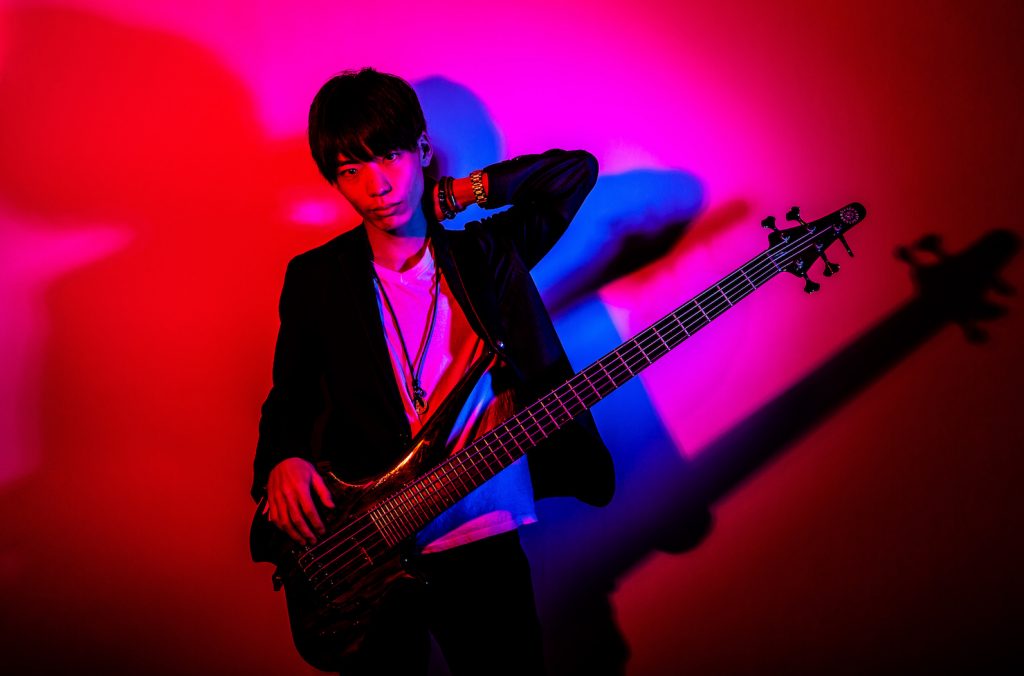
Profile: Born in 1995. A Digital Performer and Ableton Live user. After graduating from music school, he moved from Fukuoka to Tokyo as a composer.
Made his debut as a writer in August 2017, composing and arranging for Tsukicro's "STARDUST".
With the motto "songs that touch the heart", he is a multi-player who handles everything from lyrics and composition to arrangement and recording.
He is also active as the composer and arranger for the art unit "Shiro".
Website: Music Designer momo
Twitter ID: @momo_tanoue
NEW ARTICLES
Latest English Articles