Interview with Shutaro Tagami of FRONTIER BACKYARD
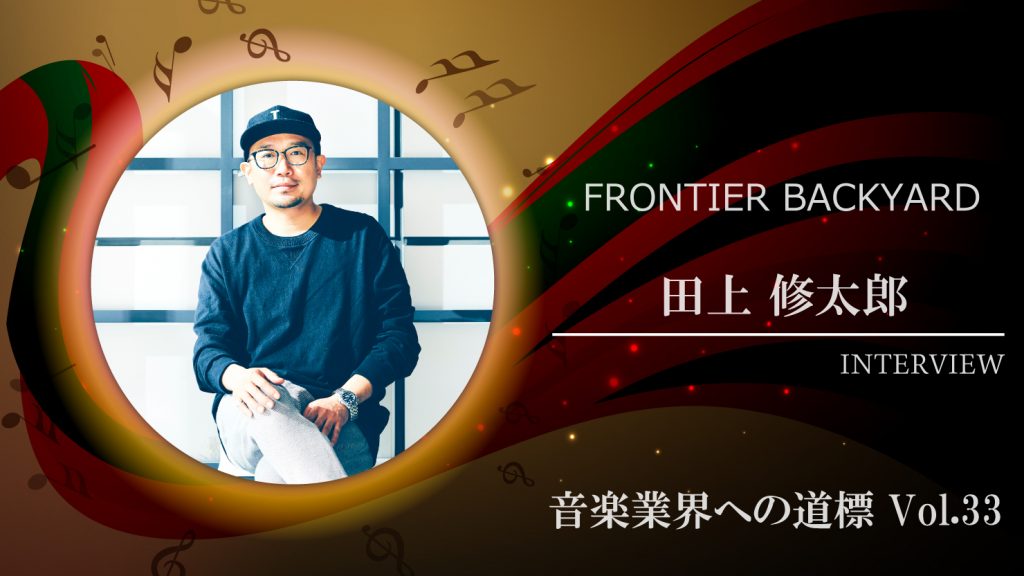
For the 33rd installment of Pathways into the Music Industry, we interviewed Shutaro Tagami, who plays in various bands including FRONTIER BACKYARD and is also active as a producer. Mr. Tagami handles many instruments and works across many roles. The interview is packed with valuable insights, from his thoughts on music to how he makes songs, so please give it a read.
Q: Thank you for taking the time despite your busy schedule. First, please tell us about your current activities.
My main activity is the band FRONTIER BACKYARD, and I also keep going at my own pace with SCAFULL KING, THE DEKITS, CUBISMO GRAFICO FIVE and others.
I also do support work for LOW IQ 01 & MASTER LOW.
Q: You're active in many places.
Basically, I try not to turn down invitations as much as possible. It would be a waste to let a connection end there, and I always want to meet all kinds of people and encounter all kinds of ideas.
Q: In your main band, FRONTIER BACKYARD, you're the vocalist. Do you also write the lyrics and music?
Yes. I write together with our drummer, Tadaaki "TDC" Fukuda.
Q: Specifically, how do you go about writing?
For us, sharing the image of a song is very important, so we start by "talking". We begin from the big picture, like "let's make a song with this kind of feel," and then decide things like, to bring out this mood, let's use this instrument and this chord progression, or if the chorus has a sad melody, let's deliberately keep the verse plain, and so on.
Once we've built the music in our heads that way, the work becomes outputting it.
FRONTIER BACKYARD "change feat. Emi Okamoto (FRIENDS)"
Q: FRONTIER BACKYARD's music has a very distinctive feel, blending live instruments and digital elements well.
Basically, I try to use hardware synths: piano-like sounds and more synth-like sounds, with a horn section on top. The bass is also mostly played on synth.
I try to strip away anything unnecessary so that each instrument sounds fat.
Q: Do you work mainly with live performance?
Yes. We do use Logic as our DAW, but almost everything, including the horn section, is recorded from live playing.
Q: Besides being a vocalist, you play many instruments, such as piano, guitar and trumpet.
When I was little I was terribly tone-deaf, and I took piano lessons as part of fixing that. As for the trumpet, I started in elementary school when I ended up joining the wind band because "they didn't have enough people."
I didn't take up piano or trumpet willingly, but later I formed bands and ended up playing ska, so in the end I was glad I did them.
I started guitar because I wanted to write songs in SCAFULL KING, so I came to it a bit late.
Q: When did you decide to make a living in music?
Hmm... you could say it was recently. (laughs)
That's because rather than "I'm going to make a living with this!", it feels more accurate to say "I kept at it and ended up here
."
I think of my title as "band guy", and I just love bands no matter what. I think I have a strong desire to keep going as a frontman forever.
FRONTIER BACKYARD "Fun summer ends"
Q: Over your long career in bands, there must have been hard times.
When FRONTIER BACKYARD's guitarist, KENZI MASUBUCHI, left the band, it was so hard that I wondered, "Is this the time to quit music?" Thankfully, I had friends who told me, "Don't quit yet!", and thanks to them I'm still going.
Also, I'm always thinking about what kind of activities I should pursue to keep living off the band.
What Matters for Making a Living in Music
Q: You also produce artists. What does that work involve specifically?
It really varies by project, and in most cases we discuss with the artist and management beforehand how far I'll be involved.
Sometimes I write lyrics and music, sometimes it's only direction, and sometimes I even handle the CD jacket artwork. It's really wide-ranging work.
Q: Is there anything you always keep in mind when producing?
I approach it with the attitude of "becoming a member of that band". I try to go into the studio with them, have meals together, and above all communicate a lot.
It takes time, but unless you get close, you can't see each other's "real side", and I think you can only make good work once you have a relationship where you can say anything to each other.
Q: So you value connections with people above all.
That never changes, in any era.
No matter how much social media and technology develop, music is born from connections between people. It's not something to neglect.
People who have something that makes others think "I want to make music with this person" are strong.
Q: Is that the kind of thing you come to see while producing?
Properly cleaning up the studio after practice, being on time, how you write emails. People show who they are in those simple things.
That also connects to how you treat your audience, and there are many moments when I think that, when all is said and done, your strength as a person may be the most important thing.
Q: For people aiming to enter the music industry, what skills besides music do you think they'll need?
I think self-producing, identifying your own strengths and getting them out there, will be essential.
Words like "major label" and "debut" are becoming obsolete, and while anyone can now easily put themselves out there, the risk of music getting buried is also growing. There are many young artists who don't know what to aim for.
Going forward, as typified by YouTube, I think eye-catching ideas and content will keep developing.
But "good music" is still the prerequisite, so it is a difficult era.
I also think that from now on, music plus something extra will be required. Unless you combine it with video or illustration and put out multifaceted content, it may be hard to survive.
Q: Thank you. Finally, please tell us about your future activities and give a message to our readers.
I want to keep doing music work in a way that's "fun".
No matter how much you love something, there will always be moments when it feels hard as you keep doing it. At those times, I always try to think about how I can enjoy the situation. For example, "Today, let's try playing my instrument with my eyes closed." (laughs)
How positively you can think and enjoy it, and how long you can keep going. I think that applies to me and to artists who are aiming higher from now on.
Q: Thank you very much.
FRONTIER BACKYARD Live Information
"Fantastic every single day" release tour
Rescheduled date
Tokyo: Tuesday, January 29, 2019, TSUTAYA O-WEST
Open 18:30 Start 19:30
* There are no changes to the venue or the doors/start times.
(Inquiries) SMASH 03-3444-6751
Ticket resale date: Saturday, December 8. Advance ¥3,800 (drink not included):
e+, Pia (P:136-675), Lawson (L:75226)
Planning/production: Niw! RECORDS/SMASH
General inquiries: SMASH 03-3444-6751
Live details: here
Website: http://www.frontierbackyard.com/pctop.html
Twitter: https://twitter.com/FBYofficial
FRONTIER BACKYARD "sauté"
Interview and text: momo (Mamoru Tanoue)
Profile: Born in 1995. A Digital Performer and Ableton Live user. After graduating from music school, he moved from Fukuoka to Tokyo as a composer.
Made his debut as a writer in August 2017, composing and arranging for Tsukicro's "STARDUST".
With the motto "songs that touch the heart", he is a multi-player who handles everything from lyrics and composition to arrangement and recording.
He is also active as the composer and arranger for the art unit "Shiro".
Website: Music Designer momo
Twitter ID: @momo_tanoue
NEW ARTICLES
Latest English Articles