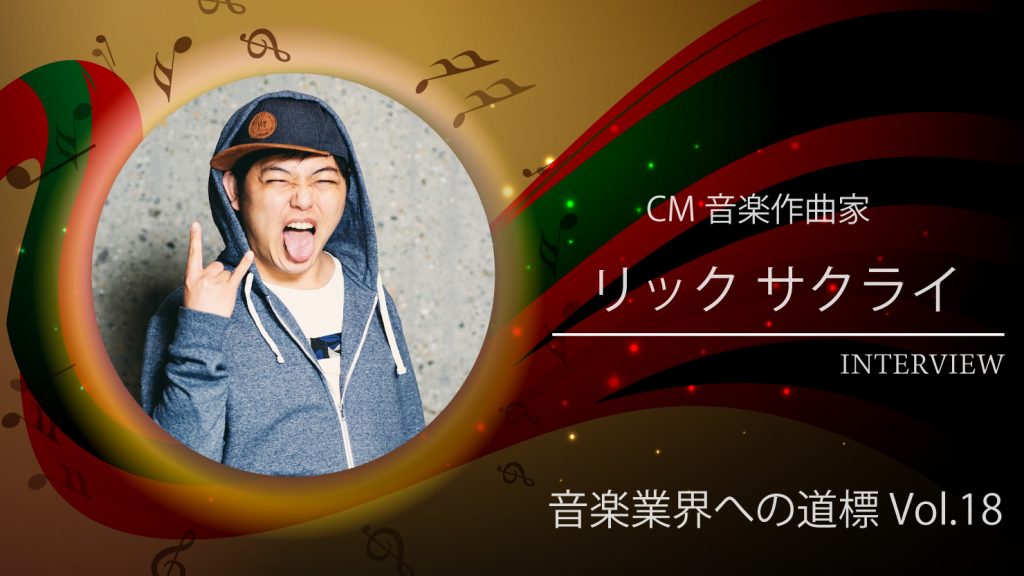
An interview with commercial music composer Rick Sakurai
For the 18th installment of Pathways into the Music Industry, we interviewed Rick Sakurai, who composes commercial music at MassiveMusic Tokyo, which we introduced in another article before!
Rick is from the US, and we heard lots of interesting stories from a global perspective. Please give it a read.
Profile
This is how commercial music is made
Thank you for taking the time to talk with us despite your busy schedule. First, could you tell us what kind of work you're doing now?
I'm currently working at MassiveMusic as a composer and creative director.
What does a creative director do?
MassiveMusic is both a music production company and an advertising company, and the advertising industry is usually divided into many roles. Among them are copywriters who write the text for magazines and producers who manage money and project schedules, and the creative director oversees and directs the specialized creative areas.
For example, when you hear "McDonald's" you think "a fun atmosphere", "Apple" is "simple and cool", and "NIKE" is "cool and weighty": every company and product has its own image.
Our job is to help with that image from the "sound side."
Rick Sakurai, arrangement: PANTENE "#I'm a Miceller" spot
So perspectives beyond those of a composer become important.
Making the music, of course, but it's a job of "creating a brand image."
How is commercial music actually produced?
There are many patterns, so I can't generalize, but let me explain the standard flow.
First, to make a commercial, there's the brand being promoted and an advertising agency.
As that agency does the casting, like "Let's give the video production to this company" and "Let's ask this actor," they decide "Then let's give the music to this company," and that's when we get the call.
We form a team like that and hold meetings with the company and agency about the target and the selling points of the product.
When you get the call, has the kind of music already been decided?
No, first we decide on reference tracks from existing songs. We call this "music selection research," and we pick out parts, like "the good part of song A" and "this feel from song B," while deciding the overall image and direction.
So you don't just start making it right away.
If you make something and it turns out "something's off," the time and effort are wasted, and above all, so many people are involved that it's important for everyone to face the same direction.
After the references are decided, is it finally time for production?
Yes. This is also case by case, but we often proceed at the same time as the video production. We receive a simple storyboard called a "V-conte" (video storyboard) and compose along the lines of "The product appears at X seconds, so build up over X seconds..."
These video storyboards vary, from hand-drawn flip-book-style videos to four-panel comics.
We produce in parallel while communicating with the video production team, and finally the work is completed by combining what both sides have finished.
Rick Sakurai, composition: UNIQLO "Ultra Stretch Pants for KIDS" spot
So a lot is packed into such a short time.
The advertising industry has very tight schedules. It's challenging.
The road into the commercial music industry
How did you come to work in commercial music?
I was born and raised in the US and went to Berklee College of Music in Boston.
I graduated in 2009, but at the time the economy was terrible because of the Lehman shock.
There were about 500 graduates in my year, and of those, maybe about ten had their path after graduation decided. That's how few jobs there were.
Japan was hit hard too, but it must have been even worse in the US...
But in my case, when I graduated, I'd already gotten engaged to my girlfriend, whom I'd only been dating for three months.
What! You were still in your early twenties, and that's a very quick marriage!?
That's right. (laughs)
Now we have kids and we're doing well and getting along, but at the time I was pretty panicked, so I got hired as an intern at a commercial music company in New York through someone I knew.
But the working conditions were very hard: I worked from 8:00 to 21:00 for 10 dollars a day.
That doesn't sound like enough to live on...
It was an amount that almost all went to lunch and the round-trip fare. I got by with part-time jobs at bars and restaurants on weekends and late at night.
On top of that, the production company had a strict hierarchy, like a ranking system, and from the time I joined, I was only allowed to go buy coffee or answer the phone.
I think it wasn't just because I was new; there were various other reasons too.
That sounds really harsh. What happened after that?
About three months after I joined, my wedding was set. So I thought, "This can't go on," and I took videos I'd found on YouTube and so on, wrote my own music to go with them, burned them onto a DVD, and marched into the president's office with it.
Th-that's bold...
I was totally terrified, though. (laughs)
But luckily it seems the president had a free day and listened to it right then and there.
The president liked it, gave me a composing room from the next day, and I became a staff member.
That's how I entered this industry as a professional.
It's so dramatic my head is spinning. (laughs)
After that I was able to work seriously on commercial music, and after several years there I switched to freelance.
Then about three years ago I moved to Japan, partly due to family circumstances and work.
And then MassiveMusic Tokyo was founded.
MassiveMusic and I had a connection from my freelance days, and when MassiveMusic Tokyo was founded, I came to work here.
Through all those hard times, there must have been the option of a path other than music. Why were you able to get through without giving up?
I thought that no matter how bad the economy, advertising would never disappear. Advertising always exists within the cycle that keeps the economy going, and naturally that creates demand for music too.
Rick Sakurai, composition: Tokyo Electric Power Company Holdings, "TEPCO Sokuho: The Honest Me" spot
The future of commercial music, and of Rick
What are the differences between Japanese and American commercials?
In America, there are few tie-in commercials that use artists' songs. That's partly simply a budget issue, and also because there's concern that the product's impression will be overshadowed by the artist's image.
In terms of musical style too, America tends to emphasize rhythm and groove, while Japan tends to emphasize melody and harmony.
It's not that one is better; I think each has its own strengths.
Commercial music seems like work that requires a big toolbox. Do you do any research?
As a student I was in a band as a keyboardist, and back then I loved progressive rock and often played Dream Theater. Dream Theater is basically rock, but it's a band with really interesting arrangements that suddenly turn orchestral or comical.
Influenced by that, I tried all kinds of arrangements with friends, and I think that's how I developed a lot of things.
Please tell us about the gear you use.
For DAWs, I went from ACID to Digital Performer and now use Pro Tools. For software instruments, I mostly use Native Instruments. I love them because they can handle a wide range of genres.
I also quite like instruments from Spectrasonics, 8Dio and Sample Modeling.
For plug-ins, I often use Waves and UAD. I'm also fond of Slate Digital plug-ins. They look cool, and I think they're great value for money.
Do you have any advice for those aiming to enter the music industry?
I think it's important to acknowledge your weak points and keep polishing your strengths.
Sometimes you also need to give up on your weak points.
For example, when I write music as a composer, I'm good at music with clear emotional expression, but not good at super-artistic pieces. But as a creative director, I don't make everything myself; when needed, I commission outside composers.
Everyone has things they're suited and not suited to, their own "color," so I think it's good to develop what you're good at and leave the areas you're weak in to others.
Also, it's important to actively create opportunities for people to get to know you. When a project goes ahead, it's often not just one song being made; several are gathered and the song is decided in a competition format. So I think that if you first get more people to know you and can join the competition, the path will open up.
How do you think the commercial music industry will change from here?
It's a problem for the whole industry, but the reality is that budgets keep shrinking. This isn't limited to music; the same goes for spending on advertising itself.
How flexibly you can respond is really important, and times are changing so that people with many skills are valued.
In my case I can play keyboards, of course, as well as guitar, bass, banjo and trumpet, but beyond that it's becoming a contest of how many hats you can wear, including engineering and sales.
Then, as creators, there must also be more concern about being used cheaply and conveniently...
Of course that way of commissioning isn't good, but I think the creators who accept it also bear some of the responsibility.
To avoid lowering your own value, it's important to have a business mindset. Making a place to talk things through properly, or if you take something on cheaply, securing a commitment for the next job in return: I think musicians need to properly do what ordinary working people do as a matter of course.
In my case, I honed those skills when I was freelance.
That's absolutely right. Finally, please tell us your goals going forward.
My goal is to raise how much the general public values music.
When I was a kid, I spent all my allowance on CDs, but I don't think young people today do that much at all.
With the rise of streaming services, music is becoming easier to access, but that's a separate matter from its value rising.
In commercial music too, the visuals are given top priority and music often comes last, so I hope to take various actions to bring it up to the same level.
Thank you very much.
Rick Sakurai, composition: Call of Duty: Ghosts "Official Trailer"
Facebook: @massivemusicagency / facebook.com/massivemusicagency
Twitter: @massivemusic / twitter.com/massivemusic
Instagram: @massivemusic / instagram.com/massivemusic
LinkedIn: MassiveMusic / linkedin.com/company/49637/
Interview and text: momo (Mamoru Tanoue)

Profile: Born in 1995. A Digital Performer and Ableton Live user. After graduating from music school, moved from Fukuoka to Tokyo as a composer.
Made a debut as a writer in August 2017, composing and arranging for Tsukicro's "STARDUST".
With the motto "songs that touch the heart", a multi-player who handles everything from lyrics and composition to arrangement and recording.
Also active as the composer and arranger for the art unit "Shiro".
Website: Music Designer momo
Twitter ID: @momo_tanoue
NEW ARTICLES
Latest English Articles