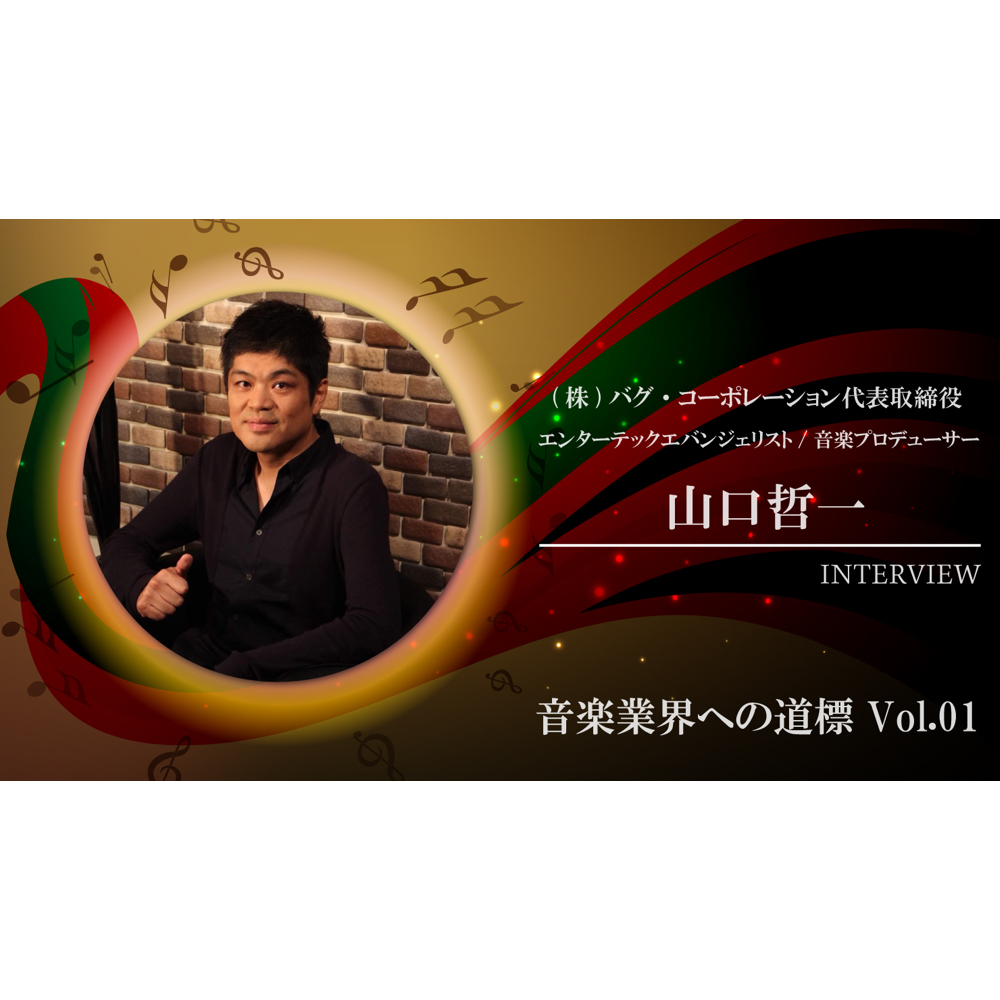
Interviews with People Active in the Music Industry
"I want to work in the music industry, but I don't know what paths there are."
"I want to become a creator, but I don't know what to do."
I think many people feel this way.
So starting with this article, we will publish occasional pieces introducing people who are active at the forefront of the music industry.
For the memorable first installment, we spoke with Norikazu Yamaguchi, an entertech evangelist who runs the creator training course "Yamaguchi Seminar," has written many books related to the music industry, and has an unrivaled network in the industry.
In fact, Yamaguchi's 2013 book "Entrepreneurs Born in the '80s Who Will Change the World: Choosing to Start a Business (SPACE SHOWER BOOKS)" features interviews with many entrepreneurs. They include Shuichiro Nishio of CREOFUGA Inc., which runs "Audiostock," a service we have covered in a previous article; Kentaro Kaiho of WorldScape Inc., which runs "Frekul"; Akiomi Fumihara of nana music Inc., which runs "nana"; and Iichiro Noda of TuneCore Japan K.K., which runs "TuneCore Japan." We were amazed by Yamaguchi's foresight in interviewing, more than four years ago, the companies and services now making waves in the music industry.
We heard many valuable insights from Yamaguchi, who always acts while looking one step ahead of the times, so please give it a read!
--Thank you for your time today despite your busy schedule. First, please give us a brief profile of yourself.
Norikazu Yamaguchi (hereafter Yamaguchi: ) I hardly went to university and dropped out, faded into the music industry, and founded my own artist management company (BUGcorp).
Among readers of this site, some of you may know drummer Shuichi "Ponta" Murakami or lyricist Saori Kodama.
As a producer, I brought acts such as Sweet Vacation, Pistol Valve and Tokyo Lsmusica to their debuts.
I served as a director of the Federation of Music Producers Japan for eight years. I'm on the editorial committee of the Ministry of Economy, Trade and Industry's "Digital Content White Paper."
I've published ten books since 2011, and a few years ago I started calling myself an entertech evangelist. I work on developing talent and creating places where new forms of expression are born.
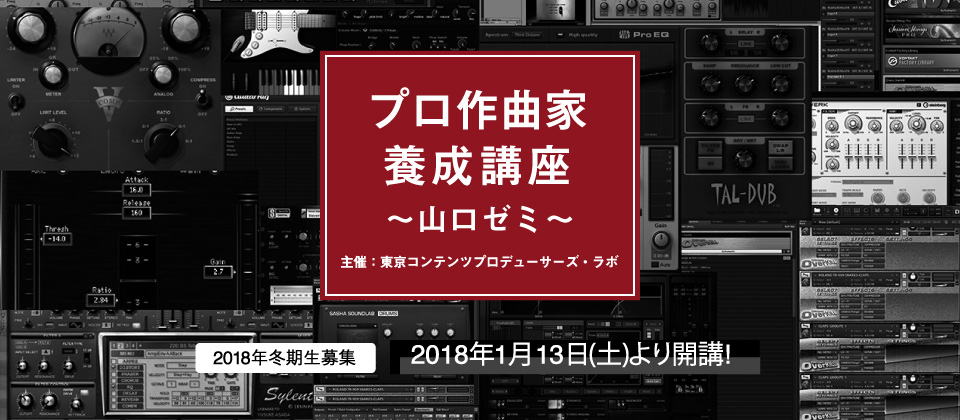
--The Yamaguchi Seminar, positioned as a training course for creators, is one of your signature activities. What led you to start it?
Yamaguchi: The connections between people during recording have become weaker, haven't they? I think music production has become too much of a solitary task.
These days you can do everything from composing to recording, mixing and mastering at home without going to a studio, so in a sense it's only natural, but it wasn't like that in the past.
Many of the sound producers active today have actually had a major-label debut.
The reason is that in the past, the average contract after a major debut was "three albums in three years." For three years you could experience professional-quality music production.
Back then you couldn't record at home, so the only way to produce was to gather in a recording studio. That experience developed the skills that later let people become sound producers, and it also built connections in the industry. Now record labels don't have the leeway, and they can no longer develop young musicians in the production setting.
The level of Japanese music has been very high, even compared with global pop standards. But as connections between people weaken, the environment for passing that on is disappearing.
That sense of crisis was the reason I started the course. I named it the "Yamaguchi Seminar" to make the responsibility clear. I don't mind putting myself on the spot. (laughs)
--Specifically, what was being "passed on" in the music industry back then?
Yamaguchi: It's comprehensive. Listening to good sound is important, and communicating with top recording engineers is also very valuable. I don't write lyrics, compose or arrange, but I understand "what makes creators fail or succeed" and "what kind of person is suited to this work."
It's a sense you naturally develop while working with all kinds of musicians in the industry. So everyone with a certain amount of experience knows it.
But those things haven't been put into words; they are "the industry's tacit knowledge."
Not just composing techniques: the music industry has a great deal of "common sense that only industry people know," and you could never learn it by shutting yourself in at home writing songs.
That's why I try to pass on that "tacit knowledge of the industry" as much as possible through the Yamaguchi Seminar.
--I see. In fact, your book "Straight from the Pros! The Road to Becoming a Professional Composer: Common Sense, Tactics and Mindset for Making Songwriting Your Job" also includes a lot of that kind of content.
Yamaguchi: That's right. I wrote that book while running the first term of the Yamaguchi Seminar. I think the only way to become a professional is to experience all kinds of difficulties firsthand in real work settings and keep struggling to overcome them. I've never seen anyone become a professional by being taught like at an ordinary school: do this assignment, and when that's done, do this next. I aimed for a school that brings you close to that professional environment while giving you a little push.
Many young creators put their effort in the wrong direction. Correcting misunderstandings and mistakes, and then letting them struggle as much as they like on their own: after four and a half years, I think that approach to developing professionals was the right one.
--Besides the basic course, the Yamaguchi Seminar has an "Extended Course." What is that?
Yamaguchi: It's an advanced course open only to people who have taken the Yamaguchi Seminar.
If you take the Yamaguchi Seminar, you should come to understand "how you can become a professional composer." But there's a wall between "understanding" and "being able to do it," so it's a course that incorporates more practical content so that you "can do it" at the same level as professionals.
Besides regular lectures, there's online interaction and many "social gatherings." That applies to the Yamaguchi Seminar as a whole, though.
I only found out later that ordinary seminars don't have after-parties. (laughs)
--So the social gatherings are about valuing connections between people?
Yamaguchi: That's right. Some people say the social gatherings are the Yamaguchi Seminar's biggest attraction. (laughs)
For me, it feels normal to have an after-party after a talk event (laughs), but being able to talk about all kinds of things more candidly with the lecturers is valuable.
Being able to talk with peers who share the same goal of succeeding as composers is also big.
It seems conversations at drinking parties often turn into "Let's write a song together!"
--You have also written books such as "Cutting-Edge Composition: A Textbook on Co-Writing (Role-Sharing Songwriting Creates Chemistry!)," and you have long advocated collaborative production, so-called co-writing. Specifically, what is co-writing, and what are its benefits?
Yamaguchi: I think professional writers overseas compose perhaps 80 to 90 percent of all their songs through co-writing. Only occasionally do they complete a song on their own. In Japan, however, few people were doing it, so when I started the Yamaguchi Seminar I set two themes: "win competitions" and "acquire the mindset and skills of co-writing."
When it comes to co-writing, I think it's fair to say we are the headquarters in Japan. Over the past few years we've published books and held co-writing camps with top writers, including from overseas, so it has become common in Japan too. We also held workshop-style events with CREOFUGA so that amateurs could enjoy co-writing as well.
With CREOFUGA, we also co-developed "CoWritingStudio," a communication tool that's handy when composers co-write. It's still running as a beta, but it's public, so anyone interested should give it a try.
One benefit of co-writing is of course that it's more efficient than working alone. But the essence is aiming for multiplication rather than addition, and for chemistry between writers. Our basic idea is that you should aim for "great songs born from a chemical reaction that only this particular group could create." It's a bit like being in a band together. Many people become close by sharing deadlines. (laughs)
Graduates of the Yamaguchi Seminar also run a creator collective called "Co-Writing Farm." It's a free association with no exclusivity, but it also has an agency function, and the number of accepted songs is increasing.
--Being able to improve your skills with peers who share the same goal is a big advantage.
Yamaguchi: Production inevitably tends to become solitary work.
The Yamaguchi Seminar is held four times a year, so if you're interested, I'd love for you to join.
The ages vary, and about 30 percent of participants are women. Many students commute from the regions, from Hokkaido in the north to Kagoshima in the south. I was surprised when someone from Taipei took the course. (laughs)
--From overseas, that's amazing. (laughs)
Yamaguchi: They commuted using low-cost airlines. (laughs) Not just the Yamaguchi Seminar: I think the music industry will become more and more global from now on.
China, once a paradise for pirated copies and illegal sites, has finally issued a national plan to develop its music industry, and flat-rate unlimited music services are spreading rapidly.
It's said that it will overtake the size of Japan's recorded music industry in about three years. China has already surpassed Japan in IT services, but I think the advantage Japanese people still have is a high level of creativity, and I want to make use of it. Especially when it comes to the diversity of pop music, Japan has an overwhelming advantage.
--So the music industry keeps changing. Are there any changes that directly affect creators?
Yamaguchi: Well, A&R people are getting worn out by so-called large-scale competitions, and I think the era of competitions will soon be over. At CWF, rather than waiting for competitions, we do a "pitch" approach where we have the artists we want to sing our songs listen to our demos, and acceptances have increased. Sonoko Inoue's "First Date" and Namie Amuro's "Hope" are songs that started from proposals by CWF members and were released.
Competitions often have deadlines four days away, right? It's a system that wears creators out. With the pitch approach, you can create songs that prioritize polish without worrying about deadlines, which is also a benefit for A&R.
In America this approach is more mainstream, and I think things will change more and more from now on.
--In that case, connections with A&R, in other words a network, become necessary. That was true for me as well, but I think many people, especially those living outside the big cities, struggle with "how can I build a network?"
Yamaguchi: If you belong to an agency, you can go through them, and I hope people will make good use of me and the Yamaguchi Seminar.
But generally speaking, the center of Japan's music industry is Tokyo, so there are many people you can only meet in Tokyo.
Tokyo will probably remain the center from now on, too. Since production can be done remotely these days, you don't need to live there, but you should build your network in Tokyo. Now there are low-cost flights and long-distance buses, so coming only when necessary is also an option. A network isn't something you can build by trying to build it; it's simply the result that forms on its own while you're working toward your goals.
On the Future of the Music Industry and Creators
--I'd like to dig a little deeper into "talk about the future." What do you think about today's era, in which CDs are no longer selling?
Yamaguchi: It's true that CD sales are falling year after year, and record labels are struggling. However, the amount of copyright royalties distributed by JASRAC has held steady at 110 billion yen for more than ten years without falling.
--So even though CDs aren't selling, the amount of money flowing to creators hasn't changed much?
Yamaguchi: Exactly. Copyrights generate royalties through all kinds of uses, such as broadcasting and karaoke. Going forward, the decline in CDs will likely be covered by the growth of streaming.
However, as the share of streaming increases, the proportion of catalog titles rises. Until now, new releases have accounted for 90 percent of record labels' sales, but with streaming services, catalog titles are listened to as much as new releases. In other words, I think we'll see a shift where the money that comes in at the time a song is released decreases, but a good song keeps being listened to and becomes an ongoing source of income.
--I see. To put it in extreme terms, the structure where writing a good song earns money hasn't changed.
Yamaguchi: Of course, success takes a different form for each person, and ways of living and thinking differ too, so I can't say in general what's good or bad, but I don't think there's much reason to be pessimistic about the times. And looking overseas will become important too.
As I mentioned earlier, the amount of money flowing into the music industry in China is now increasing explosively, and by thinking about the music industry with a broad perspective, you may see the direction for your future activities.
--In your view, is there anything that people who succeed in music have in common?
Yamaguchi: It changes a lot depending on what you define as success.
With that in mind, what I can say is "people who value connections and relationships with others."
There's also the "power of luck," of course, and an "attitude of always continuing to grow" is important too.
If you can keep going by always pursuing something new, struggling and winning things for yourself, I think you'll come to see something.
--So it's important to always keep thinking and keep moving. Finally, please say a few words to the people reading this article.
Yamaguchi: Not just in music, we're at a major turning point in the times, so I think it's important to always keep a broad perspective in your activities.
Lately I'm watching many things, such as artificial intelligence, blockchain and smart speakers, but I'm watching with anticipation how the visual tool TouchDesigner is spreading. It's software with intuitive operation similar to a DAW, so composers should find it easy to get into.
I think it's good to keep a broad perspective and then throw yourself completely into the thing you feel is "definitely the one for me!"
--Thank you very much.
What did you think? I think it was packed with very useful insights for people aiming for the music industry or to become creators.
If you want to learn more, a "Yamaguchi Seminar Winter 2018 Information Session" was scheduled to be held, so attending might have been a good idea. Thank you for reading to the end.
"Yamaguchi Seminar Winter 2018 Information Session" (This event has ended)
- Date and time: Saturday, November 25, 2017, 11:00-12:00
- Fee: Free
- Venue: Tokyo Contents Producers Lab
- Tokyo Animation College 2F, 1-1-8 Shimo-Ochiai, Shinjuku-ku, Tokyo. A 5-minute walk from JR Takadanobaba Station
For details, see here.
About the Author

Interview and text: momo (Mamoru Tanoue)
Born in 1995. Digital Performer user. Moved from Fukuoka to Tokyo as a composer after graduating from music school.
Debuted as a writer in August 2017, composing and arranging for Tsukicula's "STARDUST."
With the motto "songs that pierce the heart," momo is a multi-player who handles everything from lyrics, composition and arrangement to recording.
Also active as the composer and arranger of the art unit "Shiro."
Twitter ID: @momo_tanoue
"Shiro" Website: https://www.shiro.space/
"Shiro" Twitter ID: @shiro_unit
NEW ARTICLES
Latest English Articles