An interview with Keigo Hoashi of MONACA
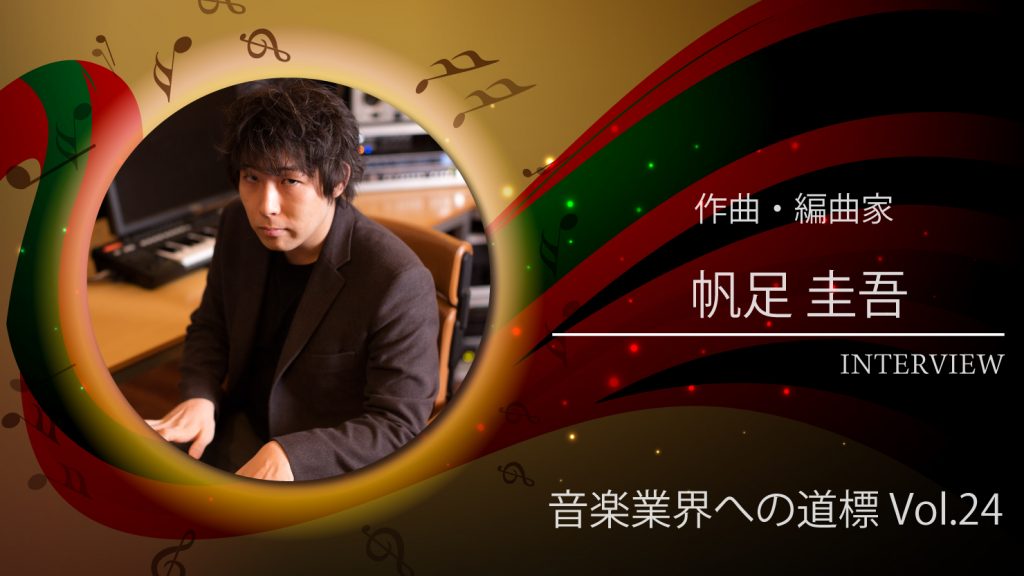
Born in Tokyo. Graduated from the Film Scoring department at Berklee College of Music.
Started classical piano as a small child and went to study in the United States after high school. After returning to Japan, joined MONACA in 2009. (See the list of works here.)
For the 24th installment of Pathways into the Music Industry, we interviewed Keigo Hoashi, a composer and arranger at MONACA Inc..
Hoashi works at MONACA, a studio so popular that no anime song fan hasn't heard of it, and shared many interesting stories, from production techniques to the right mindset.
Please give it a read!
Hoashi's approach to music production
Thank you for taking the time to talk with us despite your busy schedule. What kind of work are you doing now?
I compose at MONACA Inc.
I mostly handle background music for anime and games, but I also make vocal songs.
Please tell us about the gear you use.
I use Logic on a Mac. I was originally on Digital Performer, but I switched around the time I joined MONACA.
I look for new sound sources each time, so I don't really have an "always this one!" instrument.
For orchestral libraries I like Spitfire Audio and VIENNA.
How do you choose between them?
Spitfire Audio feels like the sound comes with the room ambience included. That's the trend in recent orchestral libraries.
VIENNA, on the other hand, is quite dry. It's the kind of library that says, "Handle the reverb and everything yourself."
I use the two according to the purpose, layering them carefully.
Are there any plug-ins you particularly like?
Lexicon products are ones I quite like.
I also use FabFilter Pro-Q 2 a lot.
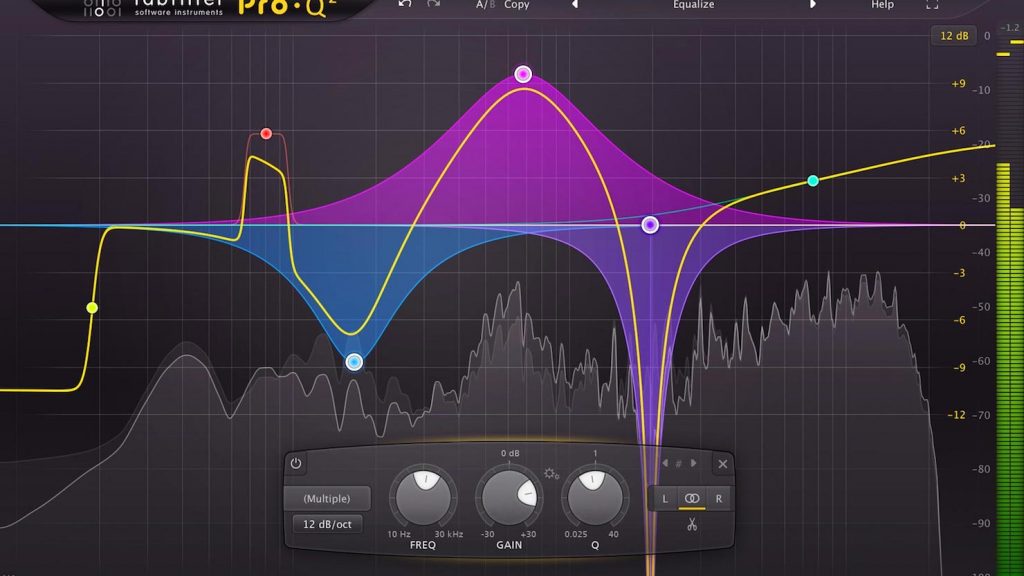
(FabFilter Pro-Q 2)
How do you go about composing?
Before I start writing a piece, I always think first about "what the music is for." I'm very conscious of that.
I often score soundtracks, so it's important to know what kind of music the client wants to put with their work.
For an anime, for example, I think about the target audience that will watch it: "For viewers like these, this kind of music might work better."
So you even take the target audience into account.
Of course, I think the job comes to us with the audience already considered to some extent, but I try to think it through a little further.
I guess, "If they like this kind of anime, they probably like this one too," and then do various research and check things out.
That shows me the direction for the music, so I keep that flavor while making sure my own color comes through.
So you cover the key points while also bringing in originality.
That's right.
I think things through like that, and once the music is playing in my head to some degree, I start putting it down. Sometimes the whole piece comes to me and sometimes just the chorus. When it's only a part, I build the piece around it.
So rather than making music while playing sounds, you picture it in your head first and then put it into the computer.
I think it through until even the instruments and the ensemble are decided, so getting that far is quite hard.
Once the basic form is done, I sometimes rework it, like playing the piano to try more interesting chord progressions.
Do you ever get stuck?
Oh, I get stuck all the time. (laughs)
When that happens, I just stay at my desk and keep at it.
The world of anime music
I have the impression that soundtrack work comes with tight deadlines.
Yes. TV anime in particular often has a very packed schedule, and it's common for it to be a case of "If this is late, the episode can't air."
To make absolutely sure the deadline is met, the recording dates are set as soon as we receive the schedule, so the final stretch is truly chaotic.
How many pieces do you write for one work?
For a one-cour series (about 12 episodes), it's roughly 50 pieces. I make them in about a month to a month and a half.
That's an amazing number of pieces in that time...
To be able to handle sudden schedules, I make a point of doing the research I mentioned earlier on a daily basis.
I've always loved anime and games, and when I'm watching something and feel, "This moment, this scene was really great," I watch it over and over and study it in all sorts of ways.
Of course, it's thanks not only to the music but to many factors like the visual direction, but I think it's very important to work out why I thought it was good.
For example, there are many patterns even for the music used in battle scenes.
Sometimes it's better to hype it up in an over-the-top, chuunibyou way, and sometimes to make it heavy and weighty. Depending on the color of the work, even similar scenes get completely different music.
If I think, "This kind of music is unusual for this scene," I wonder whether it's the composer's personal color coming out or whether there's a different intention behind it.
When I listen to the soundtrack, it sometimes sounds completely different from how it felt in the show. Anyway, I research thoroughly.
Do you feel that anime music has changed between the past and now?
For soundtracks, there hasn't been that much change. The basic psychological staging, like minor chords for a sad mood and major chords for a bright one, doesn't change.
That said, the sound sources used of course differ according to the trends of the time.
Are there differences between soundtracks for live-action and for anime?
The overall balance of sound and picture is completely different.
This is just my personal view, but anime has less visual information on screen than live-action. Also, many works lean toward fantasy, with settings that couldn't exist in reality.
So the music often carries more weight relative to the picture, and flashy, rousing music tends to fit well. That's even more true if the work's direction is "Show me something that doesn't exist in reality."
In live-action, on the other hand, there's more information on screen, so my impression is that somewhat lighter music tends to fit.
When I worked on a live-action project before, I tried putting music I'd made for anime against the live-action footage, and it didn't fit at all. Both the picture and the music were asserting themselves so strongly that it somehow turned into a gag.
You build that kind of sense by watching and listening to lots of works.
So it's important not only to have technique but to sharpen your senses.
Honestly, I think you can master the technical side if you keep at it, but personally I think you need the end user's point of view, thinking about how the people actually watching will feel.
Everyone receives a work completely differently, so it's very important to be clear about your target: "Who am I delivering this to?"
Hoashi's path so far
When did you originally start music?
My mother is a classical pianist, and I started piano at around three.
But classical music has a lot of rules, like "This composer did it this way, so play it like this." I was the kind of person who wanted to play the way I liked, so it just didn't suit me.
So in high school I wanted to go down a different path, got into band-oriented music, and later went on to Berklee College of Music.
What led you to go to Berklee?
I'd always loved film scores and Western music and was thinking of aiming for that path, but there was no school in Japan specializing in teaching film scoring.
So I did a lot of research and found Berklee.
Studying abroad seems like it takes a lot of courage.
The decision itself took courage, of course, but I remember being pretty excited when it was actually time to go.
My parents were hands-off, too, and told me, "Do what you like."
How did you get past the language barrier?
I studied a little before going to the US, but once I got there, I couldn't make myself understood at all. From there I studied like crazy, and in about one or two months I could communicate to some degree.
I lived in a dorm, so people around me taught me, and I learned pronunciation from what I heard on TV.
Until I could really follow along, I recorded my classes and listened back desperately when I got home.
But I was able to communicate more and more, so it was a fun process.
Is there anything that makes you feel going to Berklee was a good choice?
Part of it is that it let me study to be a film composer, but the experience of meeting all kinds of people from different cultures was really valuable.
It broadened my perspective and had a good influence on my music production too.
Musical tastes are completely different from country to country. In Japan there are many songs that appeal to emotion through melody, whereas in North America the emphasis is on track-making and the overall vibe of the song.
It also got me thinking about why that difference came about.
Of course, I think both are wonderful.
What path did you take after graduating from Berklee?
I did band work here and there. In total, I was in the US for about six years.
What led you to come back to Japan?
I was performing at bars and such, but it didn't really earn much, and it turned out I needed a visa to keep going. Getting one costs a huge amount in lawyer's fees.
So I thought a lot about what to do.
I felt that if I continued with the band, it would go better if I stayed in America, but for composing I liked Japanese music more, so I should go back.
After thinking it over, I decided to return to Japan and do soundtrack work.
After returning, did you have any work lined up?
None at all. (laughs)
While I was wondering what to do, a composer I was close to invited me to a kind of "composers' drinking party." When I mentioned I was looking for work, I heard, "Satoru Kosaki of MONACA seems to want an assistant."
Then I was introduced to Kosaki and started working as an assistant.
After that I officially joined MONACA, and that's how it went. That was about ten years ago now.
I imagine MONACA requires production skills across a wide range of genres. How did you hone your skills?
I originally liked and was good at symphonic music like film scores and metal, but I wasn't very good at programmed, digital-sounding music.
But our president, Okabe, is better at that side, so I broadened my range of genres by repeating trial and error: making something, having Okabe listen, and revising.
I don't think I would have improved on my own, so I'm very grateful that there are people in the company who point out what's not working.
Hoashi's path ahead
Please tell us about your goals going forward.
I hope to keep doing this job for a long time while making better and better works.
There are trends that come and go, and all sorts of difficulties, so I want to work hard and survive.
On top of that, I want to develop the parts that make clients feel, "It has to be this person."
There are fans who've supported me for a long time, so while keeping the strengths they've valued in me, I want to raise the quality to match the times and keep expanding in new directions.
Thank you. Finally, please share a message for those aiming to enter the music industry.
It can be anything, like a favorite band, anime or game, but I think the most important thing is to dig into "what you think is good about that work and what moved you," and to be clear about what you like.
If you understand that yourself and then create, I think you can make works that pierce right through people who love the same thing. On the other hand, if you create from vague feelings, it ends with "It's kind of nice, I guess."
The greater the passion that says "This person really loves this," the more it becomes something somehow different from everything else the moment it's heard.
Why not try not only to keep writing music, but to experience lots of works and pursue what you love to the fullest?
Thank you very much.
Interview and text: momo (Mamoru Tanoue)

Profile: Born in 1995. A Digital Performer and Ableton Live user. After graduating from music school, moved from Fukuoka to Tokyo as a composer.
Made a debut as a writer in August 2017, composing and arranging for Tsukicro's "STARDUST".
With the motto "songs that touch the heart", a multi-player who handles everything from lyrics and composition to arrangement and recording.
Also active as the composer and arranger for the art unit "Shiro".
Website: Music Designer momo
Twitter ID: @momo_tanoue
NEW ARTICLES
Latest English Articles