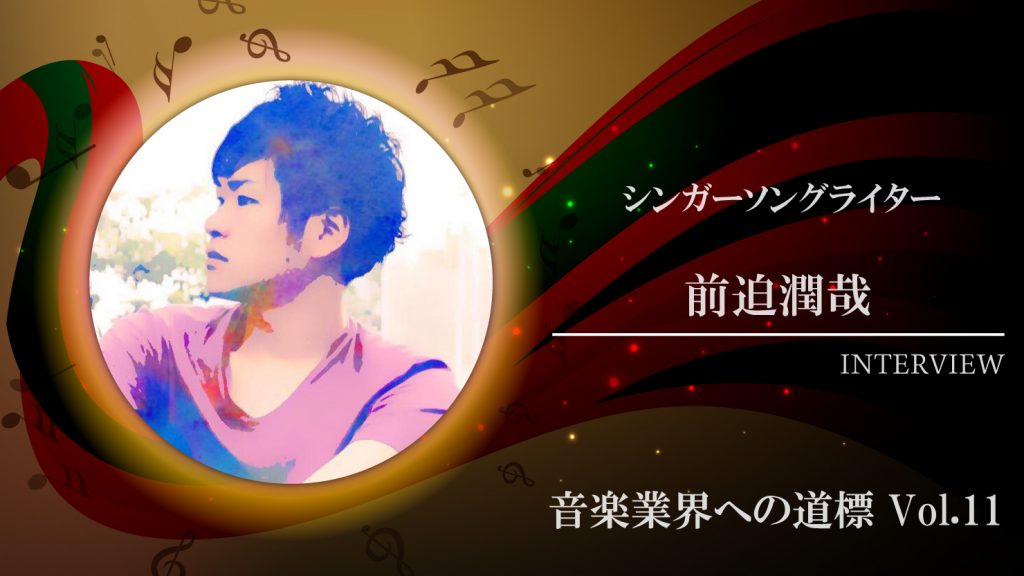
For the 11th installment of Pathways into the Music Industry, we talked with singer-songwriter Junya Maesako. As a topliner, Maesako has co-written many great songs with all kinds of composers. Many of you have probably heard Keyakizaka46's "Garasu wo Ware!," which recently passed a million.
Once again we heard some valuable stories, so please give it a read!
Junya Maesako | Profile
From Kagoshima.
Graduated from a teacher-training university, but moved to Tokyo wanting to chase the dream of becoming a singer.
When writing songs, makes a point of fully becoming the artist and writing from their feelings.
Also highly regarded as a singer, winning the grand prize in a nationwide vocal audition organized by Ryosuke Imai. On TV Asahi's "Pyramid Derby," sang Naotaro Moriyama's "Sakura" solo while impersonating the singer and successfully fooled the studio guests.
First, could you tell us about the work you're currently doing?
Right now, as a topliner, I mostly team up with various composers to create melodies. I also write lyrics, and since I was originally a singer, I've been doing more scratch vocals and vocal direction for artists.
You say most of your composing is done through so-called co-writing. Was Keyakizaka46's 6th single "Garasu wo Ware!," which could be called your signature song, also co-written?
Yes. I co-wrote it with Yasutaka.Ishio.
There are various ways to co-write. In what order do you make songs?
Taking "Garasu wo Ware!" as an example, Ishio first brought a fairly finished track, and I added a melody to it. Then we aligned our images and brushed it up until it was finished.
Of course, with some people we work out the chords together, and I try to adapt to whatever method is easiest for the other person.
(Keyakizaka46 "Garasu wo Ware!" MV. Co-written by Maesako and Ishio.)
What matters when co-writing
About how many people have you co-written with so far?
I don't know the exact number, but maybe 30 to 40. Right now I'm co-writing with about 10 composers and track makers.
When working with so many people, is there anything you pay special attention to?
I try to share the same image and direction as much as possible and make the goal clear. It's very important to share the same way of thinking about "who it's for and what approach to take." In that sense, in my case I often communicate directly by phone rather than just by text.
I often see the opinion that "you shouldn't co-write with the same members," but I don't think that's true.
By working with the same people again and again, you sync up better, and by eliminating gaps like "chord-wise it goes this way, but the melodic flow wants to go that way...", I think songs with long lives are born.
When you've just met, there's a lot you don't know about each other.
Of course sometimes you sync from the start, so I can't generalize. If it's a relationship where you respect each other, I think asking for revisions goes smoothly too. It's good to have a relationship where you can say, "I want this changed for this reason," and "Then how about this?"
Conversely, what are your criteria for people you'd like to work with?
On the technical side, I'm really happy when someone can make tracks that sound great. When I think up melodies I dive into the world of the piece, so if the mix is in order and the finished form is visible to some extent, it's easier to get into that world.
What do you think is the most important thing in co-writing?
Not halving the effort, but each person sweating and giving 100%. That this ultimately produces more than twice the power is the real joy of co-writing. If you approach it as a way to cut corners or to hand off what you lack, I don't think good songs will come out of it.
It's also necessary to have a director's perspective, or a third-person perspective. If you get too absorbed in a song, you get stuck in your head and lose sight of the right answer. So having someone who can step back and calmly think, "Is this really right?" leads to better work, I think.
The road to becoming a songwriter
When did you start aiming for the music industry?
In junior high, I'd sing CHEMISTRY songs, record them on cassette and harmonize with myself while playing them back for fun, and from then on I wanted to enter the music industry as a singer.
But I lived in the regions, so I didn't know any way into the music industry other than "winning an audition."
So while hoping to become a singer, I also had the realistic dream of "becoming an elementary school teacher."
I'm from the regions too, so I understand. The road into the music industry feels incredibly narrow.
Especially around high school entrance exam season, you have to choose between dream and reality. In my case, I chose the dream of teaching and left Kagoshima for a university in Yamanashi.
So you started down the path to teaching for a while.
Yes. But even after entering university, I kept singing, even if it was only entering karaoke contests.
Then in my third year, a junior happened to be a track maker and asked me, "Could you add a melody and lyrics to the chorus of my track?" That's how I started composing.
Meeting that track maker feels like fate.
It means I started before the word "co-writing" even existed in Japan. (laughs)
We made several songs together, and by the second half of my third year I'd started to want to "move to Tokyo and do music seriously."
After graduating, I worked part-time in Tokyo while finding live events on mixi and playing them, day after day.
It's a path everyone goes through, but balancing a part-time job and music is hard.
I worked as a singer for about three years, but I felt this wasn't going to work. I quit all my part-time jobs, focused for a month, wrote 10 songs and released a free album. From then on, things started flowing well for me.
I kept writing songs constantly and even won the grand prize in a vocal audition.
Around then, a track maker I knew asked me to sing a scratch vocal, and I ended up writing the melody too.
The president of the agency that track maker belonged to liked that song. That's when my career as a composer really began.
What I keep in mind when producing
You said you "dive into the world" when making melodies. Do you have any strategies for when you get stuck?
There are various ways, but when I have time, letting it sit for a day is effective. By working on a different project for a while and coming back the next day, I can think about it with fresh ears.
It's also important to "try smashing it once." I try not to hold on too tightly to my own fixations.
What I think is cool isn't necessarily the same as what the artist or director I'm writing for thinks is cool.
That's a way of thinking unique to creators.
I think professional composers are better off being chameleons. In that respect, I may be pretty well suited. I'm good at impressions, too. (laughs)
As you said earlier, stepping back to think may be the first step to letting go of fixations.
It might be easier to understand if you take music more by feel rather than being bound by theory. Like describing it in terms of "colors" or "emotions." Most listeners hear music by feel, like "something about this gets me," not "this chord progression is the best!"
(Flower "Hitomi no Oku no Milky Way" MV. Co-written by Maesako, RUSH EYE and Hitoshi Harukawa.)
Don't call your part-time job "work."
You're now active at the forefront of the music industry. What skill is most needed in this world?
Human skills such as communication. That applies to co-writing too, and I think it's common to every industry.
The music industry is actually more corporate than an ordinary company. It's work built on trust: manners, how you speak, replying quickly, properly meeting deadlines and so on.
In my case, studying psychology at university and the experiences from lots of part-time jobs in Tokyo often turn out to be surprisingly useful.
So beyond musical skill, gaining all kinds of life experience is surprisingly important.
In that sense, I'm glad I moved to Tokyo. There are more kinds of jobs than in the regions, and you can meet lots of people.
Many people find it hard to do music while juggling part-time work. What's the trick to getting through it?
Once you start calling your part-time job "work," that's a danger sign. You start thinking things like "I have work tomorrow, so I'll go to bed" or "I'm off work, so I'll take it easy."
But a part-time job is supposed to be a "means" to do music, right? So no matter how little you're earning, music is the core, and that's your "work."
Telling yourself that is very important.
For those aiming for the music industry, what kind of activities do you think are effective?
Now that social media is widespread, there are many ways. With that in mind, first secure a place to be active, even a small one.
Even if you're aiming to be an arena-level artist, you can only climb by laying one stone step at a time. Live houses or YouTube, whatever, first take action. You'll never reach perfection anyway, so I think it's important to do your best with what you can do now and show it to people. Just thinking won't make it happen.
Also, as I said earlier, I think it's good to gain all kinds of life experience. If you step into worlds you don't know, it often turns out to be surprisingly useful for music.
Because I do all kinds of jobs and activities, people sometimes tell me, "I don't know what you want to do."
But my starting point is simply "I want to move people," and everything I do is based on that.
Even if people around you don't understand, as long as you act without wavering from the one axis inside you, chances will surely come around.
Thank you very much.
About the author

Interview and text: momo (Mamoru Tanoue)
Born in 1995. A Digital Performer and Ableton Live user. After graduating from music school, moved from Fukuoka to Tokyo as a composer.
Made a debut as a writer in August 2017, composing and arranging for Tsukicro's "STARDUST".
With the motto "songs that touch the heart", a multi-player who handles everything from lyrics and composition to arrangement and recording.
Also active as the composer and arranger for the art unit "Shiro".
Twitter ID: @momo_tanoue
Shiro: YouTube channel
NEW ARTICLES
Latest English Articles