Interview with Bassist Hidekazu Hinata
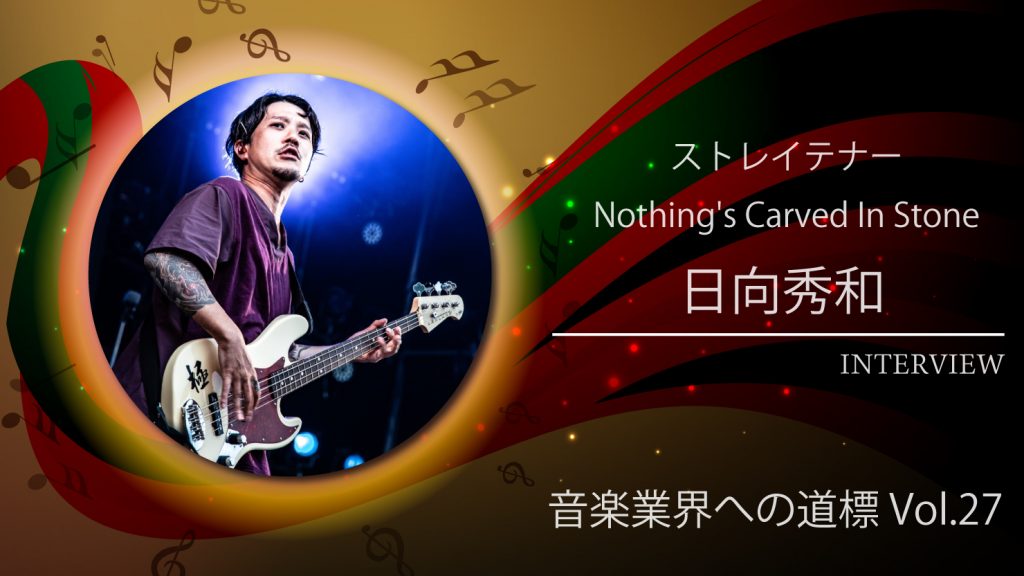
For the 27th installment of Pathways into the Music Industry, we spoke with Hidekazu Hinata, bassist for Straightener and Nothing's Carved In Stone.
A Japanese bass hero active in all kinds of settings, Mr. Hinata shared many valuable stories, including how he approaches playing in bands.
Q: Thank you for taking the time despite your very busy schedule. First, please tell us about your current activities.
My main bands are Straightener and Nothing's Carved In Stone, and I also do various other things, like a band called FULLARMOR.
I also do support and recording work, and I often take part in sessions.
Straightener - "Braver" MUSIC VIDEO
Q: You always seem to be in great demand and very busy.
That's true. Sometimes I keel over. (laughs)
For me, though, sessions are both a place to practice and a kind of breather. They often open up my vision, and they're also a chance to make new discoveries and reexamine my playing, so it's valuable time.
Q: I imagine there are many days when you play for more than 10 hours.
There are days like that sometimes. I basically don't like practicing much, so during band rehearsals I sometimes think, "I wish this would end soon..." (laughs)
Q: When did you start music?
In my first year of junior high, so at 13. My older sister had an electric guitar, and that inspired me to start too. I remember my parents buying me an Ibanez bass after that.
In high school, I joined the folk song club and formed my first band.
It was a "folk song club" in name only; everyone was in rock bands.
I also joined bands of skilled older students, and from then on I was playing in several bands at once.
Q: What music were you listening to back then?
Punk-ish bands like JUN SKY WALKER(S) and THE BLUE HEARTS were popular, and I listened to that kind of music a lot too. I also started listening to Red Hot Chili Peppers around the same time.
Q: When did you start aiming to go pro?
Actually, I never once set out to go pro. Before I knew it, I'd ended up where I am now.
I played in bands having fun with friends, went wherever acquaintances introduced me, and so on. Rather than aiming to go pro, things kept expanding simply because I enjoyed playing bass so much.
So I've never once written something like "I'm aiming to go pro" in a band member wanted ad.
Nothing's Carved In Stone "Spirit Inspiration"
Q: Are there many people like that around you?
Hmm, yes. Straightener had a really strong will from the early days to stick to making cool music. I think a lot of it also comes down to encounters and timing.
Q: Was there ever a time you stepped away from the bass?
Once, yes. When I was about 20, my mother opened a yakitori restaurant, and I was its manager. At the time I thought I'd make a living doing that, so I don't think I touched a bass for about two years.
Q: Was there something that brought you back?
A friend who came to drink at the restaurant brought along a guitarist closely connected to ART-SCHOOL. He apparently knew I was a bassist and asked, "Want to play some bass, kind of like a side job?" Meeting Riki Kinoshita there was what got me playing bass again.
From there, I started playing as ART-SCHOOL's bassist.
Q: It sounds like you were destined to be led there.
Looking back now, I think so. But I was playing bass like crazy even back then, and around Machida, where I'm from, almost everyone knew my name, so maybe that was part of it too. Oh, as a bassist, of course, not as a troublemaker. (laughs)
Q: Speaking of which, there are all sorts of "Machida delinquent legends" about you...!
No, no, not at all. I did hang out a lot with my friends and chat while fiddling with instruments, though.
How He Practices Bass
Q: How did you practice day to day?
I just kept copying the music I liked. I think conquering songs one by one was fun, like a game.
Q: Did you practice with a click?
No, I've never practiced with a click even once.
Programming rhythm patterns I liked into a drum machine and practicing along with them was a lot of fun, though.
Pedal Board Academy: Hinatch (Hidekazu Hinata)
Q: Your bass playing is distinctive not only for its groove but also for its note choices. Did you study music theory?
Not at all.
His Approach to the Bass
Q: What are you conscious of when creating a bass line?
Simply put, I want the bass to be "properly heard." To do that, if you keep narrowing the range or play a countermelody against the vocal melody, it really does start to come through.
But rather than doing that consciously, it may be more like "it just ended up that way as I played."
Q: When you work out bass lines for your bands' songs, what state are the demos in when they're sent to you?
Usually we start from something with no bass line.
With Straightener, it starts from Horie singing with a guitar, and with Nothing's Carved In Stone, we build songs while everyone brings in demos.
Q: You've always used a 4-string bass. Is there a reason for that?
A 4-string bass feels complete precisely because it's a 4-string, and I feel like extended-range basses don't have the true potential of the bass. I feel that drop tuning a 4-string makes it "resonate" more as an instrument. I haven't played a 5-string that much, though, so it's just a vague impression.
His Mindset as a Bassist
Q: Having been active as a bassist for so long, what do you think your own strengths are?
"One-of-a-kind playing," maybe. I think a lot about "being myself," about having something that makes people think, "It has to be Hinatch."
Not just in my playing but in fashion and lifestyle too, I'm particular about a vision that only Hinatch can do.
Q: Switching between various basses and mastering lots of effects pedals also seems unique to you.
As for basses, lately I mostly use my LAKELAND signature model in every situation.
As for effects, my signature bass preamp, the "BRICK DRIVE BDI-1HH 'Kiwami'," and a bass synth called the "pandaMidi Solutions Future Impact I." are my recent favorites.
Q: Do you have criteria for choosing between pick, fingers and slap?
Each has a different "feel," so I choose according to the song. I also use a pick when I want a harder sound.
My main approach lately is to change it by song, like deliberately using a flimsy pick to get a sound with no low end at all.
Q: When you hear a demo, do you already have a sound in mind to some extent?
Yes. The playing technique and what gear to use come to mind too.
When I actually create the bass line, I value the inspiration of that moment, and what interests me most is how to sharpen that speed of response.
Q: So the moment you hear it, you can already picture everything in your head.
For example, when I played on TK from Ling tosite sigure's recording, I went to the studio without listening to the demo even once, drilled the very first phrase I heard there into my head and recorded it. We finished recording two songs in about three hours.
Sharpening that response is what rock is, and nailing it in every genre is what "Hinatch bass" is.
TK from Ling tosite sigure "unravel (short version)"
Q: That's an incredible skill...
TK was laughing while we recorded. But in exchange, it's really tough at live shows. (laughs)
Q: What's on your mind while you play live?
I call it "autoplay mode": I consciously try not to think about anything. If you think, you're too slow, or it's not direct.
I want to deliver what's freshest in the moment, so my ideal state is grooving without thinking about anything at all.
Q: Is that kind of approach something you acquired through your career?
Yes.
Also, the two or three years I spent in ZAZEN BOYS had a big influence on building the Hinatch of today. My playing and way of thinking, an independent mindset as a player, the idea that the bass can step forward as a player in its own right, and so on.
The instinctive feel I learned from Mukai is really alive in what I do now.
Q: Is there anything you're mindful of as input in daily life?
I don't listen to much rock; it's mostly Black music.
My favorite bassist is Larry Graham. He's been my bass hero since high school, like a god to me.
For Those Aiming for the Music Industry
Q: What do you think is important for keeping a band going for a long time?
I think it's important to give way to each other, to take a step back.
If you get too stoic, you'll hit a wall, so I try to get excited not about self-centered fixations but about things I'm particular about "precisely because the band needs them."
I think it's good if you can keep a bit cool and, while being part of it, take the role of "producing yourself."
Straightener - From Noon Till Dawn
Q: Many people want to make a living in bands. What kind of activities should newcomers pursue?
I'm often asked, "What should I do to go pro?" but I think nobody can ever really know that. There's no information, and everyone does it differently.
So I think it comes down to whether you can hold a strong sense of "this is what I want to become."
Along the way there will be compromises and setbacks, but what matters is how long you can keep going with a strong will despite them.
Also, as I often say at seminars, "enjoying music" is what connects you the most. If you close yourself off thinking "this is all I have," you'll definitely stop expanding, and I think when you're enjoying yourself, people gather around you and you can share that joy.
I think it's important to keep repeating that, finding your own core as you go.
Q: Thank you. Finally, please tell us about your future goals.
I started solo activities around last year, so as I continue, I want to keep broadening my range. I'd like to work with all kinds of players and artists too, and I'm looking forward to what comes next.
Q: Thank you very much.
Nothing's Carved In Stone "November 15th"
Interview and text: momo (Mamoru Tanoue)
Profile: Born in 1995. A Digital Performer and Ableton Live user. After graduating from music school, he moved from Fukuoka to Tokyo as a composer.
Made his debut as a writer in August 2017, composing and arranging for Tsukicro's "STARDUST".
With the motto "songs that touch the heart", he is a multi-player who handles everything from lyrics and composition to arrangement and recording.
He is also active as the composer and arranger for the art unit "Shiro".
Website: Music Designer momo
Twitter ID: @momo_tanoue
NEW ARTICLES
Latest English Articles