In EDM production, transition techniques are an important element that greatly affects the quality of a song. This article explains in detail four practical techniques for connecting the sections of a song: cutting the kick, cutting the low end, using a different sample, and using a clap. Each technique can be used at specific points, such as the end of 16 bars or before the chorus, and by combining them with production methods such as filters, automation and reverb, you can make more dynamic, professional-sounding songs. Mastering these techniques will help you step up from DTM beginner to intermediate.
Four Transitions That Connect Song Sections
EDM Recipe part 7 introduces four transition techniques that highlight the seams between song sections!
Transition Techniques Video
- 1Pattern 1 – Cut the kick
- 2Pattern 2 – Cut the low end
- 3Pattern 3 – Use a different sample
- 4Pattern 4 – Use a clap
First, let's listen to a sound that uses the four techniques every four bars.
Using transitions like these at the boundaries of a song's sections allows for a more dynamic presentation.
The main points to place transitions are as follows.
- The end of 16 bars
- The break before the chorus
- Intro & outro
Now let's introduce each technique.
Cut the Kick
First is the technique of [cutting the kick]. It is simple but very effective, and it is used in many songs.
All you do is cut the kick playing at the end of 16 bars.
The kick is the part with the strongest character in a song, so simply removing it marks a break between sections.
▶︎ Cutting the kick


Cut the Low End
Next is the technique of [cutting the low end]. It is similar to the kick-cutting technique in technique 1, but here we [cut the kick and bass].
It cuts the prominent low end without removing the parts completely, so you can create a smoother change between sections.
This technique is often used at [the end of the verse's 16 bars] and in [the intro & outro].
Here are the steps for cutting the low end.
- 1_Add a filter to the kick and bass
- 2_Use automation
▶︎ Adding a filter
First, add a filter to the kick and bass tracks.
Switch the filter to high-pass mode and cut the lows up to 150–300 Hz.

▶︎ Using automation
Next, switch the filter's switch (On/Off) with automation.
Use automation to turn the filter switch on for [the one bar before the section changes].

Use a Different Sample
The third is the technique of [using a different drum sample]. Inserting a sample with a sound from a completely different genre at the change between sections creates a transition with strong impact.
This technique is often used [before the chorus] and at [the end of 16 bars].
Here are the steps for using a different sample.
- 1_Cut the drum parts in the song
- 2_Insert a different sample
▶︎ Cutting the drum parts in the song
First, [cut the drum parts used in the song].
The more drum parts you cut, the stronger the contrast.

▶︎ Inserting a different sample
Next, [insert a drum sample that is not used in the song].
Samples often used in four-on-the-floor genres include [Break] and [Drum & Bass].
Choosing [a sample with more drive] than the samples used in the song improves the song's groove.
We also recommend editing the inserted loop, such as changing its pitch or adding effects!

Use a Clap
Finally, the technique of using a clap to create a transition.
This technique is used in a great many songs. It may be a good idea to start by trying this one.
This technique is often used at [the end of 16 bars] and in [the break before the chorus].
Here are the steps for using a clap.
- 1_Insert a clap sound
- 2_Insert a reverb
▶︎ Inserting a clap sound
First, insert claps in the one bar before the section.

▶︎ Inserting a reverb
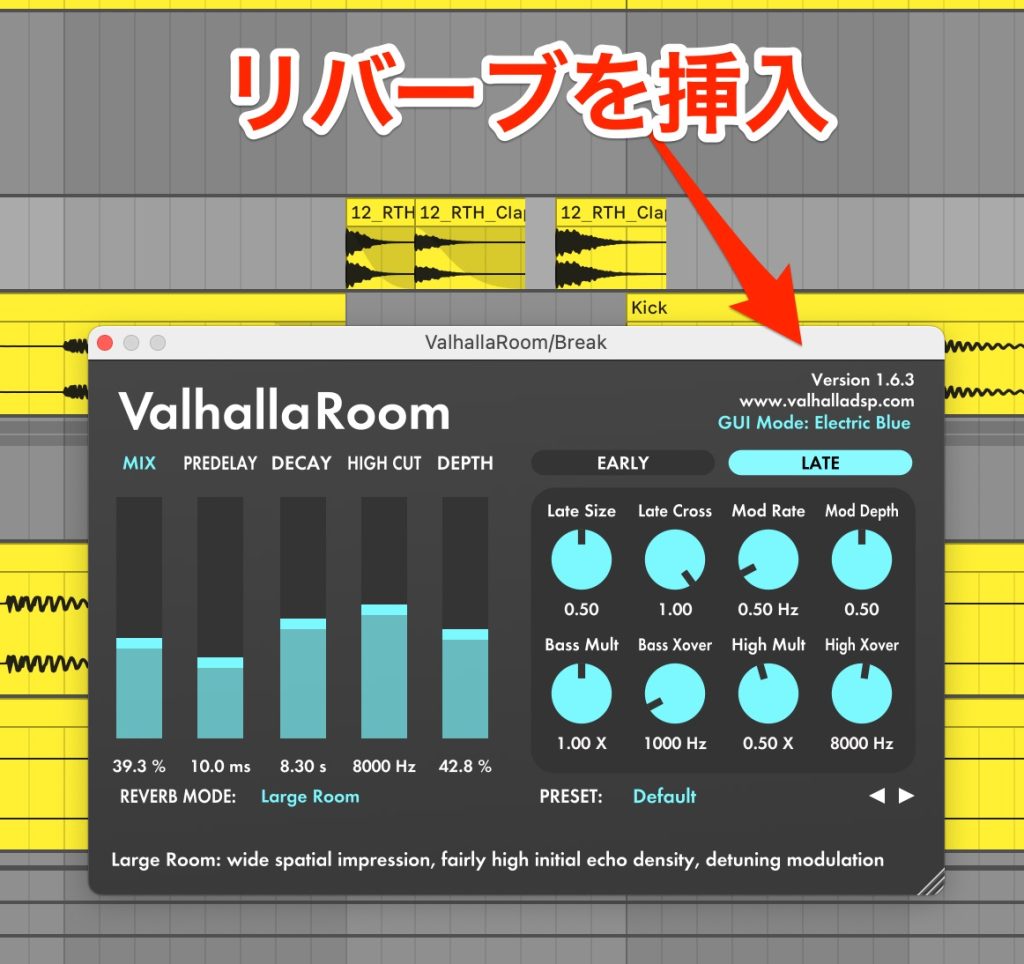
Next, insert a [reverb]. We recommend a [deep setting with a long tail].
This time we use [Valhalla Room].
Of course, this can be applied with other reverbs too, so please try it with various reverbs!
▶︎ Valhalla Room
▶︎ Inserting a reverb
How did you find it?
Transitions that connect a song's sections are a very useful technique for raising the quality of your songs.
Please incorporate these techniques to raise the quality of your own songs!
See you in the next recipe.
Frequently Asked Questions
Q1. Which transition technique should EDM production beginners try first?
The clap technique is the easiest to implement and is used in many EDM songs, so it is suited to beginners. Just insert claps in the bar before a section and add reverb to create an effective transition.
Q2. What are the best points to place transitions?
The main points are the end of 16 bars, the break before the chorus, and the intro & outro. Placing them at the boundaries where the song's structure changes achieves more natural, effective section changes.
Q3. What is the difference between the kick-cutting technique and the low-end-cutting technique?
Cutting the kick creates a stronger break, while cutting the low end creates a smoother change between sections. It is important to choose between them according to the song's mood and the effect you want.
Q4. Are there points to watch out for in the reverb settings?
A deep reverb setting with a long tail suits transitions. Choosing a high-quality reverb plug-in such as Valhalla Room gives a professional finish.
Q5. Can I use multiple transition techniques at the same time?
Yes. Combining multiple techniques lets you create more distinctive transitions with strong impact. However, keep the balance in mind and be careful not to make it overly complex.
EDM Recipe part 7 introduces four transition techniques that highlight the seams between song sections!
Article: https://t.co/tFaOZwRCYPVideo: https://t.co/HvhyGOuZr8#dtm #edm #composing #musicproduction pic.twitter.com/tQCGmeC7tt
— SLEEP FREAKS (@SLEEPFREAKS_DTM) July 1, 2023
NEW ARTICLES
Latest English Articles