
In DTM production, the compressor is an indispensable effect for mixing. This article explains everything from the basic principles of compressors to practical use in a way even beginners can understand. A compressor squashes loud sounds while leaving quiet ones as they are, evening out level differences within a track for a cohesive, easy-to-listen-to sound. It can also raise loudness by increasing the density of the waveform. Understanding the functions of the four main knobs, starting with Threshold and Ratio, is the first step toward a professional-quality mix.
Understanding the Basics of Compressors
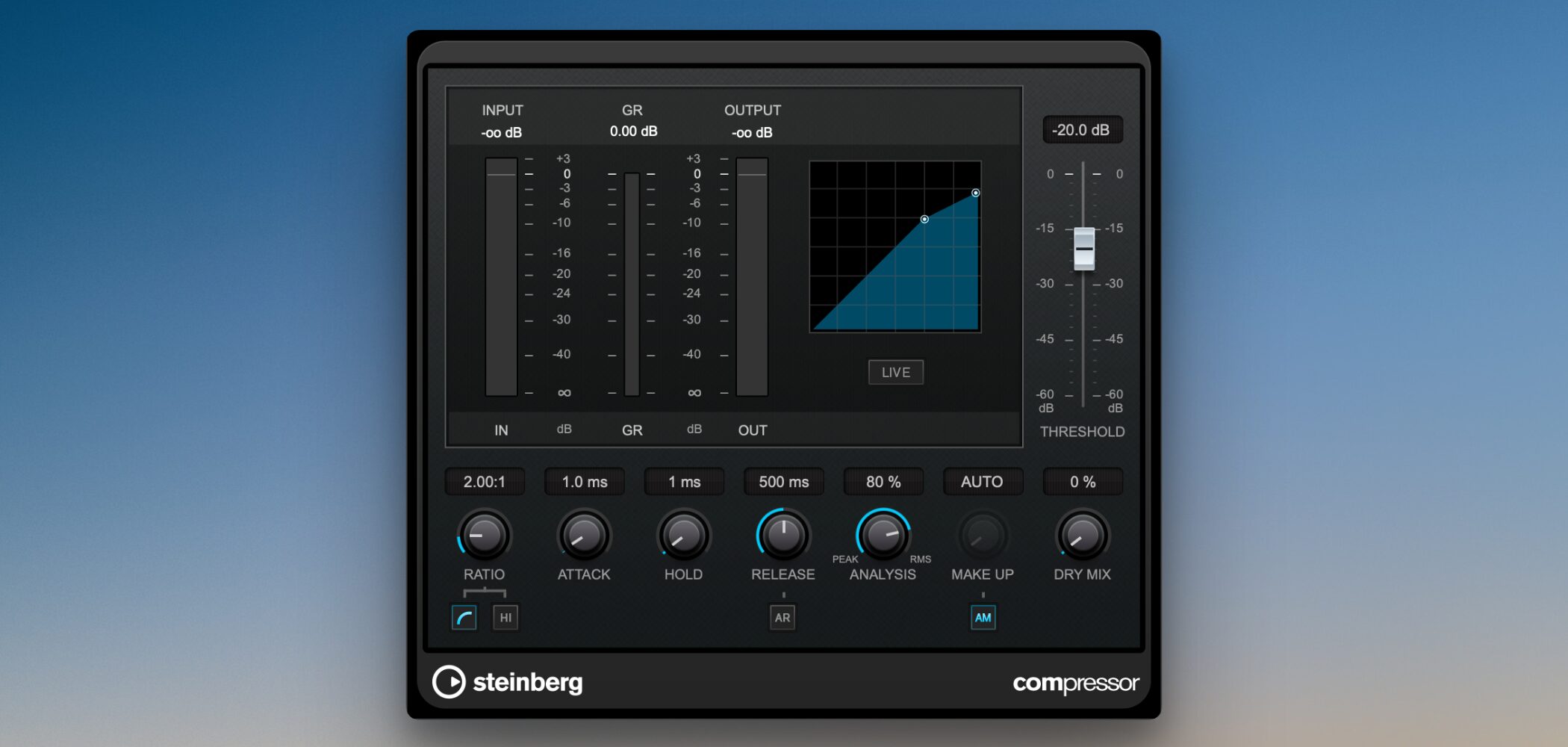
This is the compressor included with Cubase; every DAW comes with a compressor.
Anyone using a DAW has probably used a compressor at least once, but it may feel a little intimidating, with complaints like "I don't know how to set it" or "I can't hear the change."
Because it does not change the tone dramatically like EQ, its effect is hard to notice, but whether you use a compressor properly or not makes a big difference in the quality of your song.
What Is a Compressor?
A compressor leaves quiet sounds as they are and squashes loud ones.
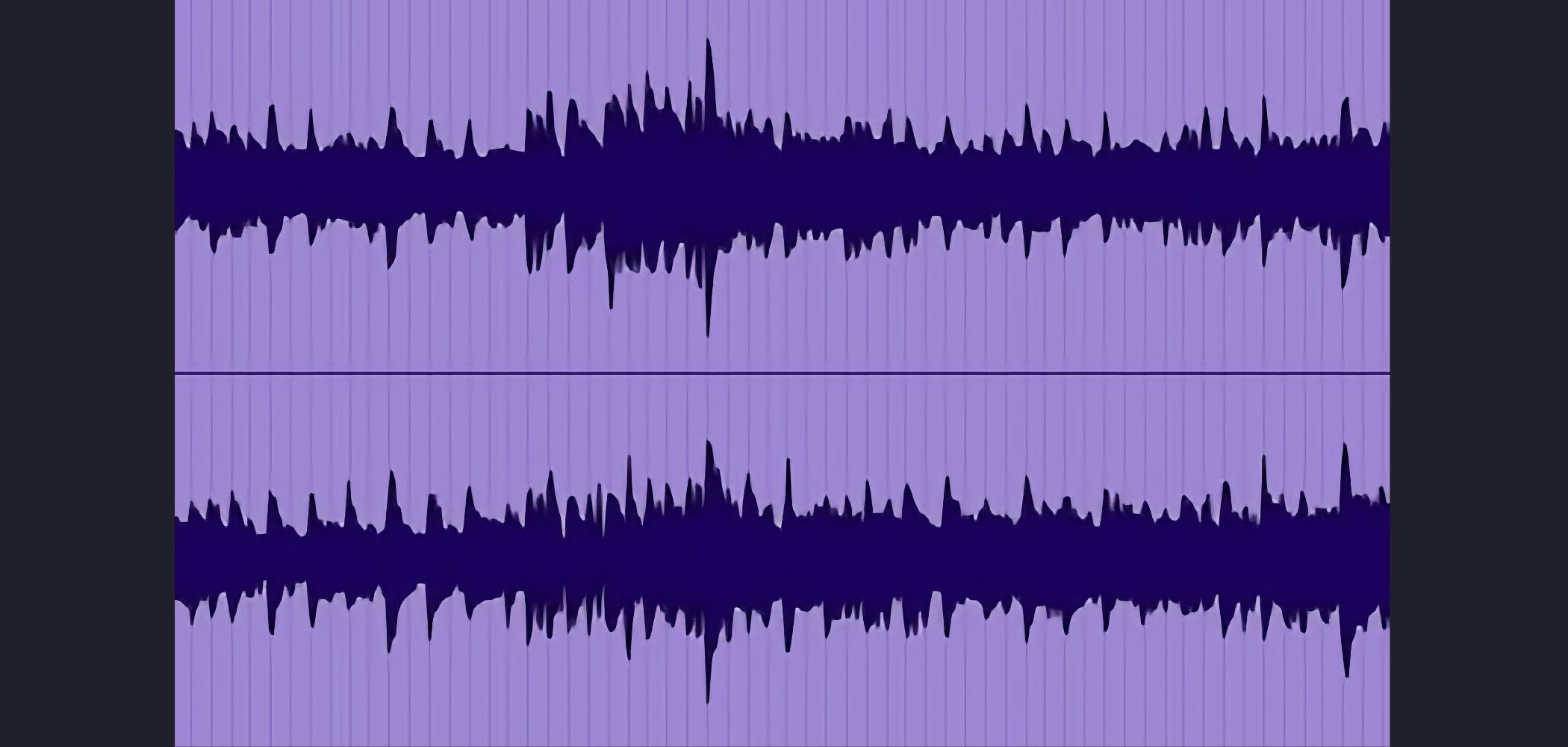
The image above is an audio waveform, and naturally it has loud parts and quiet parts.
The compressor squashes these big, spiky parts to reduce the level difference from the quiet parts.
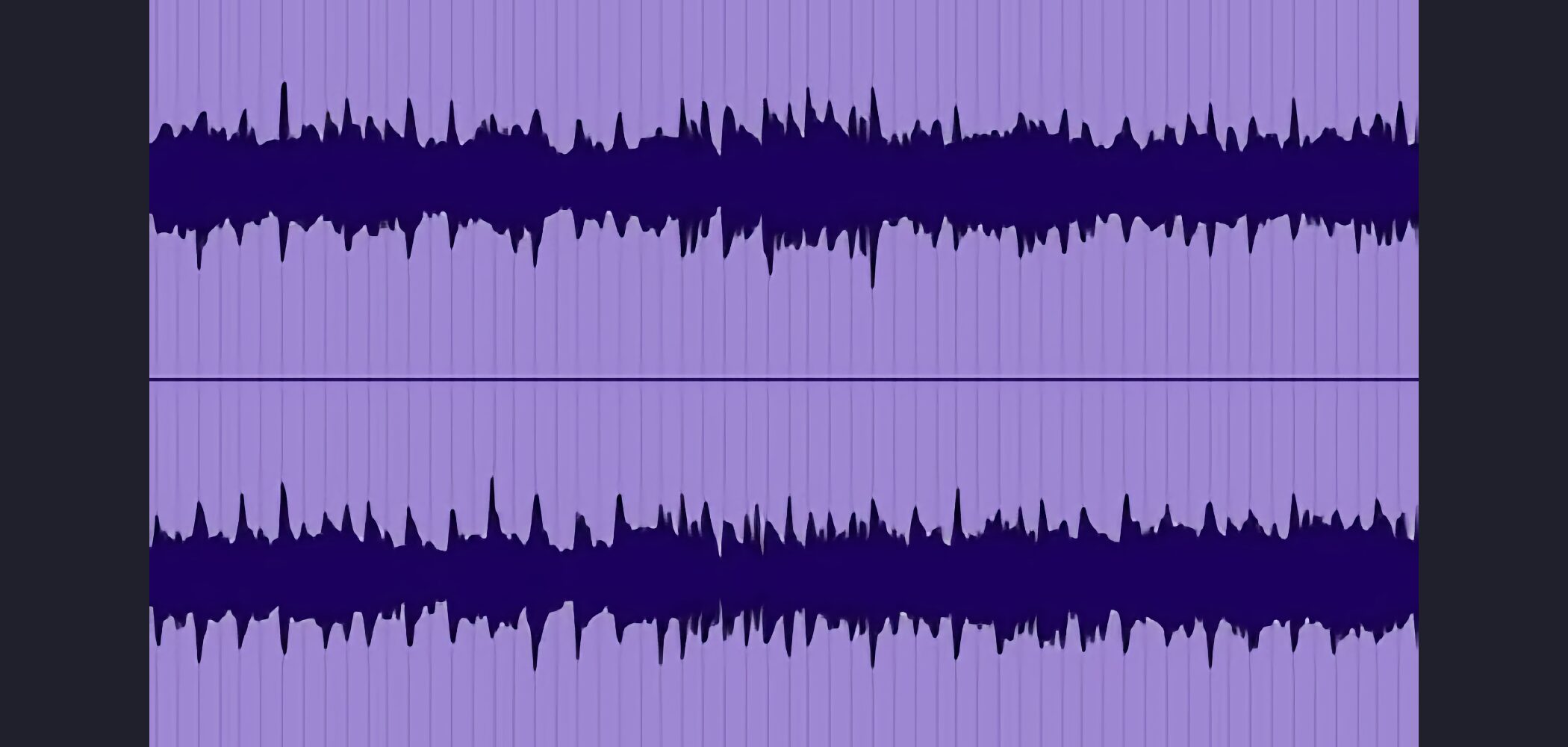
This is the same waveform with a compressor applied; you can see that the loud parts have been squashed and the whole is more even.
This lets you create a cohesive track that is easy to listen to.
Also, because the spiky parts are held down, you can raise the overall level of the track, making it possible to increase loudness.
Loudness with a Compressor
"Raise loudness with a compressor" is a phrase you often hear.
Before looking at the compressor's functions, let's touch on this idea of loudness.
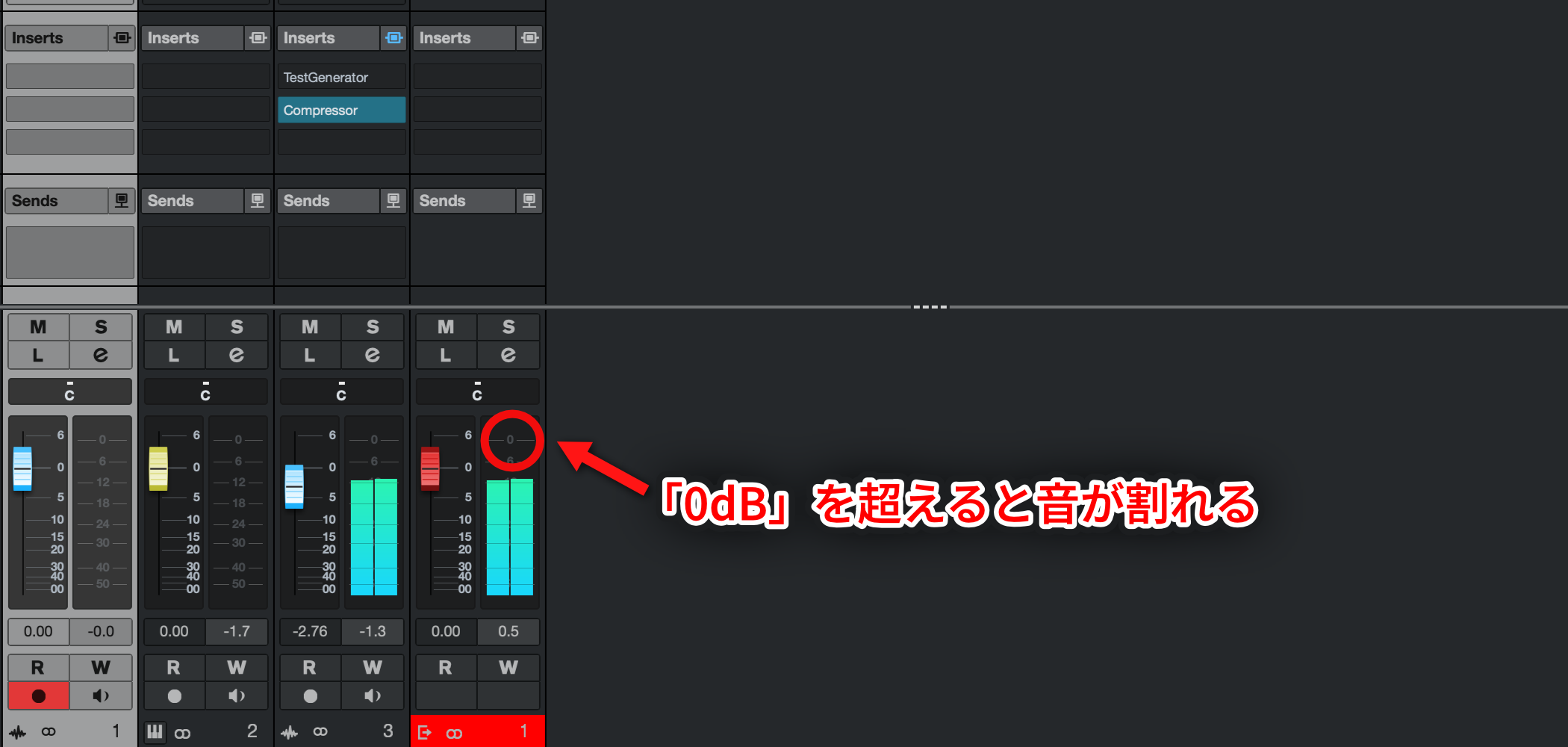
High loudness means the sound is loud, but if the input signal exceeds 0 dB (zero decibels), the maximum for digital audio, the sound clips.
In other words, professionals and amateurs alike have the same upper limit on usable level.
So what makes the difference? It is the density of the sound.
Check the two images and sounds below.
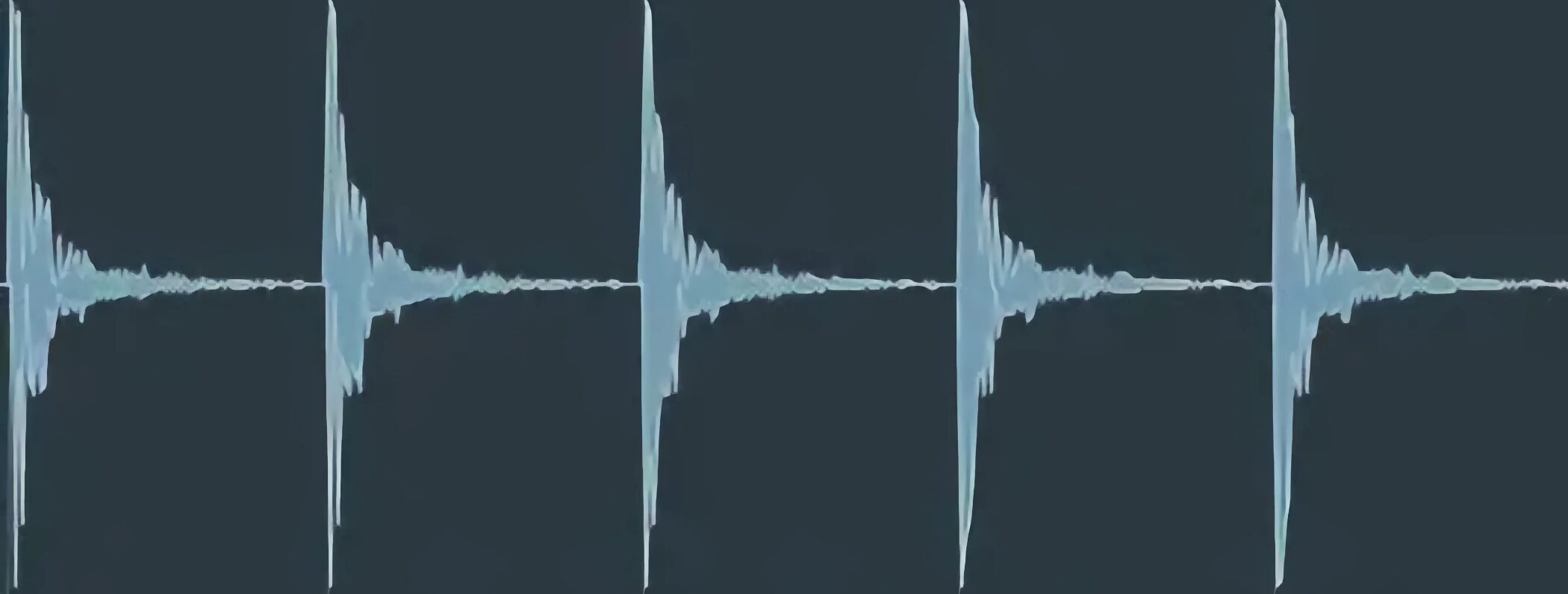
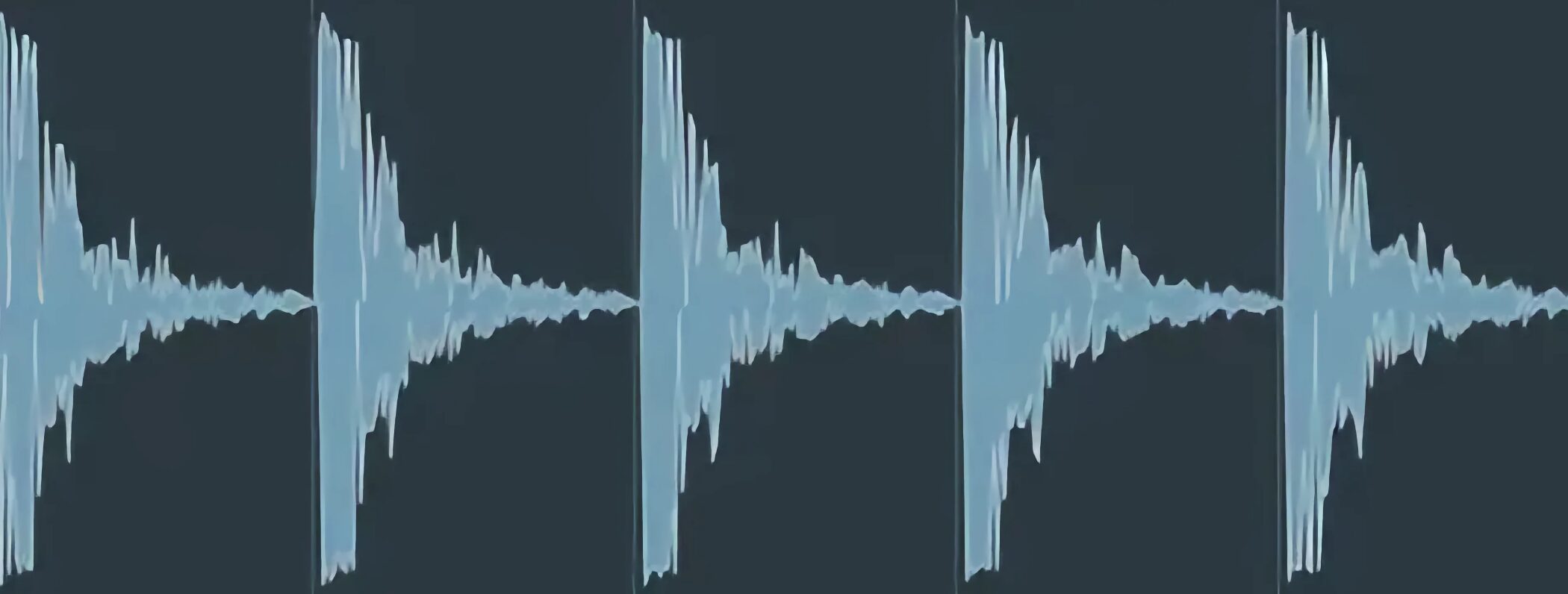
How was that?
Both waveforms were raised to the 0 dB limit where the sound clips, but the latter should have sounded louder.
Looking at the images, the level of the attacks is the same, but clearly the empty space in the waveforms differs.
This waveform area determines loudness.
How Loudness Is Increased
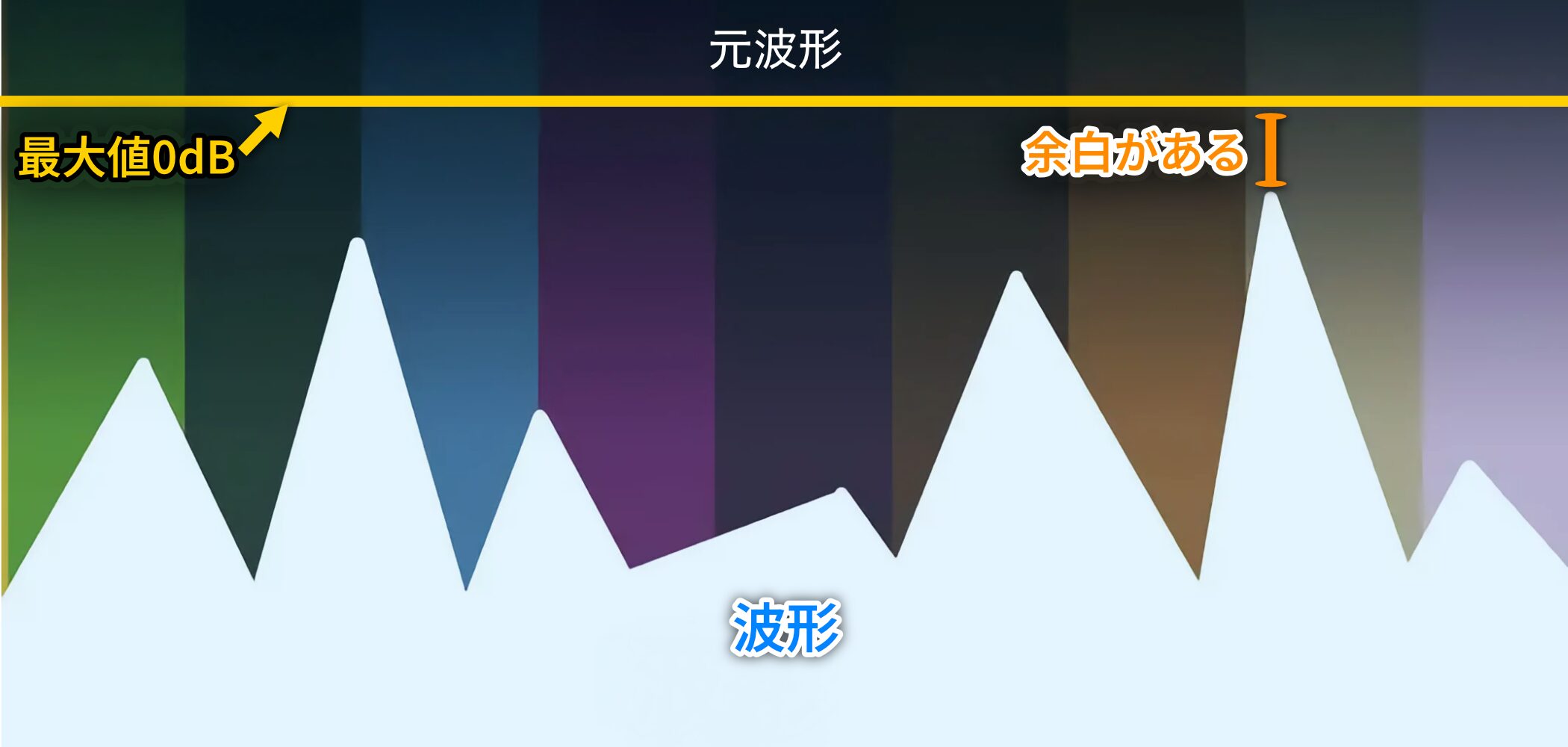
Suppose you have a waveform like the one above.
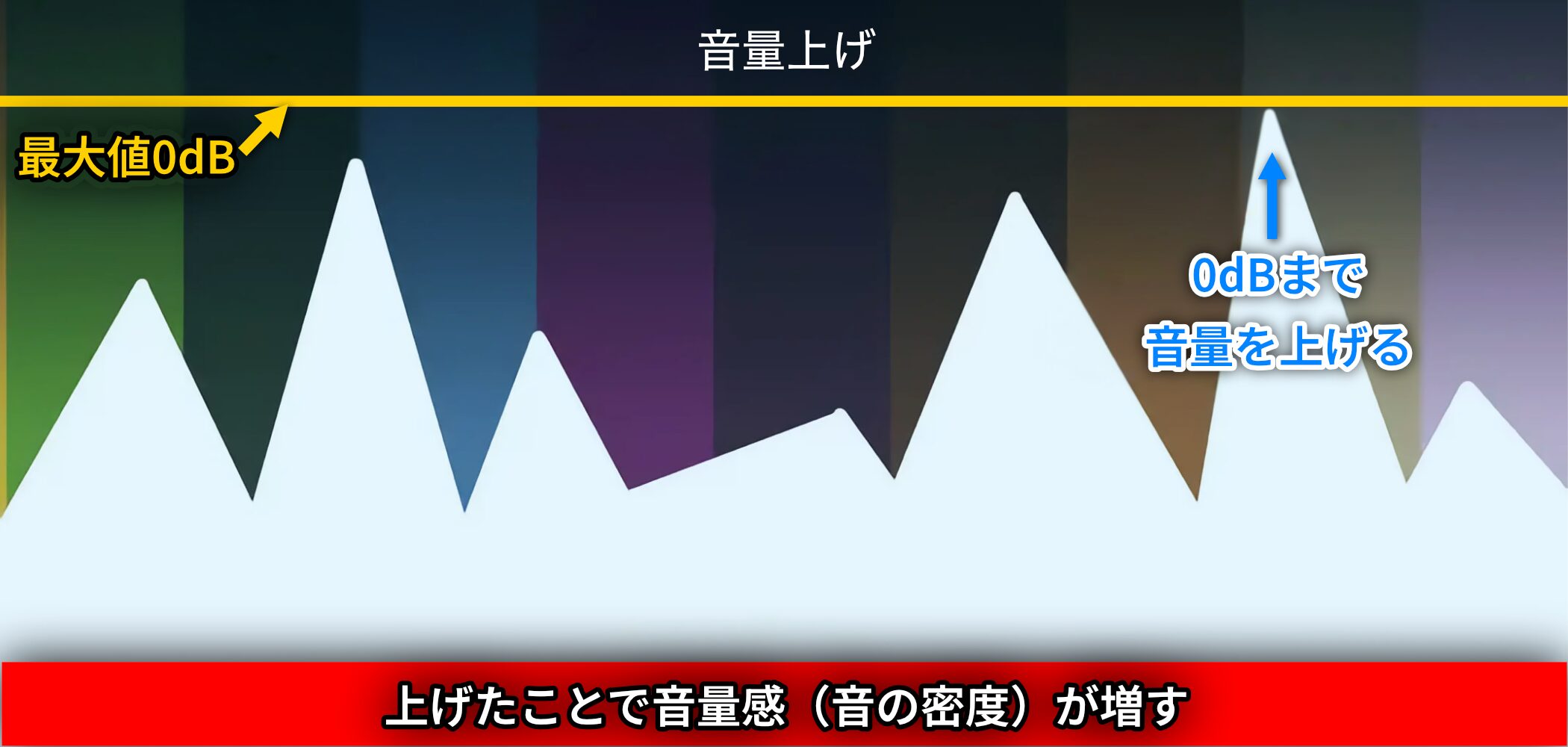
To make it louder, you raise the waveform (level) right up to 0 dB, where it clips, which inevitably increases the waveform area.
The red areas in the image are the added area, and the sense of loudness (level density) increases by that amount.
Now apply a compressor to squash the loud parts of the waveform.
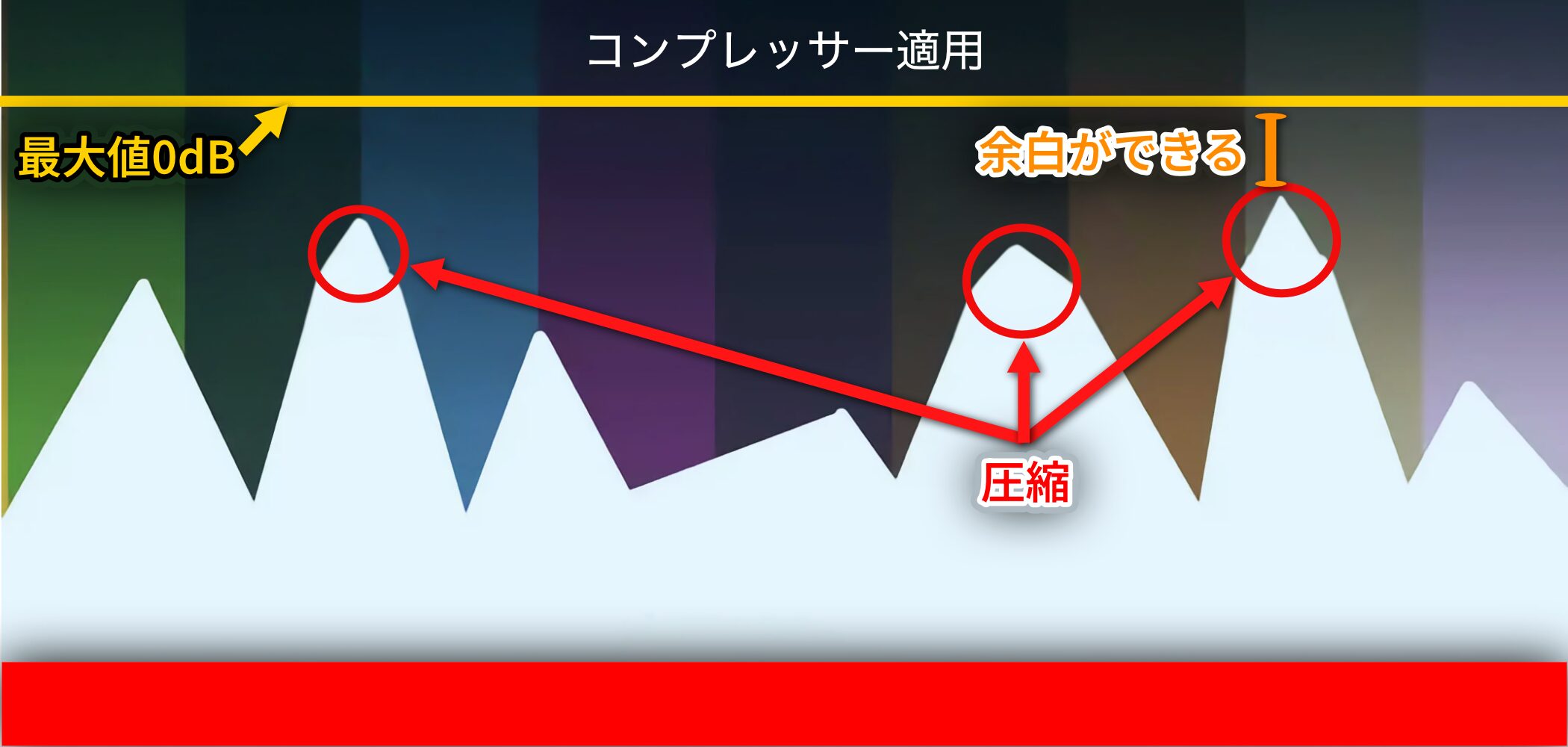
The circled red parts are where it was squashed, and the compression created plenty of headroom up to 0 dB, where it clips.
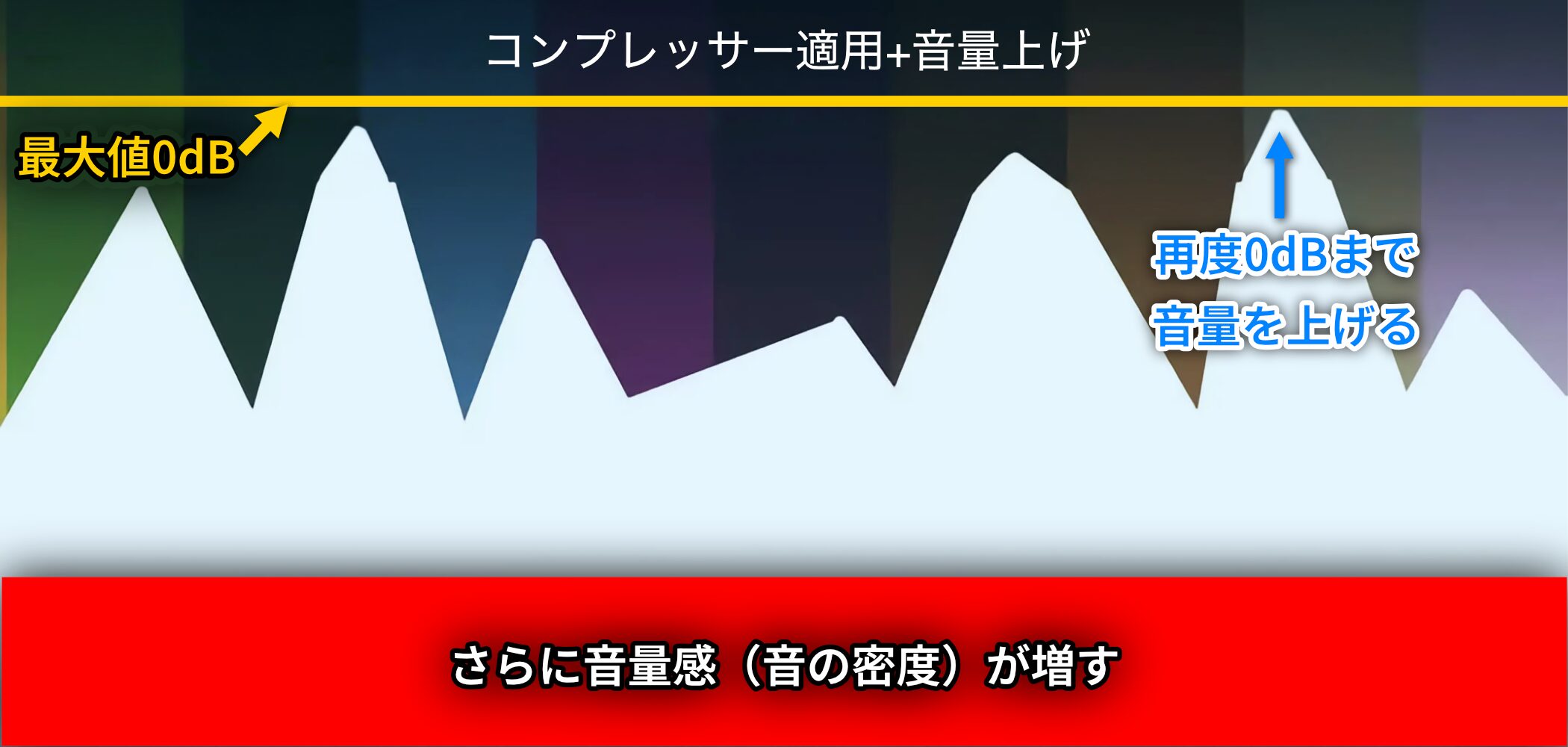
Raising it right up to 0 dB again increases the waveform area further (the red areas in the image), and the density of the whole waveform grows.
This is the state in which the loudness has been raised.
The Four Main Knobs on a Compressor
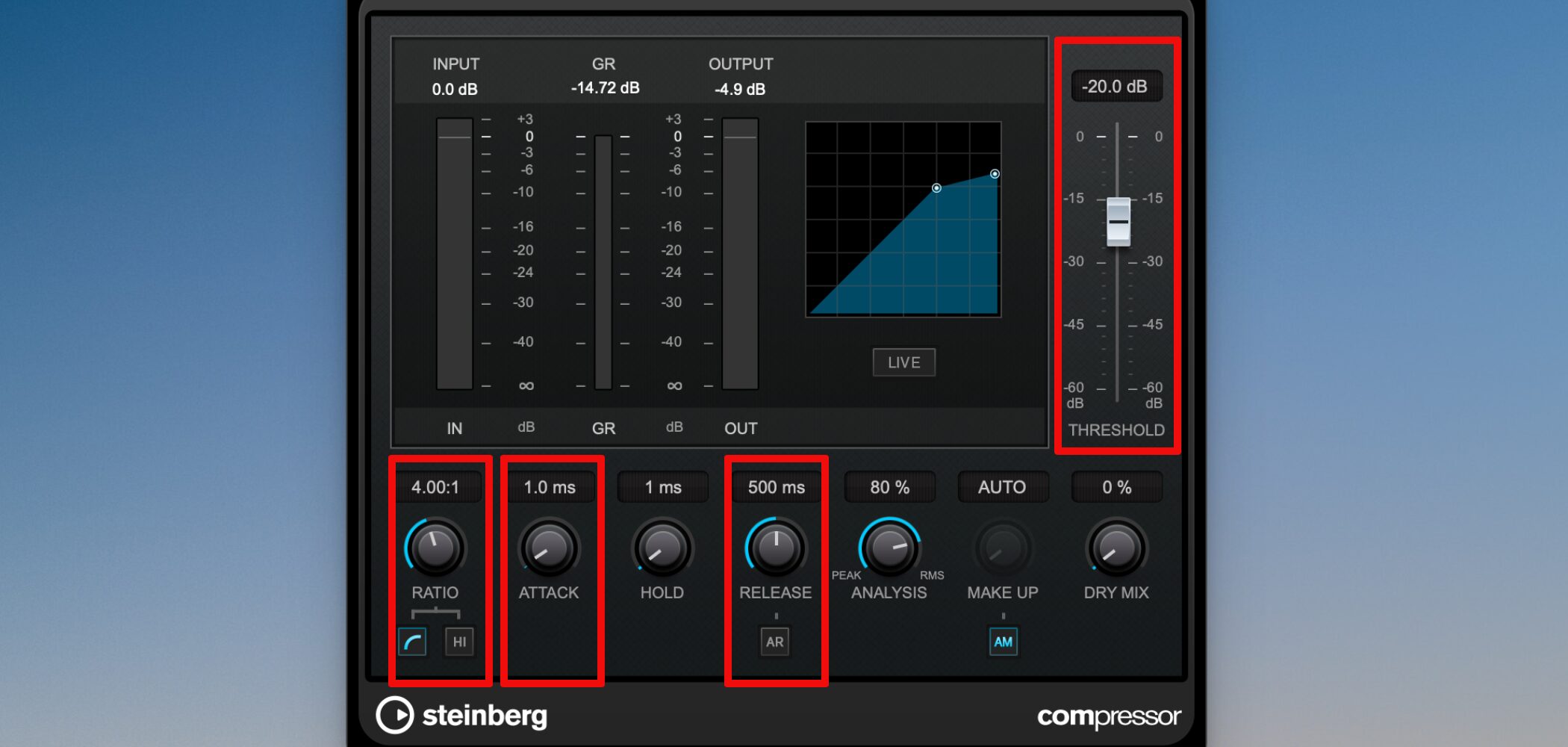
As mentioned above, the basis of a compressor is "make the loud parts of the waveform smaller and leave the originally quiet parts as they are".
The aim is to reduce level differences within the track and stabilize it.
Many people say "I can't hear the effect" or "I don't understand what the knobs do," but understanding what the knobs mean is the first step with compressors.
From here, we explain the four main knobs.
The concepts are the same in all DAWs, including Pro Tools, Logic, and Cubase!!
Threshold
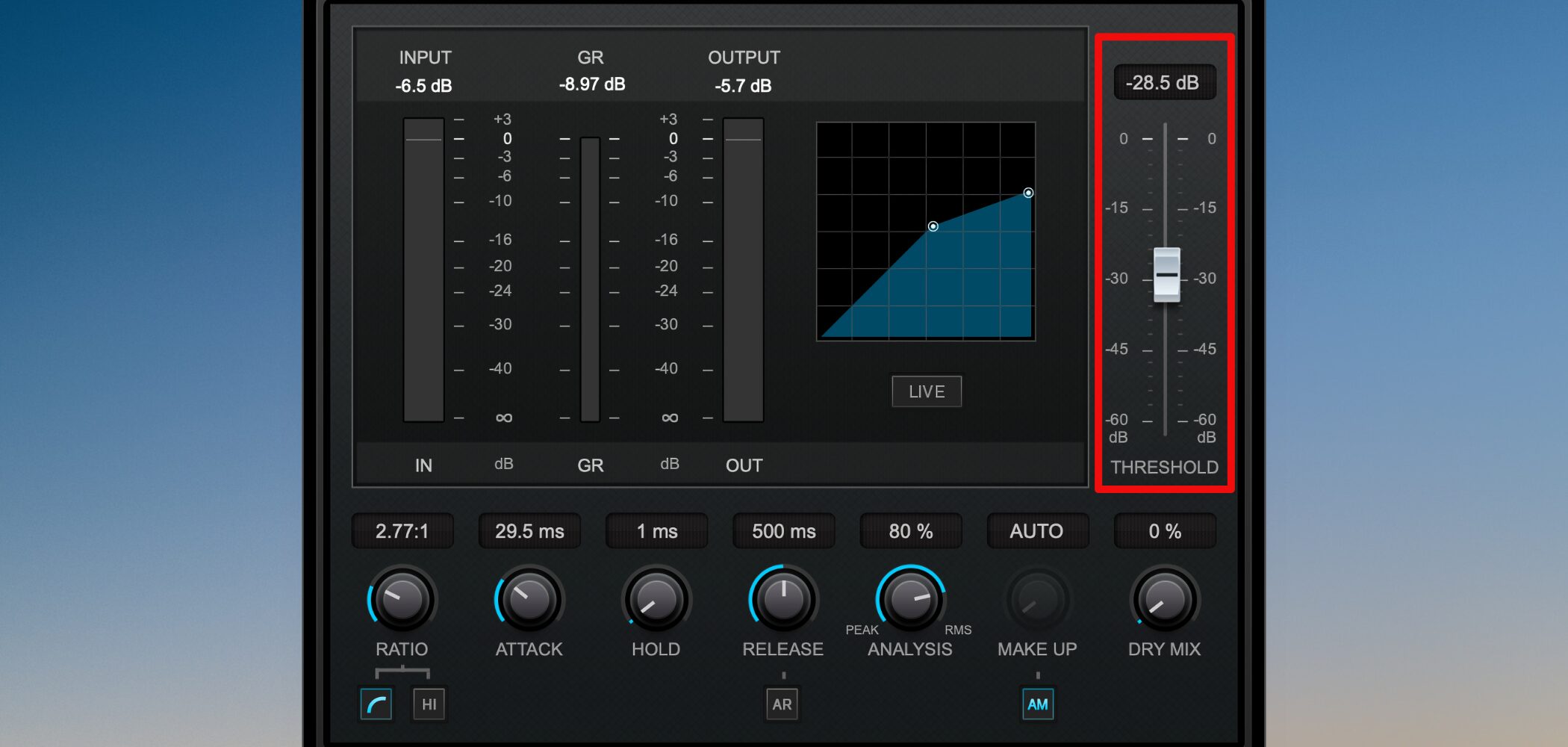
First, the threshold.
The threshold in the image is a slider, but some products use a knob.
To put it simply, the threshold is the parameter that sets the level boundary at which the effect starts to work.
Let's look at what that means in concrete terms.
Video: Threshold Explained
Selected questions and answers from the YouTube video

I have a quick question: is a compressor's threshold different from a gate's threshold?

Both are parameters that set a reference value for volume (dB), so they are the same. A compressor reduces (compresses) volume that exceeds the threshold. A gate cuts or reduces volume that falls below the threshold.
The Relationship Between Threshold Value and Compressed Sound
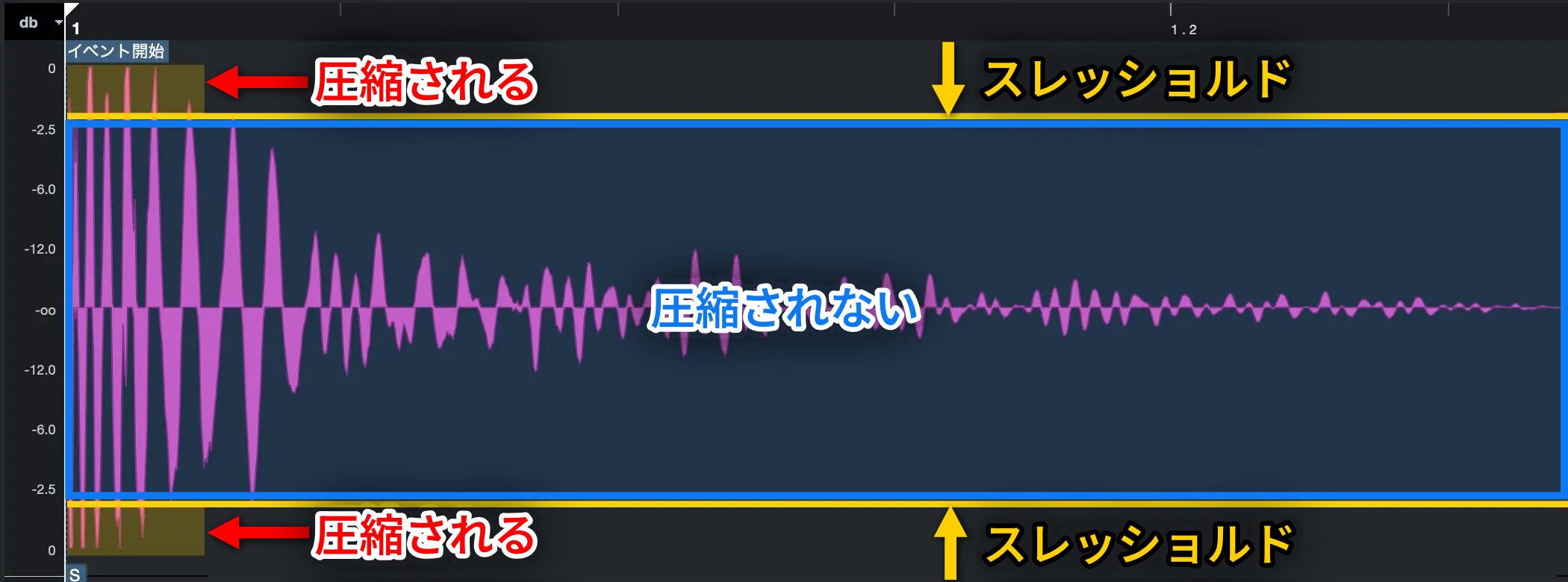
As an example, we use a kick drum waveform.
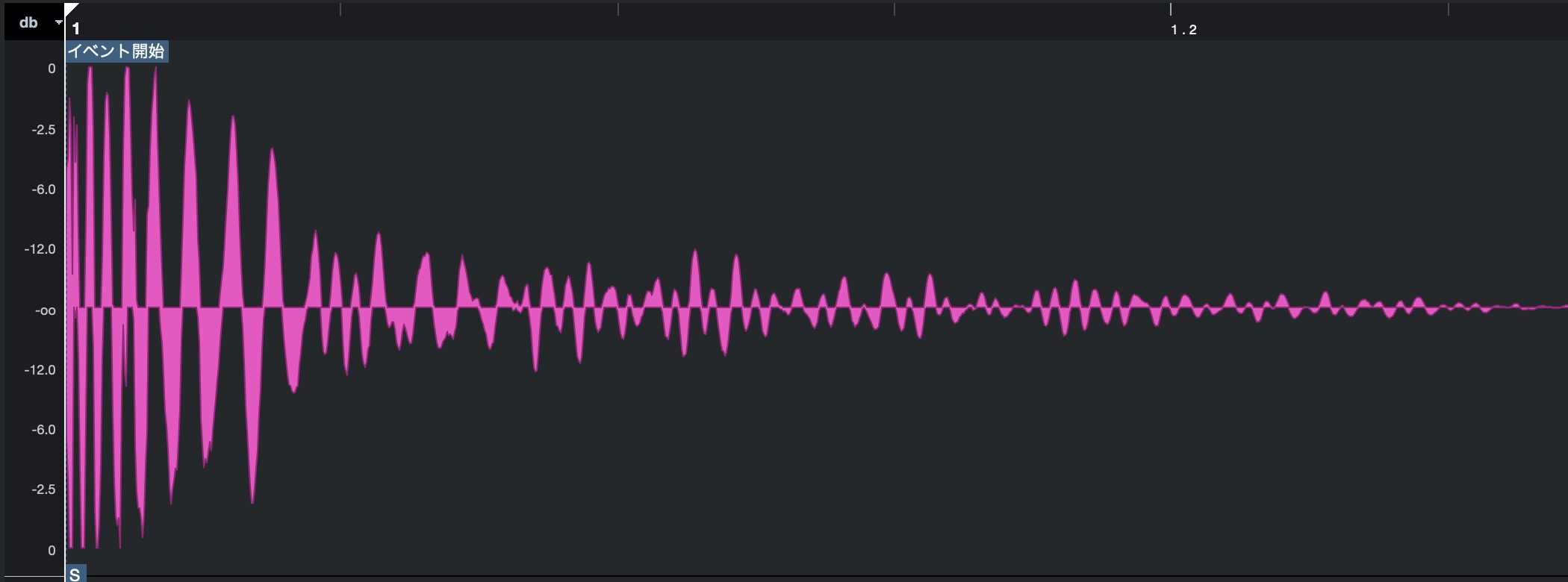
Looking at this waveform, you can tell, "Ah, this part is loud," right?
The start is the loudest, and it decays over time.
A machine cannot judge that by eye, though, so you need to give it a clear reference for what counts as a loud sound.
This reference value is the threshold, and sound that exceeds it is compressed.
Conceptually, it looks like this.
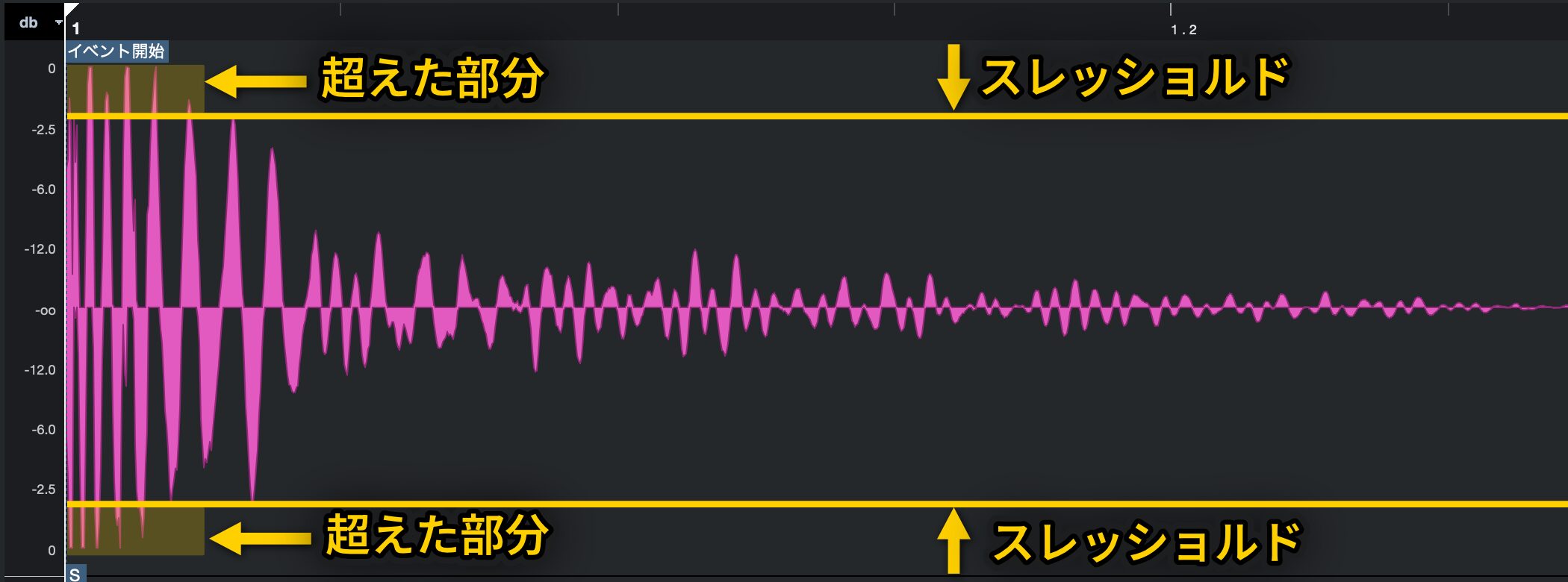
The more negative the threshold value, the closer the lines move toward the waveform from above and below.
The lines first touch the loudest parts of the waveform.
Those parts become the target of compression.
First, make sure you understand this point.
In actual work, however, no lines appear like this, so it is unclear exactly where the threshold line is.
So, how the compression target is compressed is determined by the second important parameter, the ratio.
Ratio
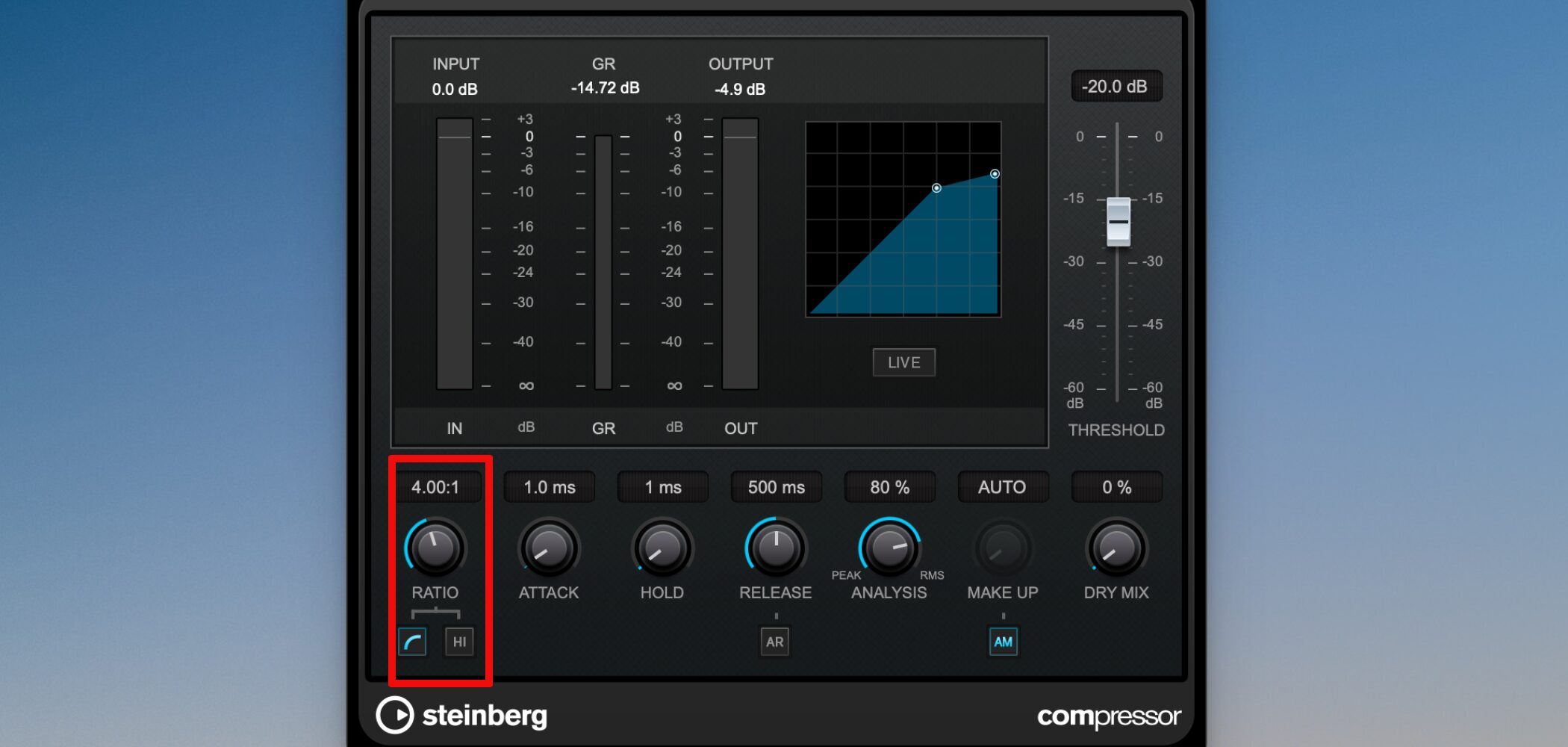
The ratio is the parameter that sets the compression ratio used when the compressor squashes the sound.
The ratio does not work on its own; it operates in close coordination with the threshold.
Video: Ratio Explained
How the Ratio Works and Sound Comparison
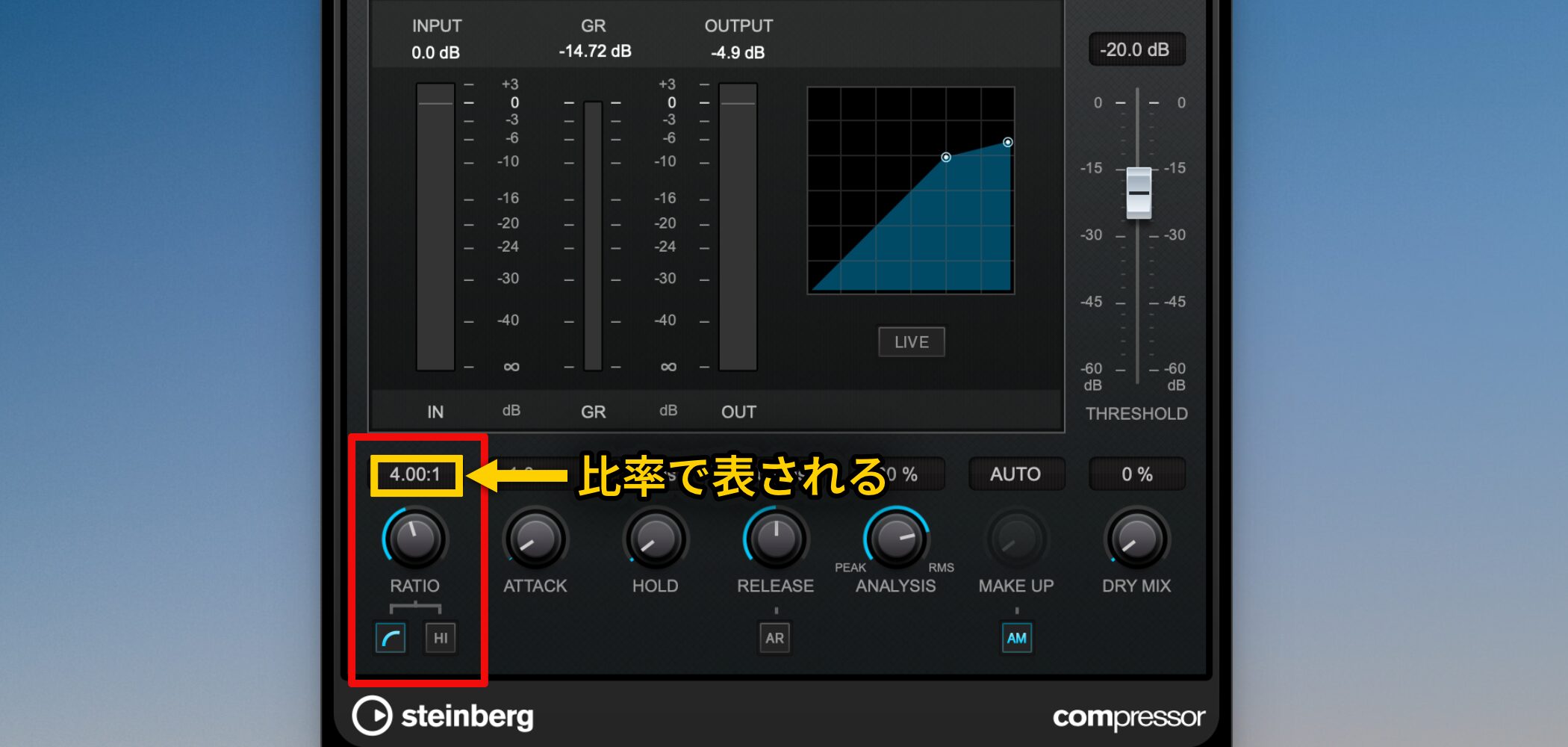
The ratio is generally expressed as a ratio such as 2:1 or 4:1, and the higher the value, the more strongly the sound is compressed.
Let's compare the actual sounds.
As the value increases, you should hear the sound become more condensed.
This is what is called "compression character," meaning the change in tone caused by compression.
An important point is that this compression is not applied uniformly to the whole input level; rather, the ratio determines how strongly to compress the portion of the signal that exceeds the threshold.
In other words, unless the input signal reaches the threshold, changing the ratio does not compress the sound.
A Concrete Numerical Example
Let's look at how a compressor works with specific numbers.
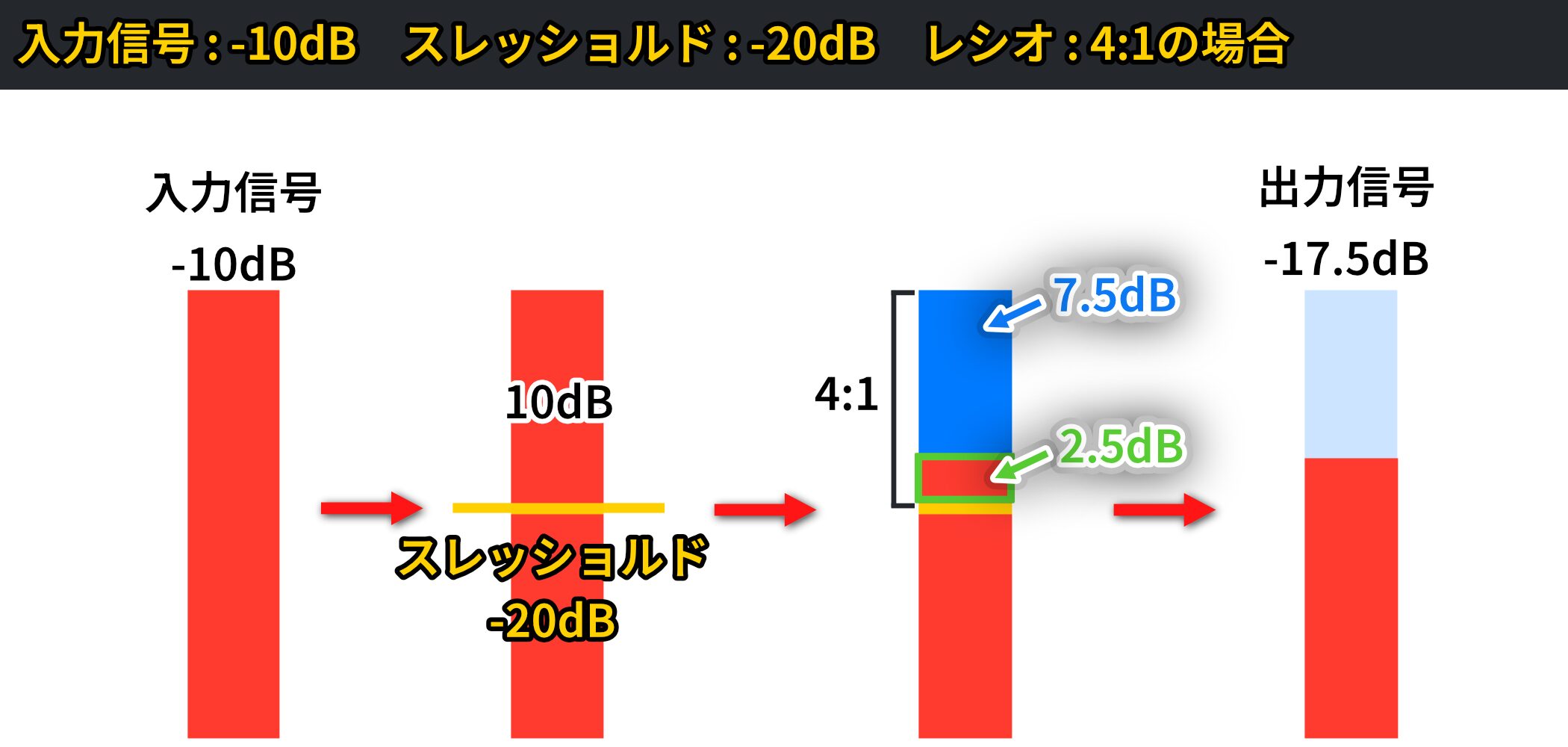
- Input signal: -10 dB, threshold: -20 dB, ratio: 4:1
First, the input signal exceeds the threshold by 10 dB.
(Formula: -10 dB - (-20 dB) = 10 dB)
Next, a 4:1 ratio is applied to this 10 dB excess.
As a result, the excess becomes 2.5 dB.
(Formula: 10 dB / 4 = 2.5 dB)
Finally, adding this 2.5 dB to the threshold (-20 dB) gives a final output signal of -17.5 dB.
As mentioned above, the key point is that only the part above the threshold is compressed by the ratio.
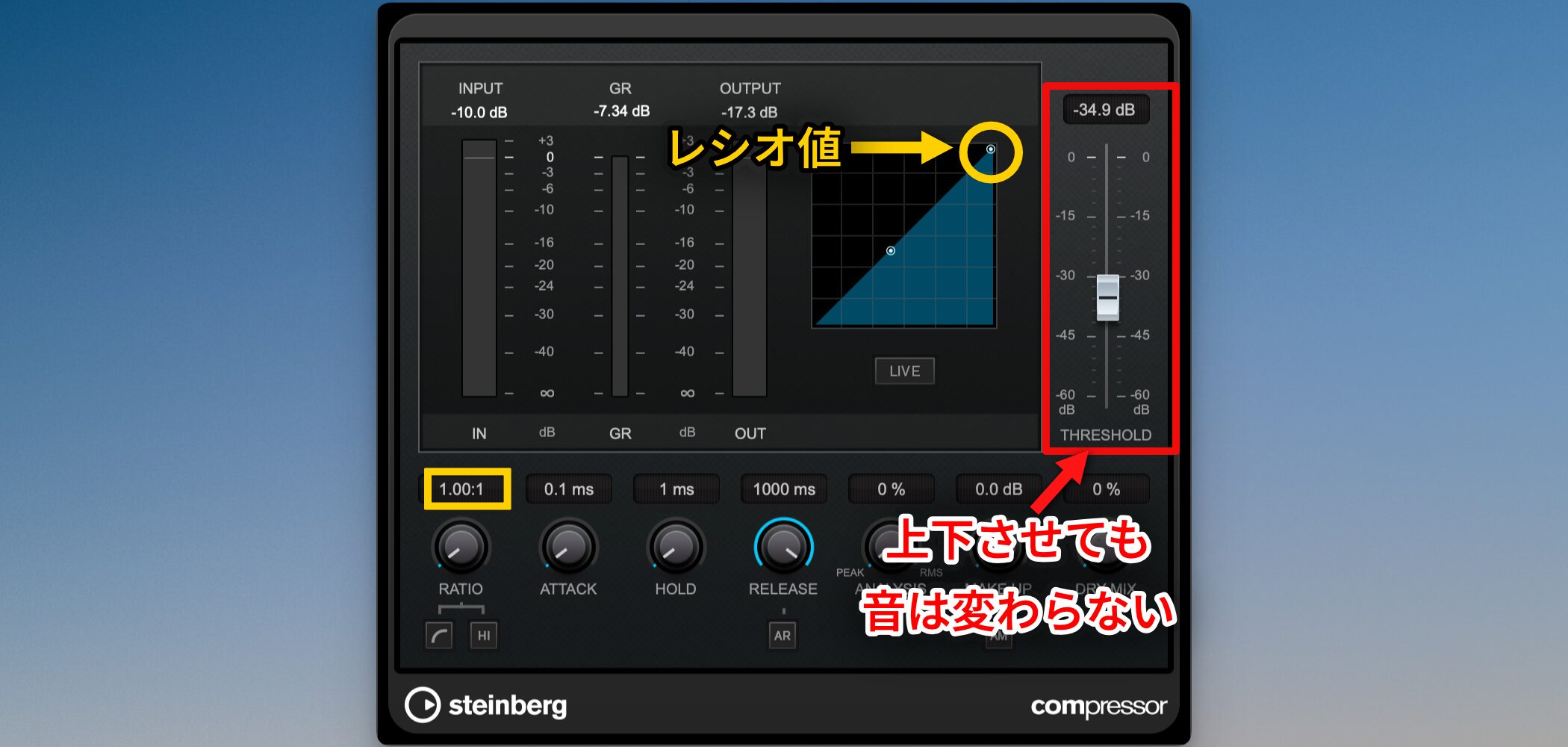
Also, when the ratio is 1:1, the result is always "input = output" no matter how you change the threshold.
This is effectively the same as the compressor being off (doing nothing), so moving the threshold up or down does not change the sound at all.
Ratio Setting Guidelines
Compressors are said to be effects whose results are hard to hear, and the right ratio varies greatly depending on the instrument and the sound you are aiming for.
| Ratio setting | Compression strength | Main uses and purposes | Effect |
|---|---|---|---|
| 1.5:1 to 3:1 | Light | Vocals, piano, acoustic instruments, master track | Evens out levels and adds cohesion while keeping natural dynamics. |
| 4:1 to 6:1 | Medium | Bass, snare drum, electric guitar, pop/rock vocals | Emphasizes presence and brings the sound forward. For assertive sound shaping. |
| 8:1 to 20:1 | Strong | Drum ambience mics, percussion, cases where you want to tame the attack | Controls dynamics strongly and emphasizes sustain. |
| ∞:1 (infinity) | Strongest | Use as a limiter, peak control | Keeps the signal from exceeding the set threshold. |
The above are general guidelines.
If you are unsure what ratio to use, start by fixing the value at around 4:1 and adjust the amount of compression by moving the threshold.
Attack
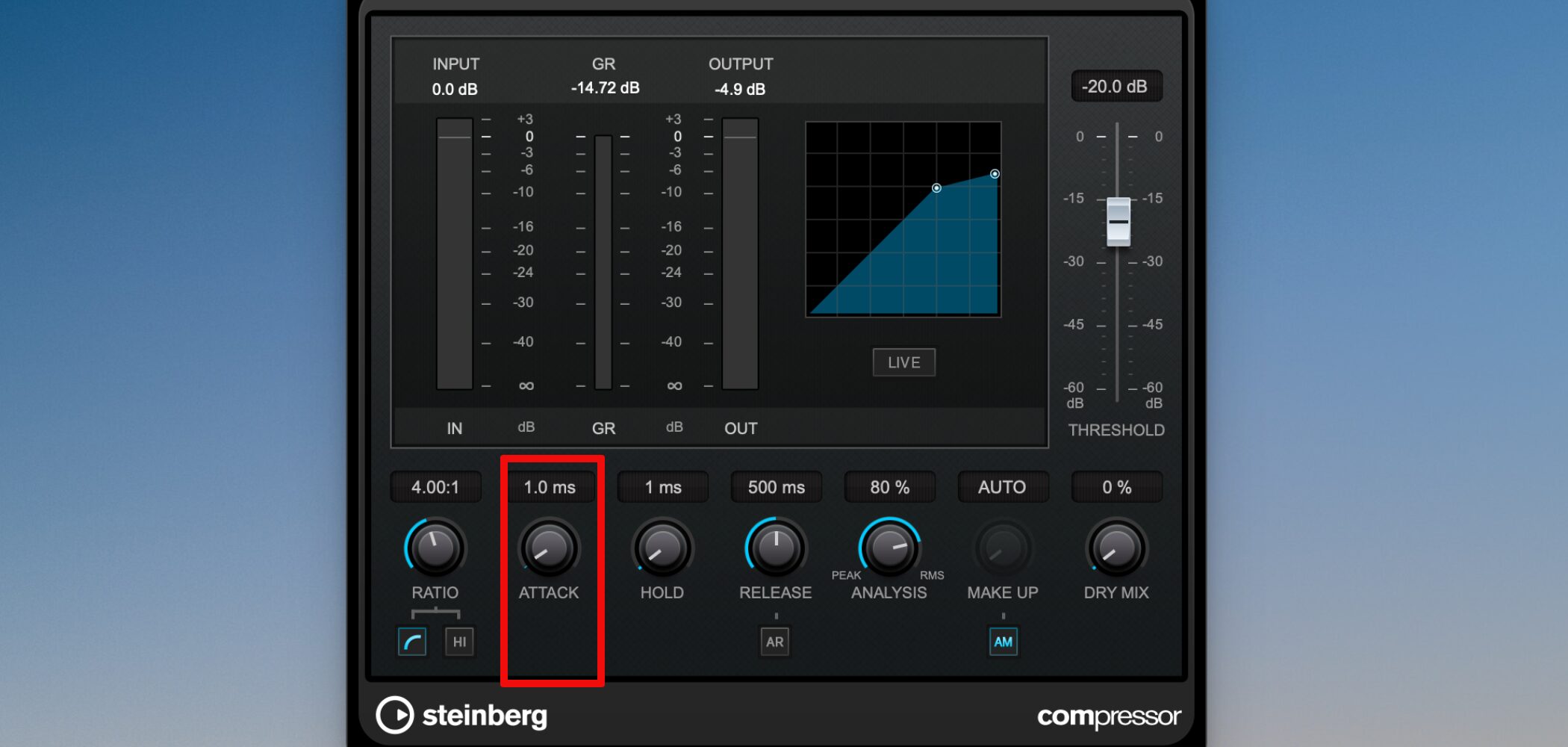
Once the threshold and ratio determine the amount of compression, adjust the attack.
The attack is the parameter that sets the time from when the sound exceeds the threshold until it reaches the full compression ratio.
An important element of an instrument's sound is this sense of attack, and how you present it changes the tone and sense of depth.
Video: Attack Explained
The Unit of Attack: ms (Milliseconds)
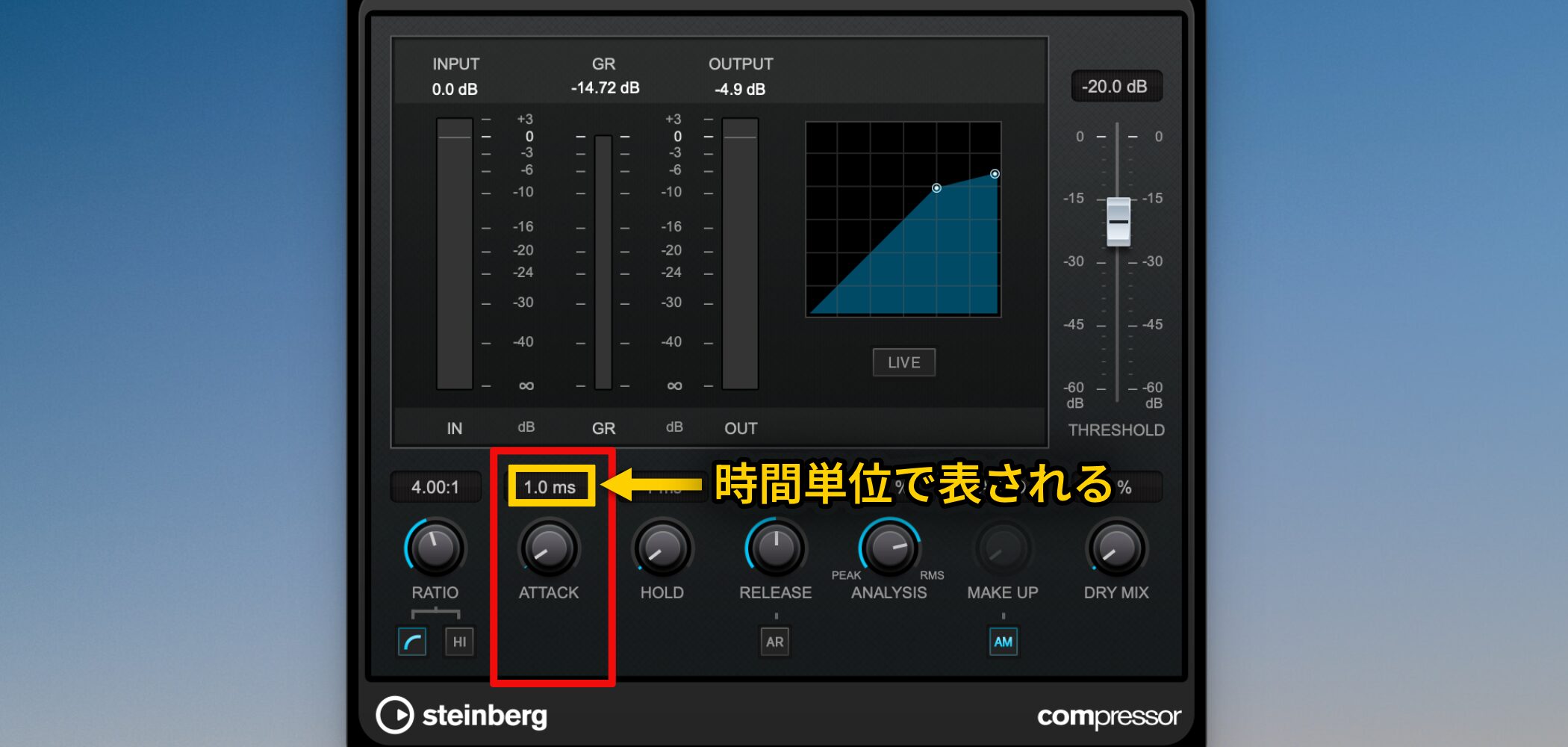
Most compressors use the time unit ms (milliseconds) for attack.
This ms unit comes up frequently in DTM.
1 ms = 1/1000 of a second
1000 ms = 1 second
That is how it works.
Make sure you memorize this here.
Video: ms (Milliseconds) Explained
Concrete Numerical Examples and Sound Comparison
Let's also look at how attack works with specific numbers.
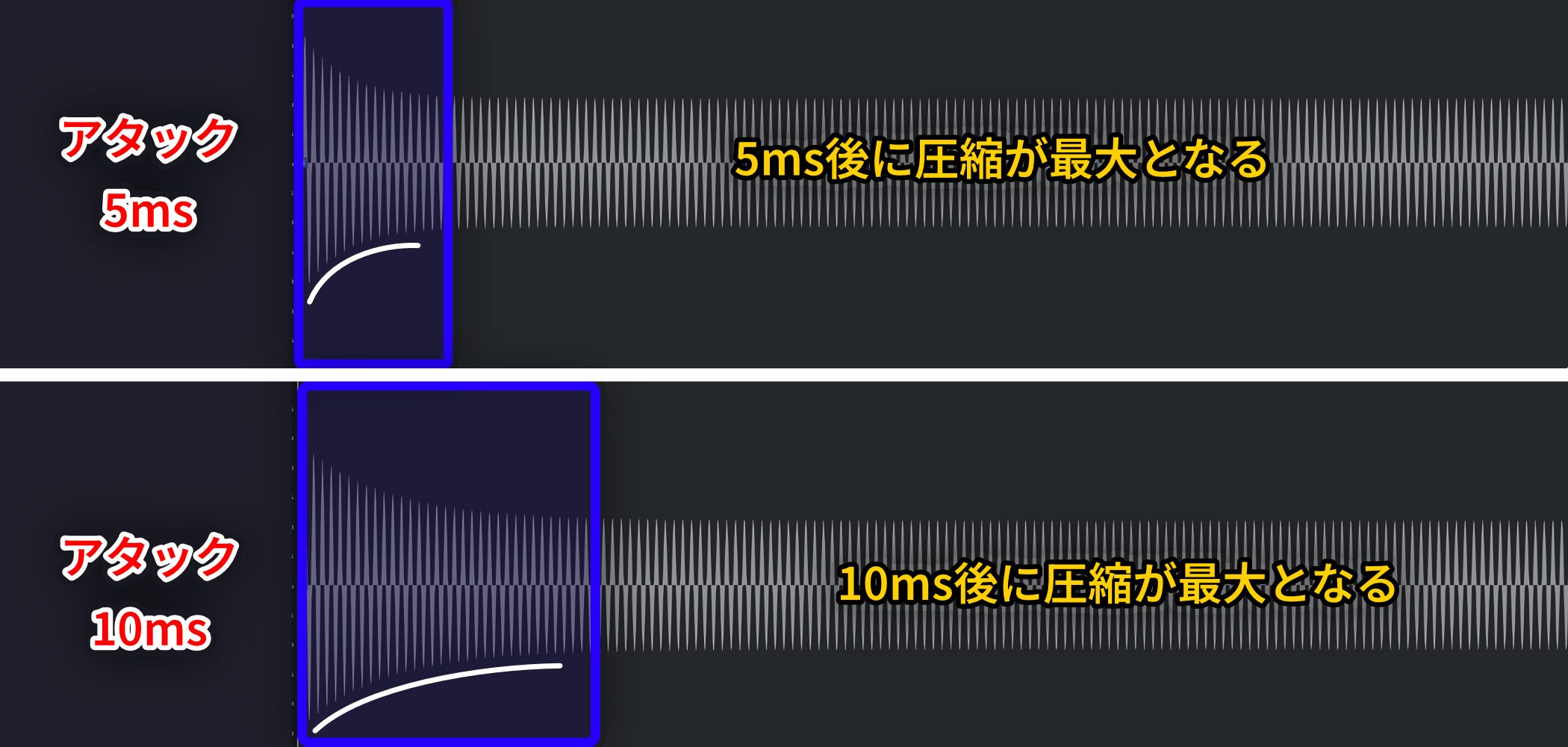
These images show waveforms with the attack set to 5 ms (top) and 10 ms (bottom), both with a ratio of 8:1.
You can see that the longer the attack time, the gentler the curve.
In this way, the sound is compressed over the time set by the attack.
Also, compression reaches its maximum once the set time has passed, and from then on it continues at that ratio (8:1 in this case).
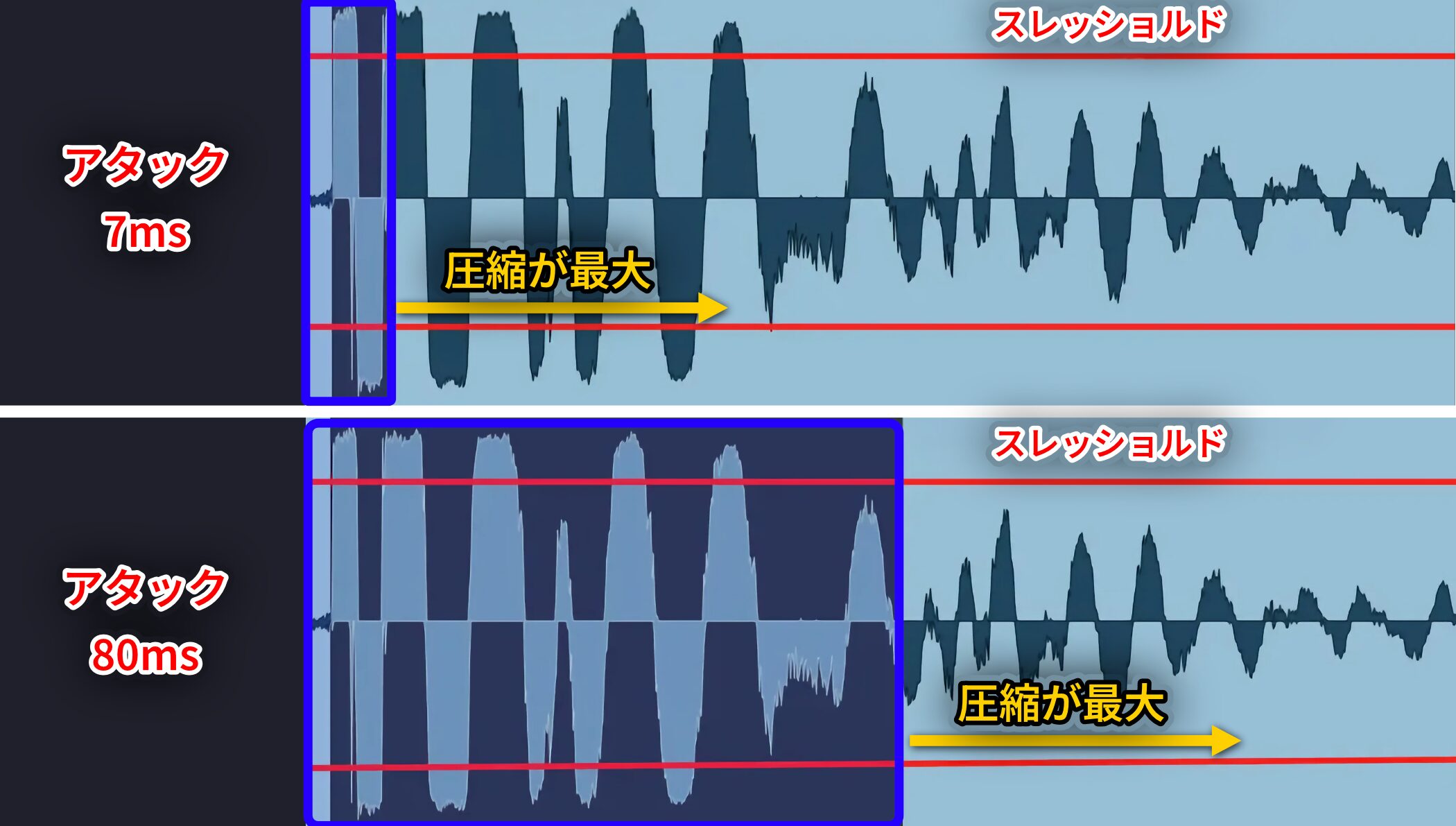
Next is an image comparing a slower attack, with the threshold reference line added for illustration.
With the 7 ms attack on top, even after compression reaches its maximum, the waveform remains above the threshold.
In contrast, with the slower 80 ms attack, compression comes in more gradually, so by the time it reaches its maximum, the waveform has already fallen below the threshold.
In other words, with a slow attack, you are not getting the full effect of the compressor.
We have also prepared sounds, so listen and compare.
With the fast attack (7 ms), the sound is compressed and pulls back a little, while with the slow attack (80 ms), it is not much different from the original.
A fast attack compresses the onset of the sound immediately, which makes it easier to tighten up, but on the other hand, the original punch tends to be lost.
However, this depends on the source and also varies by genre.
This is what makes compressors so deep, and it is also why recommended values differ between guides.
If you are unsure how to set it, use the following as a reference.
- To keep the attack (kick, snare, and so on): set a slower attack time
- To smooth out the sound (guitar, synth, and so on): set a faster attack time
Also, when setting the attack, listen to recordings by your favorite artists while paying attention to the sense of distance and the tone of a sound being squashed by compression; adjusting it many times is the shortcut to getting better with compressors.
Release
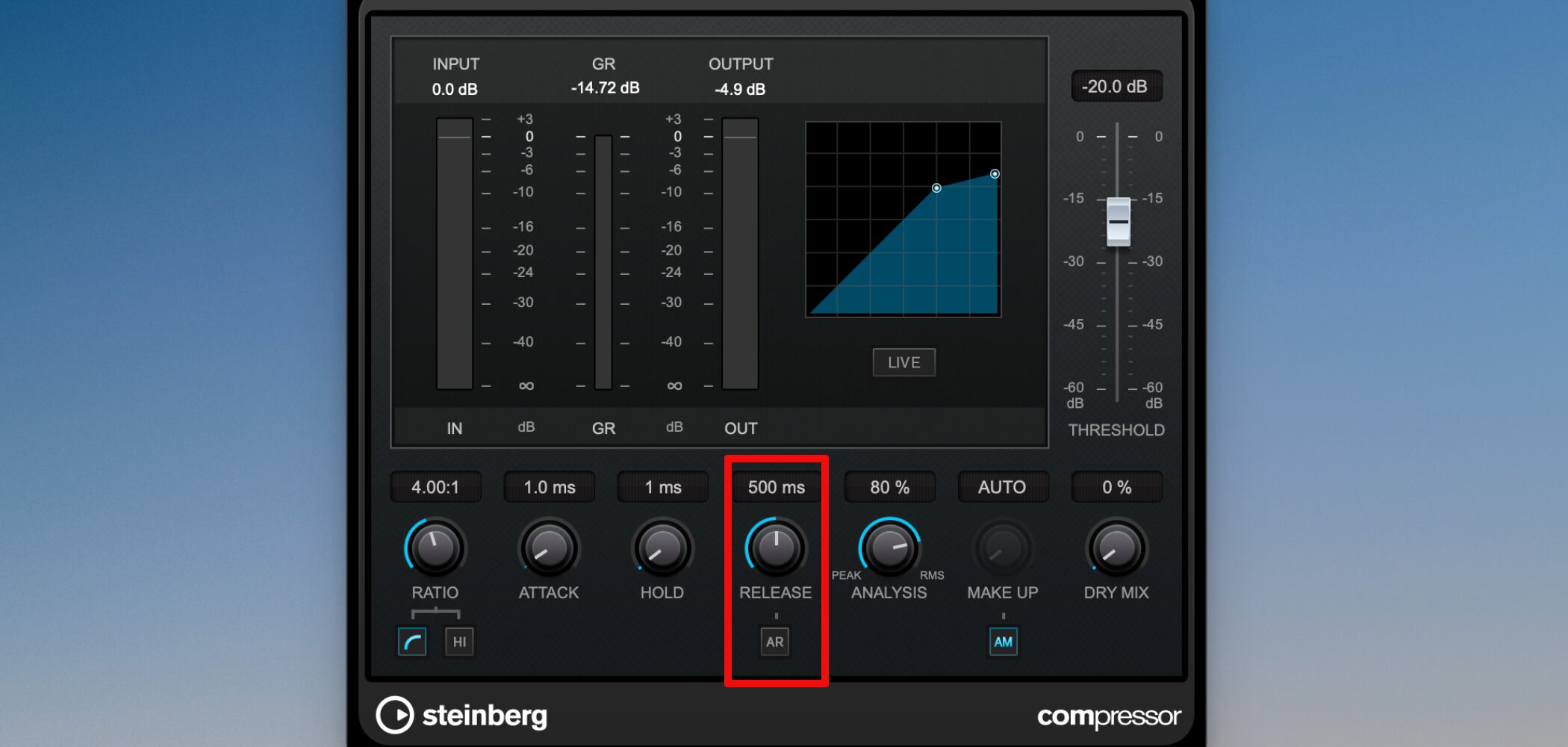
Finally, the fourth knob: release.
Release is the parameter that sets the time it takes for compression to return to zero after the level falls below the threshold.
Together with attack, it shapes the character of the sound.
Video: Release Explained
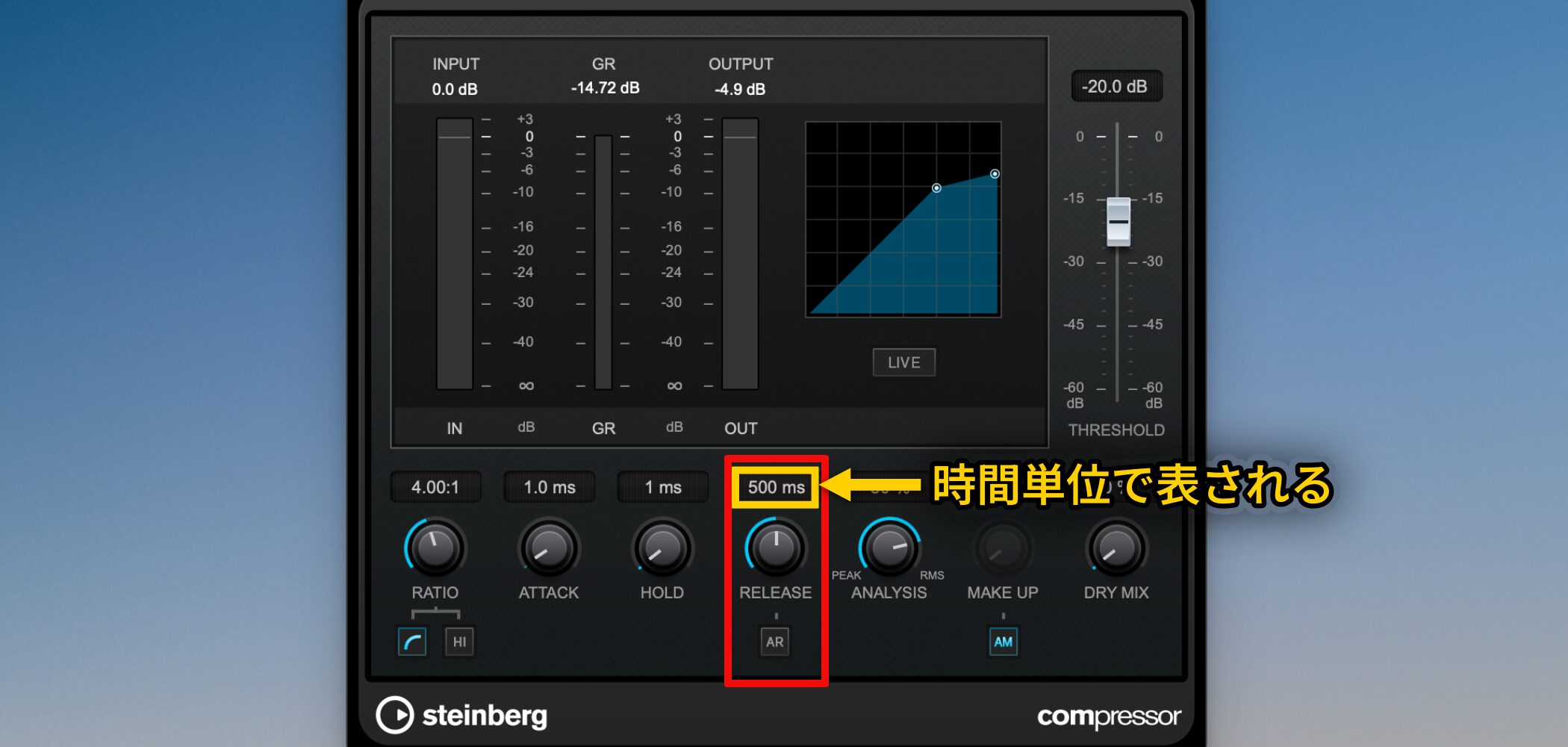
Like attack, most compressors use the time unit ms (milliseconds) for release.
1 ms = 1/1000 of a second
1000 ms = 1 second
Remember?
If you set the release to 100 ms, then after the sound falls below the threshold, it takes 0.1 seconds (100 ms) for compression to disappear completely.
What Release Is For
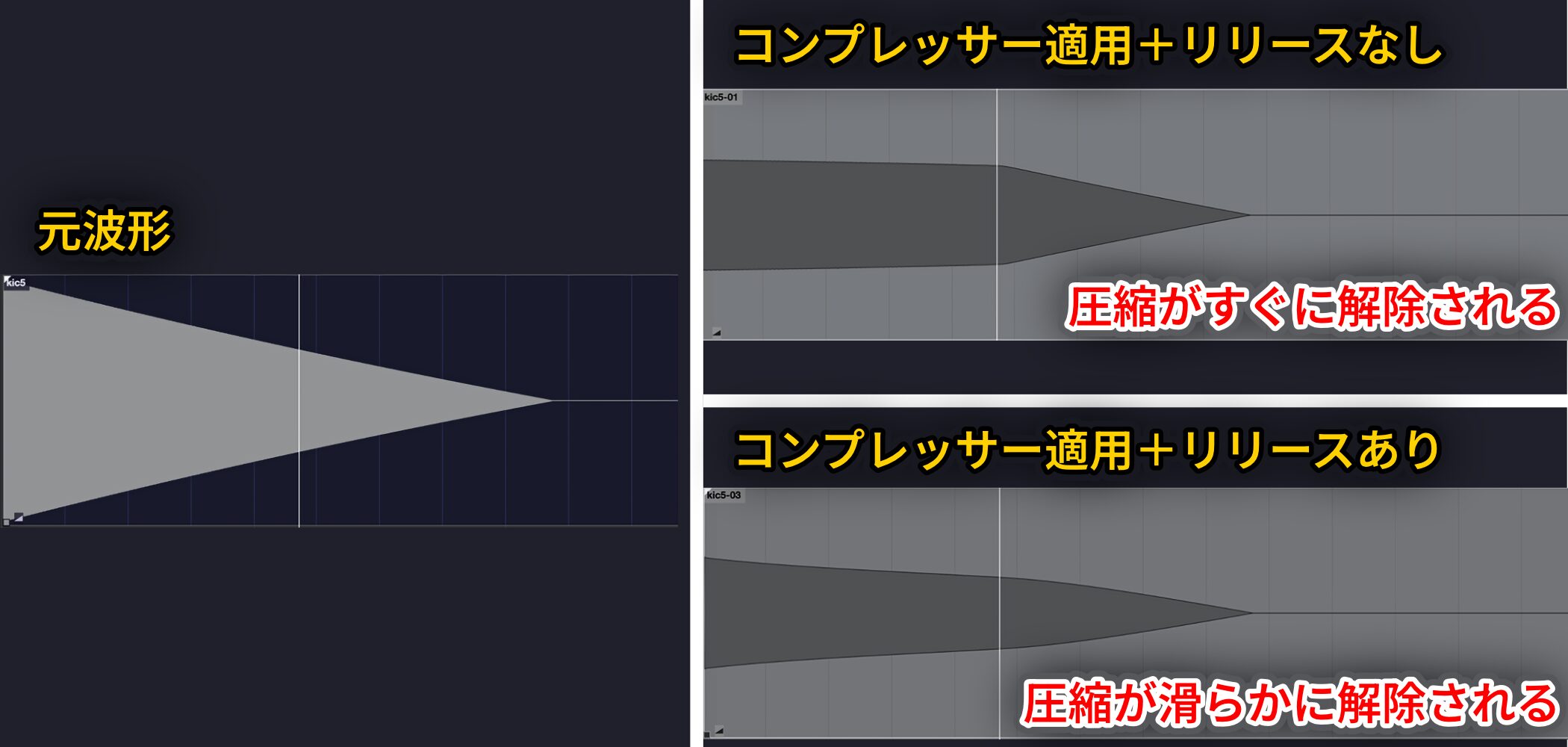
The original purpose of release is to prevent this: if compression were released immediately after the level fell below the threshold, extreme level differences would occur and the sound would become unnatural.
You can think of it as the compressor's aftercare.
Today, release is often adjusted to control a track's sense of distance and sound image.
Concrete Numerical Examples and Sound Comparison
Release is described as short or long.
Short
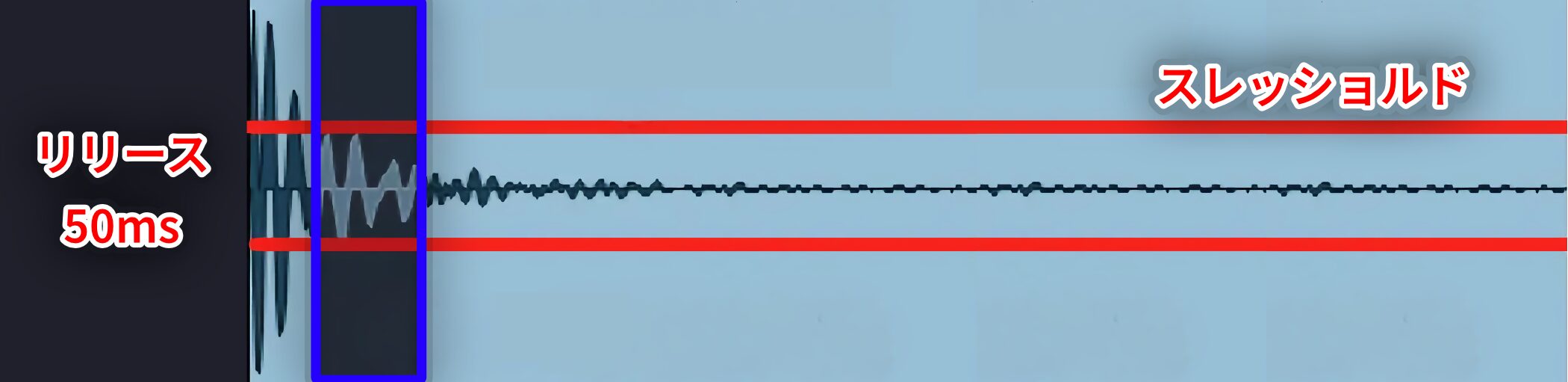
Let's look at a short release setting of 50 ms.
The area outlined in blue in the image is the 50 ms release range; after the sound falls below the threshold, it takes 50 ms for compression to be fully released.
Listening to it, compression is released quickly, so the dynamics come through clearly.
For tracks where you want clear dynamics, try adjusting the release to be short.
Long
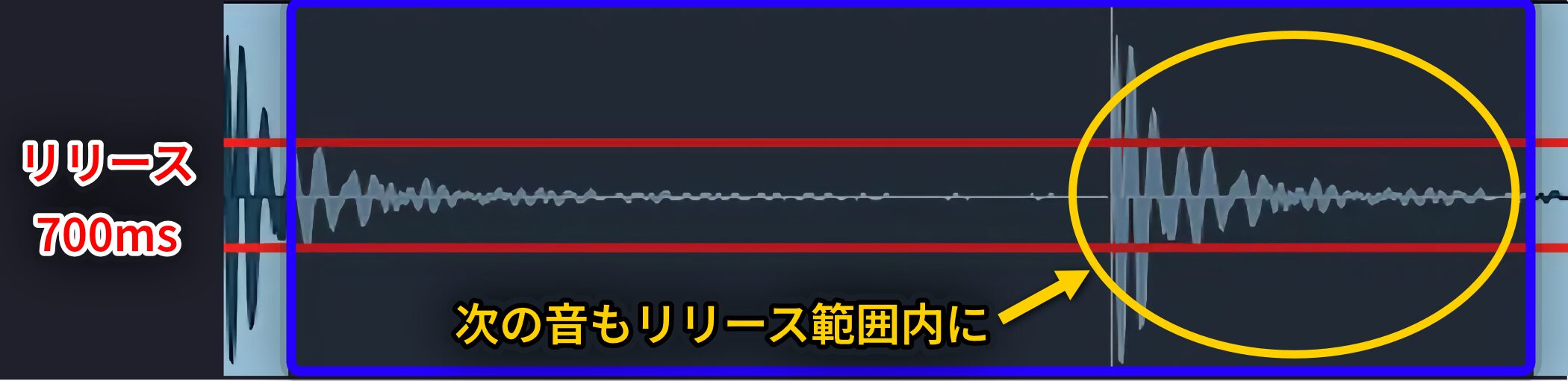
Next, let's set it long.
We set the release to 700 ms.
The area outlined in blue is the 700 ms release range, and the next kick comes in before the release of the first one has finished.
Listening to it, it sounds quite flat.
When you want to restrain the dynamics and tie the sound together firmly, a long release works well.
It is suited to cases where you want stability without much contrast between loud and soft.
Pads that create atmosphere and a wall of sound are a good example, and reverb also sits nicely on them.
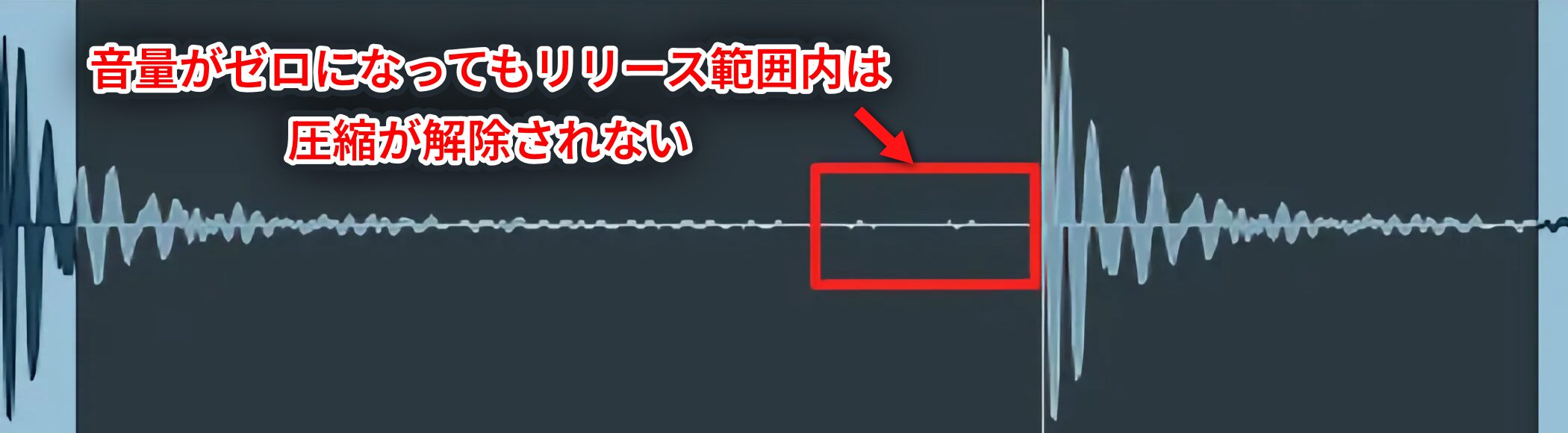
With this kick, the level drops almost to zero before the next kick, so the effect of release may be hard to hear, but even if there is silence, compression is not fully released until the set release time has elapsed, so if the next input arrives in that state, it is affected.
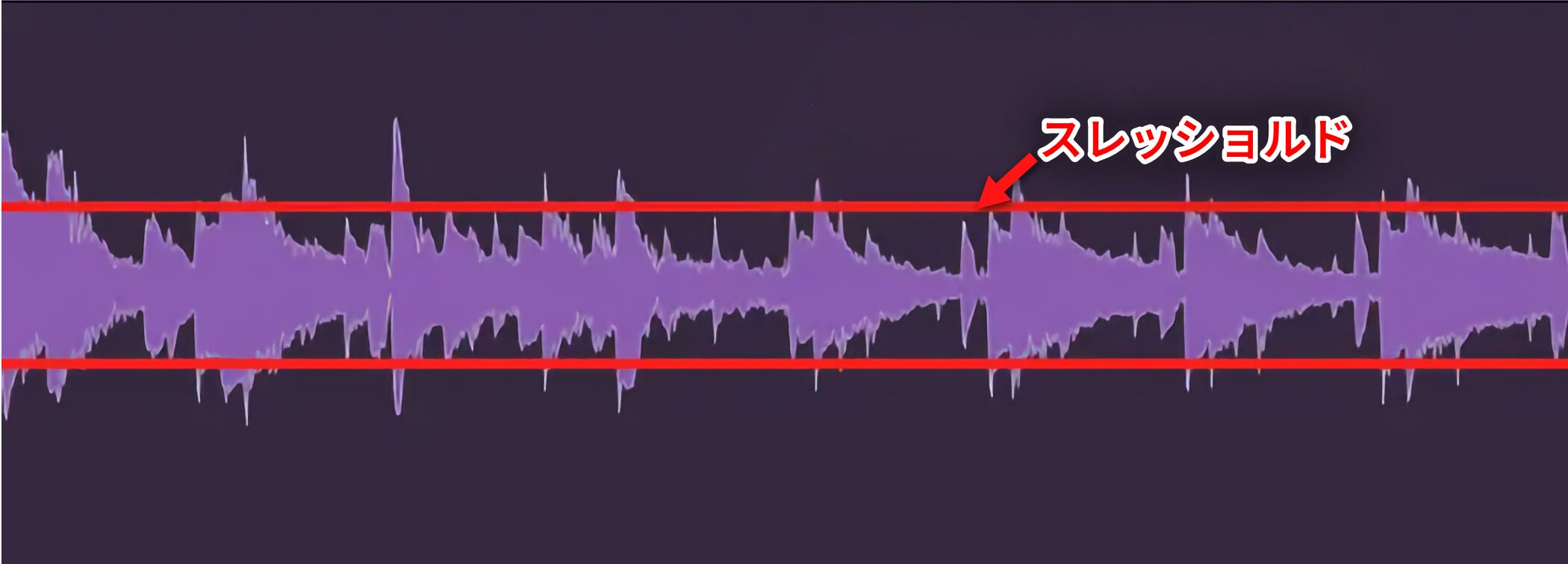
If you set a long release on a waveform like this, sound above the threshold keeps coming in before the compression is released, so it stays continuously compressed, making it easier to get compression character.
Keep cohesion and distance in mind as you apply compressors to all kinds of sounds.
Frequently asked questions
Q1. What is the difference between a compressor and EQ?
EQ changes the tone dramatically, whereas a compressor compresses level differences, so its effect can be hard to notice. However, using a compressor correctly greatly improves the quality of the whole song.
Q2. What value should I set the threshold to?
The lower the threshold, the more sound is compressed. It is important to adjust it for each track so that the loud parts of the waveform become the target of compression.
Q3. How should I set the compressor to raise loudness?
After compressing the spiky parts of the waveform with a compressor, raise the level back up to around 0 dB to increase the waveform area and loudness. Repeating this process lets you achieve professional-level loudness.
NEW ARTICLES
Latest English Articles











