Stylish without being too dark: the "minor seventh chord"

Continuing from the major seventh in the previous lesson, this time let's learn about the minor seventh chord.
If you understand the "minor triad" explained in earlier lessons, you can build it right away.

For the minor seventh chord as well, we will focus on what it has in common with the triad.
First, let's actually listen to the sound.
The notes of the chord are played one by one, followed by the chord itself.
Next, listen to a C minor chord followed by a C minor seventh.
C minor chord
C minor seventh
The minor chord gives a thoroughly dark impression.
The minor seventh has a complex sound with brilliance even within its darkness.
How the minor seventh chord is written
The minor seventh is often written as follows.
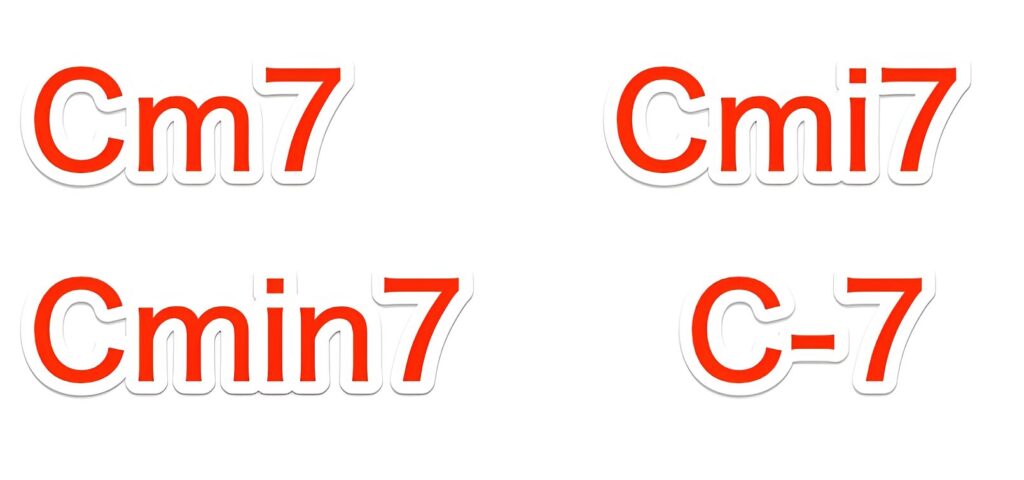
The common ones are
- C minor seventh = Cm7
- D minor seventh = Dm7
and similar notations.
You will also see notations such as "C-7" and "D-7."
The notes of the minor seventh chord
Let's look at Cm7 in both notation and the piano roll.

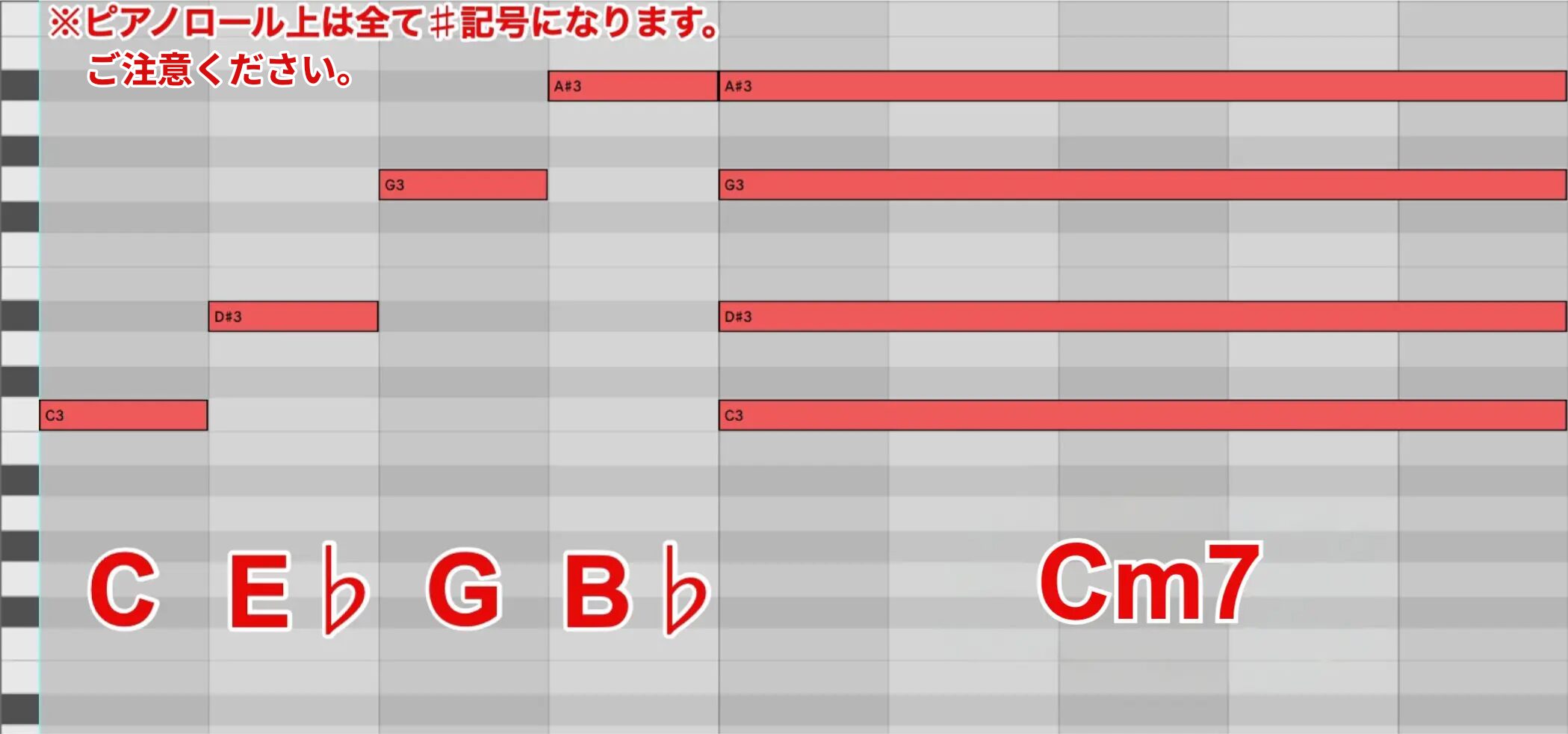
Do you notice anything here?
That's right. Up to a point, it is a C minor chord.
Here too, you have already learned most of the chord's notes.

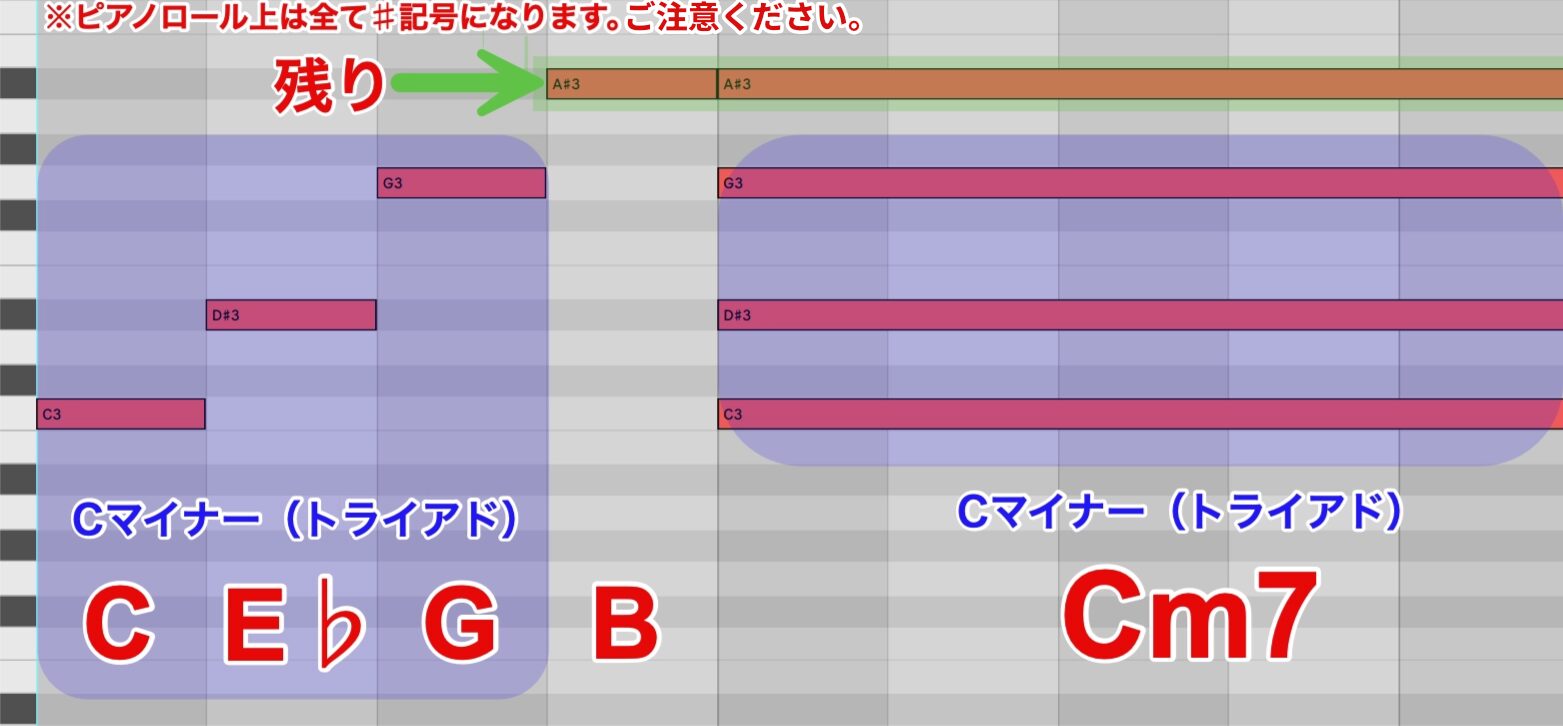
The relationship between the seventh note and the root
Let's use the "reverse thinking" approach from the previous lesson.
The idea was that instead of counting up from the root, thinking of the seventh as the note a half step below the root makes it easy to reach.
Let's apply this to the minor seventh chord as well.
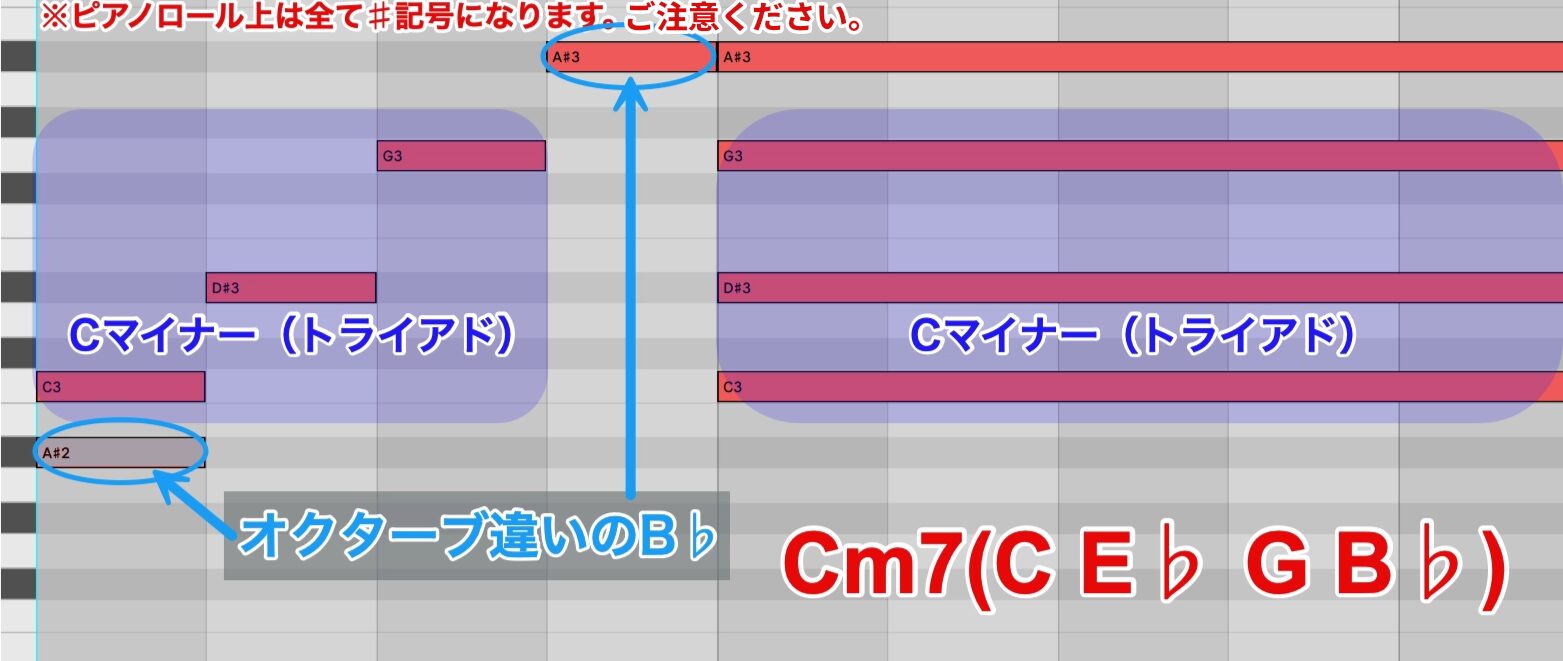
If you lower B♭ by one octave, it becomes the note a whole step below the root.
Once you can build the minor chord (triad), you can make a minor seventh chord simply by adding the note a whole step below the root.
Now let's use this method to build Dm7 from Dm.
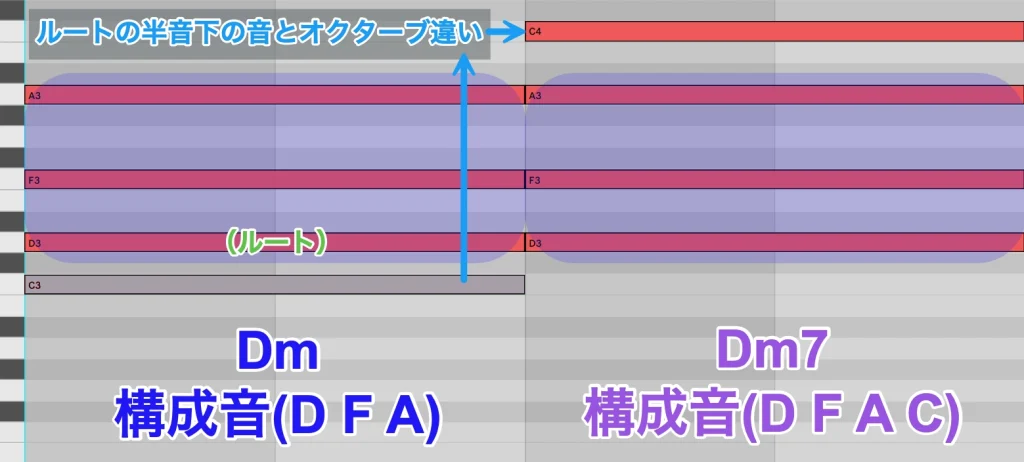
It looks like this.
Understanding it through intervals and scale degrees
Let's check the structure of "m7" with the familiar intervals and scale degrees.
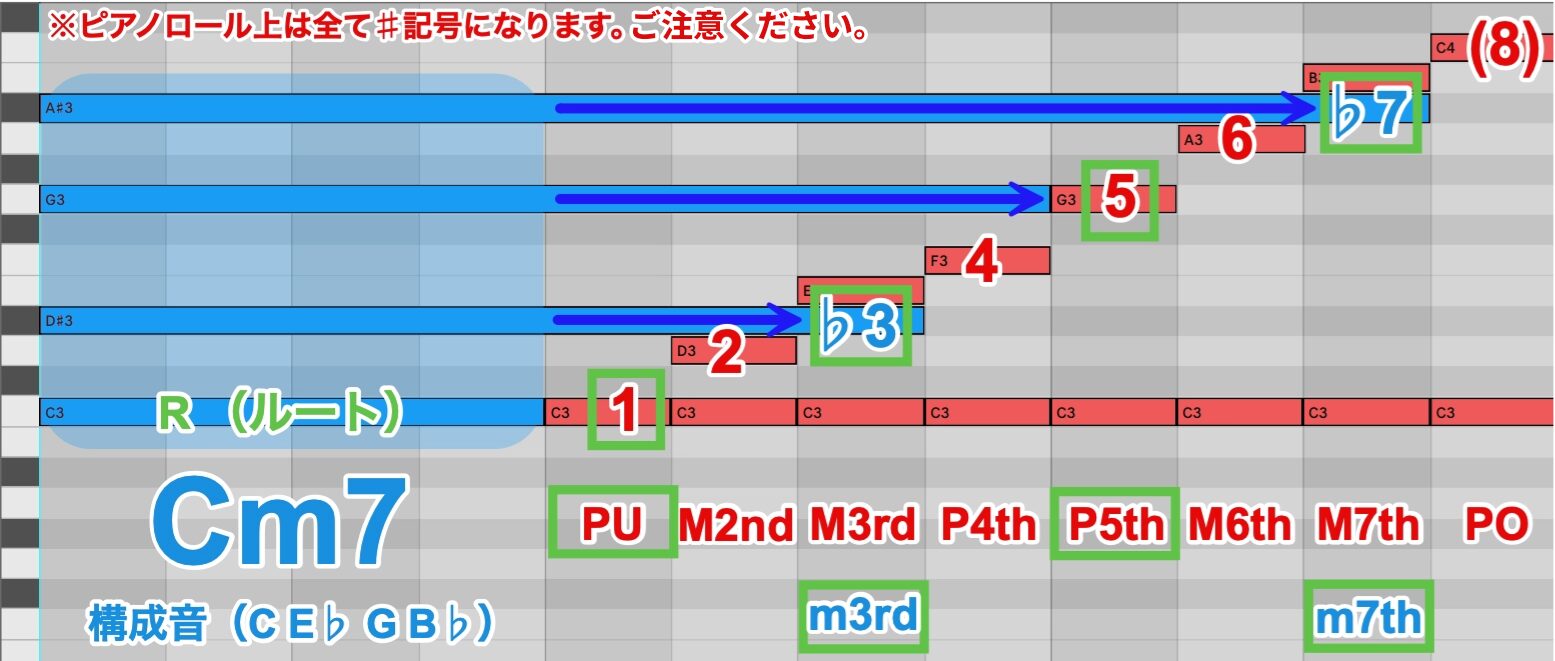
To summarize,
- If you memorize it by intervals: R m3rd P5th m7th
- If you memorize it by scale degrees: 1 ♭3 5 ♭7
.
The structure of seventh chords
You can also look at major seventh and minor seventh chords as follows.
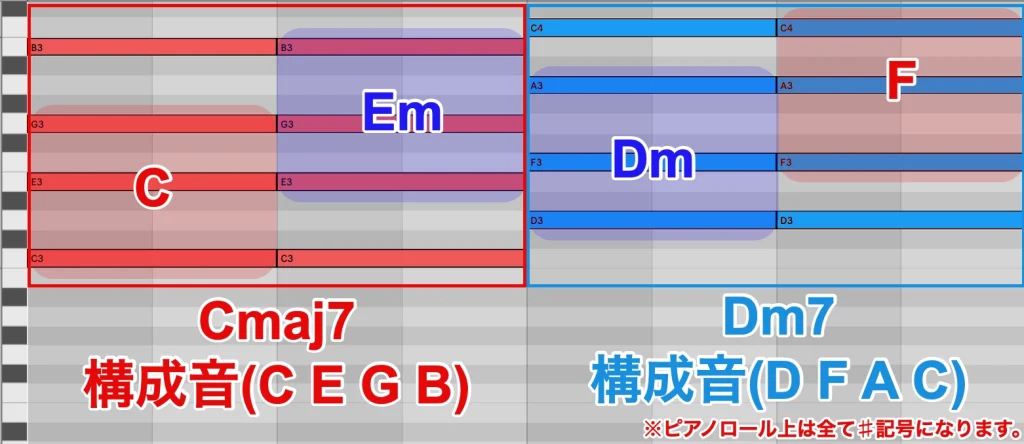
C major seventh contains the notes of both C major and E minor.
D minor seventh contains the notes of both D minor and F major.
The major seventh's sound with a touch of wistfulness within its brightness and the minor seventh's sound with brilliance within its darkness—these complex sounds may come from this structure.
Next time, let's look at the tritone, a very important sound in music production.
Frequently asked questions
Q1. What is the difference between a minor seventh chord and a minor chord?
A minor chord is a triad made of a minor third and a perfect fifth and gives a dark impression, while a minor seventh chord is a four-note chord that adds a minor seventh, creating brilliance within the darkness. The result is a more complex, refined sound.
Q2. What are the notes of Cm7?
The notes of Cm7 are C, E♭, G, and B♭. They are the root C plus the notes a minor third, perfect fifth, and minor seventh above it.
Q3. Where are minor seventh chords used in music production?
They are used in a wide range of genres such as jazz, R&B, and pop, and are especially suited to creating a calm yet refined atmosphere in loop-based tracks and chord backing.
Q4. Which is darker, the minor seventh or the major seventh?
The minor seventh sounds darker. The major seventh has wistfulness within its brightness, while the minor seventh has brilliance within its darkness, so they have different characters.
NEW ARTICLES
Latest English Articles