
Reverb is an important process in DTM production that gives songs a sense of space, but applying too much creates a "bathroom" effect that makes the sound heavy. This article explains that the cause lies in the low end, and introduces a technique for achieving a deep reverb while keeping things sharp by applying a low cut with EQ to the reverb signal. Cutting below 200 Hz lets you have both depth and clarity in your reverb, a practical solution for beginner and intermediate mixers alike.
The "Bathroom" Effect from Reverb
Reverb is a very important effect that can give a song a sense of space.
It can also help tracks blend into the song.
While mixing, you may sometimes want to make the reverb really deep.
The following sample has a fairly deep reverb applied.
To be honest...
this is the "bathroom" effect caused by deep reverb.
It sounds heavy...
I want it deep → it sounds like a bathroom → I turn the reverb down → I still want it deep
and this loops forever (lol).
Here is a technique that solves this.
Applying EQ to the Reverb
Why does it end up sounding like a bathroom?
The cause lies in the low end.
Reverb tends to stand out more in the lows than in the mids and highs,
so even the same amount feels boomy and muddy.
Reverb is rarely applied to the kick and bass,
and when it is, only a little, for exactly this reason.
Once you know this, the rest is easy.
Just cut the low end of the reverb with EQ.
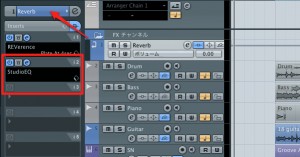
↑ Reverb is normally applied to each track via send/return.
Apply a low cut to this source reverb.
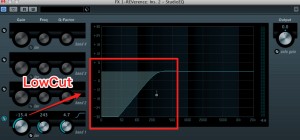
↑ Of course, fine-tuning is needed depending on the song,
but it is fine to cut everything below 200 Hz cleanly, as in the image.
*The image shows Cubase, but the same applies to Pro Tools and Logic.
Here is the sample with the low cut applied.
The impression is much sharper,
while the depth of the reverb remains.
If you are struggling with your reverb, be sure to try this technique.
Frequently asked questions
Q1. Why does reverb make my mix sound like a bathroom?
Because the low-frequency content of the reverb stands out easily, so even with the same amount of reverb the lows sound boomy. Reverb is more noticeable in the lows than in the mids and highs, so a deep reverb makes the sound heavy.
Q2. What frequency should I cut when applying EQ to reverb?
The sample in the article cuts everything below 200 Hz cleanly. However, fine-tuning is needed depending on the song, so we recommend starting around 200 to 300 Hz and adjusting by ear.
Q3. When using reverb via send/return, where do I insert the EQ?
Insert a low-cut EQ on the reverb's FX (return) channel. This cuts the lows of the reverb sent from every track at once, which is efficient.
Q4. Can this technique be used in DAWs other than Cubase?
Yes. As mentioned in the article, the same method works in major DAWs such as Pro Tools and Logic. Just add an EQ to the reverb chain in your DAW.
In Our Lessons, You Can Also Learn
- Types of reverb and a thorough explanation of their controls
- Controlling space with multiple reverbs
- Basic and advanced reverb positioning
NEW ARTICLES
Latest English Articles











