About the Avoid Note of IIm (IIm7)
This time, we return to avoid notes and, building on the two-five progression we learned last time, unpack how to think about avoid notes on the second chord of the major diatonic chords.
There are broadly two ways of thinking about this.
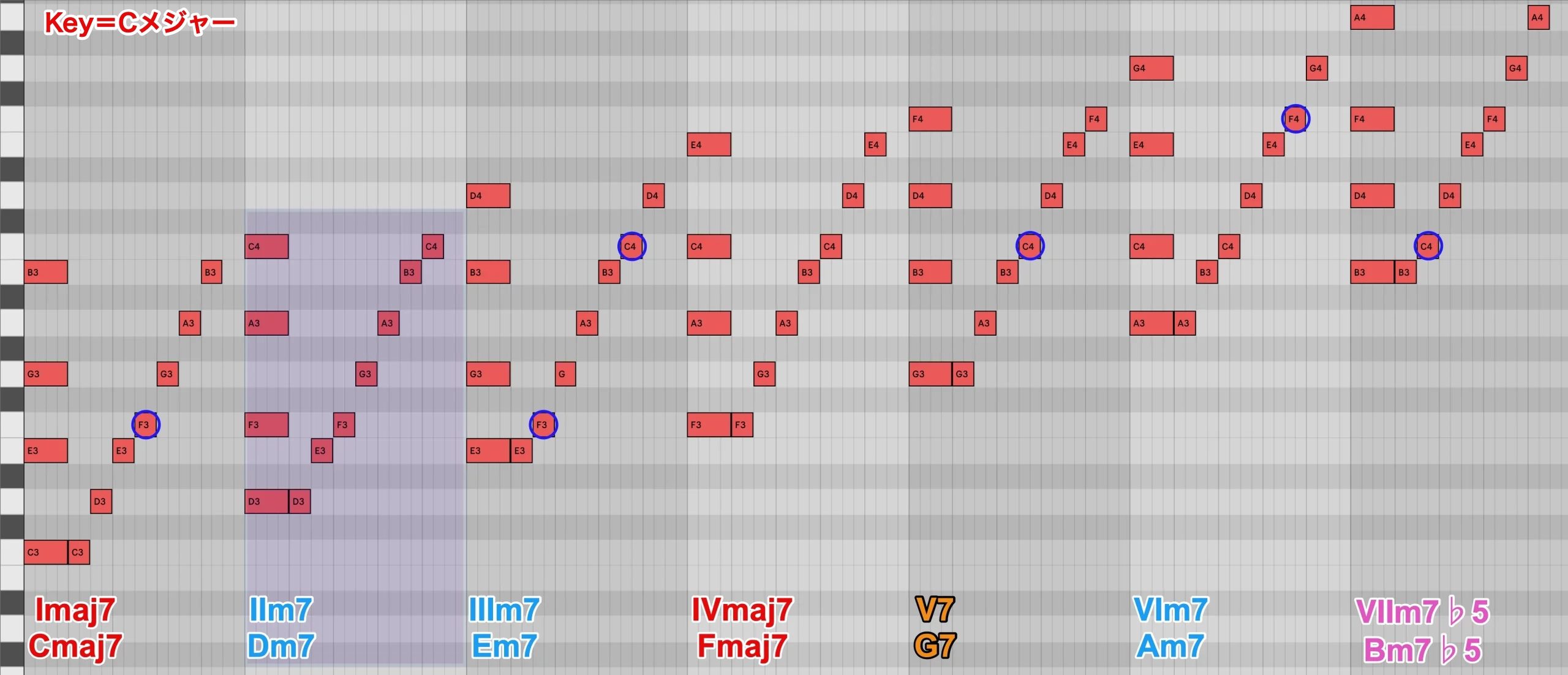
First, let's check the avoid notes of IIm7 using the procedure from two lessons ago: look for "scale notes a half step above a chord tone."
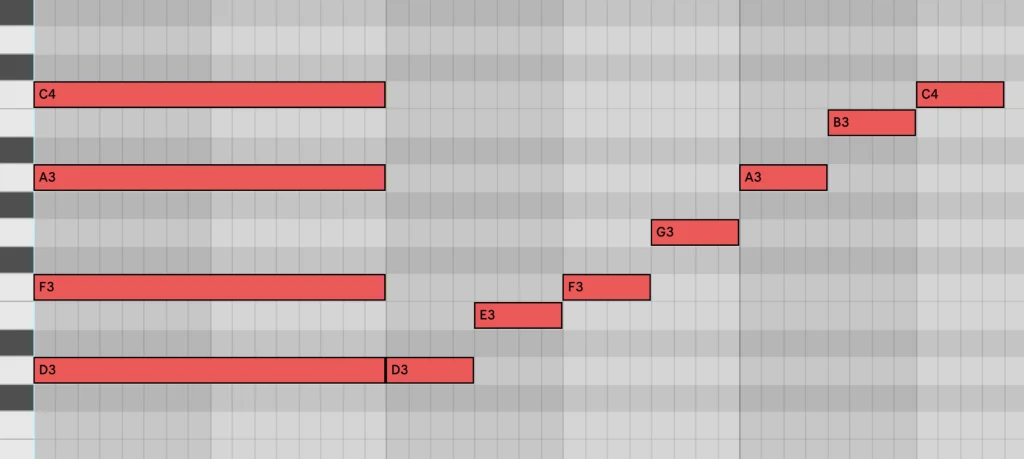
Looking at this alone, it seems that, like IVmaj7, there are no avoid notes.
Now, listen to Dm7 with non-chord tones (E, G, B) added.
- Dm7 + E
- Dm7 + G
- Dm7 + B
Each sounds more complex, but the one with B added seems to have strong tension.
The reason is that the 3rd (the m3rd, F) and B form a tritone.
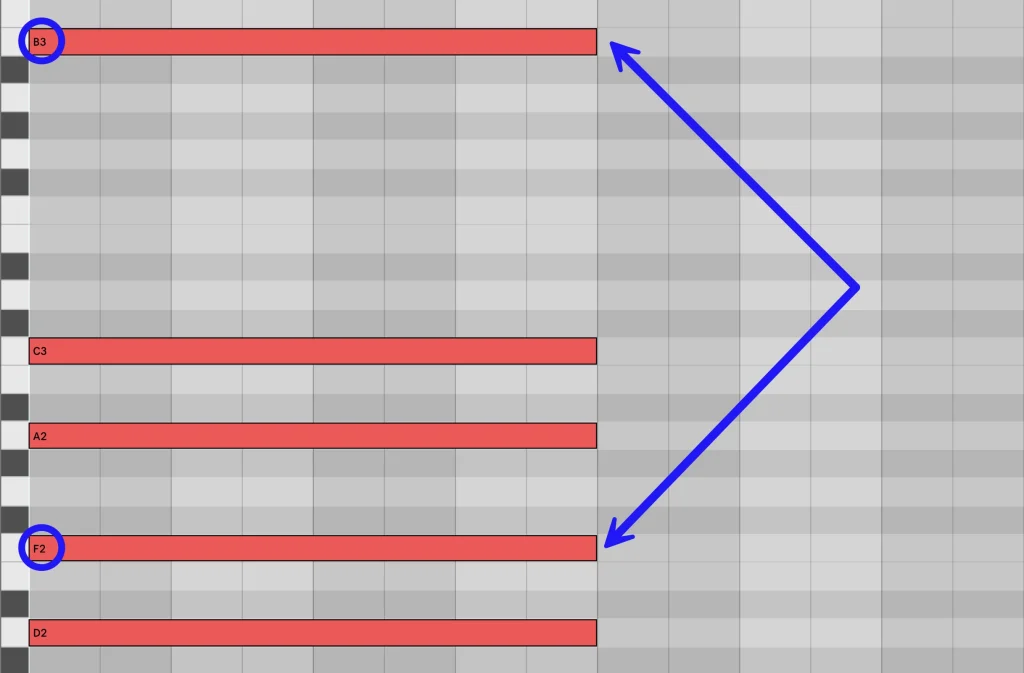
As we touched on in Lesson 30, the tritone heightens the tension of V7 (the dominant chord) and strengthens its pull back to the tonic.
With this in mind, let's recall the two-five-one progression from last time.
- Key = C major: IIm7 → V7 → I (Dm7 → G7 → C)
The flow from V7, which is a strong progression and contains the tritone, to the tonic forms a powerful chord progression.
What happens if we add a prominent B to IIm7?
- Dm7 with a prominent B added → V7 → I
Doesn't the strength of the two-five-one flow feel a little diminished?
Two lessons ago, we gave one definition of an avoid note as "a note that may undermine the chord's original function", and this is a typical example.
When tension from a tritone arises already at II, it's as if V7's functional role has been given away in advance.
In this way, making the tritone, a hallmark of the dominant chord, prominent on another chord weakens the effect of the dominant chord, so it's better to avoid it. That is the first way of thinking.
Incidentally, adding B to Fmaj7 creates a tritone with the root, but it is not considered an avoid note.
This is based on the idea that it is not a tritone with the chord's 3rd (the M3rd, A).
- Fmaj7 with a prominent B added → V7 → I
This is also a distinctive sound, but you may have felt it is less dominant-like than Dm7 + B.
The tritone in V7 includes the 3rd, so you can think of it as giving an especially strong dominant impression.
The line is drawn at avoiding the tritone with the 3rd elsewhere, so as not to dilute the effect of the dominant chord V7.
The View That "IIm (IIm7) Has No Avoid Notes"
The other way of thinking is that, because there are songs, techniques and genres that intentionally use it as a distinctive sound, you simply don't treat it as an avoid note.
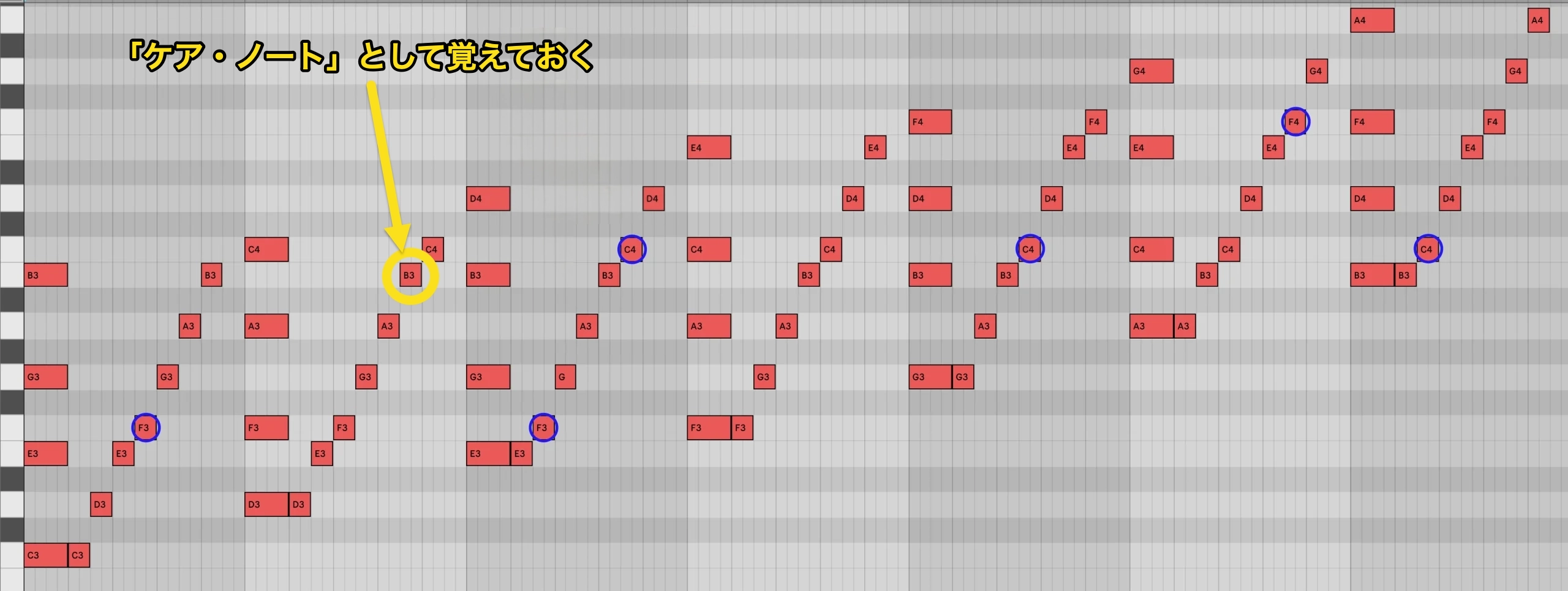
That said, it is still distinctive, so it is sometimes called a "care note" (a note to use with care).
Either way, it's safest not to force it into prominence at first.
How to Deal with Avoid Notes
While analyzing melodies and chords, you'll often find examples that actively use avoid notes or care notes.
When you do, consider why it sounded cool and pleasant.
- Was it used very far away (2-3 octaves)?
- Is it a phrase or genre that features that note distinctively?
- Does making that note stand out create more atmosphere?
- Did they want an ambiguous sound that suggests another chord?
As we mentioned before, avoid notes are not notes that must be absolutely avoided, and how they are treated changes with the times and the emergence of new genres.
Rather than "notes to avoid," avoid notes might be better described as "notes to handle with care."
Next time, we cover a new chord: the "sixth chord."
Frequently Asked Questions
Q1. Specifically, what is the avoid note of IIm7?
For IIm7 among the major diatonic chords, the note that forms a tritone with the 3rd (minor 3rd) is considered the avoid note. In the key of C major, for example, this is B added to Dm7, and care is needed because it undermines the effect of the dominant chord V7.
Q2. Must avoid notes never be used?
They are not absolutely forbidden. In modern music production, there are many examples of intentionally using avoid notes to create unique sounds. It's important to think of them as care notes (notes to use with care) and use them creatively once you understand their effect.
Q3. What happens if I add an avoid note to IIm7 in a two-five-one progression?
The strength of the chord progression decreases. The dominant function and tension that the V7-to-I progression originally has are weakened, and the smooth flow of the progression is undermined, so it's safest to avoid it at first.
NEW ARTICLES
Latest English Articles